New Zealand
Bernard Freyberg
Commander of the 2nd New Zealand Expeditionary Force and the 2nd New Zealand Division (1939–1945), commander of the defence of Crete (1941), Governor-General of New Zealand (1946–1952)
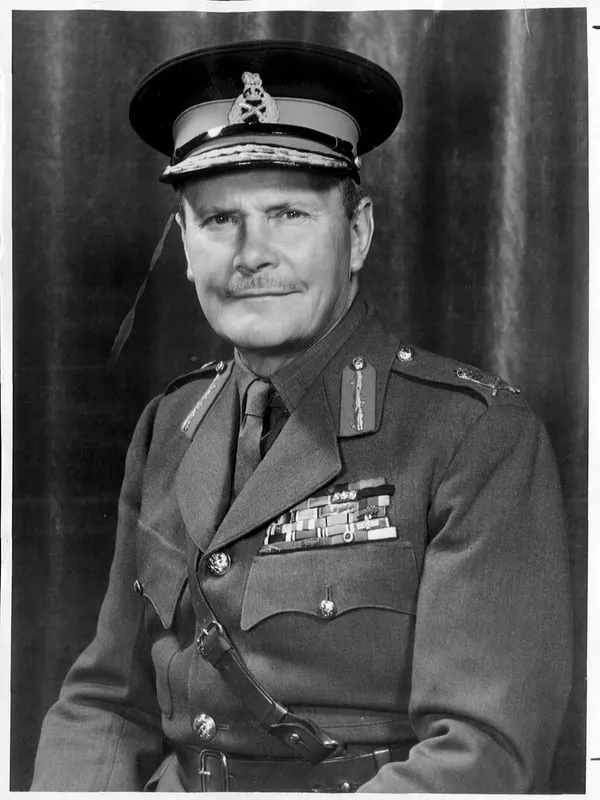
- Born:
- 21 March 1889, Richmond (Surrey, England)
- Died:
- 4 July 1963, Windsor (England)
- Author:
- Łukasz
- Photo:
- Archives New Zealand, CC BY-SA 2.0, Wikimedia Commons

Bernard Cyril Freyberg was a soldier of two nations. Born in England and raised in New Zealand, he served in the British Army through two world wars. He came out of the first as one of the most highly decorated officers of the Empire, with the Victoria Cross, three Distinguished Service Orders and nine wounds. In the second he commanded New Zealand’s expeditionary forces for six years: in Greece, on Crete, in the Libyan and Egyptian desert, in Tunisia and in Italy. Winston Churchill, his friend since 1914, called him “the salamander”, because like the mythical creature he seemed to live in fire. Freyberg was a superb divisional commander and one of the most admired soldiers of the Commonwealth, but the two battles in which he commanded larger forces – Crete in 1941 and Monte Cassino in 1944 – ended in defeats that historians still argue about.
Swimmer and dentist
He was born on 21 March 1889 in Richmond, near London, the youngest of the sons of James Freyberg, a timber merchant, and his second wife Julia, née Hamilton. In 1891 the family emigrated to New Zealand and settled in Wellington, where his father worked in the forestry administration. Bernard attended Wellington College, and at fourteen he was apprenticed to a dentist. In 1911 he was entered on the dental register, but he disliked the profession and later seldom mentioned it. His real passion was sport, above all swimming: in 1906 and 1910 he won the New Zealand 100-yard championship. From 1911 he was also a second lieutenant in New Zealand’s Territorial Force.
In March 1914 he left for California. He later claimed that he had fought in the Mexican Revolution with the forces of Pancho Villa, and many biographies repeat this version. More recent research suggests, however, that he spent most of that time in the Californian oilfields and most probably invented the Mexican adventure himself to make it easier to obtain a commission in Britain. After war broke out in August 1914 he paid his way across America with swimming races and boxing bouts until he reached England.
Gallipoli and the Somme
In London he met Churchill, then First Lord of the Admiralty, and persuaded him to grant him a commission in the newly formed Royal Naval Division, an infantry force made up of surplus naval reservists. As a company commander in the Hood Battalion he fought at Antwerp in October 1914. In the battalion he met the flower of the young English intelligentsia, among them the poet Rupert Brooke and Arthur Asquith, the prime minister’s son. Brooke died of an infection on the way to Gallipoli, and Freyberg helped to bury him on the island of Skyros.
On the night of 24–25 April 1915, before the Allied landings on the Gallipoli peninsula, Freyberg performed the deed that first made him famous. Smeared with grease, he swam several kilometres through the icy water of the Gulf of Saros to the shore, towing a raft of flares, and lit them on the beach to convince the Turks that the landing would come there. He was awarded the Distinguished Service Order for this action. In the Gallipoli campaign he was wounded several times; in August he took command of the battalion, and he left the peninsula with the last units in January 1916.
In May 1916 he transferred to the British Army, still commanding the Hood Battalion. On 13 and 14 November 1916, in the closing phase of the Battle of the Somme, he led the attack on the village of Beaucourt-sur-l’Ancre. Wounded four times, he rallied the shattered units, held out through the night in an advanced position and in the morning took the fortified village along with five hundred prisoners. For this he received the Victoria Cross. In April 1917, at the age of 28, he became a brigadier general and commander of the 173rd Brigade – the youngest general in the British Army. In September 1917 a shell exploding at his feet inflicted the worst wounds of his war. He returned to the front in January 1918, commanded the 88th Brigade during the German spring offensives and received a second DSO. He won the third on 11 November 1918, when at the head of a squadron of dragoons he seized the bridge at Lessines a minute before the armistice came into force.
Between the wars
After the war he stayed in the army as an officer of the Grenadier Guards, completed the course at the Staff College at Camberley and held staff appointments. In 1922 he married Barbara McLaren, the widow of an officer killed in the war and a daughter of Sir Herbert Jekyll. In the same year he stood unsuccessfully for the House of Commons as a Liberal in Cardiff. He went on swimming: in August 1925, after almost seventeen hours in the water, he abandoned an attempt to swim the English Channel a few hundred metres from the shore when the current began to carry him out to sea. He wrote a manual on the administration of a military unit, later used at the Staff College. In 1934, at the age of 45, he became a major general, and it seemed that the highest commands awaited him. A medical examination before a posting to India, however, revealed a heart defect, and in 1937 he had to retire.
Commander of the New Zealanders
The outbreak of war in 1939 brought him back into service. By September he was already commanding the training area on Salisbury Plain, and when New Zealand entered the war he offered his services to its government. After talks with the deputy prime minister, Peter Fraser, in November 1939 he was given command of the 2nd New Zealand Expeditionary Force and of the 2nd New Zealand Division, then being formed. Formally he remained a British officer on loan to New Zealand. His position was defined by the so-called charter, an instruction from the government in Wellington under which he answered to that government and not only to his British superiors, could communicate directly with the prime minister, and was to ensure that the division was not broken up into smaller groups or used against the country’s interests. This caused friction with British commanders, especially General Archibald Wavell, but Freyberg held to the charter throughout the war.
The division assembled in Egypt from 1940 onwards, and its second echelon, diverted to Britain during the fall of France, stood ready there in the summer of 1940 in case of a German invasion. At the beginning of 1941 Freyberg, like the Australian General Thomas Blamey, accepted the plan for the expedition to Greece with grave misgivings. Both saw in it the risk of another Gallipoli: an expedition devised in London in which Dominion soldiers would pay for the weakness of the plan.
Greece
In April 1941 the New Zealand Division defended the passes below Olympus and on the Aliakmon, and after the breakthrough at Vevi it fell back through Thessaly under constant air attack. On the Thermopylae position Freyberg took charge of the defence of the coast road at Molos. On 24 April his 6th Brigade repulsed an attack by German tanks there, and when an order came from the headquarters of General Henry Maitland Wilson for him to embark with his staff that same night, he ignored it, asking who was to command the New Zealanders if he left. When Wilson flew to Crete on 26 April, Freyberg took command of the remaining troops awaiting evacuation. He left Greece on the last boat from Monemvasia on the night of 28–29 April.
Crete
On 30 April Wavell, with Churchill’s approval, entrusted him with command of the entire defence of Crete. Freyberg had no illusions. On 1 May he reported to Wavell and to the New Zealand government that his forces were “totally inadequate” to meet the expected attack and that the decision to defend the island should be reconsidered. The garrison, some 40,000 British, Australian, New Zealand and Greek soldiers, consisted largely of men evacuated from Greece, without heavy weapons or transport, and the Luftwaffe ruled the skies over the island.
Thanks to decrypted German signals, passed on under the codename Ultra, the British knew in advance the plan, strength and timing of the German landing. On 20 May the paratroops and gliders of General Kurt Student struck at the airfields of Maleme, Retimo (Rethymno) and Heraklion. At Maleme the New Zealanders withdrew during the night from Hill 107, which dominated the airfield, and the Germans began landing reinforcements there in transport aircraft. The counter-attack came too late. Critics accused Freyberg of paying too much attention to the threat of a seaborne landing and failing to concentrate his forces on defending the airfields. His defenders point out that the Ultra messages did indeed also speak of a landing from the sea, and that Freyberg could not redeploy his troops in a way that would have revealed the source of his information to the Germans. On 26 May he judged the situation hopeless. By 1 June the navy had evacuated part of the garrison from the island, and well over ten thousand soldiers were taken prisoner. For more than a year Churchill did not speak to his friend, and the New Zealand government, troubled that Freyberg had not warned it earlier of the lack of resources, for a time doubted his fitness for command. He regained its confidence thanks to the backing of Wavell and of the Chief of the Imperial General Staff.
The desert and Tunisia
In November 1941 the New Zealand Division took part in Operation Crusader, which relieved the siege of Tobruk, and suffered heavy losses in the fighting at Sidi Rezegh. On 27 June 1942 at Minqar Qaim, as the division was breaking out of encirclement, a shell splinter badly wounded Freyberg in the neck, but within a few weeks he was back in command. Without him the division fought in July in the First Battle of El Alamein. In the autumn, at the Second Battle of El Alamein, Freyberg commanded the force that in Operation Supercharge broke through the last line of Erwin Rommel’s defences. General Bernard Montgomery regarded him as the best of his divisional commanders. In March 1943, at the head of the reinforced New Zealand Corps, Freyberg outflanked the Mareth Line through the Tebaga Gap, and in May, as acting commander of X Corps, he accepted the surrender of the Italian Marshal Giovanni Messe. Churchill, who had made his peace with him in August 1942, addressing New Zealand troops, called him “the salamander of the British Empire”.
Cassino and Trieste
In the autumn of 1943 the division moved to Italy. In February 1944 Freyberg took command of the New Zealand Corps at Monte Cassino. Convinced that the Germans were using the Benedictine abbey on the summit, he demanded that it be bombed, and General Harold Alexander agreed. On 15 February 1944 bombers reduced the monastery to ruins, and the Germans, who had not previously occupied the abbey itself, built strong positions in the rubble. Neither the February nor the March attack by Freyberg’s corps broke the defences. The monastery was finally taken on 18 May by soldiers of the Polish II Corps. The decision to bomb the abbey remained the most controversial episode of his career.
In September 1944 Freyberg was injured in an air accident, but in the spring of 1945 he led the division in the final offensive in Italy, across river after river to Padua and Venice. On 2 May 1945 the New Zealanders entered Trieste, where they found Josip Broz Tito’s partisans already in place, and for several weeks a tense stand-off with the Yugoslavs ensued. In all, Freyberg spent more than ten years at war with Germany.
Governor-General and peer
He relinquished his command in November 1945, and on 17 June 1946 he was sworn in as Governor-General of New Zealand – the first to have grown up in the country. He travelled to the remotest corners of New Zealand and later said that these were the happiest years of his life. In 1951 King George VI created him Baron Freyberg, of Wellington and of Munstead. After returning to England in 1952 he sat in the House of Lords, and from 1953 he was Deputy Constable and Lieutenant-Governor of Windsor Castle. He died there on 4 July 1963, when one of his old Gallipoli wounds ruptured.
Significance
Freyberg was one of the last generals to lead his men by personal example from the front line, and at the same time the commander of a national contingent who, on behalf of a small Dominion, was able to stand up to his British superiors. To New Zealanders he remained the father of their division, caring for his soldiers and averse to drill. “You cannot treat a man like a flunkey and expect him to fight like a lion,” he is said to have remarked. Historians judge him an excellent divisional commander and a master of carefully planned attacks, but a considerably weaker commander of larger formations. Crete and Cassino weighed on his reputation, although in both cases the defeat was also decided by decisions and shortages for which he himself was not responsible.
Sources
Commanded in battles
(03)Mentioned in battles
(08)Often appears with
People who appear in the same events.