1940–1943: The North African campaign
Siege of Tobruk
- Dates:
- 10 April – 27 November 1941
- Front:
- Mediterranean
- Location:
- Tobruk and its defensive perimeter in eastern Cyrenaica (Libya): the roads to El Adem, Derna and Bardia, the Ras el Medauar hill on the western sector and, in November, the south-eastern approaches with the Ed Duda ridge and Sidi Rezegh; the sea supply line from Alexandria and Mersa MatruhOn the battle map →
- Sides:
- Nazi Germany and ItalyErwin RommelUnited Kingdom, Australia, Poland and CzechoslovakiaLeslie Morshead, Ronald Scobie, Stanisław Kopański
- Result:
- Allied victory. Supplied by the ships of the Mediterranean Fleet, the Tobruk garrison beat off Axis attacks for more than seven months, tied down a considerable part of Rommel's forces and denied him the port he needed for a march on Egypt. On 27 November 1941, during Operation Crusader, troops breaking out of the fortress linked up with the New Zealanders of the Eighth Army at Ed Duda; the siege was finally ended by Rommel's withdrawal in the first days of December.
- Author:
- Łukasz
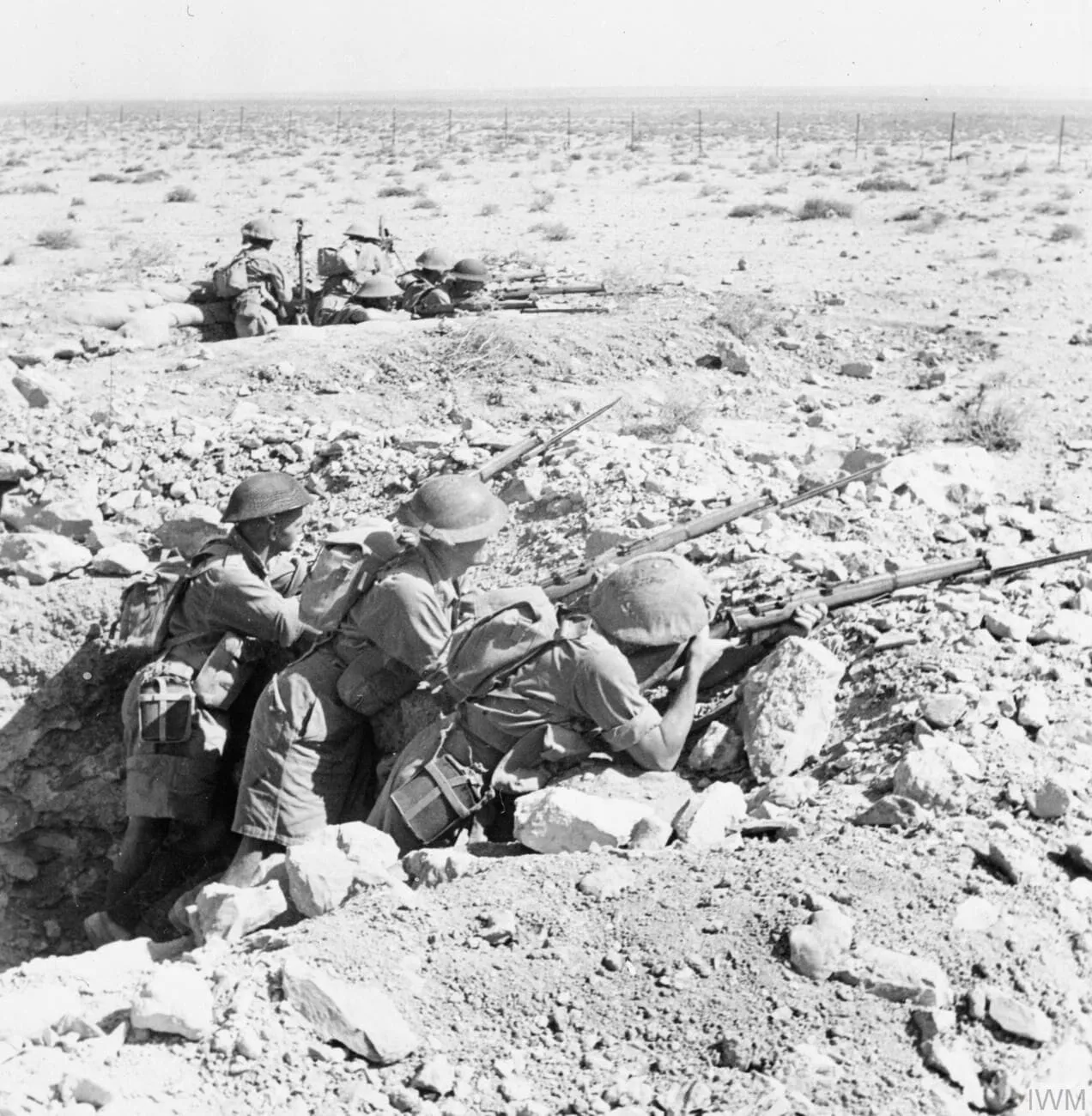
The siege of Tobruk was one of the longest battles of the war in North Africa and one of the first places where German panzer divisions were halted and thrown back. In April 1941, after a three-week march across Cyrenaica, the German and Italian forces of Lieutenant General Erwin Rommel surrounded the port of Tobruk, which the Australians had captured in January. It was held by the 9th Australian Division under Major General Leslie Morshead, reinforced with British artillery and tanks. They beat off two great assaults, at Easter and at the turn of April and May, and then throughout the summer conducted an active defence: at night they patrolled no man’s land, raided enemy positions and took prisoners. German propaganda called them rats, and they took up the nickname as a badge of honour – they went down in history as the “Rats of Tobruk”.
The fortress lived by the sea. Destroyers, sloops and small ships of the Mediterranean Fleet came in by night from Alexandria with ammunition, food and reinforcements and took away the wounded and prisoners, paying for it with dozens of vessels sunk and damaged. Between August and October most of the garrison was exchanged by the same route: the Australians were relieved by the British 70th Infantry Division under Major General Ronald Scobie, Brigadier General Stanisław Kopański’s Polish Independent Carpathian Rifle Brigade and the Czechoslovak 11th Infantry Battalion. Only in November, during Operation Crusader, did the garrison strike out from the fortress to meet the advancing Eighth Army, linking up with the New Zealanders at Ed Duda on 27 November.
Name and dates
Polish literature speaks both of the siege and of the Battle of Tobruk. It should not be confused with the capture of Tobruk by the Australians in January 1941 or with its loss by the British in June 1942.
The siege is taken to have begun on 10 April 1941. On that day the Afrika Korps vanguards came up against the fortress perimeter, Rommel ordered that the garrison must not be allowed to escape, and the commander of the 15th Panzer Division, General Heinrich von Prittwitz und Gaffron, was killed outside Tobruk. The ring finally closed on 11 April, and some authors date the siege from that day. It is taken to have ended on 27 November 1941, when units breaking out of the fortress linked up with the 2nd New Zealand Division on the Ed Duda ridge; most studies date the siege in this way. The link-up did not hold, however: on 1 December the Germans cut the corridor again, and the ring around Tobruk broke up only when Rommel withdrew his troops from the fortress on 4–7 December to a line at Gazala. The Australian War Memorial therefore counts the siege up to 7 December (242 days), while in Poland its end is often placed on 10 December, when soldiers of the Carpathian Brigade took the Ras el Medauar hill; this is also the wording of the plaque on the Tomb of the Unknown Soldier in Warsaw: “Tobruk 22 VIII – 10 XII 1941”. Hence the varying numbers of days given for the siege in the literature: from 231 (to 27 November) to 241–242 (to 7 December).
Background
At the turn of 1940 and 1941 the British and Australians had destroyed the Italian 10th Army in Operation Compass and occupied the whole of Cyrenaica, and in February the government in London decided to send its best units to Greece. Weak, inexperienced and poorly equipped units were left in Cyrenaica. On 24 March the newly arrived German Afrika Korps went over to the offensive together with the Italians and, in Rommel’s first offensive, regained almost all of Cyrenaica in under three weeks: on 3–4 April it took Benghazi, and at Mechili it forced the remnants of the British 2nd Armoured Division to surrender and captured three British generals. The British forces fell back towards the Egyptian border, and on 6 April the Germans also attacked Greece, where a British expeditionary corps was fighting.
In this situation the British Commander-in-Chief Middle East, General Archibald Wavell, decided to stop the enemy as far west as possible, at Tobruk. The port was of crucial importance to both sides. It was the only good harbour on the coast between Benghazi and Alexandria, more than 1,500 kilometres by road from Tripoli, the main port through which the Italians and Germans supplied their forces. Anyone who wanted to advance on Egypt and the Suez Canal had to hold Tobruk, or at least keep its garrison bottled up. On 7 April the Prime Minister, Winston Churchill, cabled that Tobruk seemed “a place to be held to the death without thought of retirement”. On 8 April Wavell flew into the fortress and ordered it to be held for about two months, until he could assemble forces in Egypt for a counter-offensive. Morshead, who took command of the defence, is credited with the words “There’ll be no Dunkirk here.”
Rommel counted on taking Tobruk on the march. He was convinced that the British were cracking and that the ships in the harbour had come to evacuate the garrison. On 10 April he set the Afrika Korps the Suez Canal as its objective.
Course of the siege
The fortress and its defenders
The defence rested on fortifications built by the Italians before the war. The fortress perimeter, some 45–50 kilometres long, ran in a semicircle 13–15 kilometres from the port, so that enemy field artillery could not reach the quays. It consisted of two rows of concrete, partly underground posts surrounded by barbed wire, and an unfinished anti-tank ditch. Behind them the Australians began to build a second line of defence, the so-called Blue Line, about three kilometres further in.
There were some 36,000 men in the fortress, a third of them rear-echelon troops, refugees and prisoners. The core of the defence was formed by the three brigades of the 9th Australian Division (20th, 24th and 26th) and the 18th Australian Brigade of the 7th Division, brought in by sea. They were supported by four British field artillery regiments, two anti-tank regiments, the 4th Anti-Aircraft Brigade with several dozen guns, the Indian 18th Cavalry Regiment and the 3rd Armoured Brigade, rebuilt from remnants, which at the start of the siege had several dozen light, cruiser and infantry tanks. Infantrymen also manned dozens of captured Italian guns, firing them without sights, by trial and error; Australian accounts recall this improvised “bush artillery” with pride.
Morshead decided on an active defence. Battalions held sectors several kilometres long, so enemy penetrations had to be expected anywhere. Every breach was to be sealed at once by counter-attack, and the infantry were not to fall back before tanks but to let them through onto the artillery and cut off the infantry following them. As Morshead put it, no man’s land was to become “our land”, and the garrison was not in Tobruk “to take blows but to deal them”.
The Easter battle (11–14 April)
On 11 April the ring closed: the 5th Light Division took up position on the south-east, the battle group of the fallen Prittwitz, taken over by Lieutenant Colonel Gerhard von Schwerin, on the east, and the Italian Brescia Division on the west. Rommel sent weaker units on to the Egyptian border, where on 12 and 13 April they took Bardia, Fort Capuzzo and Sollum. On 11 and 12 April tanks of the 5th Panzer Regiment approached the defences by the road to El Adem, on the sector of the 20th Australian Brigade, but artillery forced them to withdraw, and the German infantry who reached the anti-tank ditch were thrown back by the Australians.
On 13 April, Easter Sunday, leaflets calling on the garrison to surrender fell on Tobruk. During the night of 13–14 April the 8th Machine Gun Battalion, with sappers, broke through beyond the anti-tank ditch west of the El Adem road, on the sector of the Australian 2/17th Battalion. In the fighting at post R33 Corporal John Edmondson, though badly wounded, saved his commanding officer with the bayonet; he died of his wounds and became the first Australian of the war to be awarded the Victoria Cross, posthumously. At dawn some 38 tanks of the 5th Panzer Regiment drove through the bridgehead and headed north towards the port. The Australian infantry stayed in their posts and cut the German infantry off from the tanks, while the tanks ran into the fire of the 25-pounders of the 1st Regiment, Royal Horse Artillery, firing over open sights, of anti-tank guns and of British cruiser tanks. The panzer regiment turned back, losing 16 of its 38 tanks according to the British official history. The 8th Machine Gun Battalion lost some three-quarters of its strength, and its commander, Lieutenant Colonel Gustav Ponath, was killed. The defenders took about 250 prisoners, losing 26 killed and 64 wounded themselves.
It was one of the first occasions in this war on which a German armoured attack failed to break a defence of infantry and artillery. Rommel realised that he would not take Tobruk on the march.
Attacks from the west (16–22 April)
Rommel now tried from the west, where he expected the defence to be weaker. On 16 April he personally led an attack by the Ariete Armoured Division, reinforced by the 62nd Infantry Regiment of the Trento Division, in the area of the Ras el Medauar hill. A counter-attack by the Australian 2/48th Battalion ended with more than 800 Italians taken prisoner. The next day Ariete’s tanks attacked again; a few reached the forward posts, but when the infantry did not follow them they turned back, losing five vehicles. On 22 April a company of the 2/48th Battalion with three infantry tanks raided the positions of the Italian Fabris group on the western sector and took some 370 prisoners, and a company of the 2/23rd Battalion, in a costly sortie across the Derna road, took about a hundred prisoners from the Brescia Division. Rommel speeded up the transfer of the 15th Panzer Division from the Tripoli area.
Ras el Medauar (30 April – 4 May)
After the April setbacks the Italian high command and the German High Command of the Wehrmacht agreed that Tobruk had to be taken before any further advance on Egypt, and that this required a deliberate attack, the build-up of supplies and stronger air forces. In Berlin the Chief of the Army General Staff, General Franz Halder, complained that Rommel was not sending clear reports and was squandering his strength. On 27 April his deputy, General Friedrich Paulus, flew to Africa to find out what Rommel intended and to make him understand that he would receive no large reinforcements. After some reflection, on 29 April he agreed to the assault already prepared; the Italian Commander-in-Chief in Libya, General Italo Gariboldi, also gave his consent.
On the evening of 30 April, after a whole day of shelling and bombing, the 5th Light Division and the newly arrived 15th Panzer Division attacked the western sector of the perimeter on both sides of the Ras el Medauar hill, held by the Australian 26th Brigade. Italian assault groups from the Ariete and Brescia Divisions were to follow them and widen the breach on the flanks. By evening the Germans had secured a bridgehead, but some of the Australian posts held out through the night. On the morning of 1 May German tanks, lost in the mist and dust, ran onto a new minefield and were driven back by anti-tank fire. In the afternoon Morshead threw a dozen or so cruiser and infantry tanks into a counter-attack; the German attack came to a standstill, but an evening counter-attack by the Australian 2/48th Battalion on Ras el Medauar failed. Fighting in a sandstorm continued on 2 May, and the battle ended during the night of 3–4 May with an unsuccessful counter-attack by two battalions of the 18th Brigade.
The Germans and Italians had taken a bulge about 5 kilometres wide and 3–4 kilometres deep, including the hill, from which they could observe the interior of the fortress. This sector, known from then on as the Salient, remained the most dangerous part of the front until the end of the siege: in places the positions of the two sides were only a few dozen metres apart. The attack cost the Axis, according to various tallies, some 1,100–1,200 killed, wounded and missing (about 650 Germans and 500 Italians), and the defenders, according to the Australian official history, almost 800 men, nearly half of them missing and captured. Paulus judged that the attack had failed and on 4 May forbade Rommel to make any further assaults unless the garrison began to evacuate. The Afrika Korps was to hold Cyrenaica whatever happened at Sollum, Bardia and Tobruk, and to build a defensive line at Gazala in the rear.
Summer at Tobruk
The front froze. The siege took the form of positional warfare reminiscent of the First World War: trenches and dugouts hewn out of the rock, barbed wire, minefields, daily artillery fire and air raids. At night Australian patrols crossed no man’s land, laid ambushes, blew up posts and brought back prisoners. In May and June both sides fought over individual posts in the Salient; at the beginning of August an attack by the Australian 24th Brigade on its flanks broke down with heavy losses. On the Axis side the siege was conducted mainly by Italian divisions, while Rommel kept his armoured units in reserve between Tobruk and the Egyptian border.
Life in the fortress was hard. The soldiers lived in holes in the ground, in the heat, among flies and ever-present dust. The water from the desalination plant and the wells was brackish and doled out in small rations, the food consisted of tinned meat and biscuits, and dysentery and skin diseases spread. German radio propaganda, voiced by Lord Haw-Haw, mocked the defenders for sitting in holes like rats; the Australians took up the nickname with pride, and “Rats of Tobruk” became the name for all who defended the fortress, including British, Indian, Polish and Czechoslovak troops. In Polish tradition the version has taken root that it was Rommel himself who gave the defenders this name.
The sea lifeline
Tobruk was supplied by the fleet. The commander of the Mediterranean Fleet, Admiral Andrew Cunningham, assigned the task to the Inshore Squadron, made up of destroyers, sloops, gunboats, minesweepers and trawlers, joined by merchant ships, schooners and landing craft. Because German and Italian Ju 87 dive-bombers attacked any ship in the harbour or on the approaches by day, after the loss of several slow transports the burden of supply passed to fast warships. The destroyers left Alexandria timed to enter Tobruk after dark, unload their cargo and take on the wounded within an hour or two, and be far from the coast by dawn. The soldiers called the run the “Tobruk Ferry”. Particular fame was won by the old Australian destroyers Stuart, Vendetta, Voyager and Waterhen, known – reportedly after a jibe of German propaganda – as the “Scrap Iron Flotilla”, and by the newer Napier and Nizam.
According to British figures, between 11 April and 10 December the ships brought 34,113 men and nearly 34,000 tons of supplies into the fortress and took out 47,280 men, including wounded, sick and prisoners. The price was high: 34 warships and merchant ships were sunk during the siege and 33 damaged. Those sunk included the Australian destroyer Waterhen (30 June), the fast minelayer Latona (25 October) and, already during the relief, the Australian sloop Parramatta, torpedoed by a German U-boat on 27 November.
In the air the Germans and Italians had the upper hand. At the start of the siege Hurricane fighters of No. 73 Squadron RAF were stationed in the fortress, but after two weeks of fighting against a superior enemy only a few were left, and on 25 April the squadron was withdrawn to Egypt. From then on the port was defended mainly by the anti-aircraft gunners.
Attempts at relief: Brevity and Battleaxe
Wavell did not intend to hold Tobruk indefinitely. The fortress was to tie down Rommel’s forces until the army in Egypt was ready to attack. Under pressure from Churchill, who in May pushed the Tiger convoy, with more than two hundred tanks, through the Mediterranean, the British twice tried to break through to the fortress. In Operation Brevity on 15 and 16 May a small armoured and infantry force under Brigadier William Gott retook the Halfaya Pass and, briefly, Fort Capuzzo, but a German counter-attack forced it to withdraw, and on 26–27 May the Germans regained the pass as well.
The British launched a larger operation, Battleaxe, on 15 June. The 7th Armoured Division and the 4th Indian Division were to destroy the Axis forces on the Egyptian border and then advance on Tobruk, whose garrison was to strike out to meet them. The attack broke down on the defences of the Halfaya Pass and Hafid Ridge, where the Germans used 88 mm anti-aircraft guns against tanks, and a German counter-stroke forced the British to retreat on 17 June. They lost nearly a thousand men and more than 90 tanks. After this defeat Churchill replaced Wavell with General Claude Auchinleck, who took over Middle East Command at the beginning of July.
The change of garrison: Poles, British and Czechoslovaks
Wavell had spoken of holding out for eight weeks; the Australians were now in their fifth month. In July Morshead judged that his men were exhausted and that their health and discipline were deteriorating. The commander of the Australian Imperial Force, General Thomas Blamey, demanded the withdrawal of the division, wishing also to gather the scattered Australian forces into a single corps, and he was backed by successive Australian prime ministers: Robert Menzies, Arthur Fadden and, from October, John Curtin. Churchill and Auchinleck reluctantly agreed, even though the exchange delayed preparations for a new offensive. Large-scale troop movements could be carried out only by fast warships on moonless nights, in three phases.
In the first phase, from 19 to 29 August, the Polish Independent Carpathian Rifle Brigade arrived in Tobruk. It had been formed in the spring of 1940 in Syria, within the French Army of the Levant, from soldiers who after the September Campaign had made their way to the Middle East, mainly through Romania and Hungary. After the fall of France its commander, Colonel (from September 1940 Brigadier General) Stanisław Kopański, led it into British Palestine in defiance of the orders of the French authorities. In the spring of 1941 it was to have sailed for Greece, and from May it manned the defences at Mersa Matruh. Its dispatch to Tobruk was approved by the Commander-in-Chief, General Władysław Sikorski. On 30 August, according to Polish figures, the brigade had 288 officers and 4,551 other ranks in the fortress. At the same time the Australian 18th Brigade and the Indian 18th Cavalry Regiment left, more than 5,000 men in all. On 29 August the Carpathian Lancers relieved the Indians on the perimeter; at the beginning of September the Poles took over a southern sector some twenty kilometres long, and at the beginning of October they moved to the most difficult sector, the western one, into the Salient at Ras el Medauar.
In the second phase, from 19 to 27 September, the first units of the British 70th Infantry Division under Major General Ronald Scobie (called the 6th Division until October) and the tanks of the 32nd Army Tank Brigade arrived, and the Australian 24th Brigade left. In the third, from 12 to 25 October, the rest of the 70th Division arrived, together with the Czechoslovak 11th Infantry Battalion under Lieutenant Colonel Karel Klapálek, which took up position on the western sector next to the Poles, and most of the Australians left. The last runs were cut short by air attacks, in which the minelayer Latona was sunk on 25 October, and the Australian 2/13th Battalion, with two companies of the 2/15th Battalion, remained in the fortress until the end of the siege. On 22 October Morshead handed over command of the fortress to Scobie. In mid-November General Sikorski visited the Tobruk garrison; Polish authors stress that he was the only Allied commander of such high rank to make that dangerous journey.
The relief (18–27 November)
In the autumn both sides prepared for a decision. Rommel, since August commander of Panzer Group Africa, was stockpiling supplies and artillery for a general assault on Tobruk, planned for the second half of November. The British, reinforced with new tanks and organised into the Eighth Army under General Alan Cunningham, forestalled him. On 18 November they launched Operation Crusader: XXX Corps, with the armoured divisions, outflanked the fortifications on the Egyptian border from the south and moved towards the Sidi Rezegh airfield, a dozen or so kilometres south-east of the fortress perimeter, while XIII Corps, with the 2nd New Zealand Division and the 4th Indian Division, enveloped the frontier positions.
At dawn on 21 November the 70th Division, with the tanks of the 32nd Army Tank Brigade, struck south-east out of the fortress towards the Ed Duda ridge, to join hands with the armoured brigades advancing from Sidi Rezegh. The Poles staged a diversionary attack on Ras el Medauar. The Italian Bologna Division was taken by surprise, and the Scottish Black Watch battalion lost some two hundred men in its assault on the Tiger strongpoint. The breach was deepened to about six kilometres, but the British tanks from Sidi Rezegh did not arrive: Rommel threw his panzer divisions against them and in heavy fighting on 21–23 November destroyed one XXX Corps brigade after another. On 24 November he set off with his tanks for the Egyptian border to strike at the Eighth Army’s rear. The raid, however, struck mostly empty desert, and Auchinleck refused to let the offensive be broken off and on 26 November replaced Cunningham with General Neil Ritchie.
With the German tanks away, General Bernard Freyberg’s New Zealanders fought their way west along the Trigh Capuzzo and retook Sidi Rezegh. On 26 November Scobie ordered the capture of the Ed Duda ridge. In the afternoon his troops, with tanks, took the ridge, and during the night of 26–27 November the New Zealand vanguards reached them. The corridor to the fortress was open, and the siege of Tobruk was broken.
Epilogue: the end of the ring (28 November – 10 December)
Rommel did not give up. His panzer divisions returned from the frontier and in the last days of November attacked the New Zealanders at Sidi Rezegh and Belhamed. On 28 November the Australian 2/13th Battalion was moved from the fortress to Ed Duda and, together with British tanks, beat off a German attack, but on 1 December the Germans smashed the New Zealand brigades at Belhamed, and the Italian Trieste Division cut the corridor again. The Tobruk garrison nevertheless held on to Ed Duda. The Axis forces were exhausted, and on 5 December the Italian high command informed Rommel that supplies would not improve before the end of the month. Rommel pulled his troops out of the eastern sector of the ring and on 7 December began withdrawing to the line at Gazala. During the night of 9–10 December soldiers of the Carpathian Brigade occupied the Ras el Medauar hill, abandoned by the Italians, and planted the Polish flag on it. The siege of Tobruk was finally over.
Losses
There is no complete tally of both sides’ losses during the siege, and the available figures cover different periods. According to Barton Maughan’s volume of the Australian official history, the 9th Australian Division lost some 750 killed, 1,996 wounded and 604 taken prisoner between 8 April and 25 October 1941; over the whole period from March to mid-December, including attached units, the figures were 832 killed, 2,177 wounded and 941 taken prisoner. The Independent Carpathian Rifle Brigade lost, according to various Polish studies, from just over a hundred to about a hundred and fifty killed and nearly 470 wounded over the whole period of its fighting in Africa from August 1941 to the spring of 1942, most of them at Tobruk (109 killed, according to one study), as well as several hundred sick.
Italian losses from 15 February to 18 November 1941, covering the whole Libyan–Egyptian front and not Tobruk alone, are given by the British official history as 1,130 killed, 4,255 wounded and 3,851 missing, and German losses over the same period as some 538 killed, 1,657 wounded and about 681 missing. A large part of these losses fell in the fighting around Tobruk. The fleet’s losses were heavy: 34 warships and merchant ships sunk and 33 damaged.
Significance
Tobruk was an obstacle Rommel could not remove throughout 1941. The garrison in his rear tied down several Axis divisions and denied him the only large port close to the Egyptian border, so that all supplies for the troops at the front had to travel hundreds of kilometres by lorry from Benghazi and Tripoli. That is why the Afrika Korps, which had reached the Egyptian border in April, could not push on to the Suez Canal at a time when the British were losing Greece and Crete and fighting in Iraq and Syria. The siege also showed that German armoured attacks could be stopped by a defence in depth in which the infantry did not give way before tanks and the artillery fired over open sights. For Tobruk Morshead received a British knighthood and the Polish Virtuti Militari, and in 1942, as commander of the 9th Division, he fought Rommel again at El Alamein.
In Australia the “Rats of Tobruk” became one of the national legends, alongside Gallipoli, and in Poland Tobruk became the first great land battle of the Polish Armed Forces after the fall of France and one of the symbols of their fight in the West. In December 1941 the Carpathian Brigade fought on at Gazala, and in the spring of 1942 it became the nucleus of the 3rd Carpathian Rifle Division, which fought at Monte Cassino in 1944. Tobruk itself changed hands twice more. On 21 June 1942, after the defeat of the Eighth Army at Gazala, Rommel took it in a single assault within a day, capturing more than 30,000 soldiers, mostly South African, British and Indian; for this victory Hitler made him a field marshal. In November 1942, after the British victory at El Alamein, Tobruk returned to Allied hands, this time for good.