Japan
Iwao Ōyama
Army Minister (1885–1891, 1892–1896), Chief of the General Staff (1899–1904, 1905–1906), Commander-in-Chief of the Manchurian Army (1904–1905), Field Marshal (gensui), Lord Keeper of the Privy Seal (1915–1916)
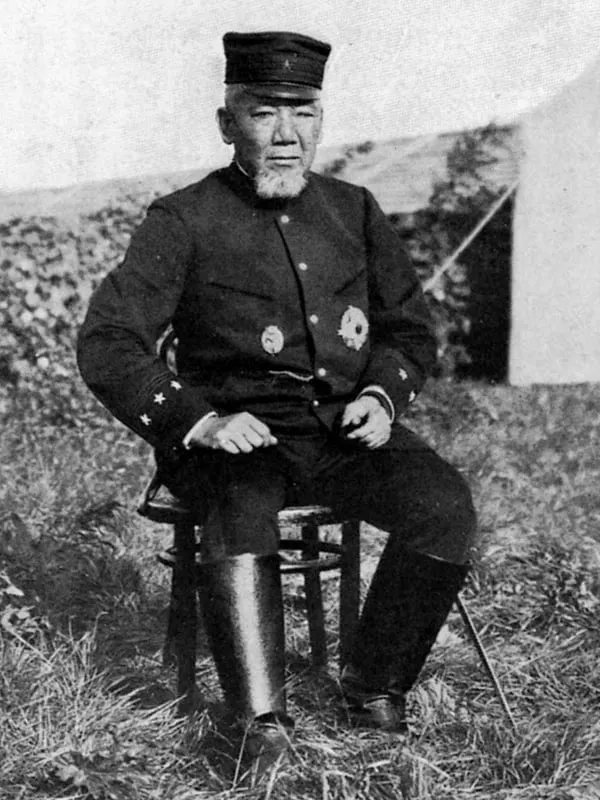
- Born:
- 12 November 1842, Kagoshima (Satsuma domain, Japan)
- Died:
- 10 December 1916, Tokyo
- Author:
- Łukasz
- Photo:
- P. F. Collier & Son, domena publiczna, Wikimedia Commons

Iwao Ōyama was one of the fathers of the modern Japanese army and its most famous commander before the Second World War. A samurai of the Satsuma domain and a cousin of Takamori Saigō, he fought in the civil war that overthrew the shogunate, then studied military science in Europe, served for many years as Army Minister and built the army on the Prussian model. In the war with China in 1894–1895 his army took Port Arthur, and in the war with Russia he commanded all the Japanese forces in Manchuria and won at Liaoyang and Mukden. In Japan people used to say: “Ōyama on land, Tōgō at sea”, meaning Admiral Heihachirō Tōgō. His victories gave Japan a foothold in southern Manchuria and gave prestige to an army that in the following decades paid less and less heed to the government. Ōyama himself, unlike many of his successors, kept out of politics.
A samurai from Satsuma
He was born on 12 November 1842 in Kagoshima, the capital of the Satsuma domain in the south of the island of Kyūshū, the second son of a samurai in the service of the Shimazu lords. As a child he bore the name Iwajirō, and later Yasuke. He grew up in the samurai quarter of Kajiya-chō, which produced many of the later leaders of the Meiji era. His older cousins were the brothers Takamori Saigō and Jūdō Saigō.
As a young man he belonged to the radicals who wanted to drive foreigners out of the country. In 1862 he was among the followers of Arima Shinshichi who were suppressed at the Teradaya inn, and as punishment he was sent home. In August 1863, when a British squadron bombarded Kagoshima, he served with the guns. The superiority of Western artillery impressed him so much that he began to study gunnery on European lines. In the Boshin War of 1868–1869, which overthrew the shogunate and restored power to the emperor, he commanded the Satsuma artillery. The improved mortars and mountain guns he designed were known as “Yasuke guns”. During the siege of Aizu-Wakamatsu castle in the autumn of 1868 he was wounded in the thigh.
Europe and the building of the army
After the Meiji Restoration Ōyama was one of a group of young officers whom the government sent to Europe. He observed the Franco-Prussian War and then lived for several years in Geneva, where he studied languages. He spoke fluent French and reportedly Russian too. During his stay in Europe he also changed the way his name was written to Iwao. He went back to Europe several more times. In 1884–1885 he led a mission, whose members included future prime ministers and generals such as Tarō Katsura, to study the organisation of European armies. At this time the Japanese army turned to German models, and in 1885 Major Jakob Meckel arrived in Tokyo as an adviser.
In 1877 Takamori Saigō led the Satsuma Rebellion, the last great samurai uprising. Ōyama, loyal to the government, commanded the siege artillery against his cousin. Saigō was killed, and, according to his biographers, Ōyama never again returned to Kagoshima for the rest of his life, although he remained on friendly terms with the Saigō family. In 1880 he became Army Minister under the old system of offices, and in 1885, in the first cabinet of Hirobumi Itō, the first Army Minister in a modern government. He held the post in successive cabinets until 1891 and again from 1892 to 1896. Together with Field Marshal Aritomo Yamagata he built a conscript army with a modern general staff and divisions capable of fighting beyond the country’s borders.
In 1883 he married for the second time. His wife, Yamakawa Sutematsu, was the daughter of a samurai family from Aizu that in 1868 had held out in the besieged castle while Ōyama stood beneath its walls. Sutematsu was one of the first Japanese girls sent abroad to study and the first Japanese woman to graduate from an American college, Vassar College. The couple were among the most Europeanised in Tokyo. The invitations to their wedding were written in French, and the minister’s house resembled a German castle.
The war with China
In the First Sino-Japanese War Ōyama commanded the Second Army, which landed on the Liaodong Peninsula and on 21 November 1894 took Port Arthur, regarded as the strongest Chinese fortress, in a single day. After the city fell, Japanese soldiers spent several days killing its inhabitants, civilians included. The number of victims of the Port Arthur massacre is disputed, with estimates ranging from several hundred to several thousand, and the Western correspondents who reported it accused the command of failing to restrain the troops. Early in 1895 the Second Army crossed to Shandong and took the naval base of Weihaiwei, where the Chinese Beiyang Fleet surrendered. Ōyama was made a marquis, and in 1898 he received the rank of field marshal (gensui).
The war with Russia
In 1899 Ōyama became Chief of the General Staff, and it was he who in June 1903 submitted a memorandum to the government arguing that the Korean question had to be settled before Russia grew stronger in Manchuria. After the outbreak of the war with Russia, Emperor Mutsuhito (Emperor Meiji) appointed him on 20 June 1904 Commander-in-Chief of the Manchurian Army, that is, of all the Japanese armies on the continent. His chief of staff was General Gentarō Kodama, regarded as the army’s ablest strategist. The two made a well-matched team. Ōyama gave Kodama and the army commanders wide latitude, kept calm himself and took responsibility on his own shoulders. It was said that during the heavy fighting on the Shaho, when nerves at headquarters were taut, Ōyama emerged from his room after a nap and asked Kodama whether there was a battle going on anywhere today, whereupon the whole staff burst out laughing and cooled down. When Kodama went to Port Arthur, however, Ōyama himself chaired staff conferences and issued orders.
At Liaoyang, from 25 August to 3 September 1904, his three armies forced Aleksey Kuropatkin to retreat, although the Russians had numerical superiority and withdrew in good order. In October Ōyama repelled the Russian offensive on the Shaho river, and in January 1905 at Sandepu, where the Russians surprised him with a winter attack, he mastered the crisis. When, after the fall of Port Arthur, he was joined by General Maresuke Nogi’s Third Army, he fought the Battle of Mukden, from 20 February to 10 March 1905. He intended to outflank the Russian army on both sides and trap it in a pocket, and he ordered that fighting in the city itself, which was full of Chinese civilians, be avoided. The encirclement failed, but the Russians, who lost some 90,000 men, had to abandon Mukden. It was the largest land battle Japan had fought up to that time. It also cost the Japanese, however, some 70,000 killed and wounded, and Ōyama’s army had no reserves left. Ōyama and Kodama understood this better than public opinion at home and warned the government that peace had to be sought. Kodama went to Tokyo for that purpose. A few months later the war was ended by the Treaty of Portsmouth.
Last years
After the war Ōyama briefly headed the General Staff again. In 1907 the emperor made him a prince (kōshaku), the highest rank in the Japanese aristocracy. He was one of the genrō, the informal council of elder statesmen who advised the emperor and nominated prime ministers, but unlike Yamagata he had no political ambitions and consistently avoided being put forward as prime minister. In April 1915 he became Lord Keeper of the Privy Seal (naidaijin), the closest adviser to Emperor Taishō, and in that capacity he took part in the emperor’s coronation in Kyoto.
He fell ill in the autumn of 1916 on his way back from manoeuvres and died in Tokyo on 10 December 1916, a day after the writer Sōseki Natsume. Almost all the army’s field marshals gathered at his bedside, among them Yamagata and the then prime minister, Masatake Terauchi. The state funeral was attended by the ambassador of Russia, Japan’s ally in the ongoing world war, and the Russian military attaché visited the dead man’s house and laid a wreath “on behalf of the whole Russian army”. Ōyama was buried at Nasu, where he had an estate and liked to spend his time farming.
Significance
Ōyama belonged to the generation of founders of modern Japan who built the army as an instrument of the state and subordinated it to the emperor and the oligarchs’ government. In Manchuria he showed that the army of a country which half a century earlier had still fought with swords and bows could defeat a great European power. His victories, however, had far-reaching and dangerous consequences. On the land he had fought for, Japan built its Manchurian railway empire after the war, guarded by troops out of which the Kwantung Army grew. The cult of the victories of 1904–1905 and the belief that Manchuria had been “won with the blood” of a hundred thousand dead served the next generation of officers as justification for the Mukden Incident of 1931 and the conquest of the whole region. The army that Ōyama had helped to create grew beyond the control of politicians, exploiting the principle that the high command answered directly to the emperor rather than to the government. Ōyama, who all his life kept out of politics and was renowned for his impartiality, did not live to see those times. The memory of him as a calm, modest commander who took responsibility for failures and gave the credit for successes to his subordinates has survived in Japan to this day. In the pantheon of national heroes he was placed alongside Admiral Tōgō.