Lithuania
Antanas Smetona
Chairman of the Taryba (1917–1919), President of Lithuania (1919–1920, 1926–1940)
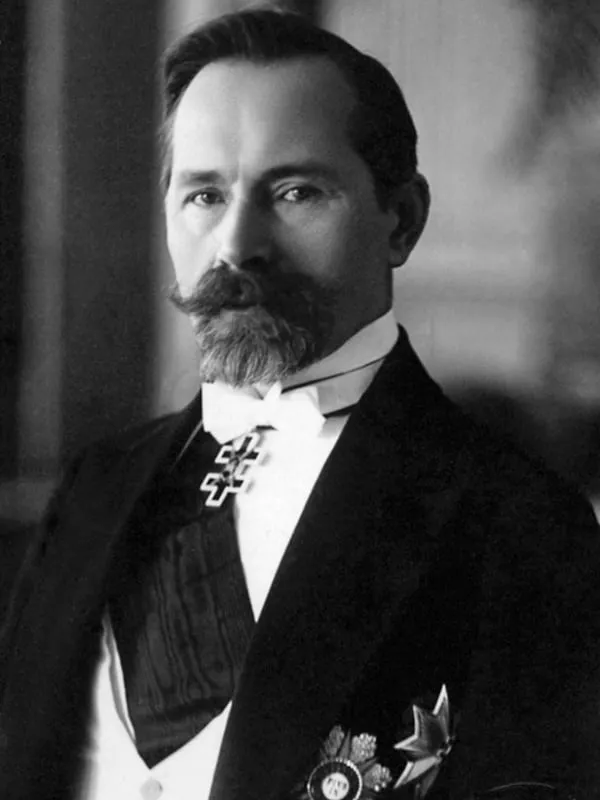
- Born:
- 10 August 1874, Užulėnis near Ukmergė (Kovno Governorate, Russian Empire)
- Died:
- 9 January 1944, Cleveland (United States)
- Author:
- Łukasz
- Photo:
- Owned by the National Museum of Lithuania, CC BY-SA 2.5, Wikimedia Commons

Antanas Smetona was a Lithuanian journalist, national activist and politician, one of the founding fathers of independent Lithuania. He chaired the council that proclaimed the country’s independence on 16 February 1918, was its first president and, after the coup of December 1926, ruled it for thirteen and a half years as the authoritarian “leader of the nation”. His Lithuania lived in the shadow of the dispute with Poland over Wilno (Vilnius), and in the last years before the war it had to accept three ultimatums: the Polish one in 1938, the German one in 1939 and the Soviet one in June 1940. After the last of these, Smetona, the only member of the government to call for even token resistance, left the country so as not to put his name to its incorporation into the USSR. He died in exile in the United States. For some Lithuanians he is a symbol of statehood; for others, a dictator who left the country defenceless.
Peasant’s son and national activist
He was born on 10 August 1874 in the village of Užulėnis in the Ukmergė district of Kovno Governorate, into a family of former serfs. His father died when Antanas was a child, but not before expressing the wish that his son should be educated. Smetona attended the elementary school in Taujėnai, studied privately in Ukmergė and then went to the progymnasium in Palanga, where he first came across Lithuanian books smuggled in from East Prussia in defiance of the tsarist ban on printing in the Latin alphabet. His mother wanted him to become a priest. He passed the entrance examinations for the seminary in Kaunas, but chose instead the gymnasium in Mitau (Jelgava), one of the centres of the Lithuanian national revival. There he was taught by the linguist Jonas Jablonskis, one of the creators of the standard Lithuanian literary language. In 1896 Smetona was expelled from the school because, together with other Lithuanian pupils, he refused to say prayers in Russian. He passed his school-leaving examinations in St Petersburg.
In 1897–1902 he studied law at the university in St Petersburg. He led a secret organisation of Lithuanian students; in 1899, for taking part in student protests, he was sent down, imprisoned for two weeks and banished to Wilno, and in 1902 he was arrested again in connection with the smuggling of banned Lithuanian publications. He nevertheless completed his studies. He rejected the socialism he had encountered in St Petersburg; his guiding idea was the nation. After graduating he settled in Wilno and until 1915 worked at the Wilno Land Bank. In 1904 he married Zofia Chodakowska, the daughter of a Polish-speaking landed family, whose brother he had once tutored.
Wilno was then a Polish-Jewish city in which Lithuanians formed a small minority, but for the national movement it remained the historic capital. Smetona joined the Lithuanian Democratic Party; in December 1905 he sat on the presidium of the Great Seimas of Vilnius, which demanded autonomy for Lithuania; and he wrote for and edited newspapers. In 1907, with the priest Juozas Tumas-Vaižgantas, he founded the newspaper Viltis (“Hope”), and in 1914 the fortnightly Vairas (“The Helm”). He was regarded as the finest stylist of the Lithuanian language of his generation.
The Act of Independence
During the First World War, when Lithuania was occupied by the Germans, Smetona headed a committee for the relief of war victims and belonged to a group of activists who in the summer of 1916 demanded from the German command in the East the right of Lithuanians to a state of their own. In September 1917 a Lithuanian conference in Wilno elected him chairman of the Taryba, the Council of Lithuania, and at the same time he began publishing the daily Lietuvos aidas. The Taryba manoeuvred between the German occupiers and its own aims. On 11 December 1917 it declared independence in an “eternal alliance” with Germany, but on 16 February 1918 Smetona and nineteen other members of the council signed the Act of Independence of Lithuania without that reservation. When Berlin sought to make Lithuania a dependent state, the Taryba under his chairmanship proclaimed a kingdom in the summer of 1918 and elected the German prince Wilhelm von Urach to the throne in order to forestall annexation. After Germany’s defeat in November 1918 it abandoned the idea.
At the turn of 1918 and 1919 Smetona sought loans for the nascent state in Germany and Scandinavia. On 4 April 1919 the Taryba elected him the first President of Lithuania. He held the office during the fighting against the Bolsheviks, the Bermontians and Poland, but in the spring of 1920 his nationalists lost the elections to the Constituent Seimas, and the duties of head of state passed to the Speaker of the Seimas, Aleksandras Stulginskis. In October of that year the division of General Lucjan Żeligowski seized Wilno. Recovering the city became an overriding cause for Lithuania, and for Smetona in particular. In his thinking Poland was a greater threat than Germany or Russia.
The dictatorship of the “leader of the nation”
For six years Smetona remained on the sidelines of power. He wrote, edited newspapers, lectured on ethics and ancient philosophy at the university in Kaunas and led the Lithuanian Nationalist Union (the tautininkai). At the beginning of 1923, after the Klaipėda Region (Memel Territory) had been seized by Lithuanian insurgents, he briefly served as government commissioner in Klaipėda, and in November that year he spent several days in prison for publishing an article by his associate Augustinas Voldemaras.
On 17 December 1926 army officers staged a coup d’état against the left-wing government of Mykolas Sleževičius and President Kazys Grinius, justifying it by the communist threat. Smetona was one of the leaders of the coup. On 19 December the Seimas, without the left-wing deputies and without the required quorum, elected him president, and Voldemaras became prime minister. In April 1927 the President dissolved the Seimas, which did not meet again for nine years, and in 1928 he imposed a constitution that gave him executive power and, in the absence of parliament, legislative power as well. In 1929 he removed the overly radical Voldemaras and put his brother-in-law, Juozas Tūbelis, at the head of the government. In 1931 and 1938 he was re-elected, as the sole candidate, by a college of “representatives of the nation”. In 1936 he convened a compliant Seimas, which two years later adopted an even more authoritarian constitution, and the opposition parties were dissolved.
Smetona’s regime was sometimes called fascist, especially by Soviet propaganda, but historians tend rather to compare it with the rule of Józef Piłsudski in Poland, Ulmanis in Latvia or Salazar in Portugal: it was a conservative authoritarianism, with a leader cult, censorship and repression of communists and the opposition, but without a mass party and without terror. Smetona suppressed both the communists and Voldemaras’s radical nationalists, who attempted a military coup in 1934. He was tolerant towards the Jews: under his rule no anti-Jewish law was passed and antisemitic excesses were punished, for which his opponents called him the “king of the Jews”. In 1934 and 1935 his authorities put the leaders of the Nazi parties in the Klaipėda Region on trial, in one of the first trials of Nazi activists in Europe. The economy, based on agriculture and exports to Britain and Germany, grew, but the countryside suffered during the Great Depression, and a farmers’ strike in Suvalkija in 1935 was put down by force.
Three ultimatums
Smetona’s foreign policy rested on non-recognition of Polish Wilno and on neutrality. Lithuania had no relations with Poland, and the constitution named Wilno as the capital; Kaunas was only the provisional capital. On 17 March 1938 Poland presented Lithuania with an ultimatum demanding the establishment of diplomatic relations. Kaunas gave way after two days. A year later, on 20 March 1939, Germany demanded Klaipėda, and Smetona had to surrender to Hitler the country’s only port. The humiliation forced him to admit opposition politicians to the government and weakened his position for the rest of his rule.
In September 1939 Lithuania declared its neutrality and rejected German urgings to attack Poland and seize Wilno. When, under the Boundary and Friendship Treaty, the country passed into the Soviet sphere of influence, Joseph Stalin offered it Wilno in exchange for Soviet garrisons. Smetona doubted whether the city was worth such a price, but the government concluded that refusal would not stop the Red Army and would merely cost Lithuania Wilno. On 10 October 1939 Lithuania signed a mutual assistance pact and received Wilno, but with some 20,000 Soviet troops in bases around Kaunas.
In the spring of 1940 Moscow used the pretext of the alleged abduction of its soldiers. On 25 May Vyacheslav Molotov accused Lithuania, and in June Smetona was still writing a personal letter to the Chairman of the Presidium of the Supreme Soviet of the USSR, Mikhail Kalinin, assuring him of Lithuania’s loyalty to the pact. Shortly before midnight on 14 June Molotov delivered an ultimatum: a new government and the admission of an unlimited number of troops. In the government’s overnight deliberations Smetona would agree only to a change of cabinet and demanded resistance, even if only symbolic, and the withdrawal of the army towards the German border. The ministers and generals considered this impossible. On the morning of 15 June the government accepted all the demands. Smetona handed over his duties to Prime Minister Antanas Merkys and in the afternoon left for Kybartai. When Lithuanian border guards would not let him through, he waded across the border stream into East Prussia around midnight. That same day the Red Army occupied the country, and two days later Moscow installed a so-called People’s Government in Kaunas.
Smetona himself later explained that had he stayed, the Bolsheviks would have confiscated his property and deported him and his family deep into Russia. He also reckoned that abroad he could do more for the country than as a puppet. The fate of the presidents of Latvia and Estonia, Kārlis Ulmanis and Konstantin Päts, who stayed, signed the occupiers’ decrees and were then deported to the USSR, where they died, showed that he was right on this point. His flight, wading through a stream, nevertheless gave Soviet propaganda the image of a cowardly dictator who had abandoned his people.
Exile and death
In Germany Smetona was taken charge of by the Gestapo. For two months he lived under surveillance in a hunting lodge in Masuria, and in August he was moved to Berlin. Hitler, then bound by his pact with Stalin, did not allow him any political activity. In the autumn of 1940 Smetona left for Switzerland. There he signed the so-called Kybartai acts, backdated to 15 June, by which he dismissed Merkys and entrusted the duties of prime minister and acting president to the Lithuanian envoy in Rome, Stasys Lozoraitis. This was meant to provide a basis for a government-in-exile, but the documents were never used. The Lithuanian diplomats who continued to represent independent Lithuania in states that did not recognise the annexation treated the former dictator with reserve.
Smetona obtained an American visa on the humiliating condition that in the United States he would not appear as head of state or as a representative of the government. In January 1941 he left for Lisbon and sailed via Brazil to New York, which he reached in March. On 1 April he was received by Under Secretary of State Sumner Welles, author of the declaration of July 1940 in which the United States refused to recognise the annexation of the Baltic states, and on 18 April by President Franklin D. Roosevelt. The meetings brought Lithuania nothing concrete. Smetona lived in Washington, Pittsburgh and Chicago, and from 1942 with his son in Cleveland, where he wrote his memoirs and a history of Lithuania. After the German attack on the USSR in June 1941 the Lithuanians rose in an anti-Soviet uprising and formed a provisional government, but the Germans dissolved it and incorporated the country into the Reichskommissariat Ostland. Smetona watched this from afar, without any influence on the course of events.
On 9 January 1944 a fire broke out in his son’s house. Smetona got out of the attic but went back for his coat and was overcome by smoke. He died on the way to hospital. Rumours that the fire had been started by Soviet agents were never confirmed. He was buried in Cleveland, and in 1975 his remains were moved to a cemetery in Chardon, Ohio, where he lies beside his wife.
Significance
Smetona was one of those figures of interwar Central and Eastern Europe who built nation states on the ruins of empires and ruled them in an authoritarian way, convinced that only strong government would protect them from their enemies. Like Piłsudski, Ulmanis and Päts, he was unable to protect his country from an agreement between its two totalitarian neighbours: the Molotov–Ribbentrop Pact and its secret protocols decided Lithuania’s fate without its participation, and the army, on which a fifth of the budget had been spent, did not fire a single shot in June 1940. In Lithuania there is still debate over whether the blame lies with the president, who for years excluded the opposition and failed to prepare the state for a crisis, or with the ministers and generals who rejected his call for resistance. The dispute also has a legal dimension: after 1990 independent Lithuania took the position that, since Smetona never resigned his office, the assumption of his powers by Merkys and Paleckis was void, and with it the whole road to annexation. For Poles he remained above all an opponent in the dispute over Wilno, yet it was during his presidency that Lithuania in 1939 refused to take part in the attack on Poland and took in thousands of Polish soldiers and refugees. Today there are monuments to him in Lithuania, and streets and schools bear his name.
Sources
Often appears with
People who appear in the same events.