Latvia
Kārlis Ulmanis
Prime Minister of Latvia (1918–1921, 1925–1926, 1931, 1934–1940), President of Latvia (1936–1940)
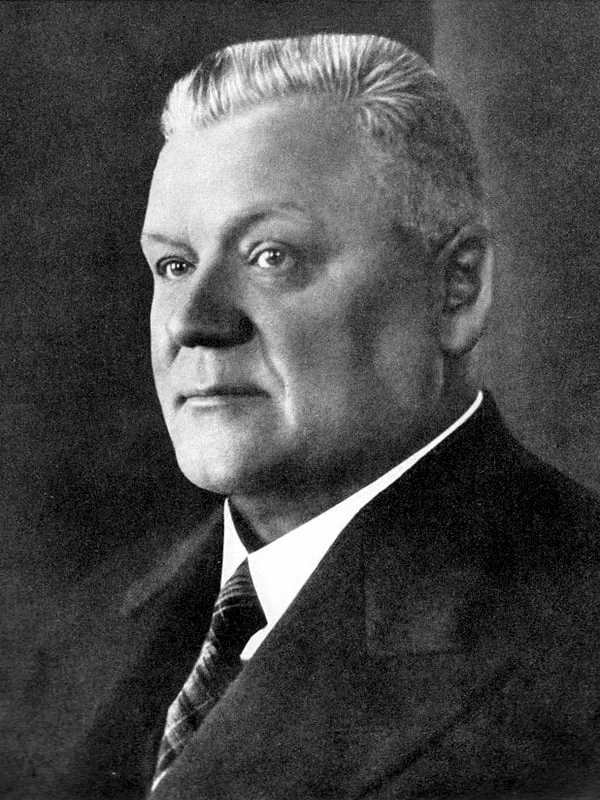
- Born:
- 4 September 1877, Pikšas farm, Bērze parish, near Dobele (Courland, Russian Empire)
- Died:
- 20 September 1942, Krasnovodsk (Turkmen SSR)
- Author:
- Natalia
- Photo:
- autor nieznany, domena publiczna, Wikimedia Commons

Kārlis Ulmanis was one of the fathers of independent Latvia: in November 1918 he became head of its first government and led the country through its war of independence. Sixteen years later the same man dissolved parliament and the political parties and, until 1940, ruled Latvia as “leader of the nation”, combining the offices of prime minister and president. For Latvians his rule is associated with the prosperity of the 1930s, but also with dictatorship and with an ending that is still disputed today. In June 1940, as the Red Army entered the country, Ulmanis did not call for resistance but said on the radio: “I will remain in my place, you remain in yours.” For five weeks he signed laws put in front of him by Moscow’s envoys, and then he was deported to the USSR, where he died in prison.
An agronomist from Courland
He was born on 4 September 1877 into a prosperous peasant family on the Pikšas farm in the parish of Bērze near Dobele, in Courland, which then belonged to the Russian Empire. He was the third son of Indriķis and Lizete Ulmanis. He went to school in Jelgava but did not finish the Realschule. In 1897 he took a dairy course at Tapiau in East Prussia, today’s Gvardeysk, and then studied agriculture at the Federal Polytechnic in Zurich and the University of Leipzig. After returning home he organised dairy courses and agricultural societies, toured Livonia giving lectures and wrote for the farming press.
During the 1905 Revolution he spent several months in prison in Pskov for articles deemed disloyal. After his release, to escape further repression, he went first to Germany and in 1907 to the United States. Under the name Karl August Ulmann he completed a degree in agriculture at the University of Nebraska in Lincoln, lectured there briefly and then bought a dairy in Houston, Texas, which ran into financial difficulties. His American years taught him pragmatism and a love of modern farming. In 1913, after a Tsarist amnesty for political émigrés, he returned home. He worked as an agronomist in Valmiera and edited the agricultural journal Zeme.
Father of independence
During the First World War he worked on committees to aid refugees from Courland, which the Germans had occupied in 1915. After the February Revolution, in April 1917, he founded the Latvian Farmers’ Union, which together with the Social Democrats became the most important party of interwar Latvia. When Germany lost the war, the Union helped to form the People’s Council, which proclaimed independence in Riga on 18 November 1918. Ulmanis became head of the Provisional Government.
The state still had to be fought for. In the War of Independence Latvia faced at the same time the Bolsheviks, who took Riga in January 1919 and proclaimed Pēteris Stučka’s Soviet republic, and the German troops and the Baltische Landeswehr, which in April 1919 overthrew Ulmanis’s government in Liepāja and installed a puppet cabinet under the pastor Andrievs Niedra. Ulmanis’s government took refuge aboard the ship Saratov under the protection of British warships. Only the Estonian and Latvian victory over the Landeswehr at the Battle of Cēsis in June 1919 allowed him to return to Riga. In the autumn he repelled the attack of Pavel Bermondt-Avalov’s army. In January 1920 Polish troops under General Edward Rydz-Śmigły and Latvian forces jointly captured Daugavpils (Dyneburg), which opened the way for the Latvians to liberate Latgale. On 11 August 1920 Latvia signed the Treaty of Riga with Soviet Russia, in which Moscow renounced “voluntarily and forever” all rights to Latvia. A year later, also in Riga, Poland and Soviet Russia concluded their own peace.
Parliamentary politician
Ulmanis was prime minister until June 1921, and then twice more, in 1925–1926 and in 1931, as well as minister of foreign affairs, of agriculture and of war. He was one of the country’s most influential politicians, but his party never won more than a little over ten per cent of the vote, and in the early 1930s it was losing support. Latvian parliamentary democracy, with its fragmented Saeima (parliament) and frequent changes of government, was going through a severe crisis, deepened by the Great Depression. Ulmanis spoke more and more often of the need for constitutional reform and a strong executive.
Coup and “leader of the nation”
On 17 March 1934 Ulmanis became prime minister for the fourth time. During the night of 15–16 May, together with the war minister, General Jānis Balodis, he carried out a bloodless coup: he declared martial law and dissolved the Saeima and all parties, including his own Farmers’ Union. The army and the paramilitary Aizsargi home guard occupied government offices and communication hubs. Some 2,000 people were arrested, above all Social Democrats, but also far-right activists of the nationalist Pērkonkrusts and Nazis from the German minority. Several hundred of them were held in a camp in Liepāja. President Alberts Kviesis did not support the coup but remained in office until the end of his term. On 11 April 1936 Ulmanis succeeded him as president without giving up the premiership, contrary to the constitution, which made no provision for such a situation.
His dictatorship differed from the other authoritarian regimes of Europe at the time. Ulmanis created no ruling party, no façade parliament and no new ideology. He ruled personally and paternalistically, had himself called “leader” (vadonis) and invoked the good of the nation. Political life died away, the press was censored, and the economy and culture were organised into professional chambers on the model of Mussolini’s corporatism. The state took over businesses and merged them into large companies, and built schools, public offices and the hydroelectric power station at Ķegums. Latvia, which had suffered badly in the Depression, recovered quickly, and exports of butter, bacon and timber to Britain and Germany brought a prosperity that Latvians long remembered as “Ulmanis’s times”. The slogan “Latvia for the Latvians”, however, meant the systematic squeezing of Baltic Germans, Jews, Russians and Poles out of the economy and education. Most Yiddish newspapers were closed and minority schools lost their subsidies. At the same time the regime pursued no openly antisemitic policy, and in the 1930s Latvia took in some of the Jews fleeing Germany and Austria.
Between Berlin and Moscow
In foreign policy Ulmanis and his foreign minister, Vilhelms Munters, staked everything on neutrality. In 1934 Latvia joined Estonia and Lithuania in forming the Baltic Entente; in 1938 it withdrew from the League of Nations’ system of collective security and declared strict neutrality. When Britain and France were negotiating with the USSR in 1939, Riga feared Soviet “guarantees” more than it feared Germany. On 7 June 1939 it signed a non-aggression pact with the Third Reich.
It was of no avail. The secret protocol to the Molotov–Ribbentrop Pact of 23 August 1939 assigned Latvia to the Soviet sphere of influence. After the fall of Poland, Moscow demanded a mutual assistance pact and military bases. Ulmanis concluded that resistance was impossible: the League of Nations was powerless, Estonia had already given way, Poland had been defeated and communications with Britain and France were cut. On 5 October 1939 Munters signed the mutual assistance pact in Moscow, and 25,000 Soviet soldiers moved into Liepāja, Ventspils and the Courland coast. That autumn, at Adolf Hitler’s call, most of the Baltic Germans left Latvia. In May 1940, in a speech on the sixth anniversary of the coup, Ulmanis warned his compatriots of trials harder than any so far and of a struggle waged “with the weapons of the spirit and the will”, not with arms in hand. The government secretly conferred emergency powers on its envoy in London, Kārlis Zariņš.
June 1940
In mid-June 1940 the USSR set about occupying the Baltic states. The Baltic Fleet blockaded the coasts; on 14 June Soviet bombers shot down the Finnish airliner Kaleva; on 15 June the Red Army entered Lithuania, and NKVD units attacked Latvian border posts at Masļenki. On 16 June Latvia received an ultimatum, which the government accepted the same evening, and on 17 June the Red Army entered Latvia and Estonia. Ulmanis gave no order to fight and, unlike the Lithuanian president Antanas Smetona, did not leave the country. On the evening of 17 June, speaking from a radio station already occupied by the Russians, he said that the troops were entering with the government’s knowledge, appealed for calm and ended with the famous sentence: “Es palikšu savā vietā, jūs palieciet savās vietās.”
Stalin’s envoy Andrey Vyshinsky arrived in Riga and on 19 June presented Ulmanis with a list of ministers for a new government, drawn up at the Soviet legation. On 20 June the president approved the “people’s government” of the microbiologist Augusts Kirhenšteins. Over the following month, in effect interned in Riga Castle, he signed more than 50 laws of the new authorities. On 14 and 15 July elections were held in which only a single list was allowed. On 21 July the People’s Saeima elected in this way proclaimed the Latvian SSR and asked to be admitted to the USSR, and Ulmanis lost his office. He asked the Soviet authorities for a pension and permission to leave for Switzerland. Instead, on 22 July he was arrested and deported to Voroshilovsk, today’s Stavropol, where he worked for a year as an agronomist.
Historians still argue over his conduct. Some see it as an attempt to spare the nation a pointless bloodbath in a hopeless situation; others point out that his signatures lent Moscow a semblance of legality, and that the words “remain in your places” kept thousands of people in the country who a year later ended up in deportation wagons. Ulmanis probably believed that by staying at his post he would protect what remained of statehood, just as in 1939 he had believed that concessions to Moscow would save independence.
Prison and death
After the German attack on the USSR, on 4 July 1941, Ulmanis was put in prison and charged with anti-Soviet activity. In the summer of 1942, as the Wehrmacht approached the Caucasus, the prisoners were evacuated across the Caspian Sea to Central Asia. On the way Ulmanis fell ill with dysentery. He died on 20 September 1942 in the prison hospital in Krasnovodsk, today’s Türkmenbaşy. His grave has never been found. A similar fate befell the Estonian president Konstantin Päts, deported in the same month of July 1940.
Memory
Ulmanis never married. “I am married to Latvia,” he is said to have replied to questions about his private life. In Soviet Latvia he was portrayed as a fascist and a bloody dictator. For the Latvian emigration he was a symbol of lost independence, and his years in power the nation’s “golden age”. After 1991 he remained a popular but controversial figure: historians agree in recognising his role in 1918–1920, but argue about the dictatorship and June 1940. In 1993 his brother’s grandson, Guntis Ulmanis, became president of the restored Latvia. In 2003, on the anniversary of the deportations, a monument to Kārlis Ulmanis was unveiled in central Riga, opposite the Foreign Ministry, where he had worked for years. A museum operates on his family’s Pikšas farm.
For the history of the Second World War, Ulmanis is one of the faces of the tragedy of the Baltic states: a leader who built a state in war and then, squeezed between Hitler and Stalin, surrendered it without a shot being fired, hoping that submission would save what an army could not defend.
Sources
Often appears with
People who appear in the same events.