Poland
Lucjan Żeligowski
Commander of the 4th Polish Rifle Division (1918–1919), commander-in-chief of the forces of Central Lithuania (1920–1921), Minister of Military Affairs (1925–1926), member of the Sejm (1935–1939)
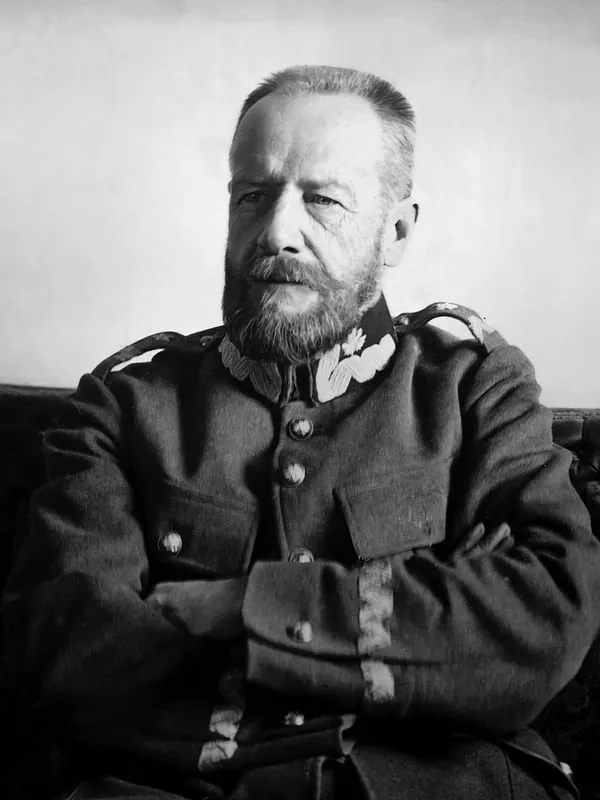
- Born:
- 17 October 1865, Oszmiana district, Wilno region (Russian Empire)
- Died:
- 9 July 1947, London
- Author:
- Natalia
- Photo:
- autor nieznany, domena publiczna, Wikimedia Commons

Lucjan Żeligowski went down in history as the man of a single day. On 9 October 1920, feigning a mutiny against his own command, he led a division of soldiers born in Lithuania and Belarus into Wilno (Vilnius) and turned the Wilno region into a formally independent Central Lithuania, which was annexed to Poland a year and a half later. In reality he was carrying out a secret order from Józef Piłsudski. This single act fixed Poland’s border with Lithuania for the whole interwar period and made the two states bitter enemies until 1938. Before it, Żeligowski had served in the Russian army for thirty years and had led a Polish division out of Russia during the revolution. Later he was a minister, a member of parliament and an original, if solitary, ideologue of pan-Slavism who, towards the end of his life and to the outrage of the émigré community, came out in favour of Stalin.
Childhood and tsarist service
He was born on 17 October 1865 in the Oszmiana district of the Wilno region. Some sources give Oszmiana (Ashmyany) itself as his birthplace, others the manor farm of Przechody near the village of Sikunie. He came from a family of the gentry. His father, Gustaw, had taken part in the January Uprising and for this was exiled with his wife deep into Russia. The boy was brought up by relatives and went to school in Żuprany and then to the gymnasium in Wilno. Years later he recalled coming to Wilno for his examinations as a small boy and sleeping on benches in the city’s parks.
Like many impoverished sons of the gentry from the lands annexed by Russia in the partitions, he chose a military career in the tsarist army. In 1885 he joined an infantry regiment as a volunteer, graduated from a cadet (junker) school and from 1888 served as an officer, for many years in the 136th Taganrog Infantry Regiment in southern Russia. As a captain he fought in the Russo-Japanese War. During the revolution of 1905 he openly supported democratic reforms and was brought before a court of honour for it, emerging unscathed thanks to the intercession of his superiors and of deputies of the Polish Circle in the Duma. In 1912 he became involved with the clandestine Union of Active Struggle, the organisation Piłsudski was building in Galicia.
War and the division from the Kuban
In the First World War he commanded a battalion and then a regiment of Russian infantry, among other places in the Carpathians. When a Polish Rifle Brigade began to be formed within the Russian army in 1915, he transferred to it at his own request. After the February Revolution he was one of the organisers of the Polish forces in Russia. In the Polish I Corps he commanded a regiment and then a division, but he fell out with the corps commander, General Józef Dowbor-Muśnicki. Żeligowski believed the Poles should stay neutral in the Russian Civil War, and in the spring of 1918 he was sidelined.
He then went to Kiev, where he worked in Polish military organisations cooperating with the French mission. In the summer of 1918 General Józef Haller appointed him commander of the Polish forces in the east and promoted him to general. In the Kuban, in the zone held by the Whites, Żeligowski organised the 4th Polish Rifle Division, several thousand strong, which cooperated with Anton Denikin’s Volunteer Army and, in the spring of 1919, with the French intervention corps in Odessa. After the evacuation of Odessa in April 1919 the division crossed the Dniester into Romania and from there, via Bessarabia and Bukovina, returned to Poland in June 1919. Piłsudski had written appreciatively to the general as early as January 1919, and his soldiers entered the Polish Army as the 10th Infantry Division.
The war with the Bolsheviks
In the Polish–Soviet War Żeligowski commanded the 10th Division and operational groups in Belarus and Polesie. During the Battle of Warsaw in August 1920 his division fought on the Warsaw bridgehead, and in September he took part in the Battle of the Niemen. He was regarded as a solid, stubborn commander loyal to Piłsudski, who trusted him, not least because both were “Wilno men” and thought, as Żeligowski himself put it, “in Wilno categories”.
The mutiny and Central Lithuania
In the autumn of 1920 Wilno was in the hands of the Lithuanians, to whom Soviet Russia had handed it over that summer. Poland, bound by the promises it had made to the powers at Spa and by talks held under the auspices of the League of Nations, could not take the city openly. On 1 and 2 October, in his headquarters train, Piłsudski proposed to Żeligowski that he “mutiny” at the head of the 1st Lithuanian–Belarusian Division and take Wilno on his own responsibility. The general agreed, after demanding larger forces. On 7 October, when he announced the “mutiny” to his officers, some of them refused to take part, and he himself had doubts and asked Piłsudski to replace him. He soon recovered his resolve, however. On 8 October his troops set off for Wilno, broke through the Lithuanian screen on the Mereczanka river, and on 9 October 1920 entered the city.
On 12 October Żeligowski proclaimed the state of Central Lithuania and assumed power in it as commander-in-chief of its forces, with a Provisional Governing Commission as its government. He believed he was creating a Lithuania, not merely a Polish province, and that a federation could be built with Kaunas Lithuania. Kaunas rejected his proposals, and the November fighting around Szyrwinty and Giedrojcie ended in a ceasefire imposed by the League of Nations. On 30 November 1921, before the elections to the Wilno Sejm, Żeligowski handed over civil authority and returned to the Polish Army. In 1922 the Sejm of Central Lithuania voted to incorporate the Wilno region into Poland. For years the general himself maintained that he had acted of his own free will, until in 1923 Piłsudski publicly admitted that it was he who had given the order.
Minister and member of parliament
From 1921 to 1926 Żeligowski was an army inspector in Warsaw, and in 1924 he was promoted to lieutenant general (generał broni). On 27 November 1925 he became Minister of Military Affairs in the government of Aleksander Skrzyński. According to many historians, as minister he made Piłsudski’s preparations for the May Coup of 1926 easier by not obstructing the concentration of units loyal to the Marshal. He lost his portfolio with the fall of the cabinet a few days before the coup, and after Piłsudski’s victory he chaired a commission charged with dealing with the aftermath of the fighting and calming the army. On 31 August 1927 he retired and settled on his estate at Andrzejewo in the Wilno region.
In 1930 he published his memoirs, Wojna w roku 1920 (The War of 1920). From 1935 to 1939 he was a member of the Sejm. In 1938, in the Wilno constituency, he defeated the head of the government’s Camp of National Unity, General Stanisław Skwarczyński, at the polls. He drifted further and further away from the Sanacja regime. He preached pan-Slavist ideas: he believed that the Slavs, threatened by the Germans, must unite, and that the state should rest on self-governing communes and home-grown production.
The Second World War and exile
Before the outbreak of war in 1939 Żeligowski, then 73, asked Marshal Edward Rydz-Śmigły for an assignment, but received no reply. In September he accompanied General Kazimierz Sosnkowski on his way from Warsaw via Brześć (Brest) to Przemyśl and Lwów (Lviv). After the defeat he made his way through Romania to France, and in 1940 to Britain. Under the government of Władysław Sikorski he was a member of the National Council of the Republic of Poland, the parliament-in-exile, chairman of its military committee and Chancellor of the Chapter of the Virtuti Militari Order.
In exile he caused a scandal. In 1943 he published in London the book Zapomniane prawdy (Forgotten Truths), in which he criticised the Sanacja’s policy towards the minorities and the incorporation of the Wilno region into Poland against Piłsudski’s federalist designs. In the spirit of his pan-Slavism he argued for an understanding with the USSR and accepted Soviet territorial demands, which most émigrés considered treason. In January 1945 President Władysław Raczkiewicz removed him as Chancellor of the Chapter after he opposed the award of the Grand Cross of the Virtuti Militari to General Tadeusz Bór-Komorowski, commander of the Warsaw Uprising. He wrote memoranda to Stalin and Bolesław Bierut. After the war he announced his intention to return home, but died suddenly in London on 9 July 1947.
His coffin was taken to Warsaw and buried in the Powązki Military Cemetery. The transport was organised by General Stanisław Tatar, who used the occasion to send part of the gold of the National Defence Fund to Poland, hidden in the crates that had formed the catafalque in London.
Significance
Żeligowski was a figure from the borderland of two worlds: a Pole who considered himself a Lithuanian in the old, multicultural sense, a tsarist officer who became a Polish general, and a Piłsudskiite who ended up as a supporter of Moscow. His mutiny gave Poland Wilno for twenty years, but at the same time made agreement with Lithuania impossible and closed the road to the federation in whose name it had been carried out. Throughout the interwar years the dispute over Wilno was one of the wounds of Eastern Europe that Germany and the USSR were able to exploit. In 1939 Stalin gave the city to Lithuania, only to seize the whole country a year later. To Poles Żeligowski remained the liberator of Wilno, to Lithuanians the man who stole their capital, and on Lithuanian posters his name was placed alongside those of Ribbentrop and Molotov.
Sources
Mentioned in battles
(01)Often appears with
People who appear in the same events.