Estonia
Konstantin Päts
Prime Minister of the Estonian Provisional Government (1918–1919), State Elder (1921–1922, 1923–1924, 1931–1932, 1932–1933, 1933–1934), President of Estonia (1938–1940)
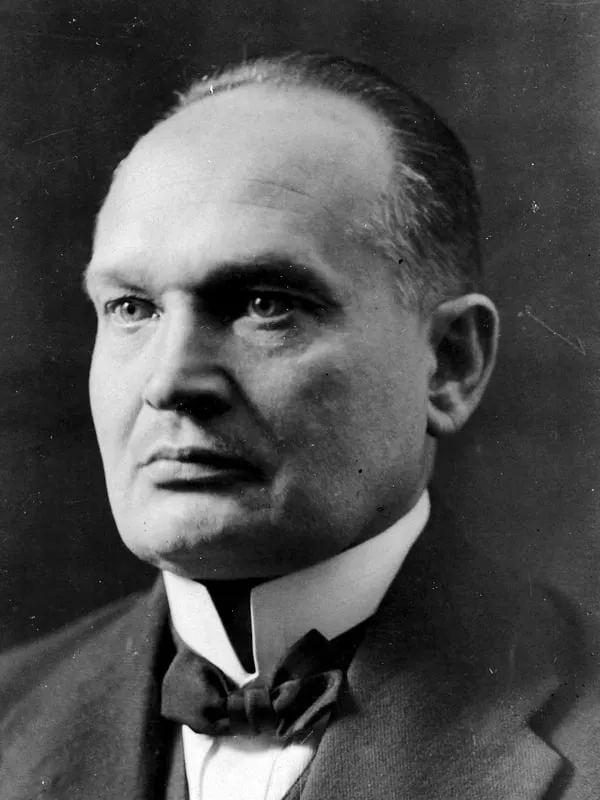
- Born:
- 23 February 1874, Tahkuranna near Pärnu (Governorate of Livonia, Russian Empire)
- Died:
- 18 January 1956, Burashevo near Kalinin (USSR)
- Author:
- Łukasz
- Photo:
- autor nieznany, domena publiczna, Wikimedia Commons

Konstantin Päts was one of the fathers of independent Estonia and for twenty years its most important politician. In February 1918 he was one of the three-man committee that proclaimed independence; he then led the Provisional Government during the war against the Bolsheviks and headed the state five times. In 1934 he suspended democracy and ruled in authoritarian fashion, and in 1938 he became Estonia’s first President. His name, however, is associated above all with 1939–1940, when, under pressure from the Soviet Union, he chose the path of concession: he agreed to Soviet bases, accepted the ultimatum and signed the appointment of a government chosen by Andrei Zhdanov. It saved neither the state nor himself. He died after sixteen years of exile, prisons and psychiatric hospitals.
Childhood and youth
He was born in February 1874 in Tahkuranna near Pärnu, into the family of a builder, Jakob Päts, and Olga, née Tumanova. His date of birth is usually given as 23 February (11 February in the Julian calendar), although the entry in the parish register points to the day before. His father, who had converted to his wife’s Orthodox faith, was one of the Estonian farmers fighting the privileges of the Baltic German nobility. The children were brought up in the Orthodox rite, and Russian was also spoken at home. Päts attended an Orthodox parish school, from 1887 to 1892 the theological seminary in Riga and, after giving up the idea of the priesthood, the gymnasium in Pärnu. From 1894 to 1898 he studied law at the University of Tartu. After graduating he served in the Russian 96th Omsk Infantry Regiment in Pskov, and in 1900 he moved to Tallinn, then known as Reval.
Journalist and revolutionary
In 1901 he founded the newspaper Teataja in Tallinn. The authorities assumed that an Orthodox lawyer would publish a paper loyal to the Empire; instead Teataja became the platform of a radical current of the national movement focused on the economy and education. This marked the start of Päts’s almost forty-year rivalry with Jaan Tõnisson of Tartu for the leadership of the Estonians. In 1904 an Estonian–Russian bloc that he had helped to organise wrested control of Tallinn city council from the Baltic Germans, and in 1905 Päts became deputy mayor.
During the Revolution of 1905 he demanded autonomy for the Baltic provinces. When the authorities closed Teataja and arrested its editorial staff, he fled to Switzerland, and a court sentenced him to death in absentia. He then lived in Finland, from where he wrote anonymously for Estonian newspapers. In 1909, once the death sentence no longer hung over him, he returned and from February 1910 to March 1911 served his sentence in St Petersburg’s Kresty Prison. During that time his wife Helma died of tuberculosis. Päts never remarried, and his two sons, Leo and Viktor, were brought up by his sister-in-law. From 1911 he published Tallinna Teataja, and during the First World War he served as an officer in Tallinn and organised Estonian units within the Russian army.
The birth of the state
After the February Revolution the Provisional Government in Petrograd created an autonomous Governorate of Estonia. Päts, who had pressed for a single governorate covering all Estonian lands, became a member of its provincial assembly, the Maapäev, and in October 1917 head of the provincial administration. After the Bolshevik seizure of power the Estonian authorities went underground, and Päts was arrested several times. On 19 February 1918 he joined the three-man Salvation Committee, which – at the moment when the Bolsheviks were already fleeing Tallinn and the Germans had not yet entered it – proclaimed Estonia’s independence on 24 February. Päts became head of the Provisional Government. The Germans, who occupied the country the next day, did not recognise it, and on 16 June 1918 they arrested Päts. He passed through several camps, the last of them in Grodno, and regained his freedom only after Germany’s capitulation in November.
As Prime Minister and Minister of War of the Provisional Government he organised the defence when the Red Army attacked Narva on 28 November 1918. In the Estonian War of Independence the Estonians, helped by the British fleet and Finnish volunteers, drove the enemy out of the country by February 1919, and on 2 February 1920, in the Treaty of Tartu, Soviet Russia recognised Estonia’s independence “for all time”. Päts invoked this treaty for the rest of his life.
State Elder
The constitution of 1920 gave all power to parliament, the Riigikogu, while the head of government bore the title of State Elder (riigivanem) and was at the same time head of state. Päts led the conservative Farmers’ Assemblies and later the Union of Settlers and Smallholders, and held this office five times: in 1921–1922, 1923–1924, 1931–1932, 1932–1933 and from October 1933. He was also Speaker of parliament and chairman of an insurance company and of the Chamber of Commerce and Industry. Critics, among them some present-day Estonian historians, have pointed to his business interests connected with the trade in Soviet gold in the early 1920s and to his lucrative post, from 1930, as legal adviser to an Estonian–Soviet oil syndicate, in which Magnus Ilmjärv sees an instrument of Soviet influence. This remains a matter of dispute.
The Great Depression and unstable coalitions favoured the movement of veterans of the War of Independence, the so-called Vaps, a right-wing populist movement resembling the fascists. Their draft constitution, which gave enormous power to the head of state, won a referendum in October 1933, and in January 1934 the Vaps triumphed in municipal elections in the towns. Their candidate stood a good chance in the presidential election. On 12 March 1934 Päts, as State Elder and Prime Minister, with the support of General Johan Laidoner and the army, declared a state of emergency, dissolved the movement and arrested several hundred of its members. Parliament initially endorsed these steps but soon ceased to meet.
The Era of Silence
Estonians call the years 1934–1938 the “Era of Silence”. The parties were replaced by a single pro-government movement, Isamaaliit (the Fatherland League), censorship was introduced, and Päts ruled by decree and built a corporatist system of professional chambers on the Italian model. The economy grew, a technical university was founded in Tallinn and surnames were Estonianised. A Vaps conspiracy in December 1935 provided a pretext for further arrests. Päts himself was no dictator in the mould of Europe’s strongmen: he did not build a large-scale personality cult, did not resort to terror, and in 1938 amnestied political prisoners, communists included. The new constitution of 1937 was nonetheless drawn up to his dictation. On 24 April 1938 Päts became Estonia’s first President.
Because their paths were similar he was sometimes called “the Estonian Piłsudski”. In the spring of 1935, while taking a cure in Truskawiec, he visited Warsaw and laid a wreath at the Tomb of the Unknown Soldier. In foreign policy Estonia concluded a non-aggression pact with the USSR in 1932 and the Baltic Entente with Latvia and Lithuania in 1934; in 1938 it declared strict neutrality, and in June 1939 it signed a non-aggression pact with Germany.
Concessions to Moscow
The Molotov–Ribbentrop Pact assigned Estonia to the Soviet sphere of influence. The escape of the Orzeł from Tallinn supplied a pretext, and on 24 September 1939 Molotov demanded a mutual assistance pact with bases. Päts told a cabinet meeting that war with Russia would mean the physical destruction of the nation, and concluded that what mattered most was to keep it alive. On 28 September Estonia signed the pact, and in October Soviet garrisons entered the country. Päts assured listeners on the radio that the state was “just as secure as before”, and appointed the moderate lawyer Jüri Uluots Prime Minister. As late as May 1940 he believed that Estonia had to hold out and comply with Moscow’s wishes until a German–Soviet war broke out.
On 16 June 1940 the USSR presented Estonia with an ultimatum, and the next day the Red Army occupied the whole country. Unlike Antanas Smetona in Lithuania, Päts did not leave, and neither did the Latvian President Kārlis Ulmanis. On 19 June he received Zhdanov, who wrote in his report to Moscow that the President had tried in every way to justify the old government. On 21 June, the day of the stage-managed coup, demonstrators outside his palace at Kadriorg shouted him down, and that evening Päts appointed Johannes Vares, Zhdanov’s nominee, as Prime Minister. Over the following month he signed some two hundred decrees of the new authorities, including a change to the electoral law that made possible the rigged elections of 14–15 July. On 23 June, Victory Day, he could still say that the nation’s greatest achievement was the Estonian state, to which it had given its love, loyalty, labour and lives. From 29 June he was under house arrest. On 21 July, when the new parliament proclaimed Estonia a Soviet republic, he sent his son to the American legation to request asylum. The visas came too late. On 21 or 22 July he signed his resignation.
Exile and prison
On 30 July 1940 Päts was arrested at his farm at Kloostrimetsa near Tallinn and deported, together with his son Viktor, his daughter-in-law and his two grandsons, to Ufa in Bashkiria. He lived there under surveillance for less than a year, writing memoirs and petitions to the authorities. After the German attack on the USSR, on 26 June 1941, he and his son were arrested on charges of contacts with the Germans and anti-Soviet activity. His grandsons were placed in a children’s home; the younger, Henn, died there of hunger in 1944. Päts passed through Moscow’s Butyrka prison, where his prison number came just after Laidoner’s, and from 1943, with the investigation suspended, he was held in prison psychiatric hospitals in Kazan and Chistopol. His son Viktor died in Butyrka in 1952. In the same year Päts, found guilty of anti-Soviet agitation, was committed to compulsory treatment – a typical case of punitive psychiatry. At the end of 1954 he was moved to the hospital at Jämejala in Estonia, but when people began to recognise and visit him he was transferred to the hospital at Burashevo near Kalinin (today Tver). He died there on 18 January 1956.
Significance
Under international law and the Estonian constitution Päts remained President until his death, and the acts he signed under duress are regarded as void. The duties of head of state passed in turn to Uluots, August Rei and the prime ministers of the government-in-exile, until in 1992 the last of them handed his credentials to the newly elected President, Lennart Meri. This continuity of the state, justified among other things by the coerced nature of Päts’s decisions, allowed Estonia in 1991 to restore the pre-war republic. In 1990 Päts’s remains were brought from Burashevo and buried in the Metsakalmistu cemetery in Tallinn.
His role remains contested. To some he is the founder of the state who, in a hopeless position, sought to spare the nation a war with a great power. Others point out that the coup of 1934 and the rule of a narrow circle deprived society of a voice at the moment of its greatest trial, that Estonia, unlike Finland, did not try to defend itself or even mobilise its army, and they suspect Päts himself of overly close ties with Moscow. What is certain is that his strategy of concessions, calculated to last until a German–Soviet war, ended in the loss of the state before that war even broke out, and for thousands of Estonians in arrest and in the deportation of June 1941, which affected some ten thousand people.
Sources
Mentioned in battles
(01)Often appears with
People who appear in the same events.