Australia
Billy Hughes
Prime Minister of Australia (1915–1923), Minister for External Affairs (1937–1939), leader of the United Australia Party (1941–1943)
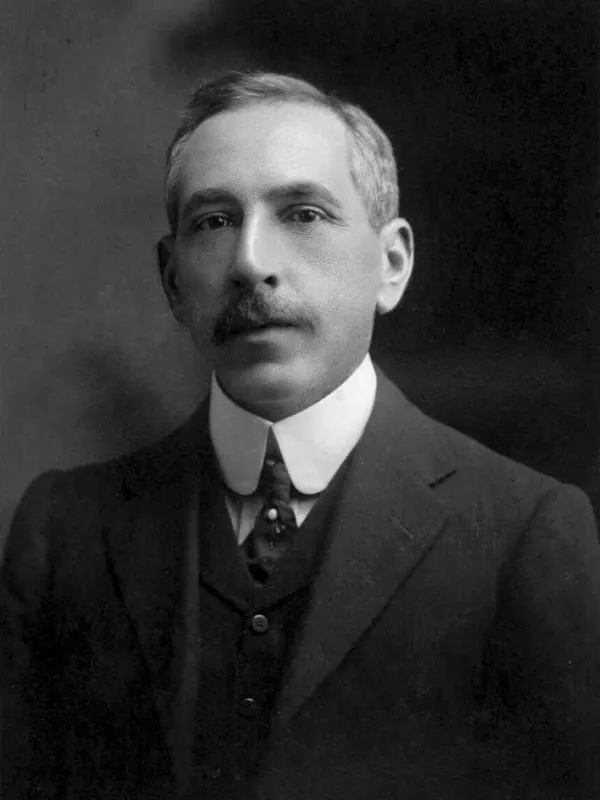
- Born:
- 25 September 1862, London (Pimlico, United Kingdom)
- Died:
- 28 October 1952, Lindfield (Sydney, Australia)
- Author:
- Łukasz
- Photo:
- National Library of Australia, domena publiczna, Wikimedia Commons

William Morris Hughes, known as Billy, was Australia’s prime minister during the First World War and the most explosive politician in its history. He sat in the federal parliament without a break for more than half a century, from its first sitting in 1901 until his death in 1952, and in that time belonged to six parties and was expelled from three of them. From the perspective of the road to the Second World War, what matters most is what he did in Paris in 1919. As a defender of the White Australia policy he was the most implacable opponent of the Japanese proposal to write the principle of racial equality into the Covenant of the League of Nations. The Japanese remembered its rejection for twenty years, and in the 1930s Hughes himself warned that Japan would become a mortal threat to Australia.
A Welshman from London
He was born on 25 September 1862 in the London district of Pimlico, the only child of a Welsh carpenter who worked at the Palace of Westminster and a domestic servant. His mother died when he was six, and his father sent him to relatives in Wales. He regarded the years spent in Llandudno and on the farms of his mother’s family as the happiest of his life. He was proud of his Welsh identity, although his Welsh was poor. As a teenager he returned to London, where at a church school he taught younger pupils in exchange for lessons from the headmaster.
In 1884, at the age of 22, he emigrated to Australia on an assisted passage. He landed in Brisbane on 8 December, giving his year of birth as 1864. For two years he wandered through Queensland and New South Wales, taking whatever casual work he could find; biographers regard his later stories of those years as heavily embellished. Around 1886 he settled in Sydney, and in 1890 in the working-class suburb of Balmain, where he and his wife ran a small shop. Small, thin, plagued by indigestion and increasingly deaf, he proved a brilliant street-corner speaker. He was active in socialist movements and worked as a union organiser.
Trade unionist and Labor politician
In 1894 Hughes won a seat in the parliament of the colony of New South Wales for the fledgling Labor Party. In 1899 he rebuilt the Sydney wharf labourers’ union and became its secretary, and in 1902 president of the waterside workers’ federation for the whole of Australia. That union gave him a power base for decades to come. When the six colonies federated as the Commonwealth of Australia in 1901, Hughes won a seat in the first federal parliament. He studied law part-time and was called to the bar in 1903.
From the very beginning he was an ardent supporter of the White Australia policy. The Immigration Restriction Act of 1901, backed by all parties, allowed officials to stop an unwanted arrival with a dictation test in any European language they chose, and served above all to close the country to Asians. For the labour movement it was a defence of wages against cheap labour; for many politicians, Hughes among them, it was also a defence of “race”. In 1904, as Minister for External Affairs in the short-lived first Labor government of Chris Watson, he personally decided applications from Chinese and Japanese for permission to work in the north of the country. In the governments of Andrew Fisher he was Attorney-General (1908–1909, 1910–1913 and 1914–1915) and one of the most important men in the party.
Wartime prime minister
In October 1915 the ailing Fisher stepped down and Hughes became prime minister. Australia was then fighting in the Great War alongside Britain, and its soldiers were just withdrawing from Gallipoli. In 1916 Hughes visited London, where his fiery speeches about economic war against Germany caused a sensation, and David Lloyd George, with whom he could quarrel in Welsh, became his ally.
After the heavy Australian losses on the Somme in July and August 1916, the commanders convinced him that without conscription the Australian divisions in France could not be kept up to strength. On 28 October 1916 Australians narrowly rejected conscription for service overseas in a referendum. The Labor Party, in which Catholics of Irish descent and trade unionists were strong, expelled Hughes. On 14 November he left the parliamentary party with twenty-four members and formed his own government, and in February 1917 his supporters merged with the Liberals to form the Nationalist Party of Australia. In May 1917 the new party won the election. A second referendum, on 20 December 1917, brought an even clearer defeat. Hughes resigned, but the Governor-General immediately commissioned him to form a government again. To Labor he remained a traitor for ever; to the soldiers he was the “Little Digger”.
Paris 1919
From the summer of 1918 Hughes took part in the deliberations of the Imperial War Cabinet in London, and in 1919, together with the former prime minister Joseph Cook, he represented Australia at the Paris Peace Conference. He demanded that the dominions have their own seats there and their own signatures on the treaty, and got his way. From the outset he was in conflict with President Woodrow Wilson. He made light of Wilson’s plan for the League of Nations, and when Wilson reminded him that he represented a mere few million people, he is said to have replied: “I speak for sixty thousand dead.” He demanded that Germany pay the entire cost of the war, not merely for material damage. He also wanted Australia to keep outright German New Guinea, captured in 1914. In the end Australia received it as a Class C League of Nations mandate, which allowed it to govern the territory as part of its own state and close it to Japanese settlers.
It was the Japanese amendment, however, that made him most notorious. On 13 February 1919 the Japanese plenipotentiary Nobuaki Makino proposed that the Covenant of the League of Nations oblige its members to treat the nationals of other states equally regardless of race. Hughes saw this as an assault on White Australia. He said that “ninety-five out of every hundred Australians” rejected the very idea of equality, and warned Lloyd George that if the clause were adopted he would leave the conference. When in March the Canadian prime minister Robert Borden and General Jan Smuts arranged a meeting between him and the Japanese, he agreed to a formula on the equality of nations only on condition of an explicit reservation that it did not apply to immigration or to states’ right to manage their own domestic affairs. Makino would not accept this. The British delegation, unwilling to break the unity of the Empire, did not support the amendment, and on 11 April Wilson, although a majority of the commission had voted in favour, ruled it rejected for want of unanimity. On 28 June Hughes signed the peace treaty at Versailles, the first international treaty to bear Australia’s signature. On his return he told parliament that he had brought the White Australia principle back from the conference “as safe as it was on the day when it was first adopted”. He was welcomed as a hero.
Fall and return
In December 1919 the Nationalists won the election again, but Hughes’s star was fading. Conservatives in his own party did not trust him, and the new Country Party loathed his tariff policy. At the Imperial Conference in London in 1921, against Canada’s wishes, he argued for renewing the Anglo-Japanese Alliance: he preferred Japan to remain tied to Britain rather than become its adversary in the Pacific. At the Washington Conference, however, the alliance was replaced by a looser Four-Power Treaty. After the 1922 election the Nationalists lost their majority, and the Country Party made it a condition that it would not enter a coalition with Hughes. He stepped down in February 1923, and his Treasurer, Stanley Bruce, became prime minister.
Hughes did not forgive. In September 1929 he led a group of rebels who brought down Bruce’s government in parliament by a single vote in a dispute over industrial arbitration. At the election that followed, Bruce lost even his own seat. Hughes was expelled from the party, founded his own Australian Party, and in 1931 joined the new United Australia Party of Joseph Lyons.
Warnings of war
In 1932 Lyons sent him as a delegate to the League of Nations Assembly in Geneva, and in 1934 appointed him Minister for Health and Repatriation. In 1935 Hughes published a book, Australia and War To-day, in which he argued that the League of Nations was powerless because it had no force behind it, that Britain was preoccupied with Europe, and that Australia must see to its own defence against the coming war. The book appeared just as the government was supporting League sanctions against Italy, which had invaded Abyssinia, and it clashed with the official line, so Hughes had to leave the cabinet. He was back in it as early as 1936. The Lyons government soon increased defence spending considerably. From 1937 to 1939 Hughes was Minister for External Affairs. He attacked Hitler and Mussolini fiercely and opposed returning Germany’s former colonies, comparing concessions to the dictators to feeding sandwiches to a hungry tiger. He also doubted the British promise to defend Australia from the base at Singapore.
After Lyons’s death in April 1939 he narrowly lost the contest for the party leadership to Robert Menzies. In Menzies’s government, which took Australia into the war with Germany on 3 September 1939, he was Attorney-General and later also Minister for the Navy. When Menzies resigned in August 1941 and John Curtin’s Labor Party took power in October, the 79-year-old Hughes became leader of the United Australia Party. Two months later Japan attacked Pearl Harbor and the British possessions in Asia. In February 1942 Singapore fell and Japanese aircraft bombed Darwin. The threat Hughes had been warning of since Paris stood on Australia’s doorstep. As a member of the all-party Advisory War Council he worked with the Curtin government. After the electoral defeat of 1943 he handed the party leadership to Menzies, and when in 1944 the party withdrew from the council but he stayed on it, he was expelled from a party for the third time.
Last years and significance
In 1945 Hughes joined Menzies’s new Liberal Party of Australia and went on winning elections under its banner. He died on 28 October 1952 at his home in Lindfield, Sydney, at the age of 90, the last serving member of the first federal parliament. According to contemporary estimates some 450,000 people bade him farewell in the funeral procession and on the streets of Sydney.
Hughes is one of the most important and most contested figures in Australian history. He was the prime minister who brought the country onto the international stage, winning it its own signature on the peace treaty and a seat in the League of Nations. At the same time he split the Labor Party, stoked hostility between Protestants and Catholics, and used wartime powers without scruple. His role in Paris shows the contradiction of the age: the same man who defended a small nation’s right to decide for itself refused to recognise the nations of Asia as equals. For the Japanese, Hughes’s name became a symbol of Western contempt, and the rejection of the racial equality clause was one of the stones from which nationalists in Tokyo built, in the 1930s, the narrative that Asia must free itself from the white man’s rule. The White Australia policy he defended so fiercely outlived him by twenty years.
Sources
Often appears with
People who appear in the same events.