United States
Woodrow Wilson
President of the United States (1913–1921), Nobel Peace Prize laureate (1919)
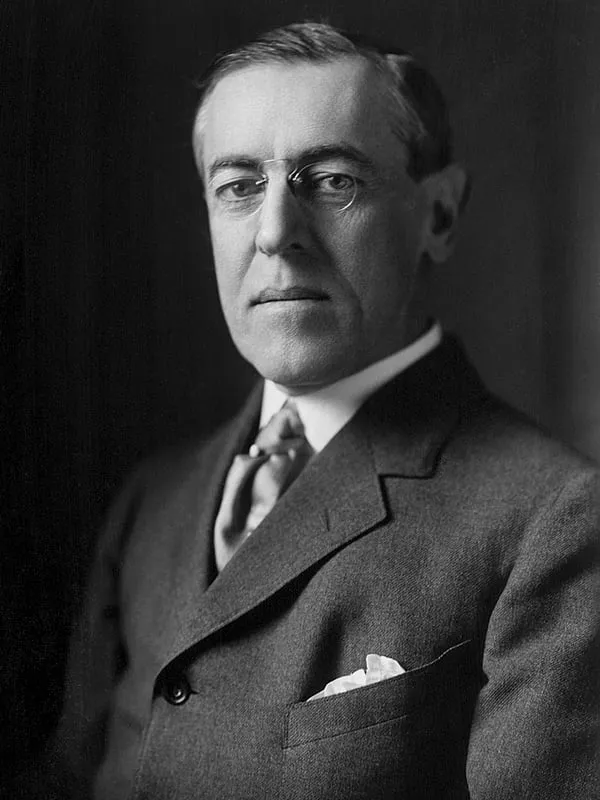
- Born:
- 28 December 1856, Staunton (Virginia, United States)
- Died:
- 3 February 1924, Washington, D.C.
- Author:
- Natalia
- Photo:
- Harris & Ewing, domena publiczna, Wikimedia Commons

Thomas Woodrow Wilson, a professor of political science who became President of the United States, took his country into the First World War and tried to build a new world order after it. His Fourteen Points of 1918 became the best-known peace programme of the age: for Poles, Czechs, Slovaks and Yugoslavs they were a promise of freedom, and for the Germans the basis on which they asked for an armistice. At the Paris Peace Conference Wilson brought the League of Nations into being, but the US Senate rejected the Treaty of Versailles, and the United States never joined the League. The Versailles order, from which the world’s greatest power withdrew and which Germany regarded as a betrayal of Wilson’s promises, proved too weak to halt the road to another war.
Professor and governor
He was born on 28 December 1856 in Staunton, Virginia, the son of a Presbyterian minister. He spent his childhood in the South, in Augusta, Georgia, where as a boy he lived through the Civil War, and then in both Carolinas. The austere Calvinist piety of his home, together with a belief in the moral order of the world and in his own calling, stayed with him all his life. In 1879 he graduated from the College of New Jersey, later Princeton University, and in 1886 he received his doctorate from Johns Hopkins University. To this day he is the only President of the United States to have held a doctorate. He wrote on the American system of government and on public administration, taught at Princeton from 1890, and in 1902 became president of the university.
In 1910 the Democratic leaders in New Jersey nominated him for governor, expecting a compliant academic. Wilson won the election, then turned against the party bosses and carried through a series of reforms. In 1912 he won the presidential nomination of the Democratic Party and won the election thanks to a split among the Republicans, some of whom backed the sitting president, William Taft, and others Theodore Roosevelt. He received just under 42 per cent of the vote, but an overwhelming majority in the Electoral College.
President
He took office on 4 March 1913. His “New Freedom” programme brought lower tariffs, a federal income tax, the creation of the Federal Reserve System and a new antitrust law. The same administration, however, introduced racial segregation in some federal offices. In foreign policy Wilson promised to break with his predecessors’ “dollar diplomacy”, but in practice he repeatedly intervened by force in Latin America: in 1914 the US Navy seized the Mexican port of Veracruz, and in the following years US troops landed in Haiti and the Dominican Republic.
Neutrality and war
When war broke out in Europe in 1914, Wilson declared neutrality and called on Americans to be impartial “in thought as well as in action”. He hoped that America, by staying out of the fighting, would be able to mediate a peace, and twice he sent his trusted adviser, Colonel Edward House, to Europe. Neutrality, however, meant disputes with both sides: with Britain over the blockade, with Germany over submarine warfare. After the sinking of the British liner Lusitania in May 1915, in which more than a hundred Americans died, Wilson did not go to war, but in a series of notes he forced Germany to restrict its attacks. In 1916 he was re-elected on the slogan “He kept us out of war”. On 22 January 1917, in an address to the Senate, he called for “peace without victory” and declared himself in favour of “a united, independent, and autonomous Poland”, a cause he had been won over to largely by Ignacy Jan Paderewski.
Nine days later Germany announced unrestricted submarine warfare. Wilson broke off diplomatic relations with Berlin, and public opinion was shaken by the Zimmermann Telegram, revealed by the British, in which Berlin offered Mexico an alliance against the United States. The February Revolution in Russia, which overthrew the Tsar, made it possible to present the war as a struggle of democracy against autocracy. On 2 April 1917 Wilson asked Congress to recognise a state of war with Germany, declaring that “the world must be made safe for democracy”, and on 6 April the United States entered the war. It did not, however, conclude an alliance with the Entente, remaining merely an “associated power”, not bound by the secret agreements of London, Paris and Rome.
A country that in April 1917 had a small professional army sent nearly two million soldiers to France within eighteen months, under the command of General John Pershing. Their arrival sealed the failure of Erich Ludendorff’s spring offensives in 1918. The whole American economy was harnessed to the war, while the government also created the first modern propaganda agency and prosecuted opponents of the war under the Espionage and Sedition Acts.
The Fourteen Points
On 8 January 1918 Wilson presented to Congress his Fourteen Points, a programme for a peace based on open diplomacy, freedom of the seas, free trade, disarmament and the right of nations to determine their own fate, crowned by “a general association of nations”. The thirteenth point called for the creation of an independent Polish state, including the territories “inhabited by indisputably Polish populations”, with free and secure access to the sea. At that point Wilson still promised the peoples of Austria-Hungary only autonomy, but in the summer of 1918 his administration came out in favour of their full independence.
In Russia, after the Bolshevik seizure of power, Wilson hesitated for a long time, but in the summer of 1918 he agreed to send small American forces to northern Russia and to Siberia. In the Siberian intervention, alongside some 9,000 Americans, several tens of thousands of Japanese took part, and they remained in the Russian Far East for several years after the Americans left in 1920.
At the beginning of October 1918 Germany, and after it Austria-Hungary, asked Wilson for an armistice on the basis of the Fourteen Points. The President conducted the exchange of notes himself, over the heads of his allies, and set ever harsher conditions. In his third note he made it clear that he would not negotiate with Germany’s “military masters and monarchical autocrats” but would demand surrender. For Emperor Wilhelm II this was a sentence. The Allies accepted the Fourteen Points as the basis of peace with two reservations, on the freedom of the seas and on reparations, and on 11 November the German plenipotentiaries signed the Armistice of Compiègne. In those weeks Poles, Hungarians, Romanians and Czechs all invoked Wilson’s principles, not infrequently against one another.
Paris
Wilson decided to lead the American delegation to the Paris Peace Conference in person. On 13 December 1918 he landed at Brest in France, the first sitting US president to visit Europe, and crowds in Paris, London and Rome hailed him as the herald of a just peace. The risk, however, was twofold: in the November elections the Republicans had won majorities in both houses of Congress, and the President took no influential Republican with him to Paris.
At the conference he was one of the “Big Four”, alongside the prime ministers of France, Georges Clemenceau, of Britain, David Lloyd George, and of Italy, Vittorio Emanuele Orlando. What mattered most to him was the League of Nations, whose Covenant was drafted by a commission under his chairmanship and incorporated into the peace treaties. Wilson hoped that the League would in time correct the mistakes of the peace. On many issues he gave way. He agreed to reparations, to the occupation of the Rhineland and to the mandate system, which in practice divided Germany’s colonies and the Arab lands among the victors. On the other hand he defended the national principle in the dispute with Italy over the Adriatic, and on Germany’s borders he joined Lloyd George in restraining France’s most far-reaching demands. He supported the rebuilding of Poland, but on Gdańsk (Danzig) he accepted the compromise of a free city.
Two decisions taken in Paris were of particular importance for Asia. On 11 April 1919, in the League of Nations commission, a Japanese proposal to write the principle of racial equality into the Covenant won the support of a majority of the delegates present, but Wilson, as chairman, ruled that it required unanimity, and it was not adopted. A few weeks later he agreed that Japan should take over Germany’s former rights in the Chinese province of Shandong. In China this provoked great protests, known as the May Fourth Movement, and in Japan the rejection of racial equality was long remembered as proof that the West did not treat the Japanese as equals. Historians see this as one of the factors that in time turned Japan away from cooperation with the West.
The Treaty of Versailles was signed on 28 June 1919. The Germans called it a dictated peace (Diktat) and accused the victors of betraying the principles of the Fourteen Points, which Berlin had invoked when asking for an armistice: self-determination was granted to the Poles and the Czechs but denied to the Austrians, who were forbidden to unite with Germany, and to the Sudeten Germans. This sense of having been cheated became one of the main arguments of German revisionism, and later of Adolf Hitler’s propaganda.
Defeat in the Senate
At home the treaty met strong resistance. The Republicans, led by the chairman of the Senate Foreign Relations Committee, Henry Cabot Lodge, were willing to ratify it only with reservations, above all to Article 10 of the League Covenant, which might oblige the United States to defend other states without the consent of Congress. Wilson refused to compromise, and in September 1919 he set off on a tour of the country to win over the voters. On 25 September he collapsed in Pueblo, Colorado, and on 2 October he suffered a severe stroke in the White House, which left the left side of his body paralysed. For many months access to him was controlled by his wife, Edith, and his doctor, and the country in effect had no functioning president. The Senate rejected the treaty in November 1919 and finally on 19 March 1920, when a two-thirds majority was missed by a handful of votes. The United States concluded a separate peace treaty with Germany in 1921 and never joined the League of Nations. The American security guarantees for France promised in Paris also fell through.
The last years
In the elections of November 1920 the Democrats suffered a heavy defeat, and the Republican Warren Harding, who promised a “return to normalcy”, became president. In December 1920 Wilson received the Nobel Peace Prize for 1919 for his part in creating the League of Nations. On 4 March 1921 he left the White House and settled in Washington. Gravely ill, he rarely appeared in public. He died on 3 February 1924 and is the only president to be buried in the capital, in Washington National Cathedral.
Significance
Wilson is one of the most contested presidents of the United States. His admirers see him as a visionary who brought America into world politics and proposed an order based on law, national self-determination and collective security. For the nations of Central Europe, the Poles included, he was for decades a symbol of justice; a square in Warsaw bears his name, and a monument to him stands in Poznań. His critics recall that in Paris he allowed himself to be drawn into compromises that contradicted his principles, that national self-determination, proclaimed as a universal rule, was in practice applied selectively, and that the champion of democracy tolerated racial segregation and the repression of opponents of the war.
For the road to the Second World War, what matters most is that the order Wilson helped to create was left without America. The League of Nations, deprived of the world’s greatest power, proved powerless in the face of the Japanese invasion of Manchuria in 1931, Italian aggression against Ethiopia and German rearmament. France, denied the guarantees it had been promised, sought security in alliances with Poland and the states of the Little Entente. Germany, convinced that the Fourteen Points had been a trick, rejected the Versailles order. And the United States returned to isolationism for two decades. Wilson’s ideas nevertheless returned during the Second World War, in the Atlantic Charter and in the United Nations, which his former wartime subordinate, Franklin Delano Roosevelt, set out to build in such a way as to avoid Wilson’s mistakes.
Sources
Mentioned in battles
(02)Often appears with
People who appear in the same events.
On the timeline
(30)1918
October
- 28
- The Aster RevolutionOn 28 October 1918 police fired on demonstrators at the Chain Bridge in Budapest. Three days later Mihály Károlyi took power in Hungary.
- The German Revolution beginsOn 28 October 1918 Germany became a parliamentary monarchy while its admirals readied the fleet for a last battle. A sailors' revolt set off a revolution.