Australia
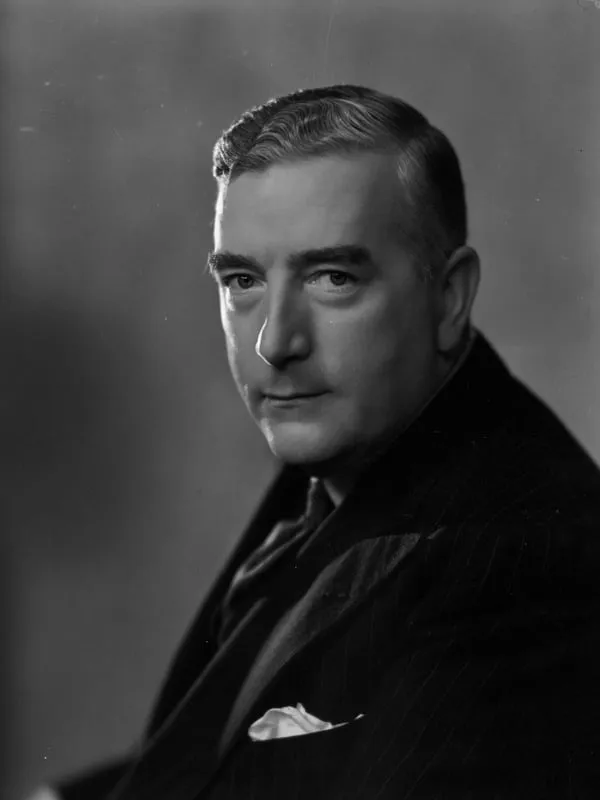
Robert Menzies
Attorney-General of Australia (1934–1939), Prime Minister of Australia (1939–1941, 1949–1966), founder of the Liberal Party of Australia (1944–1945)
- Born:
- 20 December 1894, Jeparit (Victoria, Australia)
- Died:
- 15 May 1978, Malvern (Melbourne, Australia)
- Author:
- Natalia
- Photo:
- Luke Monte, domena publiczna, Wikimedia Commons

Robert Gordon Menzies was the longest-serving prime minister in Australia’s history: he governed for more than eighteen years in all, in 1939–1941 and 1949–1966. For the history of the Second World War the most important moment of his life was the evening of 3 September 1939, when in a radio broadcast he told his fellow countrymen that, since Britain had declared war on Germany, “as a result, Australia is also at war”. Those words summed up his convictions: he was a constitutional lawyer and an Australian patriot, but above all “British to the bootstraps”, as he described himself, a man for whom Australia was part of a single, indivisible community under the Crown. His first government, in the hardest years of the war, ended in failure. His second, in the years of the Cold War, made him the most important Australian politician of the twentieth century.
From Jeparit to Melbourne
He was born on 20 December 1894 in Jeparit, a small settlement in the west of the state of Victoria, the fourth of the five children of James Menzies, who kept a general store, and Kate, née Sampson. His grandparents on both sides had come to Australia during the gold rush; his paternal grandfather was a Scot, and Menzies was proud of his Scottish ancestry all his life. Politics ran in the family: his father and two uncles sat in parliaments. The boy was taught first in a one-room school in Jeparit, then in Ballarat, where at thirteen he came first in a state scholarship examination, and from 1910 in Melbourne.
In 1913 he began studying law at the University of Melbourne, graduating with honours in 1916. He was president of the students’ representative council, editor of the university magazine and a formidable debater, though his fellow students also remembered his aloofness and sharp tongue. During the First World War he served in a university militia unit but did not volunteer to fight overseas, although two of his elder brothers did. The family reportedly decided that two sons at the front were enough. His opponents held this against him throughout his career, and he himself called the charges “a stream of mud through which I wade at every campaign”.
Lawyer and state politician
In 1918 Menzies was called to the Bar. He specialised in constitutional law, and fame came in 1920 when he won the engineers’ union case before the High Court of Australia, which permanently strengthened the power of the federation against the states. In 1929 he took silk as King’s Counsel. On 27 September 1920 he married Pattie Leckie, the daughter of a Victorian politician. They had three children who survived infancy.
He entered politics in 1928 as a member of the upper house of the Victorian parliament, moving to the lower house in 1929. In 1932–1934 he was Attorney-General, Minister of Railways and Deputy Premier in the state government. He defended the rule of law, the sanctity of contracts and free enterprise, and regarded the Labor Party with deep mistrust.
Minister in the Lyons government
In 1934 he won the federal seat of Kooyong in Melbourne, which he held until 1966, and at once became Attorney-General and Minister for Industry in the government of Joseph Lyons of the United Australia Party. In his very first months he conducted an unsuccessful case against the Czech communist journalist Egon Erwin Kisch, whom the government tried to keep out of Australia, where he had come to speak about the threat of Nazism.
Towards Germany Menzies was for a long time a supporter of Neville Chamberlain’s policy. He condemned Nazi antisemitism, but in August 1938, after an official visit of several weeks to the Third Reich, he wrote admiringly of the regime’s efficiency and of the Germans’ readiness to serve the state, while also noting the suppression of all criticism. He greeted the Munich Agreement with relief. Nor did he want a conflict over Japan, which since 1937 had been waging war in China. When at the end of 1938 waterside workers at Port Kembla refused to load pig iron for the Japanese arms industry, Menzies as Attorney-General forced an end to the boycott, arguing that foreign policy was made by the government and not by the trade unions. It earned him the nickname “Pig Iron Bob”. In March 1939 he resigned in protest at the postponement of a national insurance scheme and at inadequate defence spending.
Prime minister in the first years of the war
Lyons died suddenly on 7 April 1939. On 18 April Menzies won the party leadership ballot, defeating among others the former prime minister Billy Hughes, and on 26 April he became prime minister. The leader of the coalition partner, the Country Party, Earle Page, refused to serve with him and in Parliament accused him of cowardice in the First World War and disloyalty to Lyons. Menzies had to govern with a minority cabinet. In the summer of 1939 he believed that the dispute over Danzig had “two sides” and could be settled peacefully, but he had no intention of leaving Britain on its own. Above all he feared Japan: a war in Europe meant that the British fleet would not reach Singapore quickly, and the whole defence of Australia rested on that.
When Germany invaded Poland and London declared war on it, Menzies announced by radio on the evening of 3 September 1939 that Australia was at war. He recalled the seizure of Czechoslovakia and Hitler’s pact with Stalin, concluded “without batting an eyelid”, and argued that no empire could rest for long on broken promises. On 15 September he announced the formation of the volunteer Second Australian Imperial Force, and in November he reintroduced conscription for home service. Australian divisions sailed for the Middle East.
The year 1940 brought two blows. On 13 August three ministers of his government and the Chief of the General Staff, General Brudenell White, were killed in an air crash near Canberra, and the September election produced a hung parliament: Menzies stayed in power only thanks to two independent members. At the beginning of 1941 he went to London for four months, visiting Australian troops in North Africa on the way. He attended meetings of the British War Cabinet and pressed for the defences of Singapore to be strengthened. Under pressure from Winston Churchill he agreed, with misgivings, to the dispatch of Australians to Greece. The Balkan campaign and the Battle of Crete ended in defeat, and at home his position weakened. Some historians believe that in London Menzies even contemplated a career in British politics. When his own coalition withdrew its support, he announced his resignation on 28 August 1941, and on 29 August Arthur Fadden became prime minister. Fadden’s government fell after forty days and power passed to the Labor Party of John Curtin, which led Australia through the war with Japan.
“The Forgotten People” and a new party
Menzies went to the back benches. In 1942 he gave a series of radio talks, the most famous of which, “The Forgotten People”, was addressed to the middle class, tied neither to big business nor to the trade unions. It became the manifesto of his liberalism. After the electoral defeat of 1943 he again became leader of the opposition and brought the fragmented anti-Labor groups together in the Liberal Party of Australia, created at conferences in 1944 and formally launched in 1945.
The second government
In the election of 10 December 1949 the coalition of the Liberals and the Country Party defeated the government of Ben Chifley, and on 19 December Menzies became prime minister again. He governed without a break for sixteen years and won seven successive elections. His policy was driven by fear of communism: he sent troops to the Korean War and tried to ban the Communist Party, but the High Court struck down the act, and in a 1951 referendum the constitutional amendment was narrowly defeated. In 1954 the defection of the Soviet diplomat Vladimir Petrov (the Petrov affair) helped him win another election and split the Labor Party.
In foreign policy he remained loyal to Britain. In 1956 he led the delegation that presented President Gamal Abdel Nasser in Cairo, without success, with a plan for international control of the Suez Canal, and he supported the British intervention during the Suez Crisis. Yet the experience of 1942 led him to base Australia’s security on the United States: in 1951 he signed the ANZUS Treaty, and in 1954 Australia joined SEATO. In 1957 he concluded a trade agreement with Japan, the former enemy. Australian soldiers fought in the Malayan Emergency and in the Confrontation with Indonesia, and in 1965 Menzies sent an infantry battalion to Vietnam, having introduced conscription a year earlier. At home his years in office brought rapid economic growth, mass immigration from Europe, the expansion of the universities and the development of Canberra.
Last years
On 26 January 1966, aged 71, Menzies retired as the oldest prime minister in the country’s history and one of the few to leave office of his own accord. The British honours he prized had already come his way: in 1963 he was made a Knight of the Order of the Thistle, and in 1965, after Churchill’s death, he took on the honorary office of Lord Warden of the Cinque Ports. He was Chancellor of the University of Melbourne, lectured in the United States and published his memoirs. In 1971 he suffered a severe stroke that left him partly paralysed. He died of a heart attack on 15 May 1978 at his home in Malvern, Melbourne. His state funeral drew more than a hundred thousand people onto the city’s streets.
Significance
Menzies belonged to the last generation of Australian politicians for whom loyalty to Britain went without saying. His decision of 3 September 1939, taken without a separate declaration of war, was an expression of that faith and at the same time a calculation: without the British fleet Australia could not have defended itself against Japan. As prime minister in the first years of the war he failed to unite the country and lost power before Japan attacked. The fall of Singapore in 1942 confirmed his fears, but it also showed that Britain could no longer defend Australia. Menzies drew the lesson after the war, binding the country in alliance with the United States, though at heart he remained a man of the Empire. Historians judge him ambivalently, criticising his pre-war attitude to Germany and Japan and the way he conducted Cold War politics, but almost all agree that he shaped modern Australia more than anyone else.
Sources
Mentioned in battles
(01)Often appears with
People who appear in the same events.