United Kingdom
David Lloyd George
Chancellor of the Exchequer (1908–1915), Minister of Munitions (1915–1916) and Secretary of State for War (1916), Prime Minister of the United Kingdom (1916–1922), leader of the Liberal Party (1926–1931)
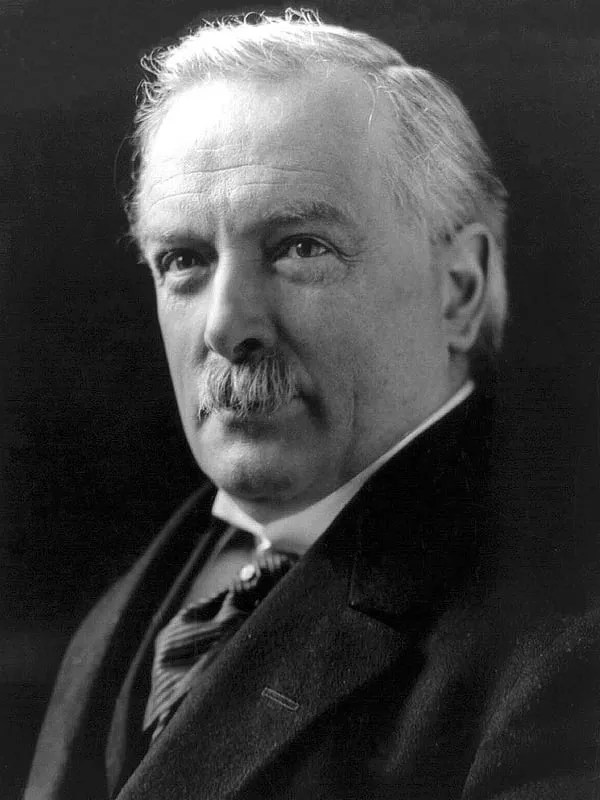
- Born:
- 17 January 1863, Manchester (England)
- Died:
- 26 March 1945, Llanystumdwy (Wales)
- Author:
- Łukasz
- Photo:
- Harris & Ewing, domena publiczna, Wikimedia Commons

David Lloyd George, a Welsh solicitor and Radical Liberal, was the most dynamic British politician of the first quarter of the twentieth century. Before the war he made his name as the author of social reforms; during the war he built up munitions production from scratch; and from December 1916, as prime minister, he led Britain to victory. In 1919 he sat in Paris in the “Big Four” alongside Woodrow Wilson, Georges Clemenceau and Vittorio Emanuele Orlando, and was one of the architects of the Treaty of Versailles. It was he who tempered France’s demands on Germany, and he who ensured that Gdańsk (Danzig) did not go to Poland and that Upper Silesia was decided by plebiscite. In the 1930s, convinced that Germany had been treated unjustly, he visited Adolf Hitler and praised him in the press, and in 1940 a single speech of his helped to bring down Neville Chamberlain’s government. His career shows clearly how in Britain pride in victory gave way to doubts about the peace, and those doubts to the policy of appeasement.
A Welshman from Manchester
He was born on 17 January 1863 in Chorlton-on-Medlock, a district of Manchester, into the family of a Welsh schoolmaster, William George. His father died in 1864, when David was just over a year old, and his mother returned with the children to her home village of Llanystumdwy in North Wales. He was brought up by his uncle Richard Lloyd, a shoemaker, Baptist lay preacher and ardent Liberal. From him the boy acquired a Nonconformist piety and a distrust of the Anglican Church and the landed gentry. Welsh was his first language.
In 1884 he qualified as a solicitor and opened a practice in his uncle’s house. He made his name with the Llanfrothen burial case, in which he won for Nonconformists the right to be buried in the parish churchyard. In 1888 he married Margaret Owen, the daughter of a prosperous farmer, with whom he had five children. In 1890, aged 27, he won a by-election in Caernarvon Boroughs and represented the constituency in the House of Commons without a break for 55 years. He became known as a champion of Welsh distinctiveness and an opponent of the Boer War, which he considered unjust. In Birmingham in 1901 a crowd of supporters of the war almost lynched him, and he was smuggled out of the town hall disguised as a policeman.
Chancellor of the Exchequer
In 1905 Lloyd George became President of the Board of Trade in Henry Campbell-Bannerman’s Liberal government, and in 1908, when H. H. Asquith became prime minister, he took the office of Chancellor of the Exchequer. His “People’s Budget” of 1909 raised taxes on the richest and on land in order to pay for pensions and the expansion of the navy. The Conservative House of Lords rejected it, provoking a constitutional crisis that ended in 1911 with an act curbing the Lords’ powers. In the same year Lloyd George carried the National Insurance Act, regarded as one of the foundations of the British welfare state. In July 1911, during the Agadir crisis (PL), he warned in a celebrated speech at the Mansion House that Britain would not allow itself to be treated as of no account, which Berlin took as a threat. In 1913 he was nearly ruined by the Marconi share scandal. From that year Frances Stevenson was his secretary and long-time partner.
The Great War
In the summer of 1914 Lloyd George was among the waverers in the cabinet. The German attack on Belgium decided the matter: the defence of a small nation gave him and most Liberals a principle in whose name they could support the war. As Chancellor of the Exchequer he quelled the financial panic of the first days of the war, but he soon went beyond his own department. He raised the alarm that the army was short of shells, and in May 1915 he took charge of the new Ministry of Munitions. He brought in industrialists and engineers, came to terms with the trade unions and within a year turned the ministry into the largest employer in the country. In July 1916, after the death of Lord Kitchener, he became Secretary of State for War, but his authority was limited by the Chief of the Imperial General Staff, William Robertson, while the army bled on the Somme.
In December 1916, in alliance with Andrew Bonar Law’s Conservatives, he brought about Asquith’s fall, and on 7 December he became prime minister. From then on the war was directed by a small War Cabinet, whose secretariat under Maurice Hankey for the first time kept minutes and saw to it that decisions were carried out. The prime minister forced the convoy system on the Admiralty, which broke the German U-boat campaign, and helped to create the Allied Supreme War Council. He did not, however, trust his generals, Douglas Haig and Robertson. He failed to stop the Passchendaele offensive, which in 1917 cost the British army a quarter of a million killed, wounded and missing, yet he did not dare to dismiss Haig. On 5 January 1918 he set out Britain’s war aims, among them an independent Poland and a league of nations, three days before Wilson’s Fourteen Points. In the spring of 1918, after the German breakthrough on the Somme, he supported entrusting the coordination of the Allied armies to Ferdinand Foch. On 11 November 1918 he announced the terms of the Armistice of Compiègne in the House of Commons.
In the December 1918 election his coalition with the Conservatives won a crushing victory. The campaign was fought amid demands for Germany to be punished. Lloyd George promised to bring the former Kaiser Wilhelm II to trial and declared that Germany would pay for the war as much as it could. But the victory came at a price: most of the coalition’s seats were won by the Conservatives, and the divided Liberal Party never regained its former position.
Paris 1919
At the Paris Peace Conference Lloyd George was the most adroit negotiator of the “Big Four”. At the opening session on 18 January 1919 he seconded Wilson’s motion that Clemenceau be made president, joking that the two of them often disagreed “because we are two Celts”. He defended the interests of the Empire: he won separate seats for the dominions at the conference and in the League of Nations, and mandates over former German colonies and Arab lands for Britain and its dominions. Against the opinion of the public at home, which demanded a harsh peace, he grew increasingly afraid that excessively severe terms would drive Germany into the arms of Bolshevism or lay the ground for a new war. In the Fontainebleau Memorandum of 25 March 1919 he warned that placing millions of Germans under foreign rule would become the cause of a future war. He held back French demands to detach the Rhineland from Germany.
Poland felt this most keenly. Lloyd George opposed giving it Gdańsk and brought it about that the city became a free city under the protection of the League of Nations. Under his pressure the Allied leaders also decided that the fate of Warmia and Masuria would be settled by plebiscite. When the Germans protested against handing Upper Silesia to Poland, it was he who in June 1919 pushed through a plebiscite there too. In Poland he was remembered as an enemy, and Roman Dmowski regarded him as the chief opponent of Polish claims. Lloyd George made no secret of his disdain for the new states of Central Europe and their aspirations. At the same time he did not escape contradiction: he promised voters reparations yet refused to have their amount fixed in the treaty, which poisoned relations with Germany for years. On 28 June 1919 he signed the Treaty of Versailles in the Hall of Mirrors. The economist John Maynard Keynes, who had resigned from the British delegation in protest at the peace terms, judged him very harshly, but some historians, such as Antony Lentin, see him as a negotiator who achieved almost all of Britain’s aims in Paris.
Last years in power
Lloyd George’s post-war government fell in a time of unrest. In January 1919, at the request of the local sheriff, his government sent troops and six tanks, which were never used, to strike-bound Glasgow, and in the years that followed Britain was swept by a wave of strikes and unemployment. In Ireland a war was being fought against the Irish Republican Army, in which British auxiliary forces committed reprisals against the population. In December 1921 the prime minister concluded a treaty with the Irish leaders that gave birth to the Irish Free State. In 1920, during the Polish–Soviet War, at the Spa Conference he made aid for Poland conditional on its acceptance of a demarcation line later called the Curzon Line, and in 1921 he concluded a trade agreement with Soviet Russia. In 1922 he convened the Genoa Conference, which was meant to bring Germany and Russia into the European economic order. It ended in failure, because in the course of it the two states concluded a separate treaty at Rapallo.
His downfall was brought about by his policy towards Turkey. Lloyd George was an ardent supporter of the Greek prime minister Eleftherios Venizelos and of the Greek landing at Smyrna. When in September 1922 the army of Mustafa Kemal routed the Greeks in the Greco-Turkish War and confronted the British positions at Chanak on the Dardanelles, the prime minister was ready to fight. The dominions refused their support, and the Conservatives concluded that he was dragging the country into a new war. On top of this came the scandal of the sale of honours in return for contributions to the prime minister’s political fund. On 19 October 1922, at a meeting at the Carlton Club, Conservative MPs decided to end the coalition, and the same day Lloyd George resigned. He never returned to power.
On the margins
From 1926 to 1931 Lloyd George led the Liberal Party. With Keynes’s help he prepared a programme of public works against unemployment, but in the 1929 election the Liberals won only 59 seats. In 1931 illness prevented him from joining the National Government, and after the election he led only a handful of MPs, most of them his own relatives. Between 1933 and 1936 he published his six-volume War Memoirs, which fiercely attacked the generals, and in 1938 the two-volume The Truth about the Peace Treaties, in which he defended the Paris settlement and his own part in it.
Over time he argued ever more strongly that Germany had been treated unjustly at Versailles. He supported revision of the arms limitations and Germany’s demands for equality of status, and paid less attention to the security of France, Poland and Czechoslovakia. In September 1936 he visited Hitler at his residence at Berchtesgaden. Hitler received him as “the man who won the war”, and Lloyd George was impressed. In an article for the Daily Express he called him a born leader and argued that Germany had abandoned for ever the idea of war with Britain and that its rearmament was defensive in character. He later changed his mind. From 1937 he sharply criticised Neville Chamberlain’s policy of appeasement, and in the spring of 1939 he warned in the House of Commons that the guarantees given to Poland without an agreement with the Soviet Union were reckless.
The Second World War
Lloyd George’s last great speech came on 8 May 1940, during the debate on the defeat in Norway. In it he called on Chamberlain to set an example of sacrifice by giving up the seals of office. The speech contributed to the prime minister’s fall and to Winston Churchill taking over the government. Churchill offered the old politician a place in the government, but Lloyd George refused, partly because he did not want to sit alongside Chamberlain. He also turned down the offer of the embassy in Washington. He believed that Britain could not win the war and reckoned with peace talks. After a pessimistic speech of his in May 1941, Churchill compared him in the House of Commons to Marshal Philippe Pétain.
In January 1941 his wife Margaret died, and in 1943 Lloyd George married Frances Stevenson. He last voted in the House of Commons in February 1943, against the government, which was delaying the introduction of William Beveridge’s plan of social reform. At the beginning of 1945 he was created Earl Lloyd-George of Dwyfor, but did not live to take his seat in the House of Lords. He died of cancer on 26 March 1945 at Llanystumdwy, aged 82, six weeks before Germany’s surrender. He was buried beside the River Dwyfor.
Assessment
The British remember Lloyd George as “the man who won the war” and as the creator of the first national insurance scheme. Historians value his energy, his boldness in bringing in experts from outside politics, and his reform of government. They criticise his distrust of the generals, which he could not bring himself to turn into their dismissal, his rule in Ireland, the trade in honours, and the fact that he split his own party.
For the history of the road to the Second World War the two sides of his Paris legacy matter most. On the one hand he was one of the few who foresaw in 1919 that a peace leaving millions of Germans under foreign rule could become the cause of a new war. On the other, his dislike of Poland and his sympathy for German grievances fitted the British conviction that the Treaty of Versailles had been too harsh. In the 1930s that conviction weakened the will to resist Hitler, who made the revision of Versailles his programme. The visit to Berchtesgaden in 1936, though an old politician’s error rather than a betrayal, remained a symbol of that attitude. Gdańsk, which Lloyd George had refused to give to Poland in 1919, became twenty years later the pretext for war.
Sources
Mentioned in battles
(03)Often appears with
People who appear in the same events.