Japan
Nobuaki Makino
Foreign Minister (1913–1914), plenipotentiary at the Paris Peace Conference (1919), Minister of the Imperial Household (1921–1925), Lord Keeper of the Privy Seal (1925–1935)
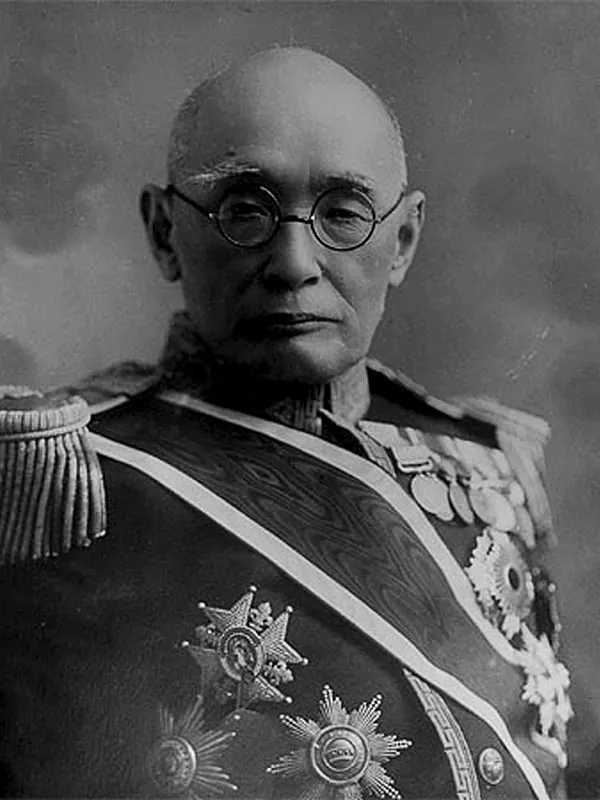
- Born:
- 24 November 1861, Kagoshima (Japan)
- Died:
- 25 January 1949, Tanaka near Kashiwa (Chiba Prefecture)
- Author:
- Natalia
- Photo:
- autor nieznany, domena publiczna, Wikimedia Commons

Nobuaki Makino was one of the last men of the Meiji era to live to see Japan’s defeat in 1945. The son of one of the founders of the modern Japanese state, a diplomat and minister, in Paris in 1919 he proposed on Japan’s behalf that the principle of racial equality be written into the Covenant of the League of Nations. For the next decade and a half, first as Minister of the Imperial Household and then as Lord Keeper of the Privy Seal, he was the closest adviser of the young Emperor Hirohito. He was regarded as the embodiment of the “old liberals” at court, who favoured an understanding with Britain and the United States, and for precisely that reason radical nationalists and young officers twice tried to kill him. His son-in-law was the post-war prime minister Shigeru Yoshida, and his great-grandson the prime minister Tarō Asō.
Son of Ōkubo
He was born on 24 November 1861 in Kagoshima, the capital of the Satsuma domain (han), the second son of the samurai Toshimichi Ōkubo, one of the three great leaders of the Meiji Restoration. Soon after his birth he was adopted by a relative of his father’s, Kichinojō Makino, and took his surname, although he grew up in the Ōkubo household, as his adoptive father was killed in 1868 in the Boshin civil war. In 1871 the eleven-year-old boy set out with his father and elder brother on the Iwakura Mission, led by Tomomi Iwakura, which toured the United States and Europe. He stayed behind in America as a pupil and went to school in Philadelphia. He returned in 1874 and began studying at the Kaisei school, from which the University of Tokyo grew. In May 1878 his father was assassinated in Tokyo by samurai assailants, and at the end of that year his mother died.
He never finished his studies. In 1879 he joined the Foreign Ministry and in 1880 went to the legation in London. There, in 1882, he met Hirobumi Itō, who was studying constitutional systems in Europe. His acquaintance with Itō, and later with Itō’s successor at the head of the moderate camp, Kinmochi Saionji, shaped Makino’s whole career. In 1885 he accompanied Itō on a mission to China, where he observed the negotiations with Li Hongzhang. He was later an official of the Council of State and the Legislative Bureau, secretary to the prime minister Kiyotaka Kuroda, governor of Fukui Prefecture (from 1891) and Ibaraki Prefecture (from 1892), and from 1893 Vice-Minister of Education. In 1887 he married Mineko, the daughter of the governor Michitsune Mishima.
Diplomat and minister
In 1897 Makino became minister in Rome, and in 1898 in Vienna, also accredited to Switzerland. According to his Japanese biographers he remained in Austria-Hungary until 1906, although some studies give a shorter period. From Vienna he followed the Russo-Japanese War, gathered intelligence on Russia and tried to counter the “Yellow Peril” slogan then popular in Europe. From those years he brought back an admiration for the British constitutional monarchy, whose court knew how to stay above politics.
In March 1906 he became Minister of Education in Saionji’s first government. He extended compulsory schooling from four years to six and in 1907 organised the first state art exhibition, the Bunten. In November of that year he was made a baron. After the cabinet fell in July 1908 he joined the Privy Council, and in Saionji’s second government (1911–1912) he was Minister of Agriculture and Commerce. In February 1913 he became Foreign Minister in the cabinet of Admiral Gonnohyōe Yamamoto. He then had to deal with an issue that would occupy him again in Paris: in May 1913 California passed a law, aimed at Japanese immigrants, forbidding the purchase of land by aliens who were ineligible for American citizenship. Negotiations with Washington achieved nothing. The Yamamoto cabinet fell in March 1914 after a corruption scandal in the navy, and Makino was appointed to the House of Peers. From 1917 he sat on the Advisory Council on Foreign Affairs, which set policy towards China and Russia in the last years of the war.
Paris, 1919
In November 1918 the government of Takashi Hara appointed Makino second plenipotentiary to the Paris Peace Conference. Formally the delegation was headed by Saionji, but the old prince reached Paris only in March and seldom spoke, so in practice it was Makino who conducted the negotiations. The delegation also included his brother-in-law Hikokichi Ijūin, his son-in-law Yoshida, the young Prince Fumimaro Konoe and the press spokesman Yōsuke Matsuoka. Makino himself supported the League of Nations and cooperation with the West, but he had instructions to ensure that, in creating it, Japan was protected from the effects of racial prejudice.
On 13 February 1919, in the League of Nations Commission, he tabled an amendment providing for equal treatment of the nationals of member states regardless of race or nationality. He argued that states which were to defend the peace together, by force of arms if necessary, could not at the same time discriminate against their own allies. The amendment fell together with the article on religious freedom. On 11 April Makino returned with a milder formula for the preamble of the Covenant and won a majority of the commission’s votes for it, but the chairman, President Woodrow Wilson, ruled that a matter of such importance required unanimity. The chief opponent was the Australian prime minister, Billy Hughes. Makino asked only that the result be entered in the minutes, and on 28 April, at the plenary session, he declared that Japan would not abandon the cause. According to the memoirs of one of the diplomats, the decision to give up the fight was taken at a night-time meeting of the delegation, when Saionji told Makino that in go it sometimes happens that one has the better strategy and still loses the game.
Japan’s second great cause in Paris ended in success. At the end of April Wilson, David Lloyd George and Georges Clemenceau awarded Japan the former German rights in the Chinese province of Shandong, and Makino gave a verbal assurance that sovereignty over the peninsula would return to China. At home, however, the press and the nationalists accused him of weakness on racial equality. Prime Minister Hara defended him. For Paris Makino was made a viscount in September 1920.
At the Emperor’s side
In February 1921 Makino became Minister of the Imperial Household. The post had fallen vacant after the so-called “Grave Affair at Court”, a dispute over the engagement of the Crown Prince Hirohito to Princess Nagako, which Field Marshal Aritomo Yamagata had tried to oppose. Makino’s candidacy was backed by the genrō Masayoshi Matsukata, while Saionji wanted a moderate at court who would not drag the monarchy into politics. Makino prepared the Crown Prince’s journey to Europe in 1921, the establishment of the regency in November of that year and Hirohito’s wedding in 1924. In March 1925 he became Lord Keeper of the Privy Seal (naidaijin), the Emperor’s closest adviser on affairs of state, and in April he was made a count.
During his ten years in this post Makino and Saionji, the last surviving genrō, jointly decided whom the Emperor should appoint prime minister. He instilled in the young monarch the ideal of a constitutional ruler on the British model: the Emperor was to stand above disputes and not take responsibility for the government’s decisions upon himself. In 1929 Makino backed the Emperor when he rebuked the prime minister Giichi Tanaka for covering up the assassination of Zhang Zuolin by officers of the Kwantung Army, which led to the government’s resignation. Some historians, among them Peter Wetzler and Herbert Bix, point out that this same principle of restraint meant that after the Mukden Incident of 1931 the court made no determined attempt to stop the army as it occupied Manchuria on its own initiative. Makino tried to prevent Japan from leaving the League of Nations, but in 1933 that attempt failed too.
To the nationalists he was the embodiment of the “treacherous advisers around the throne”. After the signing of the London Naval Treaty in 1930 the right-wing press spread the rumour that he and the Grand Chamberlain, Kantarō Suzuki, had kept the Chief of the Naval General Staff, who opposed limits on the fleet, from seeing the Emperor. On 15 May 1932, the day on which young naval officers murdered the prime minister Tsuyoshi Inukai, one of the groups of assassins threw a grenade at Makino’s residence in Tokyo and shot at a policeman. Makino was unhurt. Plagued by illness and aware that his presence was drawing attacks on the court, he resigned in December 1935. According to courtiers, the Emperor wept as he signed his dismissal.
The 26 February Incident and the war years
Resignation did not protect him from assassination. On the morning of 26 February 1936, during the young officers’ revolt in Tokyo, a detachment under Captain Hisashi Kōno attacked the inn at the spa of Yugawara where Makino was taking a cure. A police bodyguard was killed in the shooting and the inn caught fire. The 75-year-old Makino escaped to a hill behind the building thanks to the presence of mind of his granddaughter Kazuko, Yoshida’s daughter. On the same day the rebels murdered his successor as Lord Keeper of the Privy Seal, Makoto Saitō, and the Finance Minister, Korekiyo Takahashi, and gravely wounded Suzuki.
After 1936 Makino held no further office, but the Emperor continued to seek his advice, and his house remained a meeting place for supporters of an understanding with the Anglo-Saxon powers. They were unable to halt the course that led Japan, through the war with China in 1937, the Tripartite Pact with Germany and Italy and the attack on Pearl Harbor, to catastrophe. In February 1945, when Hirohito heard former prime ministers and dignitaries one by one on the further conduct of the war, he summoned Makino too. When his Tokyo house was damaged in an air raid in June 1945, the old man moved to the village of Tanaka in Chiba Prefecture.
Last years and significance
After the surrender Makino, as one of the few former dignitaries untainted by the war, was esteemed by the Americans and by the new authorities. He talked with the occupation’s advisers about the future of the monarchy and passed their views on to the court. Ichirō Hatoyama offered him the presidency of the Liberal Party, but he declined on account of his age. His son-in-law Shigeru Yoshida, who visited him often, became prime minister. Towards the end of his life he published his memoirs. He was also a keen go player and from 1924 to 1946 president of the Japanese go association, the Nihon Ki-in. He died on 25 January 1949 at his home in Tanaka, now part of the city of Kashiwa, and was buried in Aoyama Cemetery in Tokyo.
Makino has gone down in history above all as the author of Japan’s racial equality proposal, the first attempt to write a ban on racial discrimination into international law, although in Paris he himself cared less about the principle than about avoiding a break with the West. As Lord Keeper of the Privy Seal he represented a generation that wanted a constitutional Japan cooperating with Britain and America. His weakness was his conviction that the Emperor should keep out of politics, which in the 1930s made it easier for the army to seize the initiative. Because he survived two assassination attempts and his family helped to shape post-war Japan, after 1945 he became a symbol of the Japan that might have taken a different path.
Sources
Often appears with
People who appear in the same events.