South Africa
Jan Smuts
Boer general (1901–1902), Prime Minister of the Union of South Africa (1919–1924, 1939–1948), British field marshal (from 1941)
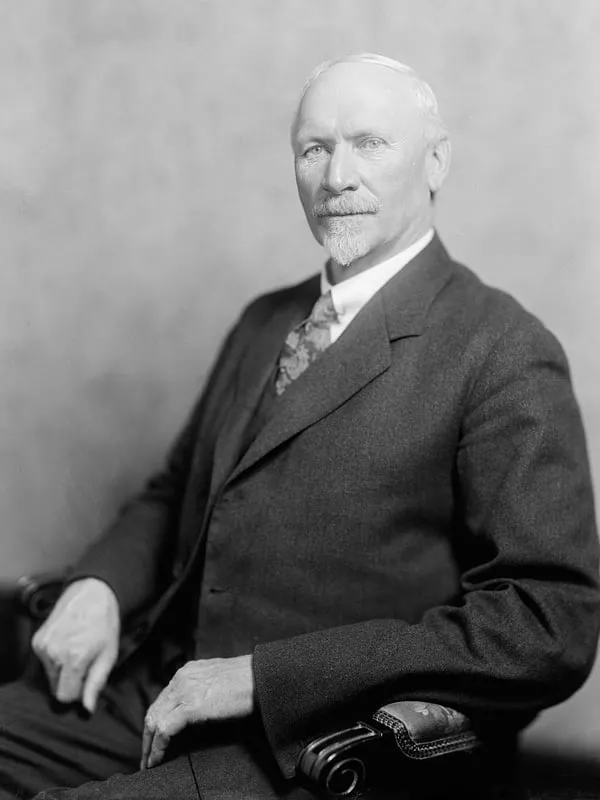
- Born:
- 24 May 1870, Bovenplaats near Malmesbury (Cape Colony)
- Died:
- 11 September 1950, Doornkloof at Irene near Pretoria (South Africa)
- Author:
- Łukasz
- Photo:
- Harris & Ewing, domena publiczna, Wikimedia Commons

Jan Christiaan Smuts was one of the most remarkable figures of the first half of the 20th century. As a young Boer general he fought against the British Empire, and some fifteen years later he sat in the British War Cabinet. He helped to create the League of Nations and the mandate system, he was the only man to sign both the Treaty of Versailles and the Charter of the United Nations, and in 1941 he became a British field marshal. In the history of the Second World War he is remembered above all for what he did in September 1939: against the wishes of the Prime Minister, Barry Hertzog, he persuaded parliament that the Union of South Africa should declare war on Germany, and throughout the war that followed he was one of Winston Churchill’s closest advisers. At the same time he was a supporter of racial segregation, and his devotion to the affairs of the Empire cost him the support of most Afrikaners and opened the way to power for the architects of apartheid.
A farmer’s son from the Cape
He was born on 24 May 1870 on the Bovenplaats farm near Malmesbury in the British Cape Colony, into a prosperous family of Afrikaner farmers. As the second son he was meant to stay on the land, but when his elder brother died in 1882 he was sent to school in Riebeek West. He quickly made up for lost time, entered Victoria College in Stellenbosch in 1886 and graduated with distinction. There he met Isie Krige, his future wife.
A scholarship allowed him to read law at Christ’s College, Cambridge. He graduated in 1894 with the highest marks and won the esteem of eminent teachers. He turned down the offer of an academic post and in 1895 returned to Cape Town as an advocate. At that time he supported the Prime Minister of the Cape Colony, Cecil Rhodes, and his vision of a united South Africa. The Jameson Raid at the turn of 1895 and 1896, a failed attempt by Rhodes’s men to overthrow the government of the Boer republic of the Transvaal, was for him a betrayal. He broke with Rhodes and moved to the Transvaal. In 1898, at the age of 28, he became the republic’s State Attorney and one of the closest associates of President Paul Kruger.
The Boer War
In 1899 Smuts was the most active member of the Transvaal delegation at the talks in Bloemfontein with the British High Commissioner, Alfred Milner, which ended in failure. In October the Second Boer War broke out. When, after the fall of Pretoria, the Boers turned to guerrilla warfare, Smuts fought under General Koos de la Rey in the western Transvaal, and in 1901–1902 he led a commando raid deep into the Cape Colony. In May 1902 he broke off the siege of the copper-mining town of Okiep to take part in the peace negotiations. He argued to the delegates that further resistance meant the destruction of the nation, since tens of thousands of Boer women and children had already died in the British concentration camps. The Treaty of Vereeniging of 31 May 1902 brought the independence of the Boer republics to an end.
From the Transvaal to the Union of South Africa
In defeat, Smuts staked everything on reconciliation with the British. Together with General Louis Botha he founded the Het Volk party and negotiated self-government for the Transvaal in London, and in 1907 he became a minister in its government. During this period he clashed with a young lawyer, Mohandas Gandhi, who was leading a campaign of passive resistance against laws aimed at Indians. The dispute ended in a compromise in 1914, and the two opponents retained a mutual respect.
Smuts was the principal author of the constitution of the Union of South Africa, created in 1910 as a British dominion. Botha became Prime Minister, and Smuts headed several ministries in turn, including defence. He put down the miners’ strikes of 1913–1914 with a firm hand. It was then, too, that he split with Barry Hertzog, who in 1914 founded the National Party, representing Afrikaners distrustful of the Empire.
The First World War
In 1914 the Union entered the war alongside Britain. Smuts and Botha suppressed a rebellion by Boer officers who wanted to use the war to restore the republics, and in 1915 they occupied German South West Africa. In 1916 Smuts took command of the imperial forces in German East Africa. He conquered most of the colony but failed to destroy the forces of Paul von Lettow-Vorbeck, and his strategy of manoeuvre cost thousands of soldiers who died of disease.
In 1917 David Lloyd George invited him to London. Smuts joined the Imperial War Cabinet and then the British War Cabinet itself, as the only representative of a dominion in it. After the German air raids on London he prepared a report that led in 1918 to the creation of the Royal Air Force as an independent armed service.
The League of Nations and Versailles
In December 1918 Smuts published the memorandum The League of Nations: A Practical Suggestion, which had a great influence on Woodrow Wilson and on the shape of the League’s Covenant. It was he who put forward the idea of mandates, under which the former German colonies and Ottoman lands passed into the administration of the victors on behalf of the League of Nations. In this way the Union of South Africa received the former German South West Africa. At the Paris Peace Conference Smuts, together with the Australian Prime Minister Billy Hughes, looked after the interests of the dominions, including in the dispute over the Japanese racial equality proposal. In April 1919 he went to Budapest on a mission to Béla Kun, which ended in failure.
He considered the terms imposed on Germany too harsh and warned that they would breed a new war. He signed the Treaty of Versailles on 28 June 1919, but at the same time issued a statement that he was doing so only to end the war and hoped its provisions would be revised. He returned to this idea in the 1930s, when he called for Germany to be granted equality of rights, which made him one of the advocates of the policy of appeasement.
Prime Minister and opposition leader
After Botha’s death in August 1919 Smuts became Prime Minister. His government was marked by bloody episodes: the massacre of the “Israelites” sect at Bulhoek in 1921, the suppression of the strike and revolt of white miners on the Witwatersrand in 1922 with aircraft and artillery, and the crushing of the Bondelswarts people in South West Africa. In 1924 he lost the election to an alliance of Hertzog and the Labour Party.
He used his years in opposition for philosophical work. In his book Holism and Evolution (1926) he introduced the concept of holism. During the Great Depression he formed a coalition with Hertzog, and in 1934 their parties merged into the United Party. Smuts was Deputy Prime Minister and Minister of Justice. Among other measures, he supported the 1936 act that deprived black inhabitants of the Cape Province of the right to vote on the common roll with whites. In 1938 he accepted Hertzog’s formula of neutrality for the Union in the event of war, but after the German seizure of Prague he distanced himself from it ever more clearly.
September 1939
When Germany invaded Poland on 1 September 1939, the cabinet split: Hertzog wanted neutrality, Smuts and most of the ministers wanted to join the war. On 4 September the House of Assembly adopted Smuts’s amendment by 80 votes to 67. The Governor-General refused Hertzog’s request to dissolve parliament, and on 5 September Smuts, at 69, became Prime Minister once again. The next day the Union of South Africa was at war with Germany.
Smuts knew that the country was deeply divided and that radical Afrikaner organisations, above all the Ossewabrandwag, sympathised with Germany. He did not introduce conscription for service overseas. Volunteers went to fight, and the government interned thousands of opponents of the war suspected of sabotage.
The Second World War
Smuts was at once Prime Minister, Minister of Defence and Minister of External Affairs. South African divisions fought the Italians in East Africa in 1940–1941, then in North Africa, where in June 1942 the whole of the 2nd South African Division was captured at Tobruk, and later at El Alamein and in Italy. On 24 May 1941, his 71st birthday, Smuts was made a field marshal of the British Army.
He was often in London and Cairo. Churchill valued his judgement more than that of many British ministers, and in August 1942 Smuts took part in the conferences in Cairo that led to changes in the Middle East command. In October 1942 he addressed both Houses of the British Parliament. It was even considered that, should Churchill die, he might head the British government. In August and September 1944 South African aircrews based in Italy flew alongside Polish and British crews to drop supplies to embattled Warsaw, suffering heavy losses.
In 1943 Smuts’s United Party won the general election. In 1945 Smuts led the Union’s delegation to the San Francisco Conference and wrote the first draft of the preamble to the Charter of the United Nations, with its reference to human rights. Yet he saw no contradiction between those words and the maintenance of white rule in Africa, something India was quick to point out at the UN.
Last years
At home the war weakened Smuts. The Afrikaner nationalists united under Daniel F. Malan, and towards the end of his government Smuts, who was inclined cautiously to ease some of the restrictions on the black urban population, came to seem too moderate to many white voters. In May 1948 the National Party won the election, and Smuts even lost his own seat. The victors set about building the system of apartheid. In the same year Smuts became Chancellor of the University of Cambridge. He died of a heart attack on 11 September 1950 at his farm, Doornkloof, at Irene near Pretoria.
Significance
Smuts remains a figure full of contradictions. He was an internationalist who helped to create the League of Nations, the Commonwealth and the United Nations, and at the same time a believer in racial hierarchy who could not conceive of equal rights for the black majority of his own country. On the road to the Second World War he was one of those who criticised the Treaty of Versailles and favoured concessions to Germany, yet in 1939 he was among the first to understand that Hitler threatened the whole world, not just Poland. His victory in the vote of 4 September 1939 ensured that the strategically vital route round the Cape of Good Hope and the raw materials of southern Africa remained on the Allied side, and that more than 300,000 volunteers from his country fought against Germany and Italy.
Sources
Mentioned in battles
(03)Often appears with
People who appear in the same events.