United States
Charles Evans Hughes
Governor of New York (1907–1910), US Secretary of State (1921–1925), Chief Justice of the United States (1930–1941)
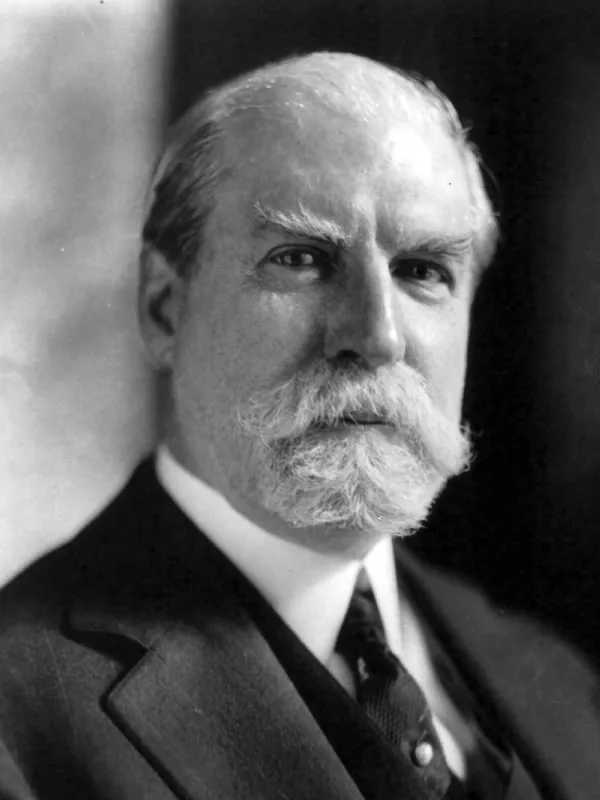
- Born:
- 11 April 1862, Glens Falls (New York, United States)
- Died:
- 27 August 1948, Osterville (Massachusetts, United States)
- Author:
- Natalia
- Photo:
- Underwood & Underwood, domena publiczna, Wikimedia Commons

Charles Evans Hughes was one of the most distinguished American lawyers and politicians of the first half of the 20th century. He was Governor of New York, twice a justice of the Supreme Court – for eleven years its Chief Justice – and the Republican presidential candidate who in 1916 lost to Woodrow Wilson by a whisker. For the history of the road to the Second World War, his four years as Secretary of State mattered most. In 1921–1922 he convened and led the Washington Conference, which halted the naval arms race between the United States, Britain and Japan and created an order in the Pacific that lasted until the early 1930s. He also helped open the way to the Dawes Plan, which stabilised Germany for several years. As Chief Justice in the 1930s he became both an adversary and a partner of President Franklin Delano Roosevelt.
A minister’s son
He was born on 11 April 1862 in the small town of Glens Falls, New York, the only child of David Charles Hughes, a Baptist minister who had come from Wales in 1855, and Mary Catherine Connelly, from a family settled in America for generations. The family moved several times before settling in New York City. The boy was taught mainly at home by his parents, who hoped he would enter the ministry. At fourteen he began his studies at Madison University (today Colgate), then transferred to Brown University, from which he graduated in 1881 near the top of his class. After a year as a teacher he studied law at Columbia University, graduating in 1884 first in his class and passing the bar examination with what was regarded as a record score.
For the next twenty years he practised law in New York, specialising in contracts and commercial cases, with a break in 1891–1893 when he taught law at Cornell University. In 1888 he married Antoinette Carter, the daughter of a partner in the firm where he worked. They had a son and three daughters. All his life he remained a devout Baptist.
Investigations and the governorship
He made his name in 1905 with two investigations conducted for the New York State legislature. The first exposed abuses by New York gas companies and led to lower gas prices and the creation of a commission to supervise public utilities. The second, as part of the so-called Armstrong Committee, laid bare the practices of the largest life insurance companies: policyholders’ money flowing to politicians and lobbyists, huge executive salaries and conflicts of interest. Most of the management of the country’s three largest insurers lost their posts, and the state passed laws that transformed the whole market.
In 1906 President Theodore Roosevelt backed Hughes as the Republican candidate for governor against the press magnate William Randolph Hearst. Hughes won and was re-elected in 1908. He governed from 1 January 1907 to October 1910. He was a reformer: he expanded the civil service, strengthened the supervision of public utilities, restricted corporate donations to election campaigns, introduced child labour protection and the first workmen’s compensation law in the United States for workers injured in industrial accidents. Party bosses disliked the fact that he did not hand out posts as rewards for party service.
Justice and presidential candidate
In 1910 President William Howard Taft appointed him to the Supreme Court. Hughes sat on it from October 1910 and often voted with Oliver Wendell Holmes in favour of the right of the states and the federal government to regulate the economy and working conditions. He also wrote important judgments against discrimination against Black Americans.
In 1916 the Republicans, still divided after the 1912 split between Taft and Roosevelt, were looking for a candidate who would unite them. They chose Hughes. He became the only sitting Supreme Court justice in history to accept the nomination of a major party, and he resigned from the bench. He was regarded as the favourite, but he ran an uninspired campaign, while Wilson benefited from having “kept America out of the war”. California proved decisive: there Hughes made the mistake of basing his campaign on conservative party men and failing to win over the progressive governor Hiram Johnson. He lost the state by fewer than four thousand votes, and with it the whole election, by 254 to 277 in the Electoral College.
He returned to the law. In 1917 he supported America’s entry into the war and conscription. After the war he defended five socialists who had been expelled from the New York State legislature for their views. In the dispute over the Treaty of Versailles and the League of Nations he favoured joining the League with reservations protecting the rights of Congress. In 1920, after the death of his daughter Helen, he did not want to run for President.
Secretary of State
The Republican Warren Harding, who won the 1920 election, appointed Hughes Secretary of State. Hughes took office in March 1921 and held it until March 1925, continuing after Harding’s death in 1923 under President Calvin Coolidge. Harding gave him a great deal of freedom, but on one matter he did not change his mind: the United States was not to join the League of Nations. Hughes accepted this and concluded separate peace treaties with Germany and Austria, and then with Hungary, which in 1921 formally ended the First World War for America.
His greatest achievement was the Washington Conference. He convened it in the summer of 1921 to halt the naval arms race that threatened America, Britain and Japan, and to settle the disputes in the Far East. On 12 November 1921, at the first session, he astonished the world with a concrete plan: a ten-year holiday in the building of capital ships and the scrapping of dozens of battleships, existing and under construction, naming them one by one. His words that the way to disarm is to disarm went round the world’s press. Under his chairmanship the conference produced the Four-Power Treaty, which ended the Anglo-Japanese alliance; the Nine-Power Treaty, guaranteeing China’s integrity; and above all the Washington Naval Treaty, signed on 6 February 1922, which fixed the ratios of the battle fleets of the United States, Britain, Japan, France and Italy. Hughes also mediated the agreement under which Japan returned its leasehold in Shandong province to China.
In European affairs he sought a way to untie the knot of reparations and war debts without drawing America into political commitments. On 29 December 1922, in a speech in New Haven, he proposed that the amount of German reparations be set by independent financial experts, Americans among them. The French government did not take up the proposal at the time, and in January 1923 it occupied the Ruhr. When the crisis plunged Germany into hyperinflation, Hughes’s idea came back. A committee of experts chaired by the American Charles Dawes prepared the Dawes Plan, adopted in London in August 1924. Hughes, who was in Europe at the time, unofficially encouraged the governments to accept it.
Hughes consistently refused to recognise the Soviet Union. He held that a government that repudiated its predecessors’ debts, confiscated foreigners’ property and supported revolution in other countries did not meet the conditions for recognition. This policy was changed only by Roosevelt in 1933. In Latin America Hughes prepared the withdrawal of American troops from the Dominican Republic and limited interventions, although he did not give up the right to them.
He failed over Japan. In 1924 Congress was preparing an immigration law that would close the United States completely to immigrants from Japan. Hughes opposed this, foreseeing that the Japanese would take the law as an insult. With his knowledge the Japanese ambassador, Masanao Hanihara, sent a letter warning of the “grave consequences” of such a step. Senator Henry Cabot Lodge presented these words as a veiled threat, and the Senate voted for Japanese exclusion by an overwhelming majority. The law, signed in May 1924, provoked a wave of outrage in Japan. After the rejection of the Japanese racial equality proposal in 1919, it was another blow to the advocates of cooperation with the West.
Between the bar and The Hague
In March 1925 Hughes left the government and was succeeded by Frank Kellogg. He returned to the law and became one of the best-paid lawyers in the country. He was president of the American Bar Association and co-founded an organisation promoting understanding between Christians and Jews. In 1928 he led the American delegation to the Pan-American Conference in Havana, where he defended the right of the United States to intervene in the countries of the region to protect the lives and property of its citizens. In the same year he supported Herbert Hoover’s presidential candidacy, and in September 1928 he was elected a judge of the Permanent Court of International Justice in The Hague, the court attached to the League of Nations, even though the United States had not joined it. Hoover offered him the post of Secretary of State again, but Hughes declined.
Chief Justice
On 3 February 1930 Hoover nominated him Chief Justice in place of the gravely ill Taft. Progressive senators charged that, as a lawyer for big corporations, he would be their judge, and after a bitter dispute the Senate confirmed him on 13 February by 52 votes to 26. Hughes resigned from the court in The Hague. The Court under his leadership was divided between four conservatives and three liberals, and Hughes and Justice Owen Roberts often tipped the balance. In 1931 he wrote the judgment that barred the states from prior restraint of the press.
During the Great Depression the Court became the arena of the struggle over the New Deal of President Franklin Delano Roosevelt, whom Hughes swore in for successive terms in 1933, 1937 and 1941. In 1935–1936 the Court struck down several of the most important New Deal laws. At the beginning of 1937 Roosevelt proposed enlarging the Court with new justices, which would have given him a majority on it. Defending the Court’s independence, Hughes sent Senator Burton Wheeler a letter, read out before the Senate committee, showing that the Court had no backlog of cases and therefore needed no additional justices. At the same time the Court began to uphold social and economic legislation, including Washington State’s minimum wage law and the National Labor Relations Act. Roosevelt’s plan failed in the Senate, but the jurisprudence that had blocked economic regulation passed into history.
On 1 July 1941, at the age of 79, Hughes retired, recommending Justice Harlan Fiske Stone as his successor. He did not return to public life during the war. At the request of Secretary of State Cordell Hull he reviewed the draft of the United Nations Charter. His wife died in December 1945. Charles Evans Hughes died on 27 August 1948 in Osterville, Massachusetts, aged 86. He was buried in Woodlawn Cemetery in New York.
Significance
Hughes belonged to the generation of American politicians who, after the rejection of the Treaty of Versailles, tried to build peace without the commitments that the League of Nations entailed: through disarmament agreements, arbitration and financial aid. The Washington Conference was the high point of that policy. It halted the naval arms race for ten years and is regarded as the first successful arms control agreement in history. Its weaknesses, however, were visible even then. The treaties provided for no sanctions, and their durability depended on whether Japan concluded that the order in the Pacific was worth its while. The 5:5:3 ratio and the ban on building bases gave the Japanese fleet the upper hand in the western Pacific, while stirring a sense of grievance in the Japanese navy. The 1924 immigration law, which Hughes had been unable to stop, confirmed the Japanese in their belief that America did not treat them as equals.
When Japan seized Manchuria in 1931 and in 1934 renounced the Washington Treaty, Hughes’s edifice collapsed. In December 1941, a few months after he left the Supreme Court, Japan attacked Pearl Harbor, and the bases in the Philippines and on Guam, which the treaty had not allowed to be fortified, fell within weeks. Historians still argue whether his work postponed the war in the Pacific by a decade or prepared the ground for it. There is no doubt, however, that Hughes was one of the few statesmen of the 1920s who managed to turn a universal longing for peace into concrete commitments that were actually carried out.
Sources
Often appears with
People who appear in the same events.