United States
Harry Hopkins
Administrator of New Deal programmes (1933–1938), Secretary of Commerce (1938–1940), special adviser and envoy of President Roosevelt (1940–1945)
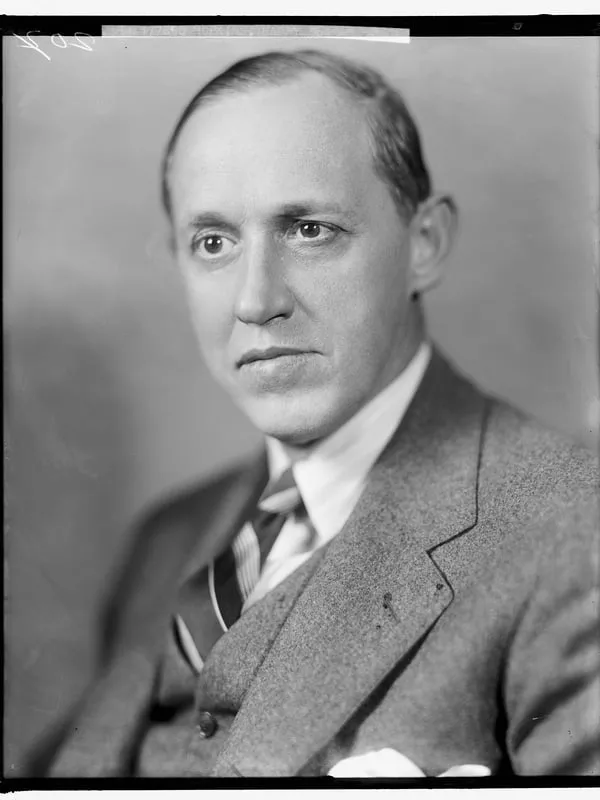
- Born:
- 17 August 1890, Sioux City (Iowa, United States)
- Died:
- 29 January 1946, New York City
- Author:
- Natalia
- Photo:
- Harris & Ewing, domena publiczna, Wikimedia Commons

Harry Hopkins was neither a diplomat nor a soldier, nor even a politician who had ever won an election. He was a social worker from Iowa who, in the years of the Great Depression, created for President Franklin Delano Roosevelt the largest public works programmes in the history of the United States, and who during the Second World War became his closest adviser, his envoy and, as people said in Washington, his alter ego. For three and a half years he lived in the White House. It was he who in January 1941 convinced Roosevelt that Winston Churchill’s Britain would hold out and was worth supporting; it was he who that summer became the first senior American representative to talk to Stalin in Moscow, and he took part in the meeting that gave the world the Atlantic Charter. Throughout the war, gravely ill, he linked the three leaders of the grand coalition. He called himself a “catalyst”.
The harness-maker’s son from Iowa
Harold Lloyd Hopkins was born on 17 August 1890 in Sioux City, Iowa, the fourth of the five children of David Hopkins and Anna, née Pickett. His father ran a harness-making shop and had earlier turned his hand to many trades. His mother, a devout Methodist, attached great importance to religion and to one’s duties towards one’s neighbour. The family moved often, through Nebraska and Chicago, until it settled in Grinnell. There, in 1912, Harry graduated from the local college, an institution with a strong tradition of the so-called Social Gospel, which taught that a Christian ought to change the living conditions of the poor.
Straight after his studies he went to New York and began work at Christodora House, a settlement house in the poor district of the Lower East Side. In 1913 he moved to the Association for Improving the Condition of the Poor, where he visited needy families and organised public works for the unemployed, some of the first in America. In 1913 he married Ethel Gross, a Hungarian Jewish activist of the Progressive movement, with whom he had three sons. The Mayor of New York put him in charge of the city’s Board of Child Welfare, which paid allowances to single mothers.
In 1917 the army turned him down because of his poor eyesight. He therefore worked for the American Red Cross, first in New Orleans and then in Atlanta, where he directed civilian relief in several Southern states. In 1922 he returned to New York, and in 1924 he became head of the New York Tuberculosis Association, which grew considerably under his leadership. He was one of the founders of the American Association of Social Workers and in 1923 its president. By the end of the 1920s he was one of the best-known organisers of social welfare in the country, and at the same time a man who smoked heavily, bet on the horses and cared little for money or dress. In 1930 he divorced his first wife, and in 1931 he married Barbara Duncan, with whom he had a daughter, Diana.
Work instead of charity
When the Wall Street Crash set off the Great Depression, Roosevelt, then Governor of New York State, set up in 1931 the state Temporary Emergency Relief Administration (TERA), the first state agency in America to help the unemployed with taxpayers’ money. Hopkins became its executive director, and in 1932 its chairman. Roosevelt got to know him better at that time and came to value his energy and his ability to spend large sums quickly and without waste.
In March 1933 the new President brought him to Washington. Hopkins took charge of the Federal Emergency Relief Administration (FERA), which passed money to the states for the unemployed. He was convinced that work was better for a man than a dole, because it allowed him to keep his dignity. In the winter of 1933–1934 his Civil Works Administration (CWA) employed some four million people within a few weeks, building roads, schools and playing fields. To critics who argued that the economy would recover by itself “in the long run”, he is said to have replied that people don’t eat in the long run – they eat every day.
In 1935, in the second phase of the New Deal, Hopkins proposed and took charge of the Works Progress Administration (WPA). In the eight years of its existence the WPA gave work to some 8.5 million Americans in all, who built or repaired hundreds of thousands of kilometres of roads, more than a hundred thousand bridges, and thousands of schools, hospitals and airfields. Hopkins also created programmes for young people and for artists, writers, musicians and actors, which his opponents ridiculed as a waste of money. Conservatives saw him as the symbol of a spendthrift, politicised state. He was bound to Eleanor Roosevelt by friendship and shared social convictions. After the death in 1936 of Louis Howe, the President’s long-time adviser, Hopkins became the person closest to him.
Illness and the White House
In 1937 his second wife died of cancer, and at the end of that year Hopkins himself underwent an operation at the Mayo Clinic in Rochester in which most of his stomach was removed because of a tumour. From then until the end of his life he had digestive problems, lost weight and grew weaker, and several times doctors gave him only weeks to live. Even so, Roosevelt, who saw in him even a possible successor, appointed him Secretary of Commerce in December 1938. Hopkins’s political ambitions soon faded, however. In 1939 he was so ill that for many months he could not work, and the department was run by his deputy. In 1940 he formally resigned.
On 10 May 1940, the day Germany struck in the west, Hopkins talked with the President late into the evening, and Roosevelt offered him a bed in the White House. He stayed there for three and a half years, in a room on the upper floor a few steps from the President’s study. As a man without an office but always at hand, he read dispatches, received visitors, wrote speeches with the President and saw to matters that Roosevelt wanted settled without going through the departments. Decisions such as the creation of a federal research agency, whose plan Vannevar Bush brought him in June 1940, came about with his help. That summer, at the Democratic convention in Chicago, he directed from a hotel room with a direct line to the White House the operation that won Roosevelt the nomination for a third term and made Henry Wallace his running mate.
Envoy to Churchill
After winning the election Roosevelt was looking for a way to help Britain, which had fought alone since the fall of France, but he did not know whether Churchill really could hold out. In January 1941 he therefore sent Hopkins as his personal representative. Hopkins arrived in England on 9 January, during the Blitz. Churchill devoted a great deal of time to him and took him on journeys around the country. Hopkins wrote to Roosevelt that Churchill was the government “in every sense of the word” and the one man with whom the President must reach a full understanding, and that the British desperately needed help. At a farewell dinner in Glasgow he rose and quoted the Book of Ruth: “Whither thou goest, I will go; and where thou lodgest, I will lodge: thy people shall be my people”, and then added quietly: “Even to the end.” Churchill wept.
Hopkins’s report strengthened Roosevelt in the fight for the Lend-Lease bill, which the President signed in March. Hopkins became the de facto director of the aid programme and the most important link between the White House and Downing Street. Churchill nicknamed him “Lord Root of the Matter”, because in every discussion he quickly got to what really needed to be decided.
Moscow and Placentia Bay
In July 1941 Hopkins was again in London to settle with Churchill the details of his meeting with the President. A few weeks earlier Germany had invaded the Soviet Union, and in Washington and London it was widely believed that the Red Army would collapse within weeks. Hopkins concluded that no one knew the true state of affairs and, with Roosevelt’s approval, flew by flying boat via Archangel to Moscow. He arrived on the morning of 30 July. That same evening and the next day he talked with Stalin in the Kremlin, telling him that the President regarded Hitler as the enemy of mankind and wanted to help the Soviet Union, although his mission was not a diplomatic one and he brought no formal commitments. Stalin asked above all for anti-aircraft guns, machine guns, rifles, aviation fuel and aluminium. “Give us anti-aircraft guns and aluminium, and we can fight for three or four years,” he said. He judged Archangel to be the best supply route, since the routes through Iran and Vladivostok were too long or too uncertain. At the second meeting the interpreter was Maxim Litvinov, the former Commissar for Foreign Affairs.
Hopkins came back convinced that the Russians would fight and that they were worth helping, and he passed this conviction on to Roosevelt and Churchill. Exhausted by the flight over the Arctic, he only just reached Scapa Flow in time, and on 4 August sailed with Churchill aboard the battleship Prince of Wales to Placentia Bay in Newfoundland. During the talks of 9–12 August he was constantly at the side of both leaders. When a dispute over British imperial tariff preferences threatened to delay the joint declaration, he argued that the announcement of the Atlantic Charter could not be held up for such a reason. On his initiative Stalin was offered a conference in Moscow on supplies. He was to have attended it himself but was too ill, so at the end of September Lord Beaverbrook and Averell Harriman went to Moscow. In the autumn of 1941 Lend-Lease was extended to the Soviet Union. The aid programme was formally taken over by a new office headed by Edward Stettinius, but Hopkins still had the decisive voice in it and throughout the war made sure that supplies for the USSR had priority, even against the objections of some of the military.
At the President’s side
On 7 December 1941 Hopkins was lunching with Roosevelt in his study in the White House when the Secretary of the Navy, Frank Knox, telephoned with news of the attack on Pearl Harbor. At first Hopkins did not believe it. A fortnight or so later Churchill moved into the White House, having crossed the Atlantic for the first wartime conference in Washington, the Arcadia Conference. Hopkins at that time chaired the newly created Munitions Assignments Board, which divided American and British war production among the Allies, and sat on the Pacific War Council.
In April 1942 he flew with General George Marshall to London to win the British over to the American plan for a landing in France. In July, when the British judged an invasion in 1942 impracticable, he negotiated in London, together with Marshall and Admiral Ernest King, the compromise from which grew the landing in North Africa, Operation Torch. On 30 July 1942 he married for the third time, in the White House, to Louise Macy, a former editor of a fashion magazine. He accompanied Roosevelt to the conferences at Casablanca in January 1943 and at Cairo and Tehran at the end of that year. He helped to draft the correspondence between the leaders and was, for Churchill, the surest channel to the President, and for Stalin one of the few Americans he was glad to talk to.
His influence aroused jealousy. The Republican press portrayed him as an éminence grise, called him a Rasputin and accused him of extravagance and abuse of privilege, while the military were irritated that a civilian with no military experience took part in strategic deliberations. In December 1943 the Hopkinses moved out of the White House to a house of their own in Georgetown. At the beginning of 1944 Hopkins’s health deteriorated sharply and he spent many months in hospital, where he underwent another operation. In February 1944 his youngest son, eighteen-year-old Stephen, a Marine, was killed on Kwajalein atoll in the Marshall Islands. Hopkins did not return to work until the end of the year, and his standing with the President was no longer what it had been.
Yalta and the last mission
In February 1945, although very ill, he travelled with Roosevelt to the Yalta Conference. He spent most of the time in bed, but took part in the most important meetings and passed notes to the President. He was among those who believed that co-operation with Stalin after the war was both possible and necessary. On the way back he left the President’s ship and flew home, which Roosevelt held against him. They never saw each other again: the President died on 12 April 1945.
Roosevelt’s successor, Harry Truman, troubled by mounting disputes with Moscow, above all over Poland, asked Hopkins to go to Stalin once more. Between 26 May and 6 June 1945 Hopkins held several long talks in the Kremlin. The main subject was Poland. Stalin agreed that, besides the communists from Warsaw, a few politicians from outside their camp, among them Stanisław Mikołajczyk, should be invited to the talks on forming a new government. Hopkins also raised the case of the sixteen leaders of the Polish Underground State, treacherously arrested by the NKVD in March, but Stalin refused to free them, and in June they were put on show trial in Moscow. The Hopkins–Stalin agreement opened the way to the formation in June of the Provisional Government of National Unity, which the United States and Britain recognised, withdrawing their recognition from the Polish government-in-exile. For Washington this was a success that averted the threat of a split among the victors. For Poland it meant the sealing of Moscow’s domination in exchange for minor concessions. In these talks Stalin also gave way on previously disputed questions of the voting procedure in the future UN Security Council and confirmed that the USSR would enter the war against Japan.
Death and disputed judgements
After returning from Moscow, Hopkins retired from public service in the summer of 1945 and did not go to the Potsdam Conference. In September Truman awarded him the Distinguished Service Medal. He died in hospital in New York on 29 January 1946, at the age of 55. Cancer was given as the cause of death; some doctors and historians link it rather to years of malnutrition and liver disease resulting from the 1937 operation and numerous transfusions. His ashes were buried in Grinnell.
Churchill wrote of him as “a soul that flamed out of a frail and failing body”, “a crumbling lighthouse from which there shone the beams that led great fleets to harbour”. Marshall believed that America would never understand how much Hopkins had done for it. Roosevelt’s friend and speechwriter, the playwright Robert E. Sherwood, drew on his papers for the book Roosevelt and Hopkins, which won the Pulitzer Prize in 1949 and remains one of the basic sources for the history of American wartime policy.
His opponents saw Hopkins above all as a man who trusted Stalin too much. During the Cold War he was accused of helping to pass secrets to the USSR, and in 1990 the KGB defector Oleg Gordievsky claimed that Moscow had regarded him as an agent. Most scholars who have examined these charges reject them: Hopkins did have regular contacts with Soviet representatives, because his role in the supply programme required it, but no evidence has been found that he acted against the President’s instructions or the interests of the United States. More often he is charged with naivety: the belief that generosity and personal trust would change Stalin’s behaviour, and the conviction that after victory the Soviet Union would be the dominant power in Europe, with which an accommodation had to be reached. For Poles his name is linked on the one hand with the American aid that helped to defeat Germany, and on the other with the agreement of June 1945 in which the West accepted the government imposed on Poland by Moscow. Yet there is no doubt that few people did as much as this ailing social worker from Iowa to enable Britain, the United States and the Soviet Union to fight together until the victory over Hitler.
Sources
Mentioned in battles
(01)Often appears with
People who appear in the same events.