United States
Frank B. Kellogg
US Senator from Minnesota (1917–1923), ambassador to the United Kingdom (1924–1925), US Secretary of State (1925–1929), judge of the Permanent Court of International Justice (1930–1935)
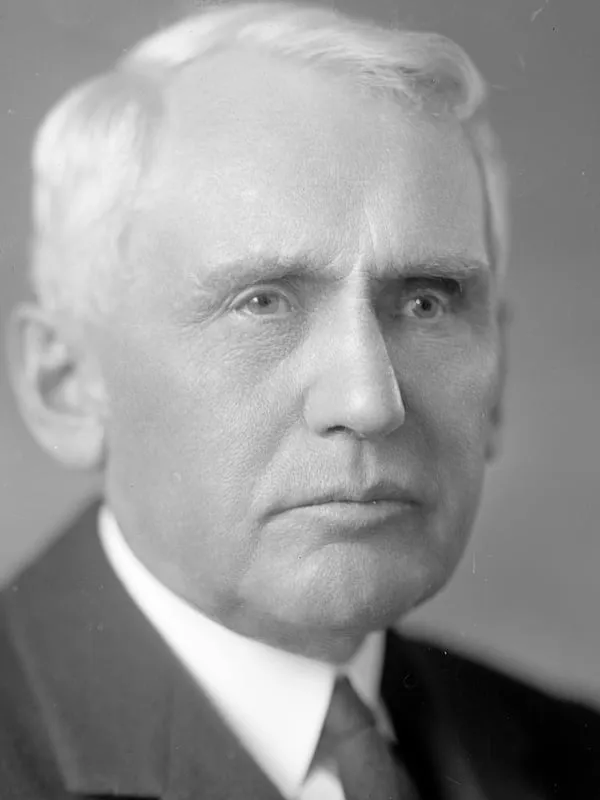
- Born:
- 22 December 1856, Potsdam (New York, United States)
- Died:
- 21 December 1937, Saint Paul (Minnesota, United States)
- Author:
- Łukasz
- Photo:
- Harris & Ewing, domena publiczna, Wikimedia Commons

Frank Billings Kellogg rose from a farm on the American frontier to the highest diplomatic office in the United States. Self-taught, he never finished high school or went to university, yet he became one of the most celebrated lawyers of his generation, the trust-buster of the Standard Oil case. As Secretary of State in Calvin Coolidge’s administration he turned a French proposal for a bilateral agreement into the Kellogg–Briand Pact, in which almost every state in the world renounced war as an instrument of policy. The pact did not prevent the Second World War, but after 1945 it became the foundation on which the leaders of the states that had unleashed it were tried at Nuremberg and Tokyo.
The farm and the law office
He was born on 22 December 1856 in the small town of Potsdam, New York, the son of Asa Farnsworth Kellogg and Abigail, née Billings. In 1865, after the Civil War, the family joined the wave of settlers moving west and took up a wheat farm in Olmsted County, Minnesota. When the boy was fourteen, his father’s illness forced him to take over the farm, and that was the end of his formal education. A few years later he began working in a law office in Rochester, supporting himself with odd jobs and teaching himself law, history, Latin and German from borrowed books. He was admitted to the bar in 1877. He served as city attorney of Rochester and, from 1882, as county attorney of Olmsted County. In 1886 he married Clara May Cook.
In 1887 his distant cousin Cushman K. Davis, a former governor of Minnesota and soon to be a senator, took him into his law firm in the state capital, Saint Paul. Davis, Kellogg and Severance became one of the most influential firms in the Midwest. Kellogg represented railway companies and iron-ore mining firms in the rich Mesabi Range, made a fortune and came to know the magnates of the age, among them Andrew Carnegie, John D. Rockefeller and the railway king James J. Hill. From 1904 to 1912 he sat on the national committee of the Republican Party.
The trust-buster
National fame, however, came from taking on big business. President Theodore Roosevelt, who knew him personally, entrusted him in the mid-1900s with the prosecution of the paper trust under the Sherman Act. Kellogg won, and went on to act for the government in cases against the railway magnate Edward H. Harriman and the Union Pacific. The most important was the case against John D. Rockefeller’s Standard Oil, which ended in 1911 with a Supreme Court ruling ordering the break-up of the oil empire. In 1912 Kellogg became president of the American Bar Association.
Senator and ambassador
In 1916 the voters of Minnesota elected him to the Senate. He was the first senator from the state to be chosen by popular vote rather than by the state legislature. He took his seat on 4 March 1917, just in time to vote in April for the United States’ entry into the war. In the great struggle over the Treaty of Versailles he supported President Woodrow Wilson more than most Republicans did. He was one of the so-called mild reservationists: he wanted the treaty ratified and the country to join the League of Nations, with minor reservations protecting the prerogatives of Congress. He was neither a good speaker nor an effective campaigner, and in 1922 he lost his seat to the Farmer–Labor candidate Henrik Shipstead.
In 1923 President Warren Harding sent him as a delegate to the Fifth International Conference of American States in Santiago de Chile. After Harding’s death the new president, Calvin Coolidge, appointed him ambassador in London in December 1923, to the surprise of the press, which did not see him as a diplomat. He presented his credentials in January 1924. The most important event of his mission was the London Conference in the summer of 1924, at which the governments of Europe adopted the Dawes Plan. Kellogg was one of its leading participants and among the negotiators who secured the acceptance of the experts’ plan drawn up under the chairmanship of Charles Dawes.
Secretary of State
On 5 March 1925 he succeeded Charles Evans Hughes as Secretary of State, holding the office until 28 March 1929, throughout Coolidge’s presidency. He had no grand vision of foreign policy and none of the polish of European diplomats. He was thought nervous and quick-tempered, but he was hard-working and open to the subordinates who suggested ideas to him. He devoted most attention to Latin America. In 1926–1927 he sent the Marines to Nicaragua, then in the throes of civil war, presenting the intervention as a defence against communist influence from Mexico. It gave rise to the guerrilla war of Augusto Sandino and a wave of anti-American feeling, which Kellogg felt at the Pan-American Conference in Havana in 1928. A dispute with Mexico over the rights of American oil companies and the ownership of land threatened a break in relations, but in the end, thanks to the mission of Ambassador Dwight Morrow, it was settled by negotiation. Kellogg also mediated in the long-running dispute between Chile and Peru over the provinces of Tacna and Arica, which ended in 1929.
In China, where Chiang Kai-shek’s armies were waging the Northern Expedition and foreigners were attacked in Nanjing in 1927, Kellogg favoured restraint and an understanding with the Chinese Nationalists, although after the Nanjing attack American and British warships shelled the city to protect foreigners. In July 1928 the United States became the first country to sign an agreement with the Nanjing government granting China tariff autonomy, the first step towards the abolition of the unequal treaties. He had less luck with disarmament. The Geneva conference that Coolidge convened in the summer of 1927 was meant to extend the limits of the Washington Naval Treaty to cruisers, but it failed because of a dispute between American and British admirals.
He believed in arbitration and legal agreements. During his time in office he signed some eighty treaties, more than any of his predecessors, among them bilateral arbitration agreements with more than a dozen states.
The Pact of Paris
On 6 April 1927 the French foreign minister, Aristide Briand, proposed in an open letter to the American people that the two countries conclude an agreement renouncing war between them. Kellogg at first brushed the proposal aside, rightly seeing it as an attempt to draw America into the French system of alliances. The peace movement and Senator William Borah, chairman of the Senate Foreign Relations Committee, would not leave him alone, however. On 28 December 1927 Kellogg replied that the United States was ready to conclude such a treaty, but with every state in the world. From then on he put all his energy into it. For half a year he exchanged notes with Paris, London, Berlin, Rome and Tokyo. He argued that the treaty took no one’s right of self-defence away, and that trying to define that right would do more harm than good.
On 27 August 1928 he signed the pact in Paris together with Briand, Gustav Stresemann and the representatives of twelve other states. On the way home he visited Ireland, where Dublin granted him the freedom of the city. In January 1929 the Senate approved the pact by 85 votes to one. A few weeks later Kellogg left office, and on 24 July 1929 he was the guest of honour of President Herbert Hoover at the ceremony at which it was announced that the pact had entered into force. Hoover credited Briand with initiating the treaty and Kellogg with extending it to the whole world.
Last years
Kellogg received the Nobel Peace Prize for 1929. The Norwegian committee did not award it in 1929 but reserved it and presented it a year later. France made him a member of the Legion of Honour. In 1930 he took the seat on the Permanent Court of International Justice in The Hague vacated by Hughes, who had become Chief Justice of the Supreme Court, and was then elected to a full term. As a judge of the court attached to the League of Nations he watched the pact he regarded as his life’s work being broken by one state after another: by Japan in Manchuria in 1931 and by Italy in Ethiopia in 1935. Yet to the end of his life he never lost faith in its purpose. Owing to illness he resigned from the bench in 1935 and returned to Saint Paul. He also endowed a foundation at Carleton College for education in international relations.
He died in Saint Paul on 21 December 1937, the day before his 81st birthday, of pneumonia following a stroke. He was buried in Washington National Cathedral. A few months earlier Japan had begun a war in China without declaring it.
Significance
Kellogg was no visionary. The pact that bears his name was proposed to him by Briand, and the idea of outlawing war came from American peace activists. His achievement was to turn a bilateral agreement, with which France wanted to tie America to its own security, into a universal treaty, and to see it through despite European scepticism. At the same time it was he who stripped the pact of anything that might have committed America to anything. A treaty without a definition of aggression, without sanctions and without a body to determine violations was a precise expression of American policy in the 1920s: peace without alliances and without risk.
On the road to the Second World War the Kellogg–Briand Pact proved powerless. Japan, Italy, Germany and the Soviet Union, all bound by its provisions, waged wars without declaring them. After the war, however, it was remembered. The International Military Tribunal at Nuremberg held that the renunciation of war in 1928 had made a war of aggression illegal, and its planning and waging a crime. On that basis the leaders of the Third Reich and Japan were convicted of crimes against peace. The principle that Kellogg signed in Paris passed into the Charter of the United Nations and remains one of the foundations of international law to this day.
Sources
Often appears with
People who appear in the same events.