United States
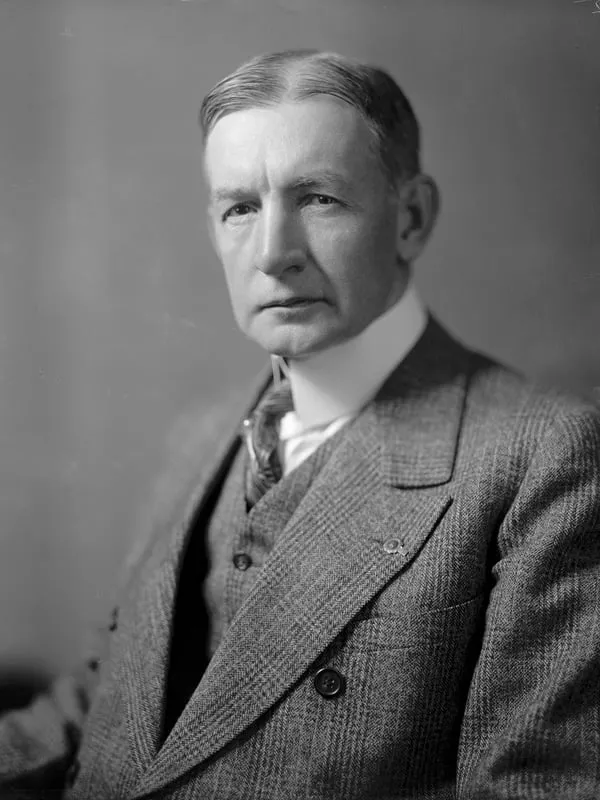
Charles G. Dawes
Director of the Bureau of the Budget (1921–1922), chairman of the reparations expert committee (1924), Vice President of the United States (1925–1929), ambassador in London (1929–1932)
- Born:
- 27 August 1865, Marietta (Ohio)
- Died:
- 23 April 1951, Evanston (Illinois)
- Author:
- Natalia
- Photo:
- Harris & Ewing, domena publiczna, Wikimedia Commons

Charles Gates Dawes was a Chicago banker, a general in charge of supply, the first director of the American budget bureau, Vice President of the United States and a Nobel Peace Prize laureate – and, along the way, the composer of a tune that became a hit after his death. Yet he went down in history thanks to a single document. In 1924 he chaired an international committee of experts that devised a new way for Germany to pay reparations. The Dawes Plan ended the conflict over the Ruhr, halted the downward spiral into which Germany had sunk after hyperinflation and opened a few peaceful years in Europe. At the same time it made Germany dependent on American credit, whose withdrawal after 1929 helped carry Hitler to power. Dawes is one of the figures who show how much Europe’s fate between the wars depended on America, even though officially it kept its distance from European affairs.
Youth, law and gas
He was born on 27 August 1865 in Marietta, Ohio. His father, Rufus Dawes, commanded the 6th Wisconsin Regiment of the famous Iron Brigade during the Civil War and fought at Gettysburg. Among the family’s ancestors were a passenger on the Mayflower and William Dawes, who in 1775, together with Paul Revere, warned the colonists of the approach of the British. Charles graduated from Marietta College in 1884 and from law school in Cincinnati in 1886, and in 1889 he married Caro Blymyer.
For several years he practised law in Lincoln, Nebraska. There he befriended two men who were to play a great part in the country’s history: Lieutenant John Pershing, then a military instructor at the local university, and the Democrat William Jennings Bryan, with whom he argued about monetary policy. Pershing is said to have considered leaving the army for the law, and it was Dawes who supposedly talked him out of it. During the panic of 1893 Dawes moved to Chicago and went into business: he bought stakes in gasworks in the Midwest and ran gas companies in La Crosse and Evanston.
The Republicans’ banker
In 1896 the Republicans put him in charge of William McKinley’s campaign in Illinois. After his victory McKinley appointed him Comptroller of the Currency in the Treasury Department – in effect the federal supervisor of banks. Dawes held the post from 1898 to 1901, recovering money owed by banks that had failed during the crisis and changing the practices that had led to it. In 1901 he resigned to run for a Senate seat, but after McKinley’s assassination the new President, Theodore Roosevelt, backed his rival. Dawes declared that he was done with politics, and in 1902 he founded the Central Trust Company of Illinois bank in Chicago, which he ran until 1921.
In September 1912 his son Rufus, a Princeton student, drowned in Lake Geneva, Wisconsin. Dawes commemorated him by funding cheap hotels for homeless men in Chicago and Boston. In the same year his short piece for violin and piano, “Melody in A Major”, became well known. Dawes, who was self-taught, played the piano and the flute. In 1951, after his death, the lyricist Carl Sigman added words to it, creating the song “It’s All in the Game”, which in Tommy Edwards’s 1958 recording topped the charts for several weeks in the United States and Britain.
The supply general
During the years of neutrality Dawes publicly supported the large loan to Britain and France made in 1915 by the bank J.P. Morgan & Co. When the United States entered the war he joined the army in June 1917, at the age of 51, as a major in an engineer regiment. Pershing, commander of the American Expeditionary Forces in France, made him General Purchasing Agent. Dawes headed a board that bought for the army in Europe everything that could not be shipped across the Atlantic, from timber to horses. He also brought about the creation of an inter-Allied military board of supply, on which he sat as the American representative. In October 1918 he became a brigadier general, and for his service he received American and French decorations.
In February 1921 he was questioned by a congressional committee investigating wartime spending. Angered by accusations of extravagance, he shouted that in Europe they had not been keeping books, they had been winning a war. His exclamation “Hell and Maria!” stuck to him for the rest of his life. A few months later President Warren Harding appointed him the first director of the newly created federal Bureau of the Budget. Within a year Dawes introduced a unified budget across the administration and cut government spending markedly.
The Dawes Plan
At the beginning of 1923 France and Belgium occupied the Ruhr to force Germany to pay reparations. Germany responded with passive resistance, the mark collapsed and Europe found itself in its deepest crisis since the end of the war. The US Secretary of State, Charles Evans Hughes, had long proposed handing the matter to independent experts. When the French Prime Minister, Raymond Poincaré, agreed to this in the autumn of 1923, the Reparation Commission set up a committee, and Dawes, with Washington’s backing, became its chairman.
The committee sat in Paris from January to April 1924. Dawes was its public face: he set the pace, looked after the atmosphere and the press, and spoke in a way that made people understand that reparations were an economic, not a political, matter. Most of the work on the figures, however, was done by another American, Owen D. Young, and the British economist Josiah Stamp. The plan, announced on 9 April, provided for rising annual instalments, supervision of the German central bank and railways, a loan to Germany to stabilise its currency and protection against converting the payments into foreign currencies at an unfavourable time. On 16 August 1924 in London it was accepted by the Allied governments and Germany, and France and Belgium promised to withdraw their troops from the Ruhr within a year.
For the plan Dawes received the Nobel Peace Prize for 1925, announced in 1926. He shared it with the British Foreign Secretary Austen Chamberlain, honoured for the Locarno Treaties.
Vice President
In June 1924, while the London conference on his plan was being prepared, the Republican convention chose him as its vice-presidential candidate alongside President Calvin Coolidge, after two other politicians had declined. During the campaign Dawes attacked the Progressive candidate Robert La Follette as a Bolshevik sympathiser, and in August in Maine he condemned the Ku Klux Klan, which took courage in those years. On 4 November 1924 Coolidge and Dawes won the election.
He began his term on 4 March 1925 with a scandal. In his inaugural address to the Senate, over which he presided as Vice President, he shook his fist at the senators and demanded a change to the rules that allowed a minority to block legislation with endless speeches. A few days later, while he was taking an afternoon nap at his hotel, the Senate unexpectedly voted on Coolidge’s nominee for Attorney General. Dawes did not arrive in time to cast the deciding vote, and the nomination failed. Relations with the President soured. Dawes supported bills to help indebted farmers, which Coolidge vetoed, and in 1928 he was not renominated. Charles Curtis became the vice-presidential candidate alongside Herbert Hoover.
Ambassador and depression
In 1929 Hoover sent him to London as ambassador. In June of that year Dawes discussed naval arms limitation with the Prime Minister, Ramsay MacDonald, which opened the way to a conference that ended in April 1930 with the London Naval Treaty. As ambassador he refused to wear the traditional knee breeches at court, explaining that Americans would not understand it. He watched at close quarters the collapse of the system he had helped to build. American banks withdrew their credit from Germany, the reparations instalments became impossible to pay, and the Young Plan, which had replaced his plan in 1929, collapsed in 1931.
At the beginning of 1932 Hoover appointed him president of the newly created Reconstruction Finance Corporation, a federal agency lending to banks and businesses threatened with bankruptcy. Dawes ran it for only a few months. In June 1932 he resigned to rescue his Chicago bank, Central Republic, and when shortly afterwards the agency lent that bank some 90 million dollars, his opponents accused him of abusing his position. That was the end of his public career. In 1936 he declined when the Republicans sounded him out about running for President against Franklin Delano Roosevelt, whose policy of heavy state spending he detested.
The last years
To the end of his life he was chairman of the board of the City National Bank in Chicago, which he had founded in 1932. He wrote and published his diaries: from the war, the vice-presidency and the embassy. He lived through the Second World War – to which the road had also led through the collapse of his plan – as an elderly man far from politics. He died on 23 April 1951 at his home in Evanston, near Chicago, aged 85. His house is now a museum.
Significance
Dawes was not an outstanding economist, and he did not devise the plan that bears his name on his own. He was, however, a man who could persuade bankers, politicians and public opinion to accept a solution, and his name became the symbol of America’s return to European affairs after its rejection of the Treaty of Versailles. The Dawes Plan saved the German currency, ended the occupation of the Ruhr and made possible Gustav Stresemann’s policy of understanding. It rested, however, on the assumption that American capital would flow into Germany indefinitely. When it stopped flowing after 1929, Germany, more indebted than other countries, plunged into a crisis out of which grew the movement of Adolf Hitler. Germany paid the last interest on the Dawes loan only in 2010.
Sources
Often appears with
People who appear in the same events.