1919–1922: The Greco-Turkish War
The Greco-Turkish War
- Dates:
- 15 May 1919 – 11 October 1922
- Front:
- Middle East
- Location:
- Western and central Anatolia, from Smyrna (İzmir), Bursa and Uşak to the Sakarya river near Ankara, as well as Eastern Thrace and the Straits zone (the Dardanelles and the Bosporus)On the battle map →
- Sides:
- The Turkish National Movement (from April 1920 the government of the Grand National Assembly in Ankara)Mustafa Kemal Atatürk, İsmet İnönü, Fevzi Çakmak
- Result:
- Turkish victory. The Greeks left Anatolia and Eastern Thrace, the Treaty of Sèvres was replaced in 1923 by the Treaty of Lausanne, and the two states exchanged populations.
- Author:
- Łukasz
The Greco-Turkish War was the last war to grow directly out of the partition of the Ottoman Empire after the First World War, and the only one in which a defeated power managed to overturn by force of arms the peace imposed on it. It began on 15 May 1919, when, with the consent of the leaders of the Paris Peace Conference, Greek troops landed at Smyrna (İzmir), the largest city of western Anatolia. The Greece of Prime Minister Eleftherios Venizelos saw this as the first step towards realising the Great Idea – the union of all Greeks in a single state. The Turks regarded the landing as the prelude to the partition of their land and rallied around General Mustafa Kemal, who built a new government and a new army in the Anatolian interior. For two years the Greeks advanced, and in the summer of 1921 they stood less than a hundred kilometres from Ankara, but they were halted on the Sakarya river. In August 1922 the Turkish army went over to the offensive and within two weeks drove them into the sea, and Smyrna went up in flames. The Armistice of Mudanya of 11 October 1922 ended the fighting, and the Treaty of Lausanne of 1923 gave birth to the Republic of Turkey and sealed an exchange of populations that put an end to a Greek presence in Asia Minor dating back to antiquity.
Name and dates
The Greeks call these events the Asia Minor Campaign (Μικρασιατική Εκστρατεία) and its end the Asia Minor Catastrophe (Μικρασιατική Καταστροφή). For the Turks the fighting against the Greeks was the western front of the Turkish War of Independence (Kurtuluş Savaşı), waged in the same years against Armenia in the east and against France in Cilicia in the south. Polish literature usually speaks of the Greco-Turkish War of 1919–1922, to distinguish it from the short Greco-Turkish War of 1897.
Most Greek and Western studies take 15 May 1919, the day of the Smyrna landing, as the start of the war. Turkish historiography tends instead to date its War of Independence from 19 May 1919, when Mustafa Kemal landed at Samsun on the Black Sea. Until the autumn of 1920 there was, moreover, no formal state of war: the Greeks held the zone around Smyrna as mandatories of the victorious powers, and they were fought above all by irregular Turkish bands.
The war is taken to have ended on 11 October 1922, when representatives of Britain, France and Italy signed an armistice with the Ankara government at Mudanya on the Sea of Marmara. Greece acceded to it two or three days later (sources give 13 or 14 October), and the armistice came into force on 15 October, which is why some sources end the war on 14 October. The fighting in Anatolia had ceased in September, and peace was not signed until 24 July 1923, at Lausanne. Greece used the Julian calendar until February 1923, so Greek sources give dates 13 days earlier (for them the Smyrna landing took place on 2 May). Dates are given according to the Gregorian calendar.
Background
The Great Idea and the National Schism. From independence in 1830 Greek politicians were guided by the Megali Idea, the dream of a state embracing all the lands inhabited by Greeks, with Constantinople as its capital. In the Balkan Wars of 1912–1913 Greece almost doubled its territory, but more than one and a half million Orthodox Greeks still lived under the Sultan’s rule in Asia Minor – in Smyrna, on the Sea of Marmara and in Pontus on the Black Sea. During the First World War the country was torn apart by the so-called National Schism. Prime Minister Venizelos wanted to join the Entente, which promised him gains in Asia Minor, while King Constantine I, brother-in-law of Kaiser Wilhelm II, insisted on neutrality. In 1917 the Allies forced the King to abdicate, and Venizelos’s Greece entered the war. The quarrel between Venizelists and royalists outlasted the war, however, and, as it turned out, weighed heavily on the fate of the campaign in Anatolia.
The partition of the Ottoman Empire. On 30 October 1918 Turkey signed the Armistice of Mudros. Its army was disarmed, and Article 7 allowed the Allies to occupy any strategic point in the event of a threat to their security. Allied fleets anchored off Constantinople, and in March 1919 the Italians landed at Antalya. During the war the Allies had repeatedly promised the same lands to different claimants: in 1917, in the Agreement of Saint-Jean-de-Maurienne, they had assigned the Smyrna region to Italy, while Venizelos held that Smyrna belonged to Greece. At the Paris Peace Conference the Greek prime minister found an ardent champion in the British Prime Minister, David Lloyd George, who saw Greece as the future guardian of British interests in the eastern Mediterranean.
The decision to land. In April 1919 the Italian delegation, led by Prime Minister Vittorio Emanuele Orlando, left Paris in protest at the refusal to give Italy Fiume. Lloyd George took advantage of its absence. Citing reports of a threat to the Christians around Smyrna, and wishing to forestall the Italians, who were beginning to move north from Antalya, he persuaded the President of the United States, Woodrow Wilson, and the French Prime Minister, Georges Clemenceau, to agree in early May to send Greek troops to Smyrna. The occupation was to be temporary and would not prejudge sovereignty over the city. The Italians, who returned to Paris on 5 May, had to accept a fait accompli.
Course of the war
1919: the Smyrna landing and the birth of Turkish resistance
On 15 May 1919, under the cover of Greek, British and French warships, the first units of the Greek 1st Infantry Division – between some fifteen and twenty thousand men, depending on the source – landed in the harbour of Smyrna. Crowds of local Greeks greeted them as liberators, and Metropolitan Chrysostomos blessed the soldiers on the quayside. As a battalion of evzones marched past the governor’s residence and the Turkish barracks, a shot rang out. Turkish tradition attributes it to the journalist Hasan Tahsin, who is said to have thus begun the resistance, although scholars still disagree about who fired. The Greeks opened fire on the barracks and the Turkish soldiers surrendered; during the march of the prisoners to the harbour and in the riots that engulfed the city, according to the most frequently cited estimates, three to four hundred people were killed on the Turkish side and about a hundred on the Greek side. An inter-Allied commission of inquiry, which investigated these events in the summer of 1919, laid the blame chiefly on the Greeks, and a Greek court martial sentenced several dozen people of various nationalities. The High Commissioner of Smyrna, Aristeidis Stergiadis, severely punished violence against Turks, but in the following months clashes and killings occurred on both sides, most bloodily at Aydın, which changed hands several times in late June and early July.
The landing electrified the Turks. Four days after it, General Mustafa Kemal, the hero of the defence of Gallipoli, landed at Samsun, sent by the Sultan’s government as an inspector of the army in Anatolia. Instead of disarming what was left of the army, he began to organise resistance. In the summer he left the army, and congresses at Erzurum and Sivas recognised him as leader of the national movement. The movement’s programme, adopted in January 1920 by the last Ottoman parliament as the National Pact, demanded the indivisibility of the lands inhabited by a Muslim majority. When in March 1920 the Allies formally occupied Constantinople and dispersed parliament, Kemal summoned a new assembly to Ankara. On 23 April 1920 the Grand National Assembly met there and declared itself the sole legitimate representative of the nation. The Sultan’s court martial sentenced Kemal to death in absentia.
For the first year the Greeks kept to the zone around Smyrna whose limits had been fixed by the Allies – the so-called Milne Line, named after the British general. Along its edge a guerrilla war went on against volunteer units (Kuva-yi Milliye) and bands swelled by demobilised soldiers.
1920: the summer offensive and the Treaty of Sèvres
In the spring of 1920 the powers agreed at San Remo on the terms of peace with Turkey. When Ankara rejected them and Kemalist forces threatened the British around İzmit, Lloyd George agreed to a Greek offensive. On 22 June 1920 the Greek army moved out from the Milne Line. Within a few weeks it had taken Balıkesir, on 8 July Bursa, the old Ottoman capital, and at the end of August Uşak. In July other Greek units occupied Eastern Thrace with Adrianople (Edirne). The weak Turkish forces fell back, avoiding a decisive battle.
On 10 August 1920 the Sultan’s government signed the Treaty of Sèvres. Greece received Eastern Thrace almost up to Constantinople, as well as the islands of Imbros and Tenedos at the entrance to the Dardanelles. Smyrna and its hinterland formally remained under the Sultan’s sovereignty but passed under Greek administration, and after five years its local parliament could request union with Greece, a question to be settled by a plebiscite under the supervision of the League of Nations. The Straits were internationalised, a greater Armenia and Kurdish autonomy were provided for in the east, and Turkey was left with a truncated Anatolia and an army of just over 50,000 men. No Turkish parliament ever ratified the treaty, and the Ankara government declared its signatories traitors. For Venizelos’s Greece – the “Greece of two continents and five seas” – it was the moment of its greatest triumph.
In the autumn of 1920 everything was reversed. In the east the forces of General Kâzım Karabekir crushed Armenia, which at the beginning of December, as the Red Army was already entering Yerevan, signed the Treaty of Alexandropol and ceded Kars to Turkey. Since the spring of 1920 Kemal had been seeking Bolshevik help, and from the autumn he received gold and weapons from Soviet Russia. In Athens, on 25 October 1920, the young King Alexander died after being bitten by a monkey in the royal garden. The election of 14 November, which Venizelos presented as a plebiscite on his policy, was won by the royalists, who promised the war-weary Greeks an early peace. Venizelos himself did not even win a seat and left the country. In December, after a referendum with an astonishingly one-sided result, Constantine I returned to Athens. For France and Italy, which had long distrusted the Germanophile king, this was a pretext to break with the policy of Greek expansion. The new government of Dimitrios Gounaris dismissed hundreds of Venizelist officers, and command of the Army of Asia Minor passed to General Anastasios Papoulas, a loyal monarchist. The royalists, who had promised peace, nevertheless carried on the war, counting on a victory that would reconcile the Allies to them.
January–April 1921: the battles of İnönü
Ankara, meanwhile, was replacing its volunteer units with a regular army. Command of the western front – initially only of its northern sector – was taken by Colonel İsmet, later İsmet Pasha and from 1934 İnönü, who since May 1920 had also been Chief of the General Staff of the Assembly’s army. He also dealt with the unruly partisan leader Çerkez Ethem. On 6 January 1921 two Greek columns set off from the Bursa and Uşak areas towards Eskişehir to reconnoitre the enemy’s strength. On 10 and 11 January, near the village of İnönü, on the pass leading to Eskişehir, they ran into Turkish positions and turned back after two days of fighting. The clash was a small one, but the national movement had its first victory won by a regular army. İsmet was promoted to general, and the Allies invited a delegation from Ankara, alongside the Sultan’s delegation, to a conference in London on revising the Treaty of Sèvres. The talks came to nothing.
On 23 March 1921 the Greeks attacked again, this time with much larger forces. In the south they took Afyonkarahisar, but in the north, at İnönü, they came up against fortified defences. After several days of fierce fighting and a Turkish counter-attack, they had to withdraw on 31 March, and the southern wing pulled back from Afyon in their wake. On 1 April Kemal answered İsmet’s report with a famous telegram in which he wrote that his soldiers had defeated not only the enemy but also the “ill fate of the nation”. Shortly before, on 16 March, Ankara’s representatives had signed in Moscow a Treaty of Friendship with Soviet Russia, which recognised their government and promised further aid. The government of Vladimir Lenin saw Kemal as an ally against British imperialism, and the Kemalists saw the Bolsheviks as their only source of arms.
July–September 1921: Kütahya, Eskişehir and the Sakarya
In the summer of 1921 Greece assembled in Anatolia the largest army in its history: nine to eleven divisions, more than a hundred thousand men in the front line. King Constantine came to Smyrna and assumed nominal supreme command. On 10 July an offensive began whose aim was to cut across Anatolia along the Afyon–Kütahya–Eskişehir railway and destroy the Turkish army. This time the Greeks did not attack head-on at İnönü but outflanked the Turks from the south. Afyon fell on 13 July, Kütahya on 17 July and Eskişehir on 19–20 July. The Battle of Kütahya–Eskişehir was the Turkish army’s heaviest defeat of the war. Mustafa Kemal, who had come to the front, decided that the army had to be saved from encirclement and ordered a retreat to the east bank of the Sakarya, a few dozen kilometres from Ankara, even at the price of surrendering an enormous territory to the enemy. The Greeks failed to intercept it.
Ankara was in turmoil. Some deputies demanded that the government be moved to Kayseri. At the beginning of August the Assembly removed İsmet from the post of Chief of the General Staff and entrusted it to Fevzi Pasha, who was already prime minister and minister of defence. On 5 August it passed a law under which Mustafa Kemal assumed supreme command for three months with the full powers of the Assembly. İsmet remained commander of the western front. Under Kemal’s orders every household had to hand over to the army a share of its grain, clothing and draught animals.
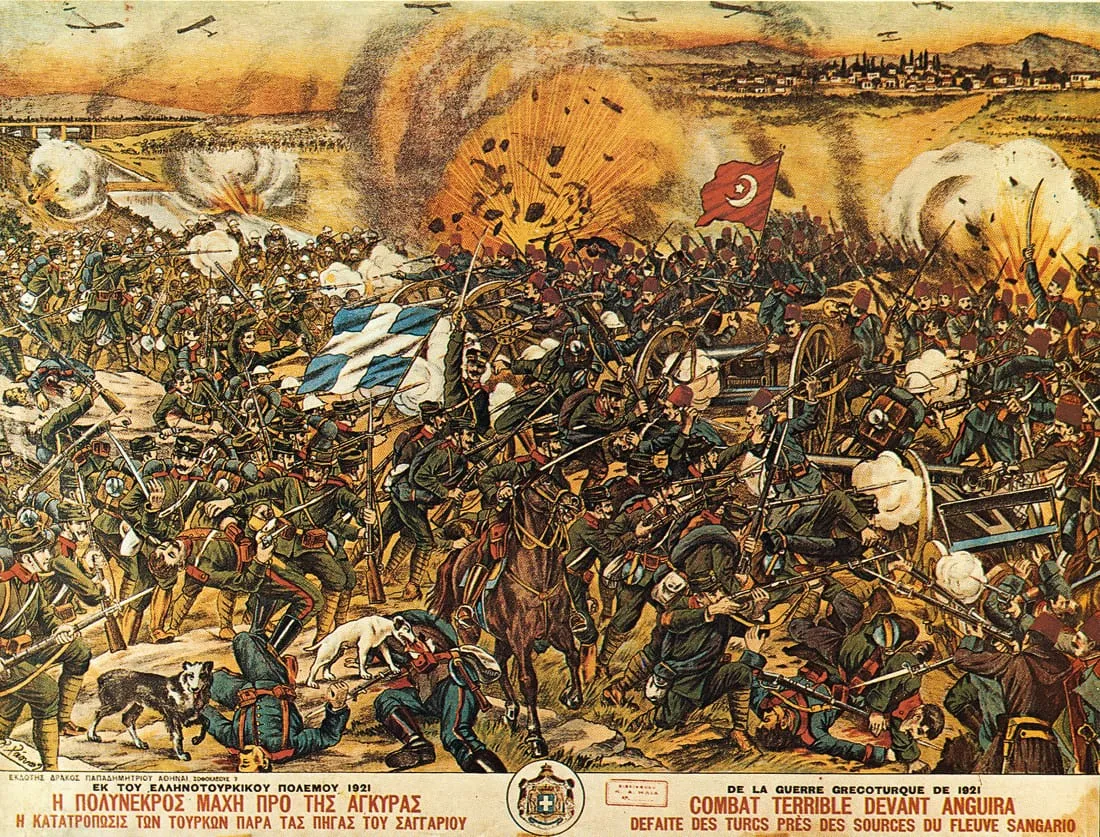
The Greeks, meanwhile, hesitated. At a council of war in Kütahya the King, Prime Minister Gounaris and Papoulas decided to march on Ankara and destroy the Turkish army on its last line of defence. Papoulas had doubts but did not oppose the politicians. After almost a month of preparations, which gave the Turks time to dig in, seven Greek divisions set off east in mid-August, marching for more than a week across a parched, almost uninhabited steppe. On 23 August 1921 the Battle of the Sakarya began, one of the longest battles of those years. On a front some hundred kilometres long, on the hills east of the river and its tributary the Gök, attacks and counter-attacks went on for three weeks. Kemal, who had broken a rib falling from his horse at the beginning of August, directed the battle from his headquarters near Polatlı. His order declared that there was no line of defence, only an area of defence, and that this area was the whole of the homeland: every unit driven from its position was to halt at the first possible spot and fight on. At the beginning of September the Greeks took the key height of Mount Çal and in several places came within less than fifty kilometres of Ankara, where the thunder of the guns could be heard. But they were short of ammunition and food, because Turkish cavalry was cutting their supply lines, and their strength was spent. After a Turkish counter-attack on 8–10 September, Papoulas ordered a retreat, and on 13 September 1921 the Greek army withdrew behind the Sakarya and then to the Afyon–Eskişehir line, blowing up bridges and railway track behind it and burning villages. The Turks call it the Battle of the Officers, because a huge proportion of the officer corps was killed or wounded in it.
On 19 September 1921 the Grand National Assembly conferred on Mustafa Kemal the rank of marshal (müşir) and the title of gazi, a victor in the fight for the faith. The victory on the Sakarya changed the diplomatic balance. On 13 October 1921 Ankara signed the Treaty of Kars with the Transcaucasian republics and Soviet Russia, which fixed its eastern border, and on 20 October an agreement with the French envoy Henry Franklin-Bouillon, under which the French evacuated Cilicia and left the Turks a large part of their weapons there. The Italians had already been withdrawing from the Antalya region and, like the French, were selling arms to the Kemalists. Greece was left practically alone, supported only by Lloyd George’s words.
September 1921 – August 1922: a year of waiting
The front froze along an arc more than 700 kilometres long, from İzmit on the Sea of Marmara through Eskişehir to Afyonkarahisar and on to the south. Greece, financially and politically exhausted, had neither the strength for a new offensive nor the courage to withdraw. In March 1922 the powers proposed a ceasefire and a plan that would return Smyrna and part of Thrace to Turkey. Athens accepted it, but Kemal rejected any settlement as long as the Greeks remained in Anatolia. In the spring of 1922 Papoulas, who disagreed with the government over the conduct of the war, resigned and was succeeded by General Georgios Hatzianestis, an officer with a reputation for eccentricity. In July Athens transferred some troops from Anatolia to Thrace and demanded that the Allies allow it to occupy Constantinople. The powers refused, and the only effect of this demonstration was to weaken the front in Asia Minor. An army that had not seen home for years was losing faith in the point of the war.
Over that year the Turks mobilised everything they had. By August 1922 the army of the western front numbered nearly two hundred thousand men, roughly as many as the Greek army, though still less well armed. Kemal adopted a plan to strike at the most exposed salient of the Greek front, around Afyon, with forces secretly concentrated in the south. Only a handful of commanders knew the date of the attack.
26 August – 18 September 1922: the Great Offensive
On the morning of 26 August 1922, from his command post on the hill of Kocatepe near Afyon, Mustafa Kemal gave the signal for the attack that the Turks call the Büyük Taarruz, the Great Offensive. The First Army of General Nureddin Pasha broke through the positions of the Greek I Corps south-west of Afyon, and the cavalry got into the rear through a lightly guarded valley. On 27 August the Greeks abandoned Afyon. The main group of Greek divisions, retreating westwards, was surrounded near Dumlupınar on 29 and 30 August and destroyed in what the Turks call the Battle of the Commander-in-Chief. 30 August is today Victory Day in Turkey; a day later Fevzi Pasha was made a marshal and İsmet was promoted to major general. Around the turn of August and September (Greek and Turkish sources give different days) the corps commanders, Generals Nikolaos Trikoupis and Kimon Digenis, were taken prisoner. Trikoupis learned in captivity that the government had just appointed him commander-in-chief in place of Hatzianestis, who had remained in Smyrna throughout and had lost control of the situation.
On 1 September Kemal issued his order: “Armies, your first goal is the Mediterranean. Forward!” The Greek army fell back in disorder towards the coast, burning towns and villages along the way, such as Uşak, Alaşehir and Manisa. The local Greeks fled with it, and Turkish soldiers and irregulars took revenge on those who stayed behind. On 2 September the Turks entered Eskişehir, and on 8 September Manisa. The Greek government asked Britain to mediate an armistice, but Kemal would not even hear of a Greek presence in Smyrna. Stergiadis left the city on 8 September aboard a British warship.
On 9 September 1922 Turkish cavalry rode into Smyrna, and Mustafa Kemal arrived the following day. Tens of thousands of Greek and Armenian refugees had gathered in the city. The Orthodox Metropolitan Chrysostomos – the same man who had blessed the Greek soldiers in 1919 – was handed over to a mob, which murdered him. Soldiers and local people looted the Armenian quarter and killed its inhabitants. On 13 September a fire broke out in the Armenian quarter which, fanned by a strong wind, within a few days destroyed the Armenian, Greek and European quarters, sparing the Muslim and Jewish ones. Tens of thousands of people – hundreds of thousands, according to some accounts – crowded onto the quayside, waiting to be rescued, while the warships of the powers lying in the harbour for many days refused to intervene, citing their neutrality. The death toll of the Great Fire of Smyrna and the killings that accompanied it is disputed: estimates range from ten thousand to more than a hundred thousand. Most historians and eyewitnesses hold Turkish soldiers responsible for starting the fire; Turkish sources accused the Armenians and Greeks. Men aged between 18 and 45 who had not managed to escape were detained by the Turks and sent to labour battalions in the interior of Anatolia, from which many never returned. On 18 September the last Greek units left Anatolia.
September–October 1922: the Chanak Crisis and the Armistice of Mudanya
The victorious army moved north towards the Straits and Constantinople, where Allied garrisons were stationed, while beyond the Straits, in Eastern Thrace, the Greeks were still present. On 15 September Kemal told a British journalist that Turkey demanded Asia Minor, Thrace up to the Maritsa and Constantinople, and that he would prefer to obtain them through negotiation but would not wait indefinitely. Lloyd George’s government decided to defend the neutral zone along the Straits and called on the Dominions to join in the war. Canada refused, the other Dominions responded coolly or evasively, and only New Zealand gave London its unequivocal support. France and Italy withdrew their troops from Çanakkale (Chanak) on the Asian shore of the Dardanelles. At the end of September Turkish units entered the neutral zone and stood facing the British barbed wire. The British Cabinet sent an ultimatum, but General Charles Harington, in command at Constantinople, decided not to deliver it and came to an understanding with the Turks. War was averted.
Negotiations opened at Mudanya on 3 October. Turkey was represented by İsmet Pasha, the Allies by British, French and Italian generals. The armistice was signed on 11 October. The Greeks were to withdraw from Eastern Thrace behind the Maritsa within fifteen days, and the Turkish authorities were to take over civil administration there within a month. According to contemporary estimates, more than two hundred thousand Greek civilians left Eastern Thrace, which Greece had held since 1920, together with the army within a few weeks.
Aftermath
The defeat set off a coup in Greece. On 24 September 1922 (11 September by the Julian calendar) officers of the troops evacuated to Chios and Lesbos, led by Colonel Nikolaos Plastiras, demanded the King’s abdication. Constantine I abdicated on 27 September in favour of his son George II and went into exile, where he died in January 1923. An extraordinary military tribunal sentenced to death for high treason five politicians, among them the former prime minister Gounaris, and General Hatzianestis. They were shot on 28 November 1922. The Greek Supreme Court overturned the verdicts in 2010.
In Turkey the National Assembly abolished the sultanate on 1 November 1922. At the Lausanne peace conference, which with an interruption lasted from November 1922 to July 1923, İsmet Pasha won recognition of Turkey’s full sovereignty. The Treaty of Lausanne, signed on 24 July 1923, gave Turkey Eastern Thrace up to the Maritsa, Imbros and Tenedos, abolished the capitulations – the privileges enjoyed by foreigners – and replaced the internationalisation of the Straits with their demilitarisation under international supervision. On 29 October 1923 the Republic of Turkey was proclaimed, with Ankara as its capital and Mustafa Kemal as president.
As early as 30 January 1923 Greece and Turkey had signed at Lausanne a convention on a compulsory exchange of populations. Venizelos, who represented Greece at the conference, had asked the League of Nations to prepare it as early as October 1922, and Ankara had long wanted to be rid of the Orthodox inhabitants of Anatolia. The criterion was religion, not language: Orthodox citizens of Turkey, even those who spoke only Turkish, were to leave for Greece, and Muslims from Greece, even those who spoke only Greek, for Turkey. The exchange covered about 1.2 million Orthodox Christians, most of whom had already fled in 1922, and about 350,000–400,000 Muslims. The only people exempted were the Greeks of Constantinople, Imbros and Tenedos and the Muslims of Western Thrace.
Losses
The figures for losses come mainly from the official studies of the two sides and are not fully comparable. According to the Greek General Staff’s tables, the Greek army lost in 1919–1922 more than 19,000 killed and nearly 5,000 dead from other causes, about 49,000 wounded and more than 18,000 missing, while some fifteen thousand soldiers were taken prisoner, many of whom did not survive. According to official Turkish figures, the Turkish army on the western front lost about 9,000 killed, nearly 2,500 dead of wounds and disease and about 31,000 wounded. Far harder to estimate are the losses among the civilian population, who died in massacres, punitive operations, deportations and in flight. Inter-Allied commissions and observers such as the British historian Arnold Toynbee documented crimes committed by Greek troops on the Yalova–Gemlik peninsula in 1921 and during the retreat in 1922, as well as killings and deportations of Greeks in Pontus and the Anatolian interior, which Greece and Cyprus recognise as part of the genocide of the Pontic Greeks and the Greeks of Anatolia. The two sides’ estimates, running to hundreds of thousands of victims, remain disputed.
Significance
The Greco-Turkish War brought the Ottoman Empire to an end and gave birth to the Republic of Turkey. Mustafa Kemal, who had started out in 1919 as a rebel general under sentence of death, emerged from it as the founder of a new state, which until his death in 1938 he rebuilt as a modern, secular nation state. For the Greeks the defeat meant the end of the Great Idea. A country of about five million people had to take in more than a million refugees, who settled in new districts of Athens and Piraeus and in Greek Macedonia. The war deepened the rift between Venizelists and royalists. In 1924 Greece became a republic; in 1935 it returned to monarchy, and a year later it came under the dictatorship of General Ioannis Metaxas, which ruled it when the Second World War broke out. Even so, the enemies of 1919–1922 were soon reconciled. In 1930 Venizelos travelled to Ankara, and in 1934 Greece and Turkey concluded the Balkan Entente with Yugoslavia and Romania.
The war also had consequences far beyond the Balkans. The Chanak Crisis showed that the British Dominions would no longer automatically go to war at London’s side, and its first victim was Lloyd George, who lost power on 19 October 1922 when the Conservatives withdrew their support. Above all, however, Turkey was the only defeated state of the First World War to overturn by force the treaty imposed on it and win a new one. In Germany, where the Treaty of Versailles was loathed, nationalists followed Kemal’s victory closely. The historian Stefan Ihrig has described how the right-wing press and the Nazis held up Ankara as a model for Germany, and Adolf Hitler was still speaking of Kemal with admiration in the 1930s. Less than three weeks after the Armistice of Mudanya, Benito Mussolini took power in Italy, and in November 1923 Hitler tried to launch a march on Berlin from Munich. Revising the post-war order had ceased to be a mere dream.
The population exchange, too, had a long afterlife. The international community came to regard it as a way of resolving national disputes, and for the next two decades it was invoked as a precedent for forced resettlement. On 15 December 1944 Winston Churchill, urging the House of Commons to accept the expulsion of the Germans from the lands that Poland was to receive, said that the separation of the populations of Greece and Turkey after the previous war had in many respects been a success. The lessons of Anatolia – both that treaties could be revised by force and that the ethnic map could be “tidied up” by expulsion – were remembered by those who reshaped Europe twenty years later.