Ireland
Éamon de Valera
President of the Executive Council of the Irish Free State (1932–1937), Taoiseach (prime minister) of Ireland (1937–1948, 1951–1954, 1957–1959), President of Ireland (1959–1973)
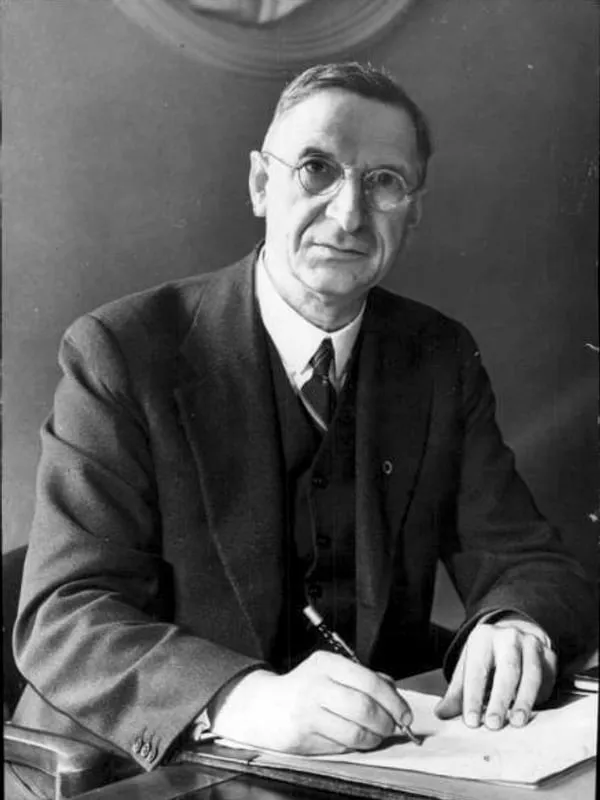
- Born:
- 14 October 1882, New York (United States)
- Died:
- 29 August 1975, Blackrock, near Dublin (Ireland)
- Author:
- Łukasz
- Photo:
- autor nieznany, domena publiczna, Wikimedia Commons

For half a century Éamon de Valera was the dominant figure in Irish politics: a veteran of the Easter Rising, leader of the republicans in the War of Independence and the Civil War, founder of the Fianna Fáil party, author of the 1937 constitution, three times head of government and twice elected president. In the history of the Second World War he matters above all as the man who in 1938 recovered from Britain the naval ports on the Irish coast and who during the Second World War kept Ireland neutral, refusing those ports to the British in the most difficult months of the Battle of the Atlantic. Some see him as the father of an independent state and a statesman who saved his country from war; others as a politician who shared responsibility for a fratricidal civil war and for Ireland’s long years of isolation and stagnation.
Childhood and youth
He was born on 14 October 1882 in New York, in a Manhattan home for destitute mothers and abandoned children. His mother, Catherine Coll, was an emigrant from the village of Bruree in County Limerick. His father, Juan Vivion de Valera, appears on the birth certificate as a Spanish artist; researchers, however, have found neither a marriage certificate nor any other documents, and his place of birth is disputed to this day. On the original certificate the boy was registered as George de Valero; as a child he was called Edward, and he adopted the Irish form of his name, Éamon, as a young activist in the language movement. His father died when the boy was two, and an uncle took him to Ireland. His mother remarried in America, and the boy was brought up in Bruree by his grandmother.
A gifted pupil, he won a scholarship to Blackrock College in Dublin and in 1904 took a degree in mathematics from the Royal University of Ireland. He taught mathematics in schools and teacher-training colleges and tried without success to obtain a university chair. All his life he remained a keen rugby fan and a lover of mathematics. In 1908 he joined the Gaelic League, which championed the Irish language, and there he met a teacher, Sinéad Flanagan. They married in 1910 and had seven children.
The Easter Rising and prison
On 25 November 1913 de Valera joined the Irish Volunteers, formed in response to the armed volunteer units of the Ulster unionists. He quickly rose to commandant of the 3rd Battalion of the Dublin Brigade and, although he disliked secret societies, was sworn into the Irish Republican Brotherhood, which was preparing a rising. During the Easter Rising, which broke out on 24 April 1916, his men occupied Boland’s Mills and the surrounding area, defending the south-eastern approaches to Dublin. He was one of the last commanders to surrender. A court martial sentenced him to death, but the sentence was commuted to penal servitude for life. Several circumstances saved him: his trial took place late, when the British were halting executions under the pressure of public opinion; the American consulate was enquiring about his citizenship; and the authorities regarded him as a figure of little importance.
He was held in the prisons of Dartmoor, Maidstone and Lewes. Released under an amnesty in June 1917, he returned home as one of the few surviving commanders of the Rising. In July he won a by-election in East Clare, and in October he became president of Sinn Féin, which had become the political voice of the republican movement.
Leader of the republic
In May 1918, during the crisis over plans to introduce conscription in Ireland, the British arrested him again. In the December election Sinn Féin won 73 of the 105 Irish seats, and instead of going to Westminster its members met in Dublin, where in January 1919 they set up their own parliament, Dáil Éireann, and proclaimed independence. The War of Independence began. In February 1919 de Valera escaped from Lincoln prison and in April became head of the Dáil government. From June 1919 to December 1920 he was in the United States. He did not obtain recognition of the republic, but he raised a loan of more than 5 million dollars among Irish Americans. In the meantime the day-to-day direction of the fight and of the government fell to Michael Collins.
After the truce of July 1921 de Valera held talks in London with Prime Minister David Lloyd George, but reached no agreement. In August the Dáil made him President of the Republic. He did not go to the actual negotiations in the autumn of 1921, sending instead a delegation that included Arthur Griffith and Collins; historians generally regard this decision as a mistake. The Anglo-Irish Treaty, signed on 6 December 1921, created the Irish Free State as a dominion of the Crown, with an oath of fidelity to the King, with the option for Northern Ireland to opt out and with three ports left to the Royal Navy. De Valera rejected it. In its place he proposed “external association” with the British Commonwealth – which, interestingly, would also have given the British temporary use of the ports. In January 1922 the Dáil approved the Treaty by 64 votes to 57, and de Valera resigned and, together with the Treaty’s opponents, walked out of parliament.
The Civil War
His fiery speeches in the spring of 1922, in which he said that the Treaty’s opponents would have to “wade through blood” – the blood of the soldiers of the Irish government – still weigh against him. When the Civil War broke out in June, de Valera backed the republican part of the IRA, although he had no real influence over its commanders’ decisions. The war, during which Griffith died and Collins was killed in an ambush, ended in May 1923 in defeat for the republicans. De Valera called on the “Legion of the Rearguard” to lay down their arms and acknowledged that military victory must for the moment rest with those who had “destroyed the Republic”. In August 1923 he was arrested at an election meeting in Ennis. He spent almost a year in prison.
Fianna Fáil and the dismantling of the Treaty
Once free, he concluded that boycotting the institutions of the Free State led nowhere. When Sinn Féin rejected his proposal, in 1926 he founded a new party, Fianna Fáil, together with Seán Lemass. In 1927, after the assassination of the minister Kevin O’Higgins and the announcement of a law that would bar from elections candidates who did not intend to take the oath, his party took the oath, which de Valera called an “empty political formula”, and entered the Dáil. In the 1932 election Fianna Fáil became the largest party, and on 9 March 1932 de Valera took office as President of the Executive Council. The losers of the Civil War took power peacefully, no small achievement for a young democracy.
He at once began to dismantle the Treaty of 1921. He abolished the oath of allegiance, curtailed the role of the Governor-General and stopped paying the land annuities owed to Britain, which set off a six-year economic war. He banned General Eoin O’Duffy’s paramilitary Blueshirts and later also the IRA. He used the abdication crisis of December 1936 to remove the King from the constitution. The new constitution, approved in a plebiscite on 1 July 1937 and in force from 29 December, gave the state the name Éire (Ireland), created the offices of president and prime minister (Taoiseach), recognised the “special position” of the Catholic Church and laid claim to the whole island.
At the same time he conducted foreign policy personally. In 1932 he presided over the Council of the League of Nations and called on the great powers to abide by its Covenant; in 1935 he supported sanctions against Italy for its attack on Ethiopia, and after they failed he warned that all that was left to small states was the resolve not to become the tool of any great power. In September 1938 he became President of the League’s Assembly. He supported Neville Chamberlain’s efforts to preserve peace, including the Munich Agreement, and in Chamberlain he found a partner with whom, on 25 April 1938, he concluded an agreement ending the economic war. Britain handed the Treaty ports – Berehaven, Cobh and Lough Swilly – back to Ireland unconditionally. For de Valera this was a precondition of true independence and of the possibility of staying out of a future war. Winston Churchill protested in the House of Commons, predicting that in the event of war Ireland would declare neutrality.
Neutrality
When war broke out, de Valera declared neutrality in the Dáil on 2 September 1939, and parliament proclaimed a state of emergency and gave the government sweeping powers: censorship, internment without trial and control of the economy. In Ireland the war years were known euphemistically as the Emergency. Neutrality was supported by almost the whole of society and by the opposition. For de Valera it was proof of sovereignty; given the weakness of the army, the only sensible defence against destruction; and also a consequence of the partition of the island, since he had no intention of fighting alongside a state that kept Northern Ireland. He dealt firmly with the IRA, which was seeking contact with Germany: its members were interned and several were executed.
The hardest test came in the summer and autumn of 1940. In June, after the fall of France, the British, through Malcolm MacDonald, offered to accept the principle of Irish unity in return for abandoning neutrality or admitting British troops and warships to Irish bases. De Valera rejected the offer on 4 July, not believing that London would impose unity on the Northern unionists and fearing, as he himself put it, that he would be “cheated in the end”. He did, however, allow secret staff talks on joint defence in the event of a German landing. On 5 November 1940 Churchill told the House of Commons that the denial of the Irish ports was “a most heavy and grievous burden”, and on 7 November de Valera replied in the Dáil that there could be no question of handing them over or leasing them while Ireland remained neutral, and that any attempt at pressure would lead to bloodshed. Britain responded by cutting supplies and shipping for Ireland, which meant years of shortages of fuel, coal and food.
In practice de Valera’s neutrality was benevolent towards the Allies. Ireland passed weather forecasts and coast-watching reports of submarines to the British, allowed British flying boats to fly over a strip of its territory in County Donegal, sent Allied airmen home while interning Germans. Tens of thousands of Irishmen served in the British Army, and even more worked in British factories. After the German air raids on Belfast in April 1941 de Valera sent Dublin firemen to the North. When, after the attack on Pearl Harbor, Churchill telegraphed him “Now or never”, hinting at unity in return for entering the war, he refused. He protested against the arrival of American troops in Northern Ireland in 1942, and in February 1944 he rejected an American demand to expel the German and Japanese diplomats.
He carried formal consistency in maintaining neutrality to an extreme. On 2 May 1945 he called on the German minister, Eduard Hempel, to express condolences on the death of Adolf Hitler, in accordance with the protocol observed towards heads of state with which Ireland maintained diplomatic relations. The gesture caused outrage, especially in the United States, all the greater because in those same days the world was seeing photographs from the liberated concentration camps. When on 13 May 1945 Churchill remarked in a broadcast that Britain had never laid a hand on Ireland, “though at times it would have been quite easy and quite natural”, de Valera answered him in a radio address on 16 May. He acknowledged that Churchill had resisted the temptation to add another bloody chapter to the history of relations between the two nations, but asked whether he could not find it in his heart to be generous enough to acknowledge a small nation that for centuries had stood alone against aggression. The speech made him immensely popular at home.
After the war
In the 1948 election Fianna Fáil lost its majority, and the other parties formed the first coalition government under John A. Costello, which in 1949 declared Ireland a republic and took it out of the Commonwealth. De Valera, meanwhile, toured the world campaigning against partition and opposed Ireland’s joining NATO as long as Northern Ireland remained British. He returned as Taoiseach in 1951–1954 and 1957–1959. In September 1953 he had his first and only meeting with Churchill at Downing Street. His eyesight was failing, and he underwent several eye operations.
In June 1959, aged 76, he won the presidential election and handed over the government and the party leadership to Lemass. As president he received John F. Kennedy in 1963, and in 1966, aged 83, he was elected to a second term. When he left office in 1973 he was the oldest head of state in the world. He died on 29 August 1975 in a nursing home in Blackrock, near Dublin, a few months after his wife, with whom he had been married for almost 65 years. He was buried in Glasnevin Cemetery.
Significance
De Valera built the Irish state in the shape that has survived to this day: with its own constitution, without a king, and with Fianna Fáil as the main political force. Critics point to his share of responsibility for the Civil War, to the Catholic conservatism, censorship and economic stagnation of his governments. Defenders recall that he led the republicans from the path of violence to democracy and did not become a dictator, although he had the opportunity. For the history of the Second World War two of his decisions matter most: the recovery of the ports in 1938 and neutrality in 1939–1945. As a result the Royal Navy lacked bases on the Western Approaches in the most difficult period of the Battle of the Atlantic, while Ireland escaped the destruction of war. The price was isolation and the reputation of a state that stood aside in the war against Nazism, and de Valera himself remains a symbol of how far the neutrality of a small nation could go.
Sources
Often appears with
People who appear in the same events.