Poland
Emil Krukowicz-Przedrzymirski
Head of the Artillery Department of the Ministry of Military Affairs (1927–1929, 1938–1939), commander of Army Modlin (1939), brigadier general, major general from 1945
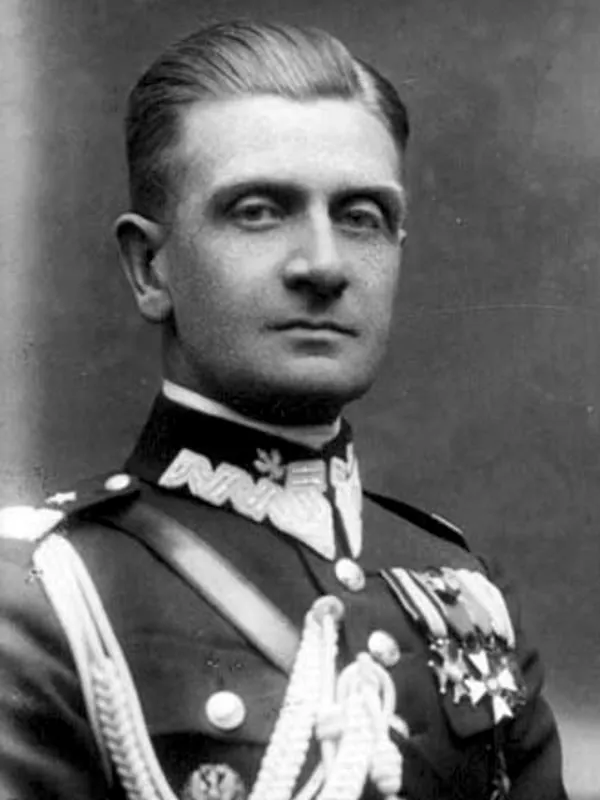
- Born:
- 25 January 1886, Niemirów (Galicia, Austria-Hungary)
- Died:
- 29 May 1957, Toronto (Canada)
- Author:
- Łukasz
- Photo:
- autor nieznany, domena publiczna, Wikimedia Commons

Emil Krukowicz-Przedrzymirski belonged to the generation of Polish generals who learned their trade in the Austro-Hungarian army. A gunner, staff officer and for many years head of the Artillery Department at the Ministry of Military Affairs, in September 1939 he commanded Army Modlin, which in the first days of the war defended at Mława the shortest route from East Prussia to Warsaw. After the retreat from the border and the fighting on the Narew and the Bug, he led the remnants of his forces south-east, until near Tomaszów Lubelski, surrounded and out of ammunition, he signed a capitulation on 26 September. He spent almost six years in German officers’ camps, did not return to Poland after the war and died in Toronto.
A gunner from Galicia
He was born on 25 January 1886 in Niemirów (PL) in Galicia, into the family of the pharmacist Karol and of Wanda, who was of Czech descent. His younger brother Henryk also became an artillery officer and was a figure skater as well, a European championship medallist. Emil completed the military secondary schools at Košice and Hranice and the Technical Military Academy at Mödling near Vienna, and in 1906 was commissioned as a second lieutenant of artillery in the Austro-Hungarian army. He served in the 32nd Field Artillery Regiment in Lemberg.
During the First World War he commanded a battery and was wounded as early as 26 August 1914 in fighting near Busk outside Lemberg. In 1915–1916 he taught at the artillery cadet school at Traiskirchen, and then returned to the regiment as adjutant, battalion commander and staff officer. In 1915 he was promoted to captain.
The war for the borders and a career in Warsaw
On 10 November 1918 he reported for service in the Polish Army. He was military delegate in a mission to Hungary and Yugoslavia, commanded a battalion of the 6th Field Artillery Regiment, and from May 1919 headed the artillery section at the High Command. During the Polish–Soviet War he took command of the 16th Field Artillery Regiment, then being formed in Grudziądz, and in the summer of 1920 also commanded the defence of the southern sector of the town; in the autumn he fought with the regiment on the North-Eastern Front. For the fighting for Horodec in Polesie he received the Silver Cross of the Virtuti Militari. He commanded the regiment until October 1922. Jerzy Kirchmayer, then his subordinate, remembered him as an elegant, composed and “exceptionally tactful” officer.
In 1922–1923 he completed a course at the Higher War School and received the diploma of a General Staff officer. He was chief of staff of Corps District No. V in Kraków and a staff officer of an army inspectorate, and in 1927 became head of the Artillery Department (PL) of the Ministry of Military Affairs. He dealt with the purchase of heavy Škoda mortars and the standardisation of the calibre of field guns, and also chaired the committee that brought the remains of General Józef Bem (PL) back from Turkey. In 1929, after a dispute with another general over the use of field guns for anti-aircraft fire, he left the department and became divisional infantry commander of the 7th Infantry Division in Częstochowa. From 1931 he commanded the 30th Polesie Infantry Division in Kobryń, and on 1 January 1932 he became a brigadier general. In 1938 he returned to the post of head of the Artillery Department.
Army Modlin
On 24 March 1939, when relations with Germany sharply deteriorated, Marshal Edward Rydz-Śmigły, in the presence of the Chief of the General Staff, General Wacław Stachiewicz, informed him that in the event of war he was to command Army Modlin. The appointment was kept secret; until mid-August Przedrzymirski officially went on running the department. The army was to cover the approaches to Warsaw and Płock, delay the Germans and as a last resort defend the line of the Narew, the Bug and the Vistula. Its commander decided to push the defence as far north as possible and give battle right at the border, on the fortified position at Mława, whose backbone was the 20th Infantry Division (PL). Two cavalry brigades stood on the flanks, and the 8th Infantry Division was in reserve near Ciechanów. The whole army numbered about 45,000 men and had to defend a sector about a hundred kilometres wide.
When on 1 September Germany invaded Poland, the Mława position was attacked by the 3rd Army of General Georg von Küchler. In the Battle of Mława the 20th Division beat off frontal attacks for three days, but on 2 September the Germans broke through the weaker sector at Rzęgnowo, east of the Niemyje marshes. On 3 September Przedrzymirski threw the 8th Division into a counter-attack; in the afternoon he changed its orders and had it attack in two diverging directions, towards Przasnysz and towards Grudusk. The attack collapsed, and during the night the division was seized by panic. In the night of 3/4 September the army commander ordered a retreat southwards. The columns of the 20th Division, withdrawing in daylight, suffered heavily from German aircraft. Historians, above all Ryszard Juszkiewicz, the author of the monograph on the battle, reproach the army command for an overextended front, poor reconnaissance on the right flank and a hasty retreat by day; others, such as General Juliusz Rómmel, blamed above all the High Command.
From the Narew to Tomaszów
Army Modlin, reinforced by Operational Group “Wyszków”, tried to hold the line of the Narew and the Bug, but as early as 6 September the Germans broke through the defences at Różan and Pułtusk. On 10 September, on the Commander-in-Chief’s orders, the 8th and 20th Divisions and the Warsaw National Defence Brigade passed to Army Warsaw; the 20th Division then defended Praga, and the 8th Division Modlin Fortress. From the remaining units of the army and of the “Wyszków” group the so-called Army of General Przedrzymirski was formed; it withdrew from the Bug towards Kałuszyn and on 11 September became part of the Northern Front (PL) of General Stefan Dąb-Biernacki (PL).
The front’s forces fell back into the Lublin region, and after the Soviet invasion on 17 September they were sent south to break through towards the Hungarian border. They reached Tomaszów Lubelski only after the capitulation of General Tadeusz Piskor’s forces and fought there the second Battle of Tomaszów Lubelski against the German VII Corps. Dąb-Biernacki dissolved the front command and left the troops, authorising Przedrzymirski to capitulate. Przedrzymirski at first did not use the authority and fought on. Only when his units were surrounded in the area of Krasnobród and Tereszpol, without ammunition or food, did he conclude that a breakthrough had no chance. At 5.30 p.m. on 26 September, in the forest near Górecko Kościelne, he signed the capitulation, having negotiated time to destroy equipment.
Captivity and emigration
He shared the fate of his soldiers. According to his Polish biography he was taken prisoner on 27 September at Piaski; some lists give 29 September. He passed through the officers’ camps Oflag VII-A Murnau, Oflag IV-A Hohnstein and Oflag VIII-E Johannisbrunn, and from 1942 was again at Murnau. At Johannisbrunn, where generals of various armies were held, he became friends with Dutch generals, for whom he commented on the course of the war on the Eastern Front. He was freed by the Americans on 29 April 1945.
After his liberation he was in Paris and Nice, where he represented a group of Polish generals before the authorities in London, and then, at the summons of the Commander-in-Chief, General Tadeusz Bór-Komorowski, came to London. Bór-Komorowski promoted him to major general in 1945, but news of the promotion reached him only in 1955. In 1947 he was reunited with his family in Great Britain, and in 1949 he left with his wife for Canada. After a year in Montreal he settled in Toronto (PL), where he founded an export-import firm, was active in Polish community and veterans’ organisations, and set up a fund to help war invalids, named after him following his death.
He died suddenly of a heart attack on 29 May 1957 in Toronto and was buried in the city’s Holy Cross Cemetery. His stepson, Ryszard Zarzycki, a scoutmaster of the Grey Ranks, was killed in the Warsaw Uprising. In 2006 the general’s name was given to the 16th Pomeranian Artillery Regiment in Braniewo, heir to the traditions of the regiment he had commanded in 1920.