- Category:
- Military operations
- Front:
- Poland
- Date:
- 1 September 1939
- Author:
- Natalia
- Battle:
- Invasion of Poland
- Tags:
- Poland, Third Reich, September Campaign, Slovakia
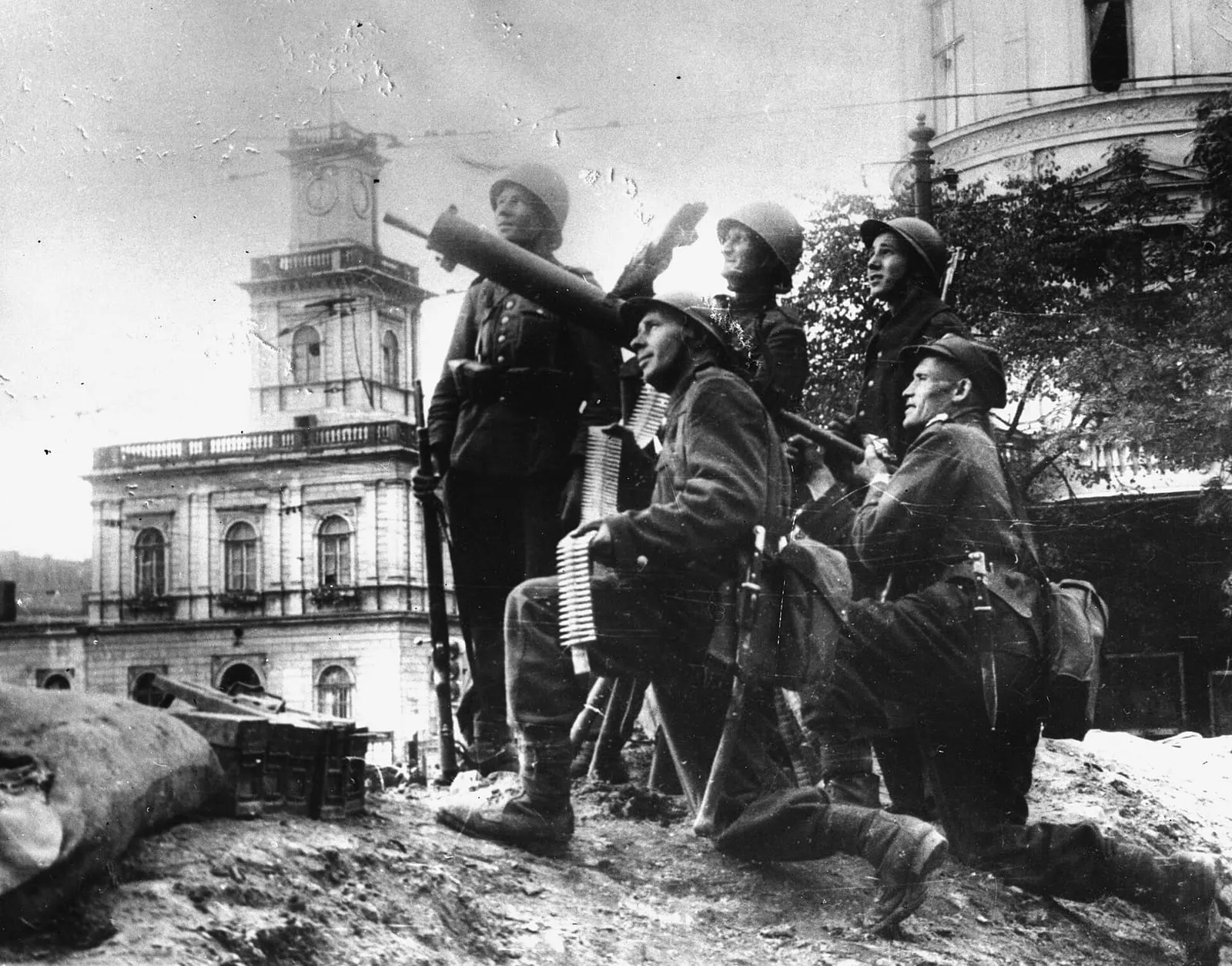
At dawn on Friday 1 September 1939 Germany attacked Poland without a declaration of war. At about 4.45 a.m. the training battleship Schleswig-Holstein, lying in the port of Gdańsk (Danzig), opened fire on the Military Transit Depot on Westerplatte (PL). In the same minutes ground forces crossed the frontier along its whole length, from Western Pomerania and East Prussia to Silesia, Moravia and Slovakia, and Luftwaffe aircraft took off to strike Polish bridges, airfields, railway junctions and towns. The Slovak army also went into action on the German side. So began the campaign that in Poland is called the defensive war of 1939 or the September Campaign, and which became the first campaign of the Second World War.
Popular chronologies describe that morning in three steps: at 4.45 the Schleswig-Holstein shells Westerplatte; “at the same time” the Luftwaffe bombs Wieluń among other places; and “shortly before 6.00” the German army crosses the border in great strength. The first statement is accurate. The other two need correcting. H-hour for the ground forces was the same as for the ship, 4.45, and in many places the border fighting began at exactly that moment, in some even a few minutes earlier. The time of the raid on Wieluń, meanwhile, is disputed, as discussed below.
The first shots
Westerplatte became the symbol of the start of the war, although it was not the only place where the first shots were fired. Most studies give 4.45 as the time the bombardment began; some sources give 4.47 or 4.48. The first assault on the peninsula by German marines, held by a garrison of about two hundred, was beaten off that day.
Among the first targets of the air force were the bridges over the Vistula at Tczew, across which troops from East Prussia were to pass. At around 4.30–4.40 a.m. a flight of Ju 87 dive-bombers attacked them in order to cut the cables to the demolition charges. Polish sappers nonetheless blew up both bridges before a German armoured train could reach them. Another of the first targets was the defenceless town of Wieluń, of no military importance, which Stukas bombed, its clearly marked hospital included. The time of this raid is disputed. Tradition, based on witness accounts, and the plaque in the town speak of 4.40, that is, of an attack that preceded the salvo on Westerplatte. Researchers who have analysed German air force documents, among them Grzegorz Bębnik of the Katowice branch of the Institute of National Remembrance (IPN), point out that the bombers took off at around 5.00 and that the bombs fell on Wieluń at around 5.30–5.40. The IPN also adopted this later time in the document closing its investigation into the matter. Whatever the hour, the raid, which destroyed most of the town centre and killed many civilians, became a symbol of a war waged against the population from the very first day. It was not, however, carpet bombing, as some chronologies claim, but a series of attacks by dive-bombers.
Even before the regular army arrived, German saboteurs went into action. During the night of 31 August–1 September and at dawn, groups made up largely of local Germans and trained by the Abwehr tried to seize mines, steelworks, bridges and railway junctions in Upper Silesia and Pomerania. They were driven off by soldiers, police, former Silesian insurgents and Scouts. In the Jablunkov Pass, where a week earlier a similar group, unaware that the attack had been called off, had attacked the station at Mosty, this time Polish sappers managed to blow up the railway tunnels before the Germans arrived. A few hours earlier, on the evening of 31 August, SS men had staged a raid on the radio station at Gleiwitz (Gliwice), which was to serve as a pretext for war.
The plan and the forces
The attack followed Case White, in preparation since April 1939. It was originally to have begun on 26 August, but on the evening of 25 August Hitler halted the offensive and used the few days’ delay for a diplomatic game around the ultimatum of 30 August. At noon on 31 August Adolf Hitler signed Directive No. 1 for the Conduct of the War, fixing the attack for 4.45 a.m. on 1 September. The ground forces, commanded by General Walther von Brauchitsch, with operations planned by the Chief of the General Staff, General Franz Halder, comprised two army groups.
Army Group North under General Fedor von Bock had two armies. The 4th Army under General Günther von Kluge was to strike from Western Pomerania into the Polish Corridor to link the Reich with East Prussia. The 3rd Army under General Georg von Küchler was to advance south from East Prussia towards Mława, the Narew and Warsaw, and from the east into Pomerania. The stronger Army Group South under General Gerd von Rundstedt was to deliver the main blow: the 8th Army under General Johannes Blaskowitz from Silesia towards Łódź; the 10th Army under General Walter von Reichenau, with most of the panzer and motorised divisions, from the Opole and Lubliniec area straight towards Warsaw; and the 14th Army under General Wilhelm List from Upper Silesia, Moravia and Slovakia towards Kraków and further east. The two army groups were to meet east of Warsaw and trap the main Polish forces in a pincer before they could withdraw behind the Vistula and the Narew. The ground forces were supported by two air fleets, Luftflotte 1 under General Albert Kesselring in the north and Luftflotte 4 under General Alexander Löhr in the south, and from the sea by the warships of the Kriegsmarine.
Germany sent some 1.5 million soldiers against Poland (some estimates say 1.8 million) in more than fifty divisions, a dozen or so of them panzer, light and motorised, with over 2,500 tanks and, according to various tallies, from about 1,600 to more than 2,000 combat aircraft. In the west, facing France, it left weaker forces, counting on France and Britain not to attack.
The Polish side, commanded by the Commander-in-Chief, Marshal Edward Rydz-Śmigły, deployed six armies and an independent operational group along a long, outflanked frontier: Independent Operational Group Narew and the Modlin Army facing East Prussia, the Pomorze Army in the Corridor, the Poznań Army in Greater Poland, the Łódź Army in the centre, the Kraków Army in Silesia and Lesser Poland, and the Karpaty Army on the border with Slovakia. Behind them the reserve Prusy Army was forming. Fully mobilised, the Polish Army could field about 1.3 million soldiers, 39 infantry divisions and 11 cavalry brigades, but general mobilisation, postponed under pressure from the allies, was proclaimed only on 30 August. According to estimates cited in Polish literature, by 1 September mobilisation was about two-thirds complete and concentration less than half complete, and many units were still in transit. Poland had about 880 tanks and tankettes, most of them light, and about 400 combat aircraft. German superiority in armour and air power was overwhelming.
The first day of fighting
In Pomerania the 4th Army attacked the Pomorze Army of Major General Władysław Bortnowski, part of which stood in the Corridor itself, pushed far forward to the west. In the evening at Krojanty near Chojnice, squadrons of the 18th Pomeranian Uhlan Regiment charged a German infantry battalion and scattered it, but, surprised by armoured cars, suffered heavy losses; the regiment’s commander, Colonel Kazimierz Mastalerz, was killed. Italian journalists who viewed the battlefield the next day gave rise to the legend of Polish uhlans charging tanks with sabres.
In northern Mazovia the 20th Infantry Division of the Modlin Army held a fortified position at Mława, where for three days it stopped the advance of the 3rd Army. In the south-west, at Mokra near Kłobuck, Colonel Julian Filipowicz’s Volhynian Cavalry Brigade beat off attacks by the German 4th Panzer Division all day long and destroyed or damaged many of its tanks. In Upper Silesia the Kraków Army of Brigadier General Antoni Szylling defended its fortifications, and on the Carpathian frontier mountain units fought German divisions advancing from Slovakia.
On the very first day the Luftwaffe bombed Warsaw, Kraków, Gdynia, Puck, Hel, Grodno, Częstochowa and dozens of other towns and villages, as well as airfields and railway stations. The Polish air force, which had been moved to field airfields a few days earlier, escaped destruction on the ground, and the Pursuit Brigade fought German bombers over Warsaw. From the first hours, news came from behind the front line of prisoners of war and civilians being shot. Behind the army came the Einsatzgruppen of the Security Police and SD, with lists of Poles marked for arrest and killing. That same day Gauleiter Albert Forster proclaimed the incorporation of the Free City of Danzig into the Reich, while in the city the defence of the Polish Post Office went on.
Slovakia at war
Slovakia attacked Poland together with Germany. The Slovak state, proclaimed in March 1939 at Berlin’s dictation, had granted Germany the right to station troops on its territory in the Treaty of Protection of 23 March. In the summer the government of the priest Jozef Tiso agreed that Slovakia should become a jumping-off area for the attack on Poland. On 26 August it proclaimed mobilisation and formed the Bernolák field army under the Minister of Defence, General Ferdinand Čatloš: three infantry divisions, more than 50,000 soldiers, subordinated to the German 14th Army. According to Slovak historians, the Germans had earlier promised that the Slovak army would serve only to cover the border. The decision to send it onto Polish territory was probably taken at the last minute.
At about 5 a.m. on 1 September, without a declaration of war, Slovak units crossed the border in Spisz and Orawa. The 1st Division took Jaworzyna and advanced into Podhale, covering the German 2nd Mountain Division; over the following days it penetrated several dozen kilometres into Poland, where on 4–5 September it fought Polish units. Slovakia never formally declared war on Poland. Its government presented its part in the campaign as the recovery of lands that Poland had taken in 1920, 1924 and the autumn of 1938. Slovak losses were small: according to various tallies, from a dozen or so to just under forty killed. By an agreement signed in Berlin on 21 November 1939, Germany handed Slovakia the disputed areas of Spisz and Orawa, some 770 square kilometres with several dozen villages.
Chronologies also state that Slovakia suspended civil liberties on 1 September. The explanation is more complicated. Civil rights there had already been curtailed in the autumn of 1938, when the Czechoslovak government declared a state of defence emergency over the Sudeten crisis. After independence the Slovak authorities extended these restrictions by successive decrees, and according to the Slovak historian Igor Baka they became permanent with the outbreak of war with Poland. By then Tiso’s state was already a one-party regime, with an internment camp for opponents at Ilava and legislation directed against the Jews.
Poland faces the onslaught
In the morning Polish Radio broadcast a proclamation by President Ignacy Mościcki: “Citizens of the Republic! Last night our age-old enemy began offensive operations against the Polish State, which I affirm before God and History.” The President called on the nation to rally round the Commander-in-Chief and the armed forces. That same day martial law was declared throughout the country. The Foreign Minister, Józef Beck, instructed the ambassadors in London and Paris to demand the immediate fulfilment of the allied obligations arising from the Polish-British treaty of 25 August and the alliance with France.
Hitler presented the war as a response to Polish “attacks”. In his speech to the Reichstag that morning he said that since dawn Germany had been “returning fire”, and he invoked staged border incidents. Germany did not declare war on Poland, in breach of the Third Hague Convention of 1907, which required either a prior declaration of war or an ultimatum. In this way an invasion months in the making could be presented within the Reich as a defensive war. Hitler’s protection against a blow from the east was the pact with the USSR signed on 23 August, whose secret protocol divided Poland into spheres of influence.
Place in the war
In Poland and most of Europe, 1 September 1939 is regarded as the beginning of the Second World War. The war between Japan and China had been going on since 1937, and some historians hold that the world war began in Asia. But it was the attack on Poland that drew the European powers into the conflict. On 3 September Britain and France declared war on Germany, but in the west they undertook no operations that might have drawn the Wehrmacht away from Poland. The Polish Army, shattered in the frontier battles of the first week, fell back to the line of the Vistula, and by mid-September the Germans had surrounded Warsaw. On 17 September, in accordance with the secret protocol, the Red Army entered Poland from the east. Warsaw capitulated on 28 September, and the last major Polish units laid down their arms at Kock on 6 October.
The campaign, in which Poland lost, by various estimates, some 65,000 to 70,000 soldiers killed, while hundreds of thousands were taken prisoner by the Germans and the Soviets, ended in the fourth partition of the country. On Polish soil both occupiers launched a policy of terror, expulsions and extermination that over the next five years cost the lives of millions of Polish citizens, Poles and Jews. Soldiers who made their way through Romania and Hungary to France, and later to Britain, fought on alongside the Allies. Poland did not capitulate and remained a belligerent until the end of the war. For Germany the campaign was the first test of the co-operation between tanks and aircraft that propaganda later called “lightning war”, and which was repeated in the west in 1940. Slovakia, the first of Hitler’s allies to take part in his war, followed him into the Soviet Union in 1941 as well.
Places·Westerplatte·Wieluń
Sources
Meanwhile
(04)Elsewhere, within a week.
- 1 September 1939 · PoliticsGermany annexes the Free City of DanzigOn 1 September 1939 Albert Forster proclaimed the Free City of Danzig part of the Reich, and the Reichstag confirmed it by law. Arrests of Poles began.
- 1 September 1939 · PoliticsHitler’s Reichstag speechOn 1 September 1939 Hitler told the Reichstag at the Kroll Opera House that since 5.45 Germany had been “returning fire”. He cast the war as self-defence.
- 1 September 1939 · DiplomacyItaly and the neutral statesOn 1 September 1939 Italy announced it would not take up arms. The Nordic states, Estonia, Latvia and Portugal, England’s ally, also declared neutrality.
- 1 September 1939 · PoliticsBritain prepares for warOn 1 September 1939 Britain ordered mobilisation, the blackout and the evacuation of its cities. A population register and a Ministry of Food followed.
Related events
(04)The same battle, people or subject.
- 4 September 1939 · PolandGermany cuts the Polish CorridorAfter the fighting in the Tuchola Forest the German 4th Army reached the Vistula and met the 3rd Army from East Prussia. The Pomorze Army lost two divisions.
- 6 September 1939 · PolandThe Germans take KrakówOn 6 September 1939 the German 14th Army entered undefended Kraków. The Kraków Army was retreating to the Nida and Dunajec; the Wawel treasures had left.
- 1 September 1939 · PolandThe defence of the Polish Post Office in GdańskOn 1 September 1939 Polish postal workers held the Polish Post Office in Gdańsk for about 14 hours. After their surrender 38 were sentenced to death and shot.
- 25 August 1939 · MilitaryHitler halts the attack on PolandOn 25 August 1939 Hitler ordered an attack on Poland for the next dawn, but that evening revoked it after news of the London alliance and Mussolini's refusal.