Poland
Tadeusz Bór-Komorowski
Commander of the Home Army (1943–1944), Commander-in-Chief of the Polish Armed Forces (1944–1946), Prime Minister of the Polish government-in-exile (1947–1949)
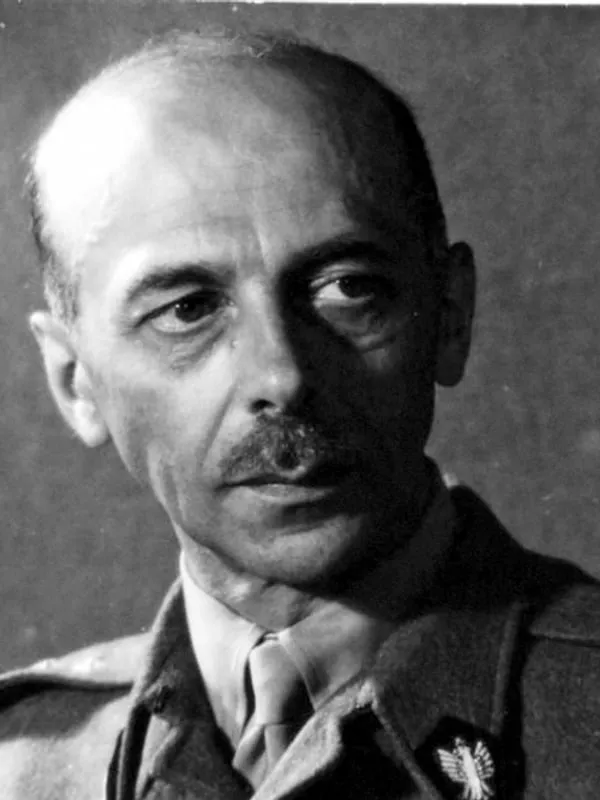
- Born:
- 1 June 1895, Chorobrów (Austria-Hungary)
- Died:
- 24 August 1966, near Bletchley (United Kingdom)
- Author:
- Natalia
- Photo:
- autor nieznany, domena publiczna, Wikimedia Commons

Tadeusz Komorowski, known by his underground pseudonym “Bór”, was a cavalryman for almost all of his adult life: an officer of the Austro-Hungarian uhlans, a regimental commander in the Second Polish Republic, an Olympic rider and commandant of the cavalry school at Grudziądz. The war turned him into the commander of an underground army. From July 1943 he headed the Home Army, and on the evening of 31 July 1944 he issued the order that launched the Warsaw Uprising the following day. That single decision fixed his place in history and divides historians to this day. After the capital capitulated he became a German prisoner, and after the war, in London, he served as Commander-in-Chief and as prime minister of a government that most of the world no longer recognised.
A Galician landowner in imperial uniform
He was born on 1 June 1895 at Chorobrów near Brzeżany, in Austrian Galicia, on an estate belonging to relatives of General Tadeusz Rozwadowski. He was the son of Count Mieczysław Komorowski of the Korczak coat of arms and of Wanda, née Prawdzic-Zaleska. He finished secondary school in Lwów (Lviv) in 1913 and that same year entered the Theresian Military Academy in Wiener Neustadt, the forge of the Austro-Hungarian officer corps.
In March 1915 he was commissioned as a second lieutenant of cavalry and posted to the 3rd Landwehr Uhlan Regiment (later the 3rd Mounted Rifle Regiment). He fought with it on the Russian and Italian fronts and in November 1916 was promoted to lieutenant. Like many Galician officers, by the time the Habsburg monarchy collapsed he already had several years of war behind him and a ready-made profession.
Uhlan and horseman in the Second Polish Republic
He was accepted into the Polish Army on 1 November 1918, keeping his rank of lieutenant, and assigned to the 9th Uhlan Regiment. With the regiment he fought first against the Ukrainians in Eastern Galicia, around Mościska in the winter of 1918/1919, and then in the Polish–Soviet War. In the summer of 1920 he commanded a composite squadron near Łuck; on 20 August he took command of the 12th Podolian Uhlan Regiment, and on 31 August, the first day of the Battle of Komarów – the great clash between the Polish cavalry and Budyonny’s First Cavalry Army – he was wounded in the arm.
He spent the interwar years in the cavalry and in the saddle. He completed the equitation course at Grudziądz and taught riding at artillery schools; he was promoted to major in 1924, lieutenant colonel in 1928 and colonel in December 1932. From 1929, for almost ten years, he commanded the 9th Lesser Poland Uhlan Regiment, stationed at Trembowla and Czortków in Podolia. In 1930 he married Irena Lamezan-Salins, daughter of General Robert Lamezan-Salins; they had two sons.
He was one of the leading Polish riders of his generation. At the 1924 Olympic Games in Paris he competed in the eventing competition on the horse Amon; according to the Olympedia database he finished 26th individually, and the Polish team was seventh. Twelve years later, at the Berlin Olympics, he led the Polish equestrian team, which won silver in team eventing. In November 1938 he took command of the Cavalry Training Centre (PL) at Grudziądz, the foremost school of the Polish cavalry.
September 1939 and the underground in Kraków
In the summer of 1939 he took command of the Cavalry Reserve Centre at Garwolin. During the September Campaign he was deputy to Colonel Adam Zakrzewski in the improvised Combined Cavalry Brigade, which fought as part of the Lublin Army at Góra Kalwaria and around Zamość, among other places. After the capitulation he evaded captivity and made his way to Kraków, taken by the Germans on 6 September and soon to become the capital of the General Government.
Before the end of 1939 he had built an underground Military Organisation there. In January 1940 he placed it under the Union of Armed Struggle (ZWZ) and adopted the pseudonym “Korczak”. He became commander of the ZWZ’s Kraków Area and, on 8 February 1940, a brigadier general. When he was in danger of exposure he moved to Warsaw in the summer of 1941 and became deputy to the commander of the ZWZ (from February 1942 the Home Army), General Stefan Rowecki “Grot”. From the autumn of 1941 until June 1943 he also directed the Western Area, which covered the lands of Greater Poland and Pomerania annexed to the Reich, and in 1942 he conducted the talks that led to the merger of the National Military Organisation with the Home Army.
Commander of the Home Army
On 30 June 1943 the Gestapo arrested General Rowecki in Warsaw. As his deputy, Komorowski took over command of the Home Army and in July was formally confirmed as its commander. A few days later, on 4 July 1943, Prime Minister and Commander-in-Chief General Władysław Sikorski was killed in the air crash at Gibraltar; “Bór”’s superior became the new Commander-in-Chief, General Kazimierz Sosnkowski. The appointment met with reservations from some senior officers of the Home Army headquarters.
In 1944 the Home Army numbered, by the most commonly cited estimates, 300,000–350,000 sworn soldiers, but had weapons for only a small fraction of them. The new commander had to wage the day-to-day struggle against the occupier while preparing for the moment when the front would pass through Polish territory. Under his command the Home Army carried out, among other things, reprisal operations in the Zamość region – according to Polish studies he ordered attacks on settlements of German colonists whose inhabitants had taken part in expelling Poles.
As the Red Army drew closer it was clear that Poland would be liberated from the Germans by the Soviets rather than by the Western Allies (as the Tehran Conference confirmed at the end of November). On 20 November 1943 Bór-Komorowski issued the order for Operation Tempest (“Burza”): Home Army units were to strike the retreating Germans just before the Soviet troops arrived and to receive the Soviets as the hosts of the territory, together with representatives of the Polish Underground State coming out into the open. In March 1944 Sosnkowski promoted him to major general.
The plan soon collided with reality. In Volhynia the Home Army’s 27th Infantry Division fought alongside the Red Army, which in January 1944 had crossed Poland’s pre-war border, but was then shattered by the Germans. In July Home Army units cooperated with the Soviets in the fighting for Wilno (Vilnius) and in Lwów, after which the NKVD arrested their commanders and disarmed the soldiers, drafting them into Berling’s army or deporting them deep into the USSR. These reports were reaching headquarters just as the front was approaching Warsaw.
The decision of 31 July 1944
Tempest had originally been meant to bypass the large cities, but in July 1944 the Home Army headquarters included Warsaw in it. Bór-Komorowski and his closest associates, especially General Leopold Okulicki and General Tadeusz Pełczyński, concluded that the capital had to be liberated by Polish forces before the Red Army entered it, and that the underground authorities should receive the Soviets as hosts. Bór himself believed that owing Warsaw’s freedom solely to the Soviets would in practice mean giving up independence. The uprising was also meant to strengthen the hand of Prime Minister Stanisław Mikołajczyk, who was then on his way to talks with Stalin.
On the morning of 31 July a headquarters briefing ended without a decision. At around 5.30 p.m. the commander of the Warsaw District, Colonel Antoni Chruściel “Monter”, reported that Soviet tanks were on the approaches to Praga. Bór-Komorowski summoned the Government Delegate for Poland, Jan Stanisław Jankowski, and once he had his agreement, at around 6 p.m., issued the order to begin fighting at 5 p.m. the next day. The report about the tanks proved exaggerated, and the Germans were just beginning a counter-attack near Radzymin and Wołomin; Bór, however, judged – as he later recalled – that cancelling the order would cause chaos.
The decision was contested from the very first moment. Sosnkowski had warned against an uprising that could not count on outside help, and according to the historian Andrzej L. Sowa the Commander-in-Chief indirectly regarded it as exceeding the Home Army commander’s authority. General Władysław Anders considered it a tragic mistake. Bór’s defenders point out that tens of thousands of conspirators ready to fight were waiting in the city, that Moscow itself had called on the people of Warsaw to rise, and that Home Army passivity could have been exploited by Soviet and communist propaganda. The historians’ dispute continues to this day.
Sixty-three days
The fighting of the Warsaw Uprising itself was in practice directed by “Monter”, while the headquarters – quartered first in the Kamler factory in Wola, then in the Old Town and in Śródmieście – dealt above all with the uprising’s politics and communications with London. From the first days Bór-Komorowski pressed for arms drops and Allied help. Some historians, drawing on accounts from the general’s entourage, describe him as sick and exhausted; on 13 August he was injured when a captured German explosives carrier blew up on Kilińskiego Street. Around him crimes were being committed that he reported to London – the Wola massacre and the massacre in Ochota, murders in hospitals and executions of prisoners.
From September, after the fall of the Old Town, Bór-Komorowski considered the capitulation talks the Germans had proposed. The talks were broken off whenever hope of help appeared – Soviet airdrops from mid-September and the landing of Berling’s soldiers at Czerniaków. On 30 September President Władysław Raczkiewicz dismissed Sosnkowski and appointed Bór-Komorowski Commander-in-Chief, with the proviso that he would take up the post only on reaching London. On 2 October at Ożarów, Bór’s plenipotentiaries, Colonel Kazimierz Iranek-Osmecki and Lieutenant Colonel Zygmunt Dobrowolski, signed with SS-Obergruppenführer Erich von dem Bach-Zelewski an agreement on the cessation of hostilities that granted Home Army soldiers the rights of prisoners of war. On 5 October Bór-Komorowski led the last units into captivity.
Captivity
From Ożarów the Germans took him, with a group of generals and officers, to East Prussia, near the headquarters of Heinrich Himmler, who – according to Bach-Zelewski – wanted to meet him; the meeting never took place. He was then moved via Berlin to the Oflag at Langwasser near Nuremberg, where he was held in isolation. The Germans tried in vain to persuade him to call on Home Army units in Poland to lay down their arms. On 5 February 1945 he was sent to Oflag IV-C Colditz, a castle in Saxony reserved for particularly “valuable” prisoners or those prone to escape. During his captivity the duties of Commander-in-Chief in London were performed by General Anders.
In April 1945, as the front approached Colditz, the SS moved Bór and other prominent prisoners via Königstein, Laufen and Tittmoning to a camp at Markt Pongau near Salzburg. There, following the intervention of the Swiss envoy, SS-Obergruppenführer Gottlob Berger released them. Near Innsbruck Komorowski was liberated by soldiers of the US 103rd Infantry Division. On 12 May 1945 he flew to London, where he was welcomed by Prime Minister Tomasz Arciszewski and members of the government.
In exile
On 28 May 1945 he assumed the duties of Commander-in-Chief, but he no longer had anyone in Poland to give orders to, and after Britain and the United States withdrew recognition from the London government in July 1945 the British ceased to recognise his post as well. In September he handed command of the army to the chief of staff, and in November 1946 the President relieved him of the office of Commander-in-Chief. From 2 July 1947 to April 1949 he was Prime Minister of the Polish government-in-exile, by then recognised by only a handful of states. From 1956 he sat on the émigré Council of Three.
He earned his living as an upholsterer. In 1950 he published his memoirs in English as The Secret Army, and a year later in Polish as Armia podziemna – the fundamental source for the history of his decisions, though written from the commander’s own perspective. He was active in the Association of Former Home Army Soldiers; on his initiative the Home Army Cross was instituted on 1 August 1966. He died three weeks later, on 24 August 1966, of a heart attack while out hunting in Buckinghamshire. He was buried at Gunnersbury Cemetery in London; in 1994 his ashes were moved to the plot of the Home Army headquarters at the Powązki Military Cemetery in Warsaw.
Place in the history of the war
Bór-Komorowski commanded the largest underground army in occupied Europe at a time when Poland’s fate was being decided not in Warsaw but between Moscow, London and Washington. His decision of 31 July 1944 led to the Home Army’s greatest battle, and also to the deaths of, by the most frequent estimates, 150,000–200,000 civilians and well over ten thousand insurgents, and to the destruction of the capital. His critics, from Sosnkowski and Anders to the writer Maria Dąbrowska, who judged his command very harshly in her diaries, saw in him a man who could not bear the weight of responsibility. His defenders argue that he acted in a situation with no good way out, and that the uprising, though lost, showed the world that the Poles were fighting for independence and not merely for a change of occupier. In communist Poland he was for years a symbol of the “reactionary” leadership; after 1989 he became one of the figures most often invoked in the debate over whether the uprising made sense.
Sources
Commanded in battles
(02)Often appears with
People who appear in the same events.