Poland
Herschel Grynszpan
Assassin of Ernst vom Rath in Paris (1938)
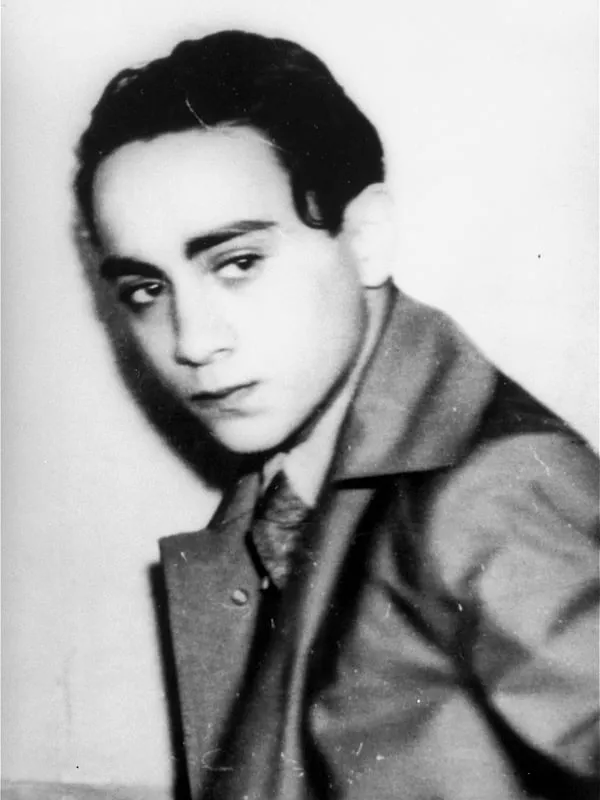
- Born:
- 28 March 1921, Hanover (Weimar Republic)
- Died:
- 1942
- Author:
- Natalia
- Photo:
- autor nieznany, CC BY-SA 3.0 DE, Wikimedia Commons

Herschel (Herszel) Feibel Grynszpan, known in Germany as Hermann Grünspan, was the son of Polish Jews, born and brought up in Hanover. On 7 November 1938, as a seventeen-year-old illegal immigrant in Paris, he shot the diplomat Ernst vom Rath in the German embassy in protest against the expulsion of his family and thousands of other Polish Jews from the Reich. Vom Rath’s death served the Nazis as the pretext for Kristallnacht, the nationwide pogrom of the night of 9–10 November 1938. After the fall of France Grynszpan himself fell into the hands of the Gestapo and disappeared into German prisons. Exactly when and how he died is unknown; most probably he did not survive 1942.
Childhood in Hanover
His parents, the tailor Sendel (Zindel) Grynszpan and Ryfka, née Silberberg, came from Radomsko in the Russian part of Poland. In 1911 they moved to Hanover, where his father opened a small tailoring business. Herschel was born on 28 March 1921, the youngest child; his siblings included an elder sister, Berta (Esther), and a brother, Mordechai. After Poland regained its independence the family took Polish citizenship. German citizenship was out of reach, because German law based citizenship on descent rather than place of birth.
The family was poor and religious. Herschel attended primary school and belonged to the Jewish sports club Bar Kochba and to a Zionist group. After the Nazis came to power, the boycott of Jewish shops in 1933 and the succession of laws discriminating against Jews left him with no chance of an apprenticeship or a job. In 1935, at the age of fourteen, he left school without a certificate. With the help of the Jewish community he studied for eleven months at a yeshiva in Frankfurt am Main, but gave it up. The emigration office refused to let him go to Palestine because he was too young.
An illegal in Paris
In the summer of 1936 his parents sent him on his Polish passport to his uncle Wolf in Brussels, and from there in September smugglers took him illegally into France, to another uncle, Abraham, who lived with his wife Chawa in the Jewish quarter of Paris. He could not enter legally, because Jews were not allowed to take money out of Germany and France would not admit people without means of support. A slight, frail youth who, living among the Yiddish-speaking community, could barely speak French after two years, he lived on his relatives’ charity, wandered about the city and went to the cinema. Acquaintances described him as a sensitive and hot-tempered teenager who wept when he talked about the fate of the Jews in Germany.
For two years he tried in vain to obtain a residence permit in France. The German police would not let him return to Hanover, and his Polish passport expired at the beginning of 1938. In August 1938 the French authorities ordered him to leave the country. He had nowhere to go, so his uncle hid him in an attic.
The Polenaktion and the shooting
On 31 March 1938 the Polish Sejm passed a law allowing citizenship to be withdrawn from people who had lived abroad for more than five years, and in October the authorities announced that passports without a special consular stamp would not entitle their holders to return. The aim was to prevent Germany from expelling Jews with Polish passports to Poland. The Germans pre-empted the deadline: between 27 and 29 October 1938 Reinhard Heydrich’s Gestapo arrested at least 17,000 Polish Jews and dumped them at the border (the Polenaktion). Herschel’s parents, Berta and Mordechai were taken from Hanover during the night of 27–28 October and ended up in a camp for deportees in Zbąszyń.
On 3 November Herschel received a postcard from his sister describing the expulsion. On 6 November he quarrelled with his uncle over money for the family and left the house. On the morning of 7 November he bought a revolver, went to the German embassy in the rue de Lille and asked to speak to a diplomat. Left alone with the legation secretary vom Rath, he fired five shots, two of which hit. He did not try to escape; he told the French police that he had wanted to avenge the persecuted Jews. In his pocket was a note to his parents: “My heart bleeds when I hear of your tragedy and that of the 12,000 Jews. I must protest in such a way that the whole world hears my protest.” Vom Rath died on 9 November.
Most historians believe the victim was chosen at random: Grynszpan wanted to strike at a representative of the Reich, and vom Rath happened to be on duty. The story that the two knew each other from the Paris homosexual milieu emerged in Paris soon after the shooting, and his lawyer considered it as a line of defence; there is no convincing evidence for it, and Grynszpan himself rejected it at the time.
Pretext for a pogrom
Joseph Goebbels’s propaganda immediately proclaimed the shooting an attack on Germany by “world Jewry”. On the evening of 9 November, after news of vom Rath’s death, Goebbels gave a speech in Munich which party activists understood as the signal for a pogrom. During Kristallnacht some 1,400 synagogues and prayer houses were burned, hundreds of people died, and some 30,000 Jewish men were taken to concentration camps. Many Jewish organisations around the world condemned the shooting, fearing precisely such retaliation, and for years portrayed Grynszpan as an unbalanced boy who had brought disaster upon the Jews. The American journalist Dorothy Thompson defended him in a radio broadcast on 14 November as a victim of Nazi persecution and raised more than 40,000 dollars in the United States for his defence.
Prisoner of two states
As a minor, Grynszpan was held in the prison at Fresnes near Paris. His counsel, the well-known lawyer Vincent de Moro-Giafferi, delayed the trial in the hope that passions would cool. Germany sent the lawyer Friedrich Grimm to Paris to take part in the trial as the representative of the victim’s family and to turn it into an indictment of “international Jewry”. The outbreak of war in September 1939 blocked the case. In June 1940, before the Germans entered Paris, the French evacuated prisoners to the south; Grynszpan, briefly at liberty, gave himself up to the authorities in Bourges and was then taken to prison in Toulouse. On 18 July 1940 the Vichy government handed him over to the Germans, even though he was not a citizen of the Reich and had committed his act in France before the war.
He was taken to the Gestapo prison in Prinz-Albrecht-Straße in Berlin and then to Sachsenhausen concentration camp, where he was held in the bunker for “special prisoners”, close to, among others, the former Austrian chancellor Kurt Schuschnigg. He was treated relatively leniently, because Goebbels was planning a great show trial before the People’s Court to prove that the Jews were behind both the assassination and the war. An indictment for high treason was drawn up in October 1941. Yet the trial never took place. Grynszpan announced that he would tell the court he had had a homosexual relationship with vom Rath; he told fellow prisoners that this was untrue, but he knew that such a claim would make a mockery of the whole trial. This undermined Goebbels’s plans, and after the fiasco of the Riom trial in France, where Léon Blum and the other defendants turned the dock into a platform, Hitler lost interest in the trial in the spring of 1942. In September 1942 Grynszpan was transferred to the prison in Magdeburg. That is the last certain trace of him in German records.
The mystery of his death
When and how Grynszpan died is unknown. Most historians, Alan Steinweis among them, believe he was murdered in 1942 or soon afterwards, once it became clear that there would be no trial. In Jerusalem in 1961 Adolf Eichmann testified that he had seen him in Berlin in 1943 or 1944 but did not know what had become of him. Rumours that he had survived the war and was living in Paris under another name were spread in the 1950s by, among others, the former SS man and journalist Michael Soltikow and the historian Helmut Heiber, who later retracted them. In 2016 it was suggested that Grynszpan appears in a 1946 photograph from a displaced persons camp in Bamberg, but this has not been confirmed. In 1960 a court in the Federal Republic of Germany declared him dead at his parents’ request.
The Grynszpan family survived. They fled from Poland eastwards into the Soviet Union and after the war emigrated to Israel. In 1961 Herschel’s father, Sendel, testified at the Eichmann trial about the expulsion from Hanover in October 1938.
Memory
For a long time Grynszpan was an awkward figure: to the Nazis a “Jewish murderer”, to many Jews a reckless boy who had supplied the pretext for a pogrom. Only later did people begin to see him differently – as the victim of a system that had robbed him of his homeland, his papers and his family, and as one of the few who in 1938 tried to draw the world’s attention to the fate of the Jews in the Reich. Inspired by his story, the British composer Michael Tippett wrote the oratorio A Child of Our Time in 1939–1941. Herschel’s name appears as a missing person on the memorial to the murdered Jews of Hanover, and in 2010 a memorial stone was laid in front of the site where the family home had stood.
His act did not cause the pogrom: the pogrom served the regime’s interests, and anything could have been used as a pretext. But the story of Grynszpan, a boy whom neither Germany, nor Poland, nor France wanted, captures well the predicament of Europe’s Jews in the last year before the war.
Sources
Often appears with
People who appear in the same events.