- Category:
- Crimes and repression
- Date:
- 9 November 1938
- Author:
- Natalia
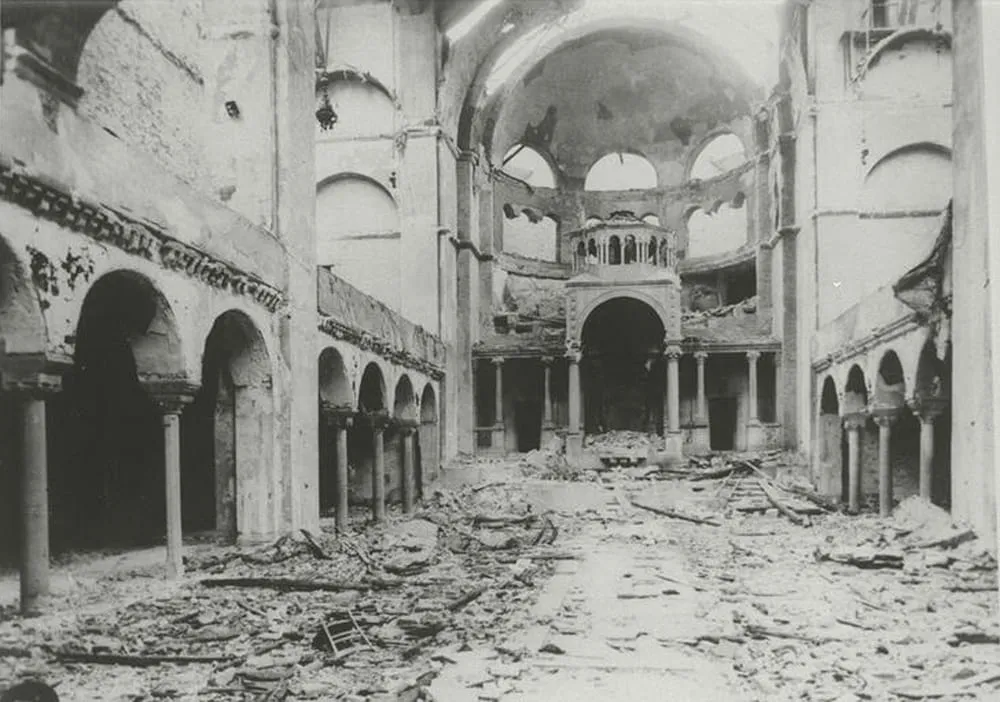
On the evening of 9 November 1938 the leaders of the NSDAP gathered, as they did every year, in the Old Town Hall in Munich to mark the anniversary of the Beer Hall Putsch. At dinner Adolf Hitler learned that the German diplomat Ernst vom Rath, shot two days earlier in Paris by the seventeen-year-old Polish Jew Herschel Grynszpan, had died. Hitler spoke briefly with Joseph Goebbels, broke with custom by not giving a speech, and left. At around 10 p.m. Goebbels took the floor. A few hours later synagogues were burning all over Germany, in Austria (annexed in March) and in the Sudetenland (occupied a month before), while squads of the SA, the SS and the party smashed the windows of Jewish shops, wrecked homes, and beat, humiliated and killed people.
The pogrom, which went down in history as Kristallnacht – the “Night of Broken Glass”, after the glass from the shattered windows – lasted in places until 13 November. Some 1,400 synagogues and prayer houses were burned or vandalised and some 7,500 shops and businesses destroyed; according to official party figures 91 Jews were killed, in reality several hundred. Around 30,000 Jewish men were taken to concentration camps. The state that had organised the pogrom then made the victims pay for the damage and imposed on them a “contribution” of one billion Reichsmarks. Kristallnacht was a turning point in the Third Reich’s policy towards the Jews: from discrimination and exclusion from public life to open violence, plunder and forced expulsion.
The pretext
In 1938 pressure on the Jews of the Reich grew month by month. After the Anschluss of Austria, Jews in Vienna were beaten and robbed in the streets; from April they had to register their property; in the summer the synagogues in Munich and Nuremberg were demolished; and in October the authorities invalidated their passports and began issuing new ones stamped with a “J”. At the end of October the Gestapo dumped at least 17,000 Jews with Polish citizenship on the Polish border, among them Grynszpan’s family. His shots at the embassy in Paris on 7 November gave the regime its pretext. From the first moment propaganda presented them as an attack by “world Jewry” on Germany and warned that the Jews of the Reich would bear the consequences. The first attacks on synagogues and Jewish homes broke out as early as the evening of 7 November in Kassel and small towns in Hesse; on 8 November the synagogue in Bad Hersfeld burned down, and on the afternoon of 9 November the one in Dessau.
There is much to suggest that the party leaders had long wanted to give vent to the feelings of the “old fighters” and to speed up the expropriation of the Jews. Goebbels, who as Gauleiter of Berlin had harassed the city’s Jews for years, may also have had a personal motive: some historians point out that his affair with the Czech actress Lída Baarová had angered Hitler, and that Goebbels was looking for a chance to regain his favour.
Goebbels’s speech
Goebbels told the Gauleiters and SA leaders assembled in the Old Town Hall that “world Jewry” was responsible for vom Rath’s death and praised the “spontaneous” actions in Hesse and Magdeburg-Anhalt. He added that the party would not organise demonstrations against the Jews, but nor would it hinder them where they broke out of their own accord. In his diary he recorded what he had heard earlier from Hitler: “Let the demonstrations continue. Withdraw the police. For once the Jews should feel the people’s anger.” His listeners understood this unambiguously. From around 10.30 p.m. they began telephoning their districts, and sent further orders from the Hotel Rheinischer Hof. The orders passed down through party and SA channels: burn the synagogues, destroy the shops, prevent looting, do not endanger “Aryan” property. The perpetrators often wore civilian clothes so as to look like outraged citizens.
Heinrich Himmler was displeased that Goebbels was acting on his own initiative, but the police apparatus quickly joined in. At 11.55 p.m. the head of the Gestapo, Heinrich Müller, sent a teleprinter message to all State Police offices: the police were not to interfere with the actions, only to prevent looting, and they were to prepare the arrest of 20,000–30,000 Jews, “above all wealthy ones”. At 1.20 a.m. Reinhard Heydrich issued detailed instructions: synagogues were to be set alight only where the fire would not endanger neighbouring buildings; Jewish shops and homes could be destroyed but not looted; foreigners, including Jews, were not to be molested; as many Jews, especially wealthy ones, were to be detained as the jails could hold – above all healthy men who were not elderly – and the concentration camps were to be contacted immediately. The SD was to secure the archives of the Jewish communities before they burned together with the synagogues.
The night of 9–10 November
Throughout the night and the whole of the next day the same scenes were repeated in hundreds of towns and villages. Squads broke into synagogues, threw out and burned Torah scrolls, books and furnishings, and then set the buildings on fire; firemen made sure only that the flames did not spread to neighbouring houses. In Berlin most of the synagogues burned down; in Vienna, where the pogrom began on the morning of 10 November and was especially brutal, of several dozen synagogues and prayer houses only the Stadttempel, squeezed between apartment buildings, survived. The windows of Jewish shops were smashed with poles and axes, goods were thrown into the street, and looters followed in the wake of the SA units. The attackers burst into homes, smashed furniture and pianos, stole money and valuables, and beat and humiliated the occupants, including women, children and the elderly. In Emden the residents of an old people’s home were marched in their nightshirts past the burning synagogue and made to do knee-bends. In Lesum near Bremen a local SA leader, who took the order as an instruction to kill, had a doctor and his wife murdered. There were rapes; the party later punished their perpetrators not for the violence but for “racial defilement”.
Some residents looked on in silence, some were ashamed, and a few helped their neighbours. Others joined in the destruction and looting, and on 10 November, an ordinary school day, mobilised young people took part in the attacks. Open protest occurred almost nowhere.
On the morning of 10 November the mass arrests began. The Gestapo and SS detained some 30,000 Jewish men, often marching them in columns through the towns. In the afternoon Goebbels announced through the DNB agency that the “justified indignation of the German people” had been expressed and that the actions were to stop; Rudolf Hess issued a similar ban on arson. In many places, however, especially in the provinces, the violence continued into 11 November, and in the Free City of Danzig the local Nazis attacked Jews and synagogues only on 12 November.
The toll
Heydrich’s first report to Hermann Göring, dated 11 November, spoke of 815 shops destroyed, 191 synagogues set on fire and 76 demolished, 36 people killed and 20,000 arrested. These figures were understated and incomplete. According to current research, some 1,400 synagogues and prayer houses – almost all of those in the Reich – were destroyed, along with some 7,500 shops and businesses, thousands of homes and many cemeteries. In February 1939 the NSDAP’s Supreme Party Court under Walter Buch gave a figure of 91 dead. Historians estimate that several hundred people died in the pogrom itself, and that if suicides and deaths in the camps in the following weeks are included, the number of victims reached, according to Richard J. Evans, between one and two thousand.
The arrested men were taken to three camps: 10,911 to Dachau, including around 4,600 from Vienna; 9,845 to Buchenwald; and between 6,000 and 10,000 to Sachsenhausen. The SS guards abused them with impunity: prisoners stood for hours at roll calls in the freezing cold, were beaten and forced into gruelling labour. According to camp records, 207 of them died in Buchenwald and 185 in Dachau; the number of victims at Sachsenhausen is unknown. Most were released within weeks or months, but only after undertaking to emigrate quickly and hand over their property.
The perpetrators went almost unpunished. The party courts dealt with only thirty murders and found that those responsible had been carrying out orders, and at the court’s request Hitler pardoned the guilty. Public prosecutors were instructed not to bring proceedings.
The “contribution” and expropriation
On 12 November Göring called a meeting of more than a hundred dignitaries at the Air Ministry. He raged that goods the state could have seized had been destroyed, telling Heydrich: “I wish you had killed 200 Jews instead of destroying such valuables.” Glass for the shop windows had to be bought with foreign currency, and the insured damage was estimated at 225 million Reichsmarks. The meeting produced three decrees. Jews who were “German nationals” were to pay a one-billion-Reichsmark “atonement” (Sühneleistung) for the “hostile attitude of Jewry towards the German people”; it was collected in instalments as 20 and later 25 per cent of declared assets, and in the end more than 1.1 billion Reichsmarks was raised. Jews had to repair the damage to their shops and homes at their own expense, and insurance payouts were forfeited to the state. From 1 January 1939 Jews were banned from running shops, mail-order businesses and craft workshops, which in practice meant the forced “Aryanisation” of their firms for a fraction of their value.
Further bans followed over the next weeks: on 12 November on entering theatres, cinemas and concerts; on 15 November on attending German schools; in December on holding a driving licence and entering designated districts. At Göring’s meeting Heydrich also set out his aim: to drive all Jews out of the Reich through a central emigration office modelled on the one Adolf Eichmann had been running in Vienna since August. Policy towards the Jews passed from the party to the SS and the police. Göring also announced that if the Reich became involved in a foreign conflict, there would be a “great settling of accounts with the Jews”.
The world and the pogrom
The pogrom provoked outrage abroad. The Auswärtiges Amt (the German Foreign Office) received around a hundred protests from foreign missions whose citizens had suffered despite the ban. On 14 November the United States recalled its ambassador in Berlin, and Franklin Delano Roosevelt told journalists that he himself could scarcely believe such things could happen in twentieth-century civilisation. In Britain public opinion turned markedly against Germany, although Neville Chamberlain’s government reacted with restraint. London did, however, agree to admit Jewish children from the Reich without visas: the first Kindertransport reached Harwich on 2 December 1938, and by the outbreak of war almost 10,000 children had been saved in this way. Most of them never saw their parents again.
The world could not bring itself to change its immigration policy fundamentally. The states that had refused to take in refugees at the Évian Conference in July accepted few more after the pogrom. Even so, after Kristallnacht more than a hundred thousand Jews left the Reich before the outbreak of war, often illegally, robbed of their last Reichsmark.
The name
The term “Kristallnacht” or “Reichskristallnacht” arose in Germany, probably as an ironic Berlin expression for the broken glass. It passed into Polish as “noc kryształowa” and into English as Kristallnacht, “Crystal Night” or “the Night of Broken Glass”. In Germany itself it is now regarded as a euphemism, because it suggests that the event was mainly about smashed windows rather than murder, rape and deportation. German historians speak instead of the “November pogroms of 1938” (Novemberpogrome) or the “Reichspogromnacht”.
The road to war
Kristallnacht was not yet the Holocaust, but it foreshadowed it. For the first time the German state organised collective violence against Jews across the entire Reich; for the first time it sent tens of thousands of people to camps solely because of their origins; and for the first time it found that the world would go no further than protests. For German Jews the last hope of surviving in their own country vanished; those who could, fled. Policy on the “Jewish question” passed into the hands of Himmler and Heydrich, whose apparatus during the war organised the ghettos, the Einsatzgruppen and the deportations to the death camps.
On 30 January 1939, less than three months after the pogrom, Hitler declared in the Reichstag that if “international finance Jewry” succeeded once more in plunging the nations into a world war, the result would be “the annihilation of the Jewish race in Europe”. At the same time the Reich, which in September 1938 had been given the Sudetenland at Munich, was preparing to seize the rest of the Czech lands. For many Britons and Americans the images of November 1938 dispelled the illusion that a lasting understanding could be reached with Hitler’s regime.
Sources
Related events
(04)The same battle, people or subject.
- 13 March 1938 · PoliticsThe AnschlussOn 13 March 1938 Seyss-Inquart's government and Hitler in Linz proclaimed Austria's union with the Reich. The day before, German troops crossed unopposed.
- 30 September 1938 · DiplomacyThe Munich AgreementOn 29–30 September 1938 Hitler, Chamberlain, Daladier and Mussolini signed in Munich an agreement giving Germany the Sudetenland. Prague was not consulted.
- 5 October 1938 · Crimes and repressionThe “J” stamp in passportsOn 5 October 1938 the Reich invalidated Jews’ passports. New ones bore a red J so Switzerland and other countries could easily turn refugees away.
- 8 November 1939 · PoliticsElser’s assassination attemptOn 8 November 1939 a bomb built by the carpenter Georg Elser exploded in Munich’s Bürgerbräukeller. Hitler had left 13 minutes earlier. Eight people died.