- Category:
- Politics
- Front:
- Western Front
- Date:
- 22 June 1940
- Author:
- Łukasz
- Battle:
- Battle of France
- Tags:
- France, Third Reich, Adolf Hitler, Wilhelm Keitel
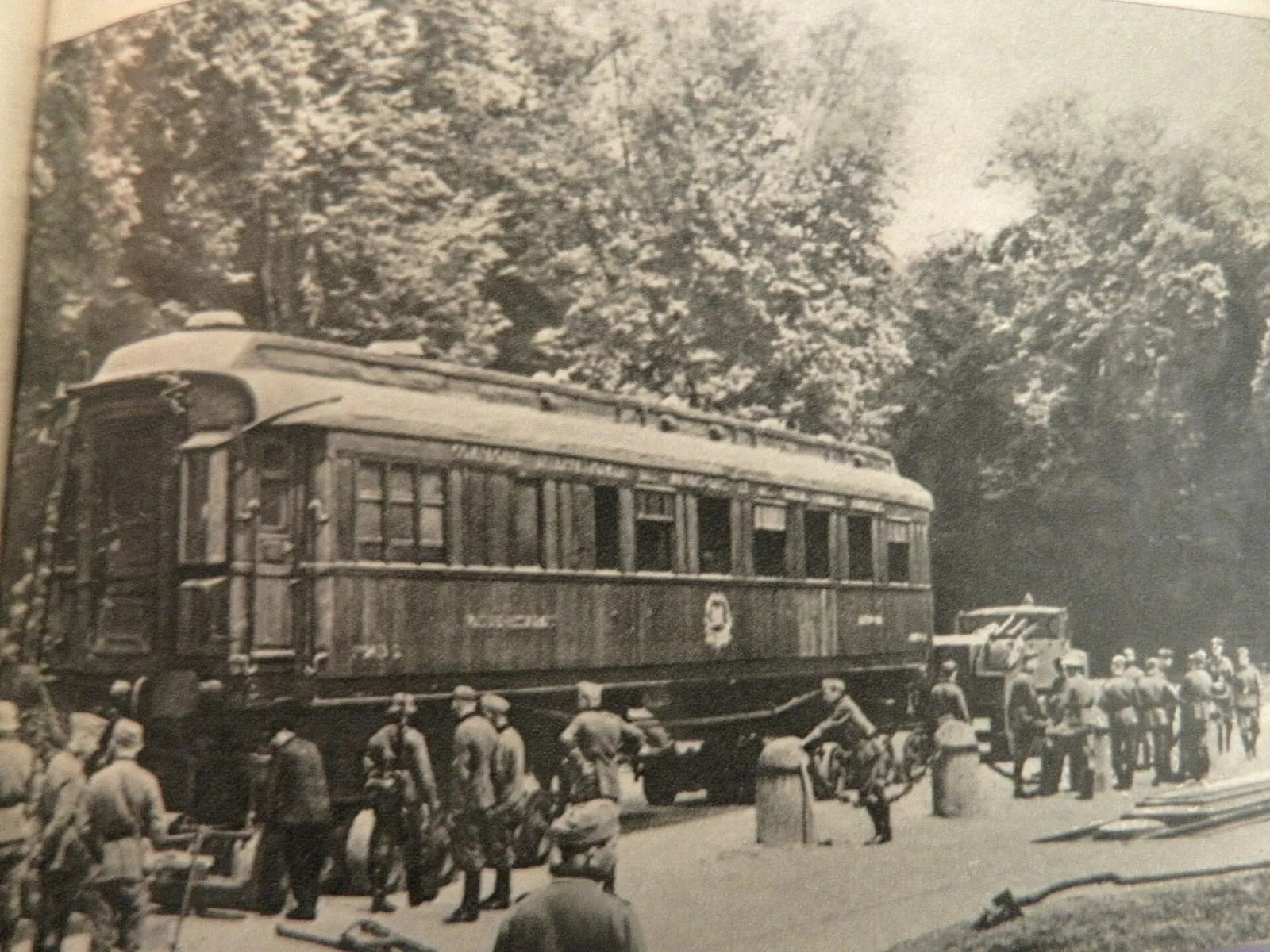
At 6.36 p.m. German time on 22 June 1940, in a wooden dining car standing in a clearing in the Forest of Compiègne near the station of Rethondes, Army General Charles Huntziger and Colonel General Wilhelm Keitel signed the Franco-German armistice agreement. It was the same carriage in which, on 11 November 1918, the representatives of a defeated Germany had accepted the terms of the armistice from Marshal Ferdinand Foch, and it stood on the same spot. Adolf Hitler chose both deliberately: they were to show the world that the defeat of 1918 had been avenged. The negotiations had begun the day before, 21 June, in the presence of Hitler himself. The agreement came into force only on 25 June, after the Franco-Italian armistice had been signed. The six-week campaign the Wehrmacht had opened on 10 May ended in a defeat such as France had not known for centuries.
War chronologies usually spread these events over three days: 21 June (the start of negotiations at Compiègne), 22 June (the signing of the armistice) and 25 June, when France is said to have “officially capitulated to Germany at 1.35 a.m.”. It should be stressed, however, that no capitulation took place on 25 June; what happened was that the armistice signed three days earlier came into force. The time of 1.35 a.m. is German time, as given in Reich radio announcements at the time. In France, whose clocks were an hour behind, the guns fell silent at 12.35 a.m., and that is the time French sources give.
The request for an armistice
When the Germans broke through the French defences on the Somme and the Aisne in the first days of June, a dispute broke out in the government of Prime Minister Paul Reynaud over whether to fight on, if need be from North Africa, or to ask for a ceasefire. The Commander-in-Chief, General Maxime Weygand, and the deputy prime minister, Marshal Philippe Pétain, argued for an armistice. France was bound by the undertaking of 28 March not to conclude a separate armistice or peace without Britain’s consent, but on 14 June the Germans entered Paris, and the government, which had left the capital four days earlier, took refuge in Bordeaux. On the evening of 16 June Reynaud resigned and Pétain became the new prime minister. That night his foreign minister, Paul Baudouin, asked the Spanish ambassador, José Félix de Lequerica, to pass on to the Germans a request for armistice terms. A similar request went through the Vatican to Italy, which had declared war on France on 10 June.
Hitler was in no hurry to reply. German troops kept advancing, and on 17 June Pétain announced on the radio that “the fighting must stop”, which many units took as an order to lay down their arms. On 18 June Hitler met Benito Mussolini in Munich. The Duce wanted to occupy France as far as the Rhône and to take Nice, Corsica, Tunisia and Djibouti, as well as the French fleet and air force. Hitler talked him out of it. He believed that excessively harsh terms would push the French to move their government and fleet to Africa and continue the war alongside the British, and Germany had no navy with which to seize the French colonial empire. He preferred to leave France a truncated state with its own government, which would keep the fleet and colonies neutral and spare Germany the trouble of administering the whole country. The enemy was to be defeated, but not driven to despair.
On 19 June the Germans asked for the names of the French plenipotentiaries. The government put at the head of the delegation General Huntziger, commander of the 4th Army Group, who in May had commanded the 2nd Army at Sedan. He was accompanied by the former ambassador in Warsaw, Léon Noël, Vice-Admiral Maurice Le Luc (PL) and General Jean Bergeret of the air force. Before they left, Pétain gave Huntziger clear instructions: the talks were to be broken off at once if the Germans demanded the surrender of all or part of the fleet, the occupation of the whole of metropolitan France or of any part of the colonial empire. On 20 June the delegation left Bordeaux by car and crossed the front line near Amboise on the Loire, and the Germans drove it through Paris. Until the last moment it did not know where it was going.
Hitler in Foch’s carriage
After the First World War the clearing in the Forest of Compiègne had become a French memorial site. Carriage no. 2419D, in which the armistice had been signed in 1918, stood in a specially built pavilion. In the middle of the clearing lay a granite slab with the inscription: “Here on the eleventh of November 1918 succumbed the criminal pride of the German Empire, vanquished by the free peoples which it tried to enslave.” At the entrance stood a monument to the people of Alsace and Lorraine, with a sword piercing the German eagle. On Hitler’s orders, sappers knocked down a wall of the pavilion, pulled out the carriage and placed it on a track at the very spot where it had stood in November 1918. The monument with the eagle was draped with the German war flag.
On the afternoon of 21 June Hitler arrived at the clearing with Hermann Göring, Grand Admiral Erich Raeder, the army commander General Walther von Brauchitsch, the foreign minister Joachim von Ribbentrop, the Deputy Führer Rudolf Hess and Keitel. The American correspondent William L. Shirer, who watched him through binoculars from a few dozen yards away, noted in his diary that Hitler stopped by the granite slab and read the inscription. “I have seen that face many times at the great moments of his life. But today! It is afire with scorn, anger, hate, revenge, triumph,” Shirer wrote. Hitler’s short, hopping step was later looped in a newsreel by the Scottish documentary maker John Grierson, then head of Canada’s National Film Board, so that it looked like a joyful jig. This “victory dance” went round the world, although in reality it never happened.
In the carriage Hitler took the seat Foch had occupied in 1918. When the French came in, Keitel read out the preamble to the terms. It said that on 11 November 1918 a time of suffering for the German people had begun in this carriage, that the Germans had then laid down their arms trusting in President Wilson’s promises and had been deceived, and that the choice of the Forest of Compiègne was meant to erase once and for all Germany’s deepest humiliation. It ended with the assurance that Germany did not intend to give the terms or the negotiations the character of a humiliation towards “so brave an opponent”. After a quarter of an hour or so Hitler rose and left, just as in 1918 Foch had left the negotiations to his chief of staff, Weygand. A band played the German anthem and the Horst Wessel song. Keitel remained in the carriage with the interpreter Paul Schmidt, and they were joined by the chief of the OKW operations staff, General Alfred Jodl.
Keitel declared that the text could not be altered and that the French could only ask for clarification. Huntziger replied that the terms were harsher than those Germany had accepted in 1918. Since the delegation could sign nothing without the government’s consent, the Germans put up a tent with a telephone nearby. At about 8 p.m. Huntziger got through to Bordeaux and for two hours dictated the entire text of the convention to Weygand, now Minister of National Defence. The Germans tapped and recorded this conversation and, the next day, everything said in the carriage as well. Some of the recordings were found in the 21st century.
Ultimatum and signature
The government in Bordeaux debated the terms during the night and on the morning of 22 June. The delegation put its objections to Keitel, and the negotiations, interrupted by further telephone calls to Weygand, went on all day. The French gained little: the article on the surrender of military aircraft was changed so that it was enough to disarm them and place them under German control, and the clause on the transfer of valuables and stocks from the occupied zone was softened. The Germans, on the other hand, rejected protests against the article on the surrender of refugees, which Huntziger called contrary to honour, since France was a land of asylum, and against making the armistice conditional on an agreement with Italy. Italy, the French pointed out, had not beaten them in the field. In the late afternoon Keitel issued an ultimatum: if the French did not accept the terms within an hour, the negotiations would be considered broken off and the delegation escorted back to its own lines. Huntziger received orders from Bordeaux to sign, and at 6.36 p.m. German time the two generals put their signatures to the document. Some sources give 6.50 p.m., but the text of the agreement explicitly states 6.36 p.m. German summer time.
After the signing Keitel asked that the two of them be left alone in the carriage. According to his memoirs, he expressed his respect for his opponent’s soldierly bearing, and Huntziger apologised if he had lost his composure during the talks, but made it clear how deeply the dependence of the armistice on Italy had wounded him.
The terms
The convention had 24 articles. The most important provided that:
- France would cease hostilities at home, in the colonies, protectorates and mandated territories and at sea, and troops already surrounded would lay down their arms at once;
- Germany would occupy the northern and western part of the country, with Paris and the whole coast of the Channel and the Atlantic, about three-fifths of metropolitan France. The boundary of the occupied zone ran from the Swiss border near Geneva through Dole, Paray-le-Monial and Bourges, then about 20 kilometres east of Tours and of the Tours–Angoulême–Libourne railway, through Mont-de-Marsan and Orthez to the Spanish border. The south of the country remained the unoccupied zone;
- in the occupied zone the Reich would exercise all the rights of an occupying power, and French authorities were to comply with its regulations and “collaborate with it in a correct manner”. The French government retained authority over the whole country and could choose its seat in the unoccupied zone or even in Paris;
- the armed forces would be demobilised and disarmed, except for units needed to maintain order; weapons and equipment were to be handed in under German or Italian control, and arms production would cease;
- the navy, apart from the part needed to safeguard French interests in the colonies, was to assemble in its home ports and be disarmed under German or Italian control. The Reich government “solemnly” declared that it had no intention of using the fleet for its own purposes or of claiming it when peace was concluded;
- France would undertake no hostile action against the Reich and would not allow soldiers to leave the country, and Frenchmen fighting on the side of states still at war with Germany would be treated as francs-tireurs, that is, irregulars without the rights of prisoners of war;
- France would bear the cost of maintaining the occupation troops;
- all German prisoners would return to Germany at once, and the French government would surrender on demand any German national named by the Reich (Article 19);
- French soldiers in German captivity would remain prisoners until peace was concluded (Article 20);
- implementation of the agreement would be supervised by a German armistice commission, with a French delegation attached to it;
- the armistice would remain in force until a peace treaty was concluded, but Germany could terminate it at any moment if France failed to meet its obligations.
The agreement said nothing about Alsace and Lorraine. Even while the talks were under way, however, the Germans placed the departments of Haut-Rhin, Bas-Rhin and Moselle under German civil administration, and within a few weeks they had in effect annexed them to the Reich. Nor was the amount of occupation costs specified. In August the Germans set it at 20 million Reichsmarks, or 400 million francs, a day, a sum many times greater than the occupation troops actually needed.
Many Frenchmen, including members of the delegation, expected the armistice to be short. It was widely assumed that Britain would soon make peace, and that the one and a half to nearly two million prisoners would then come home. That is why no one in the delegation protested against Article 20. Most of the prisoners spent five years in German camps.
25 June
Under Article 23, the armistice was to come into force only once France had reached an agreement with Italy, and hostilities were to cease six hours after the Italian government had notified Berlin of it. On 23 June Huntziger’s delegation flew in a German aircraft to Rome, where on the evening of 24 June, at the Villa Incisa, it signed the armistice with Italy with Marshal Pietro Badoglio. The Italians, who in a few days of fighting in the Alps had taken only scraps of the border area, settled for a small occupation zone. On 25 June at 12.35 a.m. French time, or 1.35 a.m. German time, the guns fell silent on every front. A few Maginot Line forts that had not been taken surrendered only in the following days, on the orders of the French command.
Pétain declared 25 June a day of national mourning. In a radio address that day he set out the terms, announced that “a new order is beginning” and called for moral renewal and a return to the land, which, he said, “does not lie”. General Charles de Gaulle, who on 18 June had called from London for the fight to go on, replied the following day on the BBC that the armistice was dishonourable. In Germany Hitler ordered flags to be flown for ten days and church bells to be rung for a week. Early on the morning of 23 June he also paid a visit of a few hours to conquered Paris.
The clearing at Rethondes shared the fate of the vanquished. On Hitler’s orders German sappers blew up the granite slab, the Alsace-Lorraine monument and the pavilion. Only the statue of Foch was left, to stand thenceforth amid emptiness. The carriage was taken to Berlin and from July was displayed as a trophy, first by the Brandenburg Gate and then in the Lustgarten. In 1944 it was moved to Thuringia. It was destroyed in the last months of the war near Crawinkel – set on fire by SS men in 1945, according to most accounts, although some witnesses spoke of bombing. After the war the French restored the clearing and placed in it a twin carriage from the same series.
Place in the war
The armistice of 22 June was not formally a capitulation, since France kept its government, its colonial empire and its fleet, but in practice it ended France’s part in the war as an Allied power. Britain was left alone. The British did not trust the German assurances about the fleet, and on 3 July 1940 they attacked French warships at Mers-el-Kébir (Operation Catapult), killing nearly 1,300 French sailors. On 10 July, at Vichy, parliamentarians granted Pétain full powers, which brought the history of the Third Republic to an end. The new French State treated the armistice as the basis of its relations with Germany and in the autumn set out on the path of collaboration. Over the summer Huntziger headed the French delegation to the German armistice commission in Wiesbaden, and from September he was Vichy’s war minister.
For more than two years the demarcation line became a frontier that people and goods could cross only with a German pass. Article 19 allowed the Germans to hunt down refugees who had sought shelter in France from Nazism. In July 1940 the Vichy authorities handed Herschel Grynszpan over to the Germans, and in February 1941 the French police delivered the Social Democratic politicians Rudolf Breitscheid and Rudolf Hilferding to the Gestapo. Hilferding died soon afterwards in Gestapo hands, and Breitscheid in Buchenwald concentration camp in 1944. The occupation costs drained the French economy, and holding more than one and a half million prisoners gave Germany constant leverage over Vichy. France’s truncated sovereignty ended in November 1942 when, after the Allied landings in North Africa, the Germans and Italians occupied the unoccupied zone (Operation Anton), and the French fleet scuttled itself at Toulon to avoid falling into their hands.
For Hitler the day in the Forest of Compiègne was the summit of triumph. The reversal of the roles of 1918, planned down to the place and the gesture, fulfilled the promise he had been making to the Germans for twenty years: to wipe out the disgrace of the armistice and of Versailles. For the French, and above all for the men who accepted its terms, the armistice became the source of a dispute that lasted for decades: did it save the country from total occupation and preserve its fleet and colonies, or was it the first step towards a collaboration that could have been avoided by moving the government to Africa?
Sources
Meanwhile
(04)Elsewhere, within a week.
- 20 June 1940 · PolandExecutions at PalmiryOn 20 and 21 June 1940 the Germans shot 358 Pawiak prisoners at Palmiry, among them Maciej Rataj, Mieczysław Niedziałkowski and Janusz Kusociński.
- 18 June 1940 · PoliticsGeneral de Gaulle’s appealOn 18 June 1940 General de Gaulle urged the French on BBC radio to fight on. On 28 June London recognised him as leader of the Free French.
- 26 June 1940 · DiplomacyThe Soviet ultimatum to RomaniaOn 26 June 1940 Molotov demanded Bessarabia and northern Bukovina. Lacking Berlin’s support, Bucharest gave way; on 28 June the Red Army crossed the Dniester.
- 17 June 1940 · PoliticsThe Red Army enters Latvia and EstoniaOn 17 June 1940, a day after the Soviet ultimatums, the Red Army entered Latvia and Estonia. By 18 June all three Baltic states were occupied.
Related events
(04)The same battle, people or subject.
- 14 June 1940 · Western FrontThe Germans enter ParisOn 14 June 1940 German troops entered Paris, declared an open city, without a fight. A swastika flag was hoisted over the Eiffel Tower.
- 16 June 1940 · PoliticsPétain becomes Prime Minister of FranceOn 16 June 1940 at Bordeaux Reynaud resigned and President Lebrun entrusted the government to Marshal Pétain. That night France asked for an armistice.
- 15 June 1940 · Western FrontOperation AerialOn 15 June 1940 the British began evacuating troops from the ports of western France. By 25 June they had also taken off Poles, Czechoslovaks and some French.
- 24 May 1940 · Western FrontThe halt order before DunkirkOn 24 May 1940 Hitler approved halting the tanks before Dunkirk. By 26 May the Allies had strengthened their defence, and the Germans took Boulogne and Calais.