Japan
Emperor Meiji
Emperor of Japan (1867–1912)
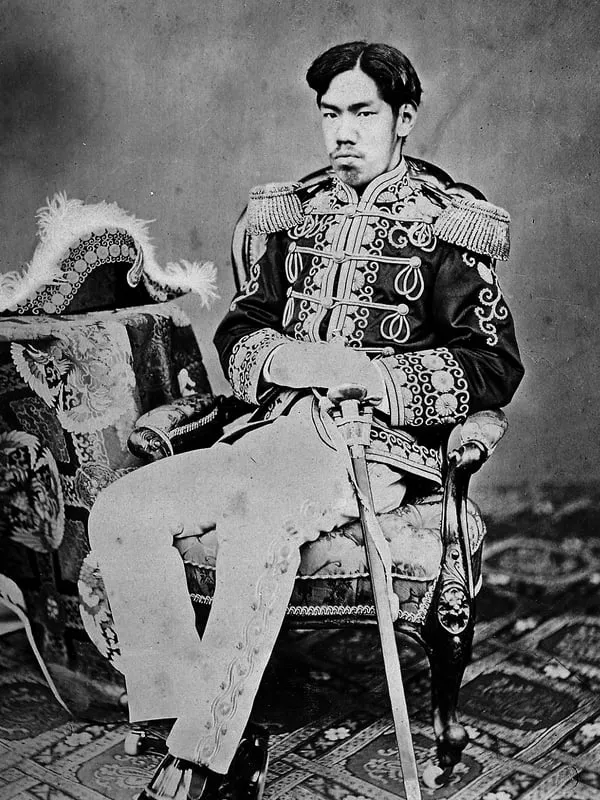
- Born:
- 3 November 1852, Kyoto
- Died:
- 30 July 1912, Tokyo
- Author:
- Natalia
- Photo:
- Uchida Kuichi, domena publiczna, Wikimedia Commons

Mutsuhito, known after his death as the Emperor Meiji, came to the throne as a fourteen-year-old boy in a country ruled by the shoguns, cut off from the world and defenceless against Western warships. When he died 45 years later, Japan had a constitution, a parliament, modern industry, an army and a navy that had defeated China and Russia, as well as colonies: Taiwan, southern Sakhalin, the Kwantung Leased Territory and Korea. One of the swiftest transformations in world history was carried out in his name, and he himself became its symbol. Historians disagree over how much of it was his personal will and how much the decisions of the oligarchs who governed in his name. What is certain is that the state he left behind, with a divine emperor at its summit and an army answerable directly to him rather than to the government, became in the 1930s an instrument in the hands of the militarists who, under the reign of his grandson Hirohito, led Japan to war.
Childhood in Kyoto
He was born on 3 November 1852 (the 22nd day of the 9th month in the lunar calendar) in Kyoto, in the house of his maternal grandfather, the courtier Tadayasu Nakayama. He was the son of Emperor Kōmei and his lady-in-waiting Yoshiko Nakayama. As a child he bore the name Sachi-no-miya. For more than two hundred years the emperors had held no power: the shogun of the Tokugawa house ruled from Edo, while the court in Kyoto occupied itself with ceremonial, poetry and calligraphy. Half a year after the prince’s birth, Commodore Matthew Perry’s American “black ships” sailed into Edo Bay, and soon the shogunate had to sign the first unequal treaties with the powers. In 1860 the boy was proclaimed heir to the throne and received his adult name, Mutsuhito.
He spent his childhood behind the walls of the palace in Kyoto, in a world of court ladies, studying the Chinese classics and waka poetry, which he practised all his life. According to later accounts he was an average pupil. In those years the country was sliding into chaos: radical samurai under the slogan “revere the emperor, expel the barbarians” murdered foreigners and shogunate officials, while the domains of Satsuma and Chōshū prepared to fight Edo.
The Restoration
On 30 January 1867 Emperor Kōmei died unexpectedly of smallpox. Rumours of poisoning circulated at once but were never proved. On 13 February the fourteen-year-old Mutsuhito ascended the throne. In November 1867 the last shogun, Yoshinobu Tokugawa, relinquished power, and on 3 January 1868 the restoration of imperial rule was proclaimed in the palace in Kyoto. The Boshin War broke out, in which the forces of Satsuma and Chōshū, fighting under the imperial banner, had defeated the shogunate’s supporters by the middle of 1869.
On 6 April 1868 the Emperor proclaimed on behalf of the new government the Charter Oath in five articles, which promised deliberative assemblies to debate matters of state and announced that Japan would seek knowledge throughout the world. In October the enthronement ceremony took place and a new era was proclaimed, Meiji, meaning “enlightened rule”. From then on each emperor was to have only one era name and to receive it as his name after death. Edo was renamed Tokyo, the “eastern capital”, and at the end of 1868 the Emperor came for the first time to the former seat of the shoguns, taking up permanent residence there in 1869. At the beginning of 1869 he married Haruko Ichijō, the daughter of an aristocrat. The Empress had no children, and all the Emperor’s offspring were born to court ladies. Of his fifteen or so children only five reached adulthood, among them one son, the future Emperor Taishō.
Rebuilding the state
Real power was exercised by a group of young samurai from Satsuma, Chōshū, Tosa and Hizen, together with a few courtiers, who carried out the Meiji Restoration. In 1871 the domains were abolished and replaced by prefectures. In 1873 universal military conscription was introduced, which took away the samurai’s monopoly on bearing arms, and later their stipends and privileges as well. The rebellion of embittered Satsuma samurai led by Takamori Saigō in 1877 was Japan’s last civil war. The government built railways, factories, telegraph lines, schools and a modern army on French and later German models, and a navy on British lines.
The Emperor, brought up to a secluded life, became a public figure in these years. He wore uniform, rode on horseback, travelled around the country, received foreign visitors and attended cabinet meetings, although he rarely spoke at them. His portraits hung in schools and government offices.
On 4 January 1882 the Imperial Rescript to Soldiers and Sailors was issued in his name. It declared that supreme command of the army and navy belonged to the Emperor, that soldiers owed him absolute loyalty, and that, set against duty, death was “lighter than a feather”. The armed forces were to keep out of politics, yet at the same time they were answerable directly to the monarch rather than to the government. On 11 February 1889 the Emperor granted the nation a constitution, drawn up under the direction of Hirobumi Itō on the Prussian model. In it the Emperor was “sacred and inviolable”, held supreme command of the army and navy, declared war and made peace. The first parliament met in 1890, and in October that year the Imperial Rescript on Education was proclaimed, teaching generations of children obedience to the Emperor and readiness to sacrifice themselves for the state.
In May 1891, at Ōtsu, a policeman, Sanzō Tsuda, attacked with his sabre the Russian heir to the throne, the future Tsar Nicholas II, who was visiting Japan. The horrified government feared war. The Emperor travelled personally to Kyoto to visit the wounded Tsesarevich and accompanied him aboard a Russian warship at Kobe.
The wars with China and Russia
In August 1894 Japan declared war on China over influence in Korea. The Emperor moved to Hiroshima, where Imperial Headquarters was located, and spent most of the war there. The Treaty of Shimonoseki gave Japan Taiwan, the Pescadores and the Liaodong Peninsula, as well as a large indemnity, but a few days later Russia, Germany and France forced Tokyo to give back Liaodong. The Emperor issued a rescript calling on his subjects to accept this decision. In October 1895 Japanese soldiers and hired swordsmen, at the instigation of the envoy Gorō Miura, murdered Queen Min, the wife of King Gojong, in Seoul. The perpetrators were tried in Hiroshima and released for lack of evidence.
When in 1904 the government decided on war with Russia, the Emperor approved the decision at a conference on 4 February. According to court accounts he was uneasy and feared defeat. It is from the time of this war that his poem comes in which he asks why, if all the seas of the four quarters of the world are brothers, winds and waves rise upon them. His grandson Hirohito read this poem aloud on 6 September 1941 at the Imperial Conference which approved the preparations for war with the United States, to signal that he would prefer peace.
Japan won the war with Russia thanks to the armies of Field Marshal Iwao Ōyama and the fleet of Admiral Heihachirō Tōgō. On 28 August 1905 the Emperor approved the decision to make peace even without an indemnity, and the Foreign Minister, Jutarō Komura, signed the Treaty of Portsmouth. After it Korea became a protectorate; in 1907 King Gojong was forced to abdicate in favour of his son, Sunjong, and in 1910 Japan annexed Korea. The Korean royal family was absorbed into the Japanese aristocracy.
The last years and death
The final years of the reign brought the first signs of tension in a society that modernisation had torn out of the old order. In 1910 the police uncovered a plot by a few anarchists who had considered an attempt on the Emperor’s life. On this basis dozens of people were charged with high treason, and in January 1911 twelve of them were executed, among them the writer and activist Shūsui Kōtoku, although his part in the plot was doubtful.
The Emperor had suffered for years from diabetes and kidney disease. He died in Tokyo, according to the official announcement at 12.43 a.m. on 30 July 1912. Some scholars believe that he actually died late in the evening of 29 July and that the time was shifted to allow the formalities of the succession to be completed. The throne passed to his son Yoshihito, the Emperor Taishō. On 13 September 1912, the day of the funeral in Tokyo, General Maresuke Nogi, the conqueror of Port Arthur, committed suicide together with his wife in order to follow his master. The Emperor was buried in the Fushimi-Momoyama mausoleum in Kyoto, and the Meiji Shrine was built in his honour in Tokyo.
Ruler or symbol
The Emperor kept no diary and wrote few letters, and the accounts of people who knew him are scanty and contradictory. Some historians see him as a figurehead who rubber-stamped the decisions of the oligarchs, known as the genrō: Hirobumi Itō, Aritomo Yamagata and their associates. Others believe that he had distinct views, conservative and hostile to democracy, and was able to exert effective influence on disputes between ministers. Most agree that his role consisted above all in arbitrating and legitimising, rather than initiating, policy.
Significance
Meiji Japan was a model of modernisation for the whole of Asia and a source of pride for the Japanese, but it was also a state built on a system full of dangerous gaps. The constitution did not make clear who was responsible for policy: the Emperor was the source of all authority but was not meant to exercise it personally. The army and navy were answerable directly to him, and the ministers of war and of the navy had to be serving officers. In Mutsuhito’s lifetime disputes were settled by the genrō, who had carried out the Restoration together. Once they had died out, no one could keep the military in check any longer. In the 1930s officers invoked the independence of the supreme command and the will of the Emperor to act without the government’s consent, as in Manchuria in 1931, while the rescripts of the Meiji era taught soldiers that life was nothing compared with duty to the monarch.
The gains of his reign – Taiwan, Korea, southern Sakhalin and rights in Manchuria – were the foundation of the Japanese empire, which in the 1930s and 1940s reached out for the rest of China and South-East Asia. They were lost in 1945, when his grandson announced Japan’s surrender.
Sources
Mentioned in battles
(01)Often appears with
People who appear in the same events.