Japan
Aritomo Yamagata
Founder of the Imperial Japanese Army, Prime Minister of Japan (1889–1891, 1898–1900), Chief of the General Staff (1904–1905), President of the Privy Council (1905–1909, 1909–1922), genrō, Field Marshal (gensui, from 1898)
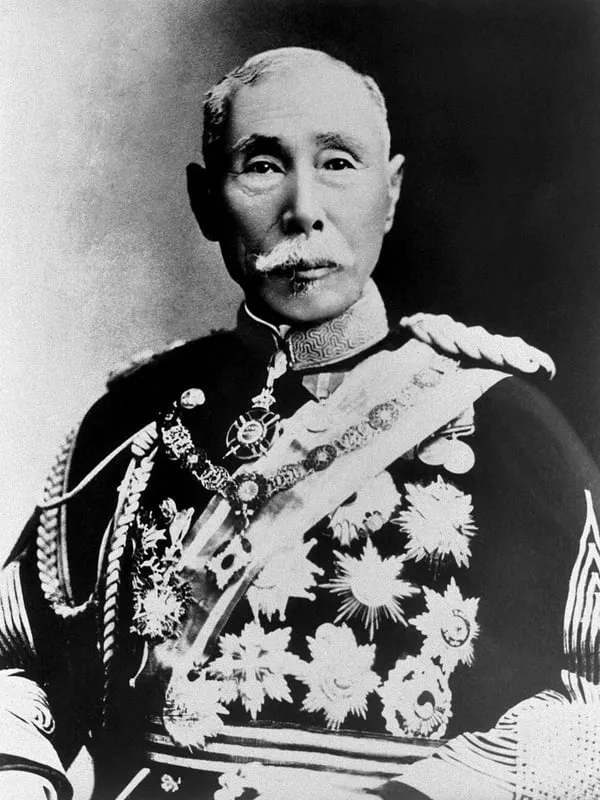
- Born:
- 14 June 1838, Hagi (Chōshū Domain, Japan)
- Died:
- 1 February 1922, Odawara (Kanagawa Prefecture, Japan)
- Author:
- Łukasz
- Photo:
- autor nieznany, domena publiczna, Wikimedia Commons

Aritomo Yamagata was the father of the modern Japanese army and for a quarter of a century the most powerful man in Japan after the emperor. He introduced universal conscription, built a general staff on the Prussian model, wrote the soldier’s moral code and was twice prime minister, and as the senior genrō – the informal council of elder statesmen – he decided who would head the government. From the point of view of the history of the war, what matters most is that he created the framework within which the army operated right up to 1945: an army answerable directly to the emperor rather than to the government, with the power to block cabinets, and a doctrine according to which Japan’s security required control of Korea and later of Manchuria. He raised a whole generation of generals, from Tarō Katsura to Masatake Terauchi, and remained an enemy of political parties to the end of his life.
Youth in Chōshū
He was born on 14 June 1838 in Hagi, the capital of the Chōshū domain at the western tip of the island of Honshu, into a samurai family of the lowest rank. His mother died when he was five and he was brought up by his grandmother. As a young official of the domain, in 1858 he spent a few months at the school of Shōin Yoshida, a teacher whose pupils also included Hirobumi Itō and many other leaders of the Meiji Restoration. After Yoshida’s execution in 1859 he joined the Chōshū radicals who, under the slogan “revere the emperor, expel the barbarians”, fought the shogunate and the foreigners.
In 1863 he joined the Kiheitai, a volunteer unit formed by Shinsaku Takasugi in which peasants and townsmen served alongside samurai, and soon became one of its commanders. In 1864 he was wounded when a fleet of the Western powers bombarded the forts at Shimonoseki. His experience in the Kiheitai convinced him that well-trained peasants could make soldiers as good as samurai. In the Boshin War of 1868–1869 he commanded the Chōshū forces in heavy fighting against the domains of northern Japan that were defending the shogunate.
A conscript army
In 1869–1870 Yamagata, together with Tsugumichi Saigō, the younger brother of Takamori Saigō, toured Europe and studied the armies of France, Britain and Prussia. What impressed him most was the Prussian system of universal conscription. On his return he became Vice-Minister of War and helped create the Imperial Guard, made up of troops from Satsuma, Chōshū and Tosa, which in 1871 gave the government the force it needed to abolish the feudal domains.
In January 1873, largely on his initiative, universal military service was introduced for men of all classes. Many samurai saw this as the loss of their privilege, while peasants rebelled against the “blood tax”. Yamagata, Army Minister from 1873, suppressed this resistance. In 1872 he had nearly lost his career when it emerged that an acquaintance of his, a military supplier, had squandered huge sums from the ministry’s funds and then committed suicide, but he was soon back in favour. The test for the new army came with the Satsuma Rebellion of 1877. Yamagata commanded the government forces, and his conscripts defeated the samurai of Takamori Saigō, who was killed in the final battle at Shiroyama in September 1877.
A state within the state
In December 1878 Yamagata separated a general staff on the Prussian model from the Army Ministry, with Tarō Katsura as one of its chief advisers, and became its chief himself. The Chief of Staff answered directly to the emperor and in matters of command could approach the throne without going through the government. This principle of the independence of the supreme command, later enshrined indirectly in the constitution, became the source of many later crises, when the army acted without the knowledge and consent of the cabinet. In 1882, on Yamagata’s initiative, Emperor Mutsuhito issued the Imperial Rescript to Soldiers and Sailors. It enjoined loyalty to the emperor, obedience and abstention from politics, and declared duty to the sovereign heavier than a mountain, and death lighter than a feather. Every soldier had to know it by heart until 1945.
In the 1880s, as Home Minister, Yamagata built up a centralised police force and, with the help of the German jurist Albert Mosse, a system of local government in which officials from Tokyo controlled life right down to village level. In December 1887, under the Peace Preservation Law, several hundred activists of the Freedom and People’s Rights Movement were expelled from the capital.
Prime minister and the “line of interest”
On 24 December 1889 Yamagata became prime minister. In 1890 his government prepared the Imperial Rescript on Education, issued in October, which set the course of Japanese schooling for half a century: loyalty to the emperor and readiness to give one’s life for the state. At the first session of the new parliament, in December 1890, Yamagata set out in a speech the doctrine that would shape Japan’s policy towards the mainland. Japan, he argued, had to defend not only its “line of sovereignty” – its own borders – but also its “line of interest”, the area on which its security depended. That area was Korea. It followed from the doctrine that the army and navy had to be many times larger than the defence of the home islands alone would require. Over time the “line of interest” moved further out, to Manchuria and Mongolia. Yamagata’s government fell in May 1891 after clashes with the opposition in parliament.
In the war with China of 1894–1895 Yamagata, although already 56, insisted on being given command of the First Army. He led it through Korea and across the Yalu River into Manchuria, but he was ill and acted against Tokyo’s plans, and in December 1894 the emperor recalled him to Japan. After the war Yamagata secured a doubling of the number of divisions, from seven to thirteen. After the assassination of Queen Min in 1895, when Russia gained the upper hand in Seoul, he went to Moscow for the coronation of Nicholas II, and on 9 June 1896 signed a protocol with the Foreign Minister, Aleksey Lobanov-Rostovsky, in which the two states agreed to share influence in Korea and to have the right to station troops there. In January 1898 he was made a field marshal (gensui).
Second government
From November 1898 to October 1900 Yamagata was prime minister for the second time. He raised the land tax to pay for armaments and made it harder for party politicians to gain high office. In March 1900 his government passed the Public Order and Police Law, aimed at the labour movement, and sent troops to China during the Boxer Rebellion. Most momentous of all was the regulation of May 1900 under which only generals and admirals on the active list could serve as army and navy ministers. From then on the army could bring down a government by withdrawing its minister, or prevent one from being formed by refusing to provide a candidate. The rule was relaxed in 1913, but it was restored in 1936 and served the military as a means of imposing its will on successive cabinets.
Genrō
After 1900 Yamagata was no longer prime minister, but as a genrō he ruled from behind the scenes. His faction, made up of soldiers and officials, competed with that of Itō, who in 1900 founded the Rikken Seiyūkai party. His protégé Katsura was prime minister from 1901 to 1906. Yamagata supported the alliance with Britain of 1902 and was among those who in 1903–1904 considered war with Russia inevitable.
In the Russo-Japanese War, from June 1904, he was Chief of the General Staff in Tokyo, while Field Marshal Iwao Ōyama commanded the armies in Manchuria. After the Battle of Mukden in March 1905, knowing that the army was running short of officers and ammunition, Yamagata argued for a swift peace, which came with the Treaty of Portsmouth. In 1907 he was made a prince and helped draw up the first Imperial Defence Policy, in which Russia figured as the army’s principal potential enemy and the United States as the navy’s.
Yamagata favoured a hard line on Korea. After Itō’s assassination in Harbin in October 1909 no one could oppose him any longer, and his protégé Terauchi carried out the annexation of Korea in 1910. From 1905 until his death – with a break of a few months in 1909, when the post was held by Itō – Yamagata was President of the Privy Council, the emperor’s highest advisory body.
The last decades
After the death of Emperor Meiji in 1912 Yamagata devoted himself to protecting the court from the politicians. In the winter of 1912 he backed the army’s demand for two new divisions in Korea, which brought down Saionji’s government when the army minister resigned and the military refused to name a successor. Katsura became prime minister for the third time, but protests in Tokyo forced him to step down in February 1913. In 1915 Yamagata and the other genrō criticised the way in which the Foreign Minister, Takaaki Katō, had presented China with the Twenty-One Demands, as he feared it would alienate the Western powers from Japan. More than China, he feared a coalition of the white powers against the Asians. For that reason he supported a rapprochement with Russia, sealed by a secret alliance in July 1916, which collapsed together with the tsar. His protégé Terauchi was prime minister once again from 1916 to 1918.
After the rice riots of 1918 Yamagata had to accept a government led by the Seiyūkai leader Takashi Hara, the first fully party-based cabinet in Japanese history, and to the surprise of many he worked well with him. In 1920–1921 he suffered his last defeat. He tried to prevent the marriage of Crown Prince Hirohito to Princess Nagako because colour blindness ran in the family of her mother, who came from the Shimazu clan of Satsuma. The court and Yamagata’s opponents saw this as an intrigue aimed at the Satsuma clan; in February 1921 it was announced that the engagement stood, and Yamagata offered to resign all his honours. The emperor did not accept his resignation. At the same time he supported Hirohito’s journey to Europe in 1921.
Death and legacy
He died on 1 February 1922 at his villa in Odawara, aged 83. His state funeral in Tokyo drew few people, and the press contrasted it with the funeral of Shigenobu Ōkuma, who had died a few weeks earlier and whose funeral had attracted crowds. He was buried in the cemetery of the Gokoku-ji temple in Tokyo.
Yamagata was a convinced conservative who distrusted parties, parliament and social movements, and above all believed in the army as a school of loyalty to the throne. He was no adventurer, and in foreign policy he was at times more cautious than the younger generals. Yet the institutions he built outlived him and turned against what he had stood for. The independence of the supreme command from the government, the army’s right to nominate the minister and the ideology of the soldier devoted solely to the emperor allowed officers of the Kwantung Army in the 1930s to conquer Manchuria against the government’s wishes, and the generals to bring the state under their control. His “line of interest”, pushed ever further into the mainland, led Japan first to war with China and then to the war in the Pacific.