Japan
Tarō Katsura
General, Governor-General of Taiwan (1896), Army Minister (1898–1900), Prime Minister of Japan (1901–1906, 1908–1911, 1912–1913)
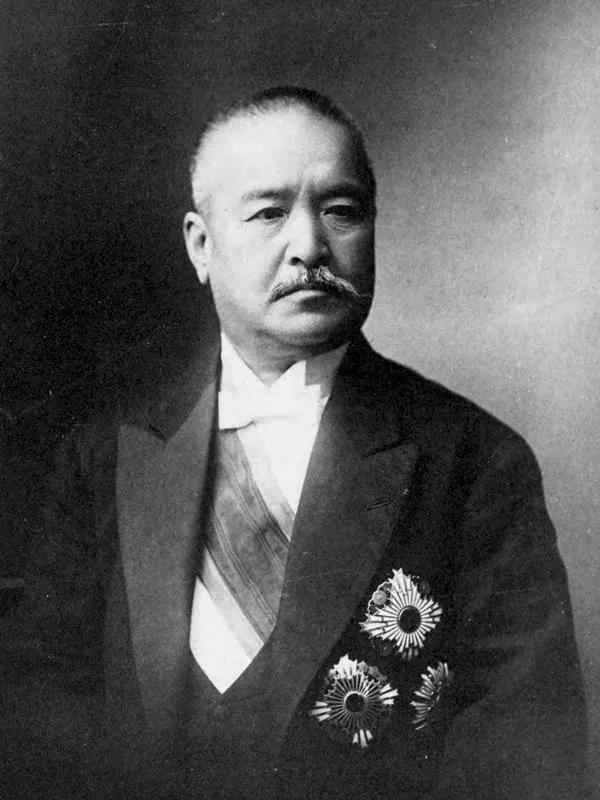
- Born:
- 4 January 1848, Hagi (Chōshū Domain, Japan)
- Died:
- 10 October 1913, Tokyo
- Author:
- Natalia
- Photo:
- 故桂公爵記念事業会, domena publiczna, Wikimedia Commons

Tarō Katsura was a general who became the longest-serving prime minister in Japanese history, a record that stood until the 21st century. He held office three times, for almost eight years in all, and in that time Japan went from a regional power to a great power: it concluded an alliance with Britain, won the war with Russia, obtained recognition of its paramountcy over Korea from the United States and Britain, and in 1910 annexed Korea. A protégé of Field Marshal Aritomo Yamagata, he helped to build an army on the German model, and towards the end of his life, when his third government fell under pressure from the streets, he tried to remake himself as a party politician. His governments opened up for Japan the road to the Asian mainland, which his successors followed all the way to Manchuria and war with China.
Youth and studies in Germany
He was born on 4 January 1848 in Hagi, in the domain of Chōshū, the son of a samurai of middle rank. As a boy he served in the domain’s Western-trained units, fought against the shogunate’s expedition against Chōshū in 1866, and in the Boshin War of 1868–1869 saw action in northern Japan. In 1870 he went to Germany at his own expense and studied the art of war there until 1873. From 1875 to 1878 he was military attaché at the embassy in Berlin, and he spent a second period in Europe in 1884–1885.
Army reformer
Katsura belonged to the group of Chōshū officers who, under Yamagata’s patronage, rebuilt the Japanese army. After returning from Germany in 1878 he advised on the creation of a General Staff separate from the Army Ministry. In the second half of the 1880s, as one of the most important officials of the Army Ministry and later its vice-minister, he carried out, together with General Soroku Kawakami, a reform supported by the German adviser Major Jakob Meckel. Japan abandoned French models in favour of Prussian ones, and in 1888 the old regional garrisons were replaced by divisions capable of independent operations abroad. The army, which had until then been meant to put down internal revolts, began to prepare for war on the mainland.
In the war with China of 1894–1895 Katsura commanded the 3rd Division, which fought in Manchuria, among other places in the winter battles for the town of Haicheng. In 1895 he was made a viscount. From June to October 1896 he was Governor-General of Taiwan, taken from China a year earlier, where the army was still fighting the resistance of the local population. In January 1898 he became Army Minister, a post he held in successive governments until December 1900. In the same year he founded a school to train officials for the colonies, which grew into Takushoku University in Tokyo.
First government: alliance and war
On 2 June 1901 Katsura became prime minister. His government, the first not headed by one of the genrō, the elder statesmen of the Meiji Restoration generation, was regarded as a stopgap but lasted four and a half years. In September 1901 Jutarō Komura became foreign minister, and Katsura conducted foreign policy together with him. While Hirobumi Itō travelled to St Petersburg in search of an understanding with Russia, Katsura’s government chose an alliance with Britain, signed on 30 January 1902. In 1903 Katsura, Komura and Yamagata concluded that Russia, which had not withdrawn its troops from Manchuria, would not give way over Korea, and that time was on its side. On 4 February 1904 a council attended by Emperor Mutsuhito decided on war.
The war, won on land by Field Marshal Iwao Ōyama and at sea by Admiral Heihachirō Tōgō, exhausted Japan financially and in manpower. Katsura’s government knew this better than anyone, and in the spring of 1905 it sought the mediation of President Theodore Roosevelt. Before negotiations began, Katsura secured Japan’s gains in Korea. On 27 July 1905 in Tokyo he held a conversation with the American Secretary of War, William Taft, recorded in a note known as the Taft–Katsura memorandum: Japan gave assurances that it had no designs on the American Philippines, and Taft took note that Japan would establish its suzerainty over Korea. In August Britain, in renewing the alliance, recognised the same.
The Treaty of Portsmouth, signed on 5 September 1905, gave Japan Korea, the lease of Kwantung and the railway in southern Manchuria, but brought none of the indemnity the public had been counting on. Three days of rioting broke out in Tokyo’s Hibiya Park; crowds attacked police boxes and pro-government newspapers, and the government declared a state of emergency. In the autumn Katsura signed a preliminary agreement with the American railway magnate Edward Harriman on joint management of the South Manchuria railway, but on his return from America Komura persuaded the government to annul it. In November 1905 Korea was forced to accept a Japanese protectorate. On 7 January 1906 Katsura resigned, handing power to the leader of the Seiyūkai party, Kinmochi Saionji.
The Keien era and the annexation of Korea
Over the following years Katsura and Saionji took turns as prime minister, a period named the Keien era after the first characters of their surnames. Katsura represented the bureaucracy and the army associated with Yamagata, Saionji the largest party in parliament, and the two sides came to terms behind the scenes. On 14 July 1908 Katsura took office for the second time, also running the finance ministry himself.
His second government completed the subjugation of Korea. In the spring of 1909 Katsura and Komura presented the plan for annexation to Itō, who to their surprise accepted it, and in July the government adopted a resolution that Korea would be annexed “at an appropriate time”. After Itō’s assassination in Harbin in October 1909, the Army Minister in Katsura’s government, General Masatake Terauchi, was appointed Resident-General in Seoul in May 1910. On 22 August 1910 Terauchi and the Korean prime minister, Yi Wan-yong, signed the treaty of annexation. In April 1911 Katsura was made a prince for the annexation. In 1911 Komura secured the restoration of Japan’s full tariff autonomy, which brought the era of the unequal treaties to a close.
At home Katsura’s second government was marked by repression. In 1910 the police uncovered a plot by several anarchists to assassinate the Emperor, and on this basis several dozen people were charged with high treason. In January 1911 twelve of them were executed, among them the writer Shūsui Kōtoku, whose involvement in the plot was doubtful. In 1911 a special section for combating subversive movements was set up in the Tokyo police, from which the secret political police of the 1930s grew. In 1911 the government also passed the first law protecting factory workers. On 30 August 1911 Katsura again handed power to Saionji.
The Taishō political crisis
In the summer of 1912 Katsura set off for Europe on the Trans-Siberian Railway. He had reached St Petersburg when news came of the Emperor’s grave illness, and he turned back. After Mutsuhito’s death in July 1912 Yamagata, who wanted control over the court of the young and sickly Emperor Yoshihito, installed Katsura as Lord Keeper of the Privy Seal and Grand Chamberlain. Many took this as a way of removing him from politics.
In December 1912 Saionji’s government refused the army the money for two new divisions in Korea. The Army Minister resigned, the army did not nominate a successor and the cabinet fell. On 21 December Katsura became prime minister for the third time. When the navy delayed nominating a minister, Katsura induced the Emperor to issue a rescript obliging it to do so. The opposition concluded that a general from Yamagata’s circle was using the throne to defend the army and the bureaucracy. The movement to “protect the constitution” drew thousands to its rallies. In January 1913 Katsura announced the founding of his own party, the Rikken Dōshikai, which meant a break with Yamagata, who despised parties, but only some of the deputies joined the new group. On 5 February 1913 the deputy Yukio Ozaki accused him in parliament of hiding behind the throne as behind a rampart and using rescripts as bullets. On 10 February crowds surrounded the parliament, set fire to police boxes and attacked pro-government newspapers. The next day Katsura resigned, and his cabinet, which had lasted 62 days, is sometimes described as the first government in Japanese history to be brought down by a popular movement. Formally he remained in office until 20 February, when Admiral Gonnohyōe Yamamoto formed a new cabinet.
Death and significance
Katsura died in Tokyo on 10 October 1913, aged 65. Sources differ on the cause: according to some it was stomach cancer, according to others a stroke, and the post-mortem revealed a tumour. He was buried in Tokyo beside the shrine of Shōin Yoshida, the teacher of the Chōshū generation. The party he had announced was formally founded after his death, in December 1913. Under the leadership of Takaaki Katō it became the Kenseikai, one of the two great parties of the 1920s, which governed Japan in the era of Taishō democracy. His record for length of service as prime minister, 2,886 days, was broken only in 2019 by Shinzō Abe.
Katsura was a skilful administrator and a pragmatist who knew how to reach compromises with parliament rather than simply fight it as Yamagata did. Yet it was under his governments that Japan tied its security to dominion on the mainland. The alliance with Britain, the victory over Russia and the annexation of Korea gave it an empire whose borders now had to be defended. The South Manchuria Railway zone, which he no longer wished to share with the Americans, became the base of the Kwantung Army, and the army that in 1912 brought down Saionji’s government by withdrawing its minister used the same method in the 1930s to bring the state under its control.
Sources
Mentioned in battles
(01)Often appears with
People who appear in the same events.