Russia
Anton Denikin
Commander of the Volunteer Army (1918–1919), Commander-in-Chief of the Armed Forces of South Russia (1919–1920)
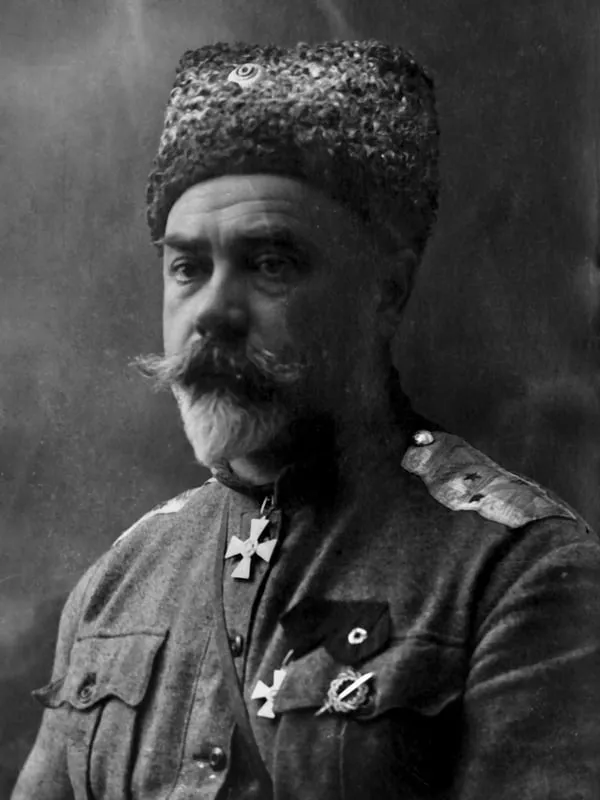
- Born:
- 16 December 1872, Włocławek (Russian Empire)
- Died:
- 7 August 1947, Ann Arbor (United States)
- Author:
- Łukasz
- Photo:
- autor nieznany, domena publiczna, Wikimedia Commons

General Anton Ivanovich Denikin was the most successful White commander of the Russian Civil War. The son of a former serf who had risen to the rank of major and of a Polish woman from Włocławek, he made his career in the Tsarist army without patronage, and in the First World War commanded one of the best divisions in the Russian army. After the Bolshevik seizure of power he helped found the Volunteer Army, and in the autumn of 1919 his troops stood in Oryol, some 350 kilometres from Moscow. That was the moment when the White movement came closest to victory. The defeat that followed consolidated Bolshevik power and opened the way to the creation of the Soviet Union. In exile Denikin became one of the few White leaders who, during the Second World War, refused to collaborate with Adolf Hitler and urged his compatriots not to fight against their own country at Germany’s side.
Childhood on the Vistula
He was born on 16 December 1872 (4 December in the Julian calendar) in Szpetal Dolny, a suburb of Włocławek on the far bank of the Vistula, in the Warsaw Governorate. Some sources give his birthplace as Łowicz, where Denikin later attended the non-classical secondary school (Realschule), but the general himself named Włocławek in his memoirs. His father, Ivan Yefimovich, was born a serf in Saratov Governorate and was handed over by his landlord to the army. After more than twenty years’ service he reached officer rank; he fought in Hungary in 1849, in the Crimean War and against the January Uprising, and in 1869 retired as a major of the border guard. His mother, Elżbieta Wrzesińska, came from a poor family of the Polish nobility and was a Catholic.
The boy was baptised into the Orthodox faith and brought up “the Russian way”, but Polish was spoken at home, and he spoke Polish with his mother until the end of her life. The family lived in poverty on his father’s pension, and after his father’s death in 1885 the thirteen-year-old Anton began giving private lessons. His biographer Dimitry Lehovich observed that this leader of the counter-revolution had a more “proletarian” background than Vladimir Lenin or Leon Trotsky.
An officer without patronage
In 1890, after finishing school in Łowicz, he enlisted as a volunteer in a rifle regiment in Płock and then entered the cadet school in Kiev. In 1892 he was posted as a second lieutenant to an artillery brigade in Biała Podlaska. In 1895 he was admitted to the Nicholas General Staff Academy in St Petersburg and graduated in 1899, but the academy’s new commandant arbitrarily struck him off the list of officers assigned to the General Staff. Denikin lodged a complaint with the Tsar, something unheard of for a young officer, and refused to withdraw it in exchange for a favour: “I am not asking for a favour; I demand only what is my due.” He was admitted to the General Staff only in 1902, when the War Minister, Aleksey Kuropatkin, acknowledged that an injustice had been done. Under the pen name Ivan Nochin he wrote articles in the military press about bureaucracy, the humiliation of soldiers and the need for army reform.
In the Russo-Japanese War he volunteered for the front. He served as chief of staff of Cossack divisions; in December 1904 he repulsed a Japanese attack with the bayonet on a hill later known as “Denikin’s Hill”, and he fought at Mukden and in General Pavel Mishchenko’s cavalry raids. He came home a colonel, and from the 1905 Revolution, through which he made his way along the Trans-Siberian Railway, he took away the conviction that in times of anarchy “even a small fist counts for something”. Politically he was close to the liberals: he supported constitutional monarchy and admired the reforms of Prime Minister Pyotr Stolypin.
The Iron Brigade
He began the First World War as a major general on the staff of General Aleksei Brusilov’s Eighth Army, but soon asked for a field command. In September 1914 he took over the 4th Rifle Brigade, known as the Iron Brigade, and made it one of the most famous units of the Russian army. He fought at Gródek, in October took the village of Górny Łużek, where Archduke Joseph had his headquarters, in a surprise attack, and in the winter led the brigade across the Carpathians and captured Mezőlaborc in Hungary. In the spring of 1915 the brigade was expanded into a division. In September 1915, during the Great Retreat, Denikin made an unexpected strike on Lutsk and took nearly 10,000 prisoners, and in June 1916, in the Brusilov Offensive, he captured the town a second time. For this he received the Sword of St George with diamonds and the rank of lieutenant general. In the autumn of 1916 he took command of a corps on the Romanian front.
1917: against the disintegration of the army
The February Revolution found him in Romania. He accepted it with understanding but feared anarchy. In April 1917 the War Minister, Alexander Guchkov, made him chief of staff to the Supreme Commander, General Mikhail Alekseyev. Denikin fought the “democratisation” of the army and the soldiers’ committees, and in May, at an officers’ congress in Mogilev, he gave a celebrated speech about officers betrayed by the government. When Brusilov replaced Alekseyev, Denikin took over the Western Front, and in August the South-Western Front. At a conference at Headquarters at the end of July he accused Alexander Kerensky to his face of destroying the army with his policies. In September he sent a telegram supporting General Lavr Kornilov in his conflict with the government. On 11 September 1917 he was arrested in Berdichev, where soldiers almost lynched him, and taken to the prison at Bykhov to join Kornilov.
The Volunteer Army
After the October Revolution General Nikolai Dukhonin released the Bykhov prisoners on 2 December 1917. Denikin shaved off his beard and, with false papers in the name of Alexander Dombrowski, made his way to Novocherkassk on the Don, where Alekseyev and Kornilov were forming the Volunteer Army. It was Denikin who devised the compromise that reconciled the quarrelling generals: Kornilov commanded the troops, Alekseyev handled politics and finance, and the ataman Aleksey Kaledin the Don. At the beginning of 1918 he married Ksenia Chizh, whom he had known since her childhood. The young officers called the forty-five-year-old general “Grandpa Anton”.
In February 1918, as Kornilov’s deputy, he set out on the First Kuban Campaign. When Kornilov was killed outside Yekaterinodar on 13 April 1918, Denikin took command, broke off the hopeless assault and led the army out of encirclement. In the summer he led the second march on the Kuban and in August captured Yekaterinodar, today’s Krasnodar. After Alekseyev’s death in October 1918 he concentrated all military and civil authority in his own hands, and in January 1919, after an agreement with the Don Cossacks, he became Commander-in-Chief of the Armed Forces of South Russia. Unlike the Don ataman Pyotr Krasnov, he rejected cooperation with the Germans and held to the Entente allies, from whom he received weapons.
The march on Moscow and defeat
In the spring and summer of 1919 his armies routed the Reds in the Donbas and took Kharkiv, Tsaritsyn and Kiev. On 3 July 1919 in Tsaritsyn Denikin issued his Moscow Directive, and in June he had recognised the supreme authority of Admiral Alexander Kolchak as Supreme Ruler of Russia. On 13 October 1919 his troops entered Oryol. He then ruled an area inhabited by several tens of millions of people.
The success proved fragile. The front was too long, there were no reserves, and the raid of the anarchist Nestor Makhno wrecked the rear. The slogan of “one and indivisible Russia” repelled the Kuban Cossacks, who wanted autonomy, as well as Ukrainians, Georgians and Poles. Land reform never came into force, and the returning landowners frightened the peasants. In Ukraine Denikin’s troops, especially the Cossacks, carried out bloody pogroms of Jews in which thousands of people died. Denikin issued orders against the pogroms but did not enforce them, and his propaganda agency, OSVAG, spread antisemitism by equating Jews with Bolsheviks. In October 1919 the Reds under Alexander Yegorov and the cavalry of Semyon Budyonny went over to the counter-offensive near Oryol and Voronezh, and the White armies began a long retreat.
Towards Poland Denikin was intransigent. He recognised its independence, but only within ethnic borders, roughly west of the Bug. Talks with the Polish mission of General Aleksander Karnicki in the autumn of 1919 came to nothing, and Józef Piłsudski, who regarded the Whites as the greater danger to Poland, halted operations against the Bolsheviks at that time. In the pamphlet Who Saved Soviet Power from Destruction?, published in Paris in 1937, Denikin accused him of knowingly contributing to the defeat of the Whites.
In January 1920 Kolchak passed the title of Supreme Ruler to him, but Denikin did not accept it. In March the remnants of the army were pushed back to Novorossiysk, and the chaotic evacuation to the Crimea turned into a disaster. Criticised by General Pyotr Wrangel and blamed by his own officers, he handed over command to Wrangel on 4 April 1920 and left Russia for ever aboard a British warship. In Constantinople, in the embassy building, his chief of staff and friend, General Ivan Romanovsky, was shot dead.
Exile
By way of England, Belgium and Hungary, where living was cheaper, Denikin reached Paris, the centre of the Russian emigration, in 1926. He withdrew from politics and devoted himself to writing. His five-volume Ocherki russkoy smuty (Sketches of the Russian Turmoil, 1921–1926) remains one of the most important sources for the history of the revolution and the White movement, and The Old Army is a portrait of the Tsarist army. He distrusted the clandestine activity of the Russian All-Military Union inside the Soviet Union, convinced that it had been penetrated by Soviet intelligence. He was right: in 1930 and 1937 agents kidnapped two successive heads of the Union in Paris, Generals Alexander Kutepov and Yevgeny Miller. In 1938 Denikin testified as a witness at the trial of the singer Nadezhda Plevitskaya, the wife of General Nikolai Skoblin, a Soviet agent implicated in Miller’s kidnapping.
Hitler and the Second World War
When the Nazis came to power in Germany, Denikin condemned Hitler. Some émigrés hoped that foreign armies would overthrow the Bolsheviks; he believed that an invader would not liberate Russia but would dismember and enslave it. In a 1939 lecture, “World Events and the Russian Question”, he rejected both the “Bolshevik noose” and the “foreign yoke”: Russians were to defend their country against the invader and only then overthrow Soviet power.
The war found him in France. In 1940, fleeing the Germans, he became stranded at Mimizan on the Atlantic coast and spent the occupation there under German surveillance. He refused to register as a stateless person, insisting that he was a subject of the Russian Empire. After the German attack on the Soviet Union in June 1941 he called on émigrés not to support the invader, and called those who entered German service “Hitler’s admirers”. According to his biographers, in 1942 the Germans offered to move him to Berlin and make him patron of the émigrés’ anti-Bolshevik formations, but he refused. At the same time former comrades-in-arms such as Krasnov and Andrei Shkuro sided with Germany; in 1945 the British handed them over to the Soviet Union, where they were hanged.
In 1945 Denikin, fearing Soviet influence in France, left for the United States. He obtained a visa because he had been born on Polish soil. In January 1946 he appealed to General Dwight Eisenhower to halt the forced repatriation of former Soviet citizens, and in a memorandum, “The Russian Question”, he warned the West that in a future conflict it should fight Stalin, not Russia. He died of a heart attack on 7 August 1947 in Ann Arbor, Michigan; some sources give 8 August. He was buried with military honours in Detroit and later moved to a Cossack cemetery in New Jersey. In 2005 his remains were brought to Moscow and reburied in the Donskoy Monastery.
Assessment
To Soviet historiography Denikin was the embodiment of counter-revolution and reaction; to the emigration and to present-day Russia he is a patriot who tried to save his country from communism. Historians such as Peter Kenez see in him a capable and brave commander and an honest man, but a weak politician who did not understand that a civil war cannot be won by the army alone. He did not give the peasants land, did not win over the nations of the former empire and did not stop terror and pogroms in his own ranks. His defeat in 1919 was one of the reasons for the Bolshevik victory, and thus for the emergence of the state that, under Joseph Stalin, divided Eastern Europe with Hitler in 1939. His stance during the Second World War showed that not all White émigrés, contrary to Berlin’s hopes, were ready to fight against Russia under German colours.
Sources
Commanded in battles
(01)Mentioned in battles
(01)Often appears with
People who appear in the same events.