- Category:
- Crimes and repression
- Date:
- 3 April 1940
- Author:
- Natalia
- Tags:
- Katyn massacre, Soviet Union, Poland, Great Purge
On 3 April 1940 the first transport of Polish officers left the prisoner-of-war camp at Kozelsk. The prisoners, whom the guards told they were going “home” or to another camp, were taken to a forest near the village of Katyn, outside Smolensk. In the following days transports set off from the camps at Starobilsk and Ostashkov, and Poles under arrest were taken away from the prisons of the occupied eastern borderlands. By the middle of May officers of the NKVD had killed, each with a shot to the back of the head, almost 22,000 Polish citizens: officers of the Polish Army, policemen, soldiers of the Border Protection Corps (KOP), prison guards, officials, landowners, clergy and members of the intelligentsia. They did so on the basis of a decision of the highest authorities of the Soviet Union, signed by Joseph Stalin. All 22,000 victims are sometimes attributed to the single day of 3 April. In reality that was the day the crime began, and it went on for six weeks. It is called the Katyn massacre after the place where the first graves were discovered in 1943.
Prisoners in the hands of the NKVD
After the invasion of 17 September 1939, carried out in accordance with the secret protocol of the Molotov–Ribbentrop Pact, some 230,000–250,000 Polish soldiers fell into Soviet captivity, most of them disarmed without a fight during the less than three weeks of the Soviet campaign. The Red Army handed them over to the NKVD, although under the convention on prisoners of war they should have remained under military authority. As early as 19 September the People’s Commissar for Internal Affairs, Lavrentiy Beria, set up within his commissariat a Directorate for Prisoner-of-War Affairs, headed by Major Pyotr Soprunenko, and a network of camps for Polish prisoners (PL).
In the autumn of 1939 the NKVD carried out a selection. Most of the rank-and-file soldiers and NCOs from the territories occupied by the USSR were released to go home; those from the lands under German occupation were exchanged with the Germans; and more than ten thousand were sent to hard labour building roads and in the mines. Officers, policemen and men from other uniformed services, whom the NKVD regarded as especially “dangerous”, were separated from the rest. They were concentrated in three special camps set up in former monasteries. At Kozelsk (PL), in the buildings of the Optina Monastery, and at Starobilsk in eastern Ukraine, the prisoners were above all officers, among them more than a dozen generals and one admiral. At Ostashkov on Lake Seliger, in the Nilov Stolobensky Hermitage, the NKVD gathered officers of the State Police, gendarmes, KOP soldiers, and border and prison guards. In the spring of 1940 the three camps held some 15,000 men in all.
Most of the officers were reservists. The Polish conscription system required university graduates to become reserve officers, so the camps held doctors, lawyers, engineers, teachers, university professors, journalists, officials and artists. Throughout the winter NKVD officers interrogated every prisoner, opened a file on him and tried to persuade him to collaborate. Few agreed. Meanwhile, in the territories incorporated into the Ukrainian and Byelorussian SSRs, whose annexation had been decided in November 1939, the NKVD arrested thousands of people deemed to be enemies: officers who had escaped captivity, policemen, officials, landowners and political activists.
The decision of 5 March 1940
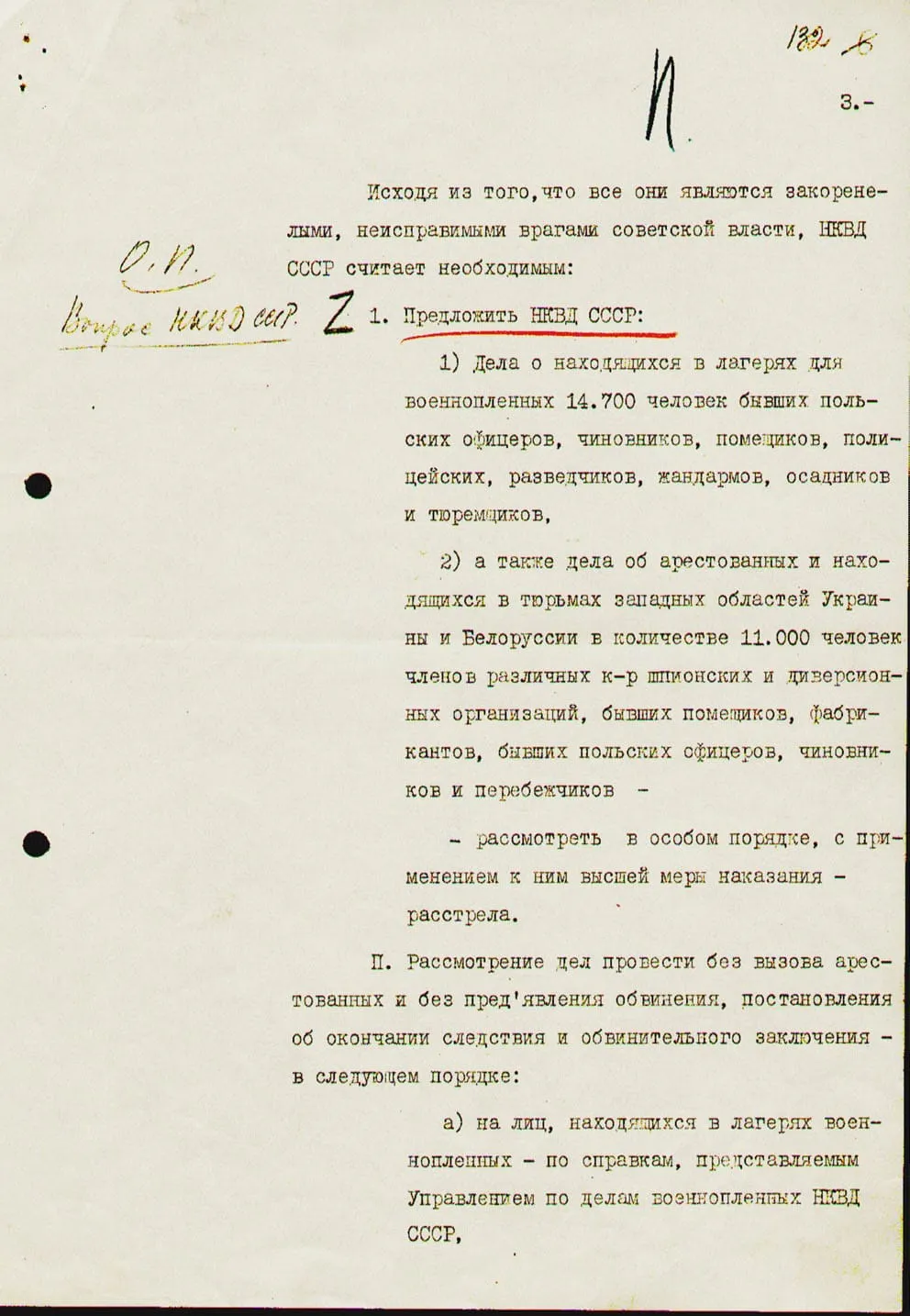
At the beginning of March 1940 Beria sent Stalin memorandum No. 794/B. In it he wrote that the NKVD camps held 14,736 former officers, officials, landowners, policemen, gendarmes, prison guards, settlers and intelligence agents, and the prisons of the western oblasts of Ukraine and Belarus 18,632 people under arrest, and that “all of them are hardened, incorrigible enemies of Soviet power”. Every one of them, Beria argued, was merely waiting to be freed in order to take up the struggle against Soviet power. He proposed that the cases of 14,700 prisoners of war and 11,000 prisoners be examined “in a special procedure” and that “the supreme penalty – shooting” be applied to them, without summoning the condemned, without presenting charges to them and without an indictment. The decisions were to be taken by an NKVD troika: Vsevolod Merkulov, Bogdan Kobulov and Leonid Bashtakov (PL).
On 5 March 1940 the Politburo approved the proposal. The memorandum was signed by Stalin, Kliment Voroshilov, Vyacheslav Molotov and Anastas Mikoyan, and the secretary added a note that Mikhail Kalinin and Lazar Kaganovich had also voted in favour. It was a death sentence passed by the authorities of a state on tens of thousands of people, not one of whom ever stood trial. Most of them were prisoners of war, protected by international law.
The documents do not say plainly why Stalin took this decision. Some historians see it as the deliberate extermination of the Polish elite, the stratum that might one day rebuild an independent state, and point to its similarity to the German operations against the Polish intelligentsia, from Operation Tannenberg in the autumn of 1939 to the AB-Aktion in the spring of 1940. Others stress the class character of the crime, a continuation of the Great Terror and of the operations against “hostile elements”, including the NKVD’s Polish Operation of 1937–1938. The Russian historian Alexander Guryanov notes that the motive was stated outright in Beria’s proposal: these were people regarded as irreconcilable opponents of Soviet power. Hypotheses have also been put forward about Stalin’s personal revenge for the defeat in the war with Poland in 1920, but historians treat them with caution.
Preparations
The machinery moved quickly. On 14 March a conference was held in Kobulov’s office in Moscow, attended by Soprunenko and by the heads of the NKVD directorates of the Smolensk, Kalinin and Kharkiv oblasts and their subordinates, to whom the prisoners from the individual camps were assigned. On 22 March Beria issued order No. 00350 on the “unloading” of the NKVD prisons of the Ukrainian and Byelorussian SSRs, which held mainly Polish citizens. Several thousand prisoners were transferred to Kyiv, Kharkiv, Kherson and Minsk. At the beginning of April so-called disposition lists began to arrive at the camps from Moscow, bearing the names of prisoners selected for removal. With a few exceptions they were death sentences.
The camps were in a state of excitement. Rumours circulated that the prisoners would be handed over to the Germans, released to neutral countries or sent home. Those departing were given a send-off, and the NKVD took care not to arouse alarm: those leaving received dry rations for the journey.
Katyn, Kharkiv, Kalinin
Convoys left Kozelsk from 3 April to 12 May. The prisoners were taken in prison railway carriages via Smolensk to Gnezdovo station, and from there in closed prison buses to the forest at the place known as Kozy Gory (Goat Hills), where before the war the Smolensk NKVD had had a rest house. The victims’ hands were tied behind their backs, some had their greatcoats thrown over their heads, and they were killed with a shot to the back of the head at or near the pits. Some of the prisoners were probably murdered in the NKVD prison in Smolensk. The notebook of Major Adam Solski has survived, in which he recorded the journey up to the very last moment: on the morning of 9 April they were brought to the forest, “something like a summer resort”, and their watches, wedding rings, belts and penknives were taken from them. Some 4,400 men were buried at Katyn in eight mass graves, among them Generals Mieczysław Smorawiński, Bronisław Bohatyrewicz and Henryk Minkiewicz, Rear Admiral Xawery Czernicki, the Chief Rabbi of the Polish Army, Major Baruch Steinberg, and the only woman among the prisoners, Second Lieutenant Janina Lewandowska, a pilot and the daughter of General Józef Dowbor-Muśnicki.
The prisoners from Starobilsk, removed between 5 April and 12 May, were taken to the NKVD’s internal prison in Kharkiv. There, in the cellar, they were killed at night, and their bodies were taken by lorry to the forest at Pyatykhatky on the outskirts of the city. Some 3,800 men died there, among them Generals Stanisław Haller, Leon Billewicz and Konstanty Plisowski, the defender of the Brest fortress in September 1939, as well as Captain Jakub Wajda, father of the film director Andrzej Wajda.
The policemen and KOP soldiers from Ostashkov, removed from 4 April to the middle of May, were murdered in the cellar of the NKVD headquarters in Kalinin, today’s Tver. According to the testimony given to Russian prosecutors in 1991 by the former head of the Kalinin NKVD, Dmitry Tokarev (PL), some 390 men were brought in on the first day and the executioners could not kill them all before dawn, so subsequent batches numbered no more than 250. The condemned man was led into a room where his personal details were checked, and then into an adjoining cell with a felt-padded door, where the shot was fired. The bodies were taken by lorry to Mednoye, about 20 kilometres from the city, and buried in pits dug in advance by an excavator. Some 6,300 men died there, the overwhelming majority of them ordinary policemen and NCOs. A group of NKVD officers was sent to Kalinin from Moscow, among them Major of State Security Vasily Blokhin, commandant of the administrative and economic department of the NKVD headquarters. According to Tokarev’s account, Blokhin, wearing a leather apron and gloves, personally shot one condemned man after another, and many authors attribute to him the killing of several thousand people in the space of those few weeks.
According to Tokarev, the executions in Kalinin were carried out with German Walther pistols brought from Moscow, because Soviet revolvers overheated after so many shots. German cartridge cases found in the graves at Katyn were later used by Soviet propaganda to pin the crime on the Germans.
Prisoners were being killed at the same time. According to NKVD documents, 3,435 people were shot from the so-called Ukrainian list, brought from prisons in Lwów (Lviv), Łuck, Równe, Tarnopol, Stanisławów and Drohobycz. Among them were generals, officers and more than 750 policemen. Their bodies were hidden in various places, among them Bykivnia (PL) near Kyiv. From the so-called Belarusian list, from prisons in Białystok, Brest, Pińsk, Baranowicze and Wilejka, 3,870 people died, probably buried at Kurapaty near Minsk. That list has never been made public.
Few survived. Of the prisoners from the three camps, 395, singled out by Moscow for various reasons, were taken to the camp at Pavlishchev Bor (PL) and later to Gryazovets near Vologda. Among those who survived were the painter Józef Czapski, from Starobilsk, and the economist Stanisław Swianiewicz of the University of Wilno (Vilnius), who on orders from Moscow was taken out of his carriage at Gnezdovo station at the end of April. Through a crack in the carriage he managed to see his companions being transferred to a bus with painted-over windows and driven off towards the forest. He became one of the most important witnesses.
Victims and perpetrators
The exact number of those murdered was given in 1959 by the chairman of the KGB, Alexander Shelepin, in a secret note to Nikita Khrushchev in which he proposed destroying the victims’ files. According to his note (PL), 21,857 people had been shot under the decision of 5 March 1940: 4,421 at Katyn, 3,820 near Kharkiv, 6,311 in Kalinin and 7,305 in the camps and prisons of western Ukraine and western Belarus. Polish researchers, comparing the lists of names, have established at least 21,768 names. Almost half of the Polish Army’s regular and reserve officers perished, and the victims included more than a dozen generals and hundreds of doctors, lawyers, engineers, teachers and clergy of various faiths: Catholics, Orthodox, Protestants and Jews. Among the murdered were Poles, Jews, Ukrainians and Belarusians, all citizens of the Polish Republic.
The crime was carried out by NKVD officers, from the leadership in Moscow down to the escort guards, drivers and gravediggers in the oblasts. On 26 October 1940 Beria, in a secret order, rewarded 125 of them for the “successful execution of special tasks”. The Polish prosecutor Witold Kulesza estimated that almost 2,000 people took part in it in one way or another. Not one of them ever stood trial.
The deportation of the families
The decision of 5 March had a second part. As early as 2 March 1940 the Politburo, at the request of Beria and of the party secretary in Ukraine, Nikita Khrushchev, had decided to deport the families of the prisoners of war and of those under arrest. On 13 April, while the executions were under way at Katyn, Kharkiv and Kalinin, the NKVD carried out the second mass deportation from the eastern borderlands. Within a few days, according to NKVD documents, some 61,000 people, the overwhelming majority of them women, children and the elderly, were deported to the collective and state farms of northern Kazakhstan. The wives and children of the murdered men did not know that they were already widows and orphans. They wrote letters to the camps, which came back or vanished.
Silence and lies
In the spring of 1940 the letters from Kozelsk, Starobilsk and Ostashkov stopped. After Germany attacked the USSR in 1941 the government of General Władysław Sikorski concluded an agreement with Moscow, and General Władysław Anders, who was forming a Polish army in the USSR, searched for thousands of missing officers. Czapski travelled round labour camps and government offices asking after his comrades. In December 1941 Stalin told Sikorski and Anders that the prisoners had perhaps escaped to Manchuria.
On 13 April 1943 Berlin radio announced that graves of Polish officers murdered by the NKVD had been discovered in the Katyn Forest. The Propaganda Minister, Joseph Goebbels, hoped in this way to split the Allied coalition. Moscow accused the Germans of the crime, and when the Polish government asked the International Red Cross to investigate, the Soviet Union broke off relations with it on the night of 25–26 April 1943. Winston Churchill’s British government and the American administration, although their diplomats’ reports contained no shortage of evidence of Soviet guilt, kept silent for the sake of the alliance. After Smolensk was retaken in the autumn of 1943 the NKVD prepared false evidence and witnesses, and in January 1944 the Burdenko Commission (PL), headed by Nikolai Burdenko, announced that the Poles had been killed by the Germans in the autumn of 1941. At the Nuremberg trial in 1946 the Soviet prosecutors included Katyn in the indictment against Hermann Göring and others, but after hearing the witnesses the tribunal left the matter out of its judgment.
In communist Poland the truth about Katyn could not be spoken, and the Soviet version was repeated in textbooks and on official monuments. The truth was kept alive by the émigrés and the victims’ families. On 13 April 1990 the TASS agency admitted that the crime had been committed by the NKVD, calling it “one of the grave crimes of Stalinism”, and in October 1992 Russia handed Poland documents from the so-called special file No. 1, including Beria’s memorandum with the signatures of the Politburo members and Shelepin’s note. In 2000 Polish war cemeteries were opened at Katyn, Mednoye and Kharkiv. The Russian Chief Military Prosecutor’s Office conducted an investigation from 1990. In September 2004 it discontinued it, classified most of the files and the discontinuation decision itself, and refused to recognise the crime as genocide. Since 2004 the investigation has been conducted by the Polish Institute of National Remembrance. In 2012 the European Court of Human Rights called the mass killing a “war crime”.
Place in the war
The Katyn massacre was part of the common policy of the two occupiers towards Poland. In the very months in which the NKVD was murdering the prisoners and deporting their families, the Germans in the General Government were preparing the AB-Aktion, aimed at the same social stratum. Both occupiers sought to deprive the Poles of the people capable of leading the state, the army and society. The Polish Army being rebuilt in France, and later in Britain and the USSR, lost thousands of trained officers.
Katyn weighed on Polish–Soviet relations for half a century. In 1943 it gave Stalin a pretext to break with the Polish government in London and to build a communist authority subordinate to himself. The Katyn lie became one of the foundations of communist Poland, and the memory of the crime one of the symbols of independence from it. For the families of tens of thousands of victims the war did not end in 1945, but went on for decades more in uncertainty, silence and fear.
Places·Katyn
Sources
Meanwhile
(04)Elsewhere, within a week.
- 30 March 1940 · Far EastWang Jingwei’s government in NanjingOn 30 March 1940 Wang Jingwei set up a collaborationist government in occupied Nanjing. It hailed a “return to the capital” but ruled only where Japan allowed.
- 9 April 1940 · ScandinaviaGermany invades NorwayOn 9 April 1940 Germany landed troops in Norwegian ports and took Oslo from the air. The king, government and gold left the capital, and Norway fought on.
- 9 April 1940 · ScandinaviaGermany occupies DenmarkOn 9 April 1940 the Wehrmacht invaded neutral Denmark. After skirmishes in Jutland and at Amalienborg the king and government ended resistance within hours.
- 9 April 1940 · ScandinaviaThe sinking of the Blücher in the Drøbak NarrowsOn 9 April 1940 the guns and torpedoes of Norway’s Oscarsborg fortress sank the cruiser Blücher. The delay let the king, government and gold leave Oslo.
Related events
(04)The same battle, people or subject.
- 5 March 1940 · PolandDecision to shoot Polish prisonersOn 5 March 1940 the Politburo adopted Beria's proposal to shoot 14,700 Polish POWs and 11,000 prisoners without trial. Stalin was among the signatories.
- 10 February 1940 · PolandFirst deportation from the eastern landsOn 10 February 1940 the NKVD began deporting families of military settlers and foresters from the Kresy. NKVD documents put the total at nearly 140,000.
- 13 April 1940 · PolandSecond deportation from the eastern landsOn 13 April 1940 the NKVD deported about 61,000 people to Kazakhstan, mainly families of imprisoned officers, policemen and officials killed in those weeks.
- 29 June 1940 · PolandThird deportation from the eastern landsOn the night of 28 to 29 June 1940 the NKVD began a third deportation from the Kresy. Those taken were mainly refugees from German-occupied Poland, mostly Jews.