- Category:
- Military operations
- Front:
- Central and Eastern Europe
- Date:
- 14 February 1919
- Author:
- Łukasz
- Battle:
- The Polish–Soviet War
- Tags:
- Poland, Russia, Bolsheviks, Polish–Soviet War
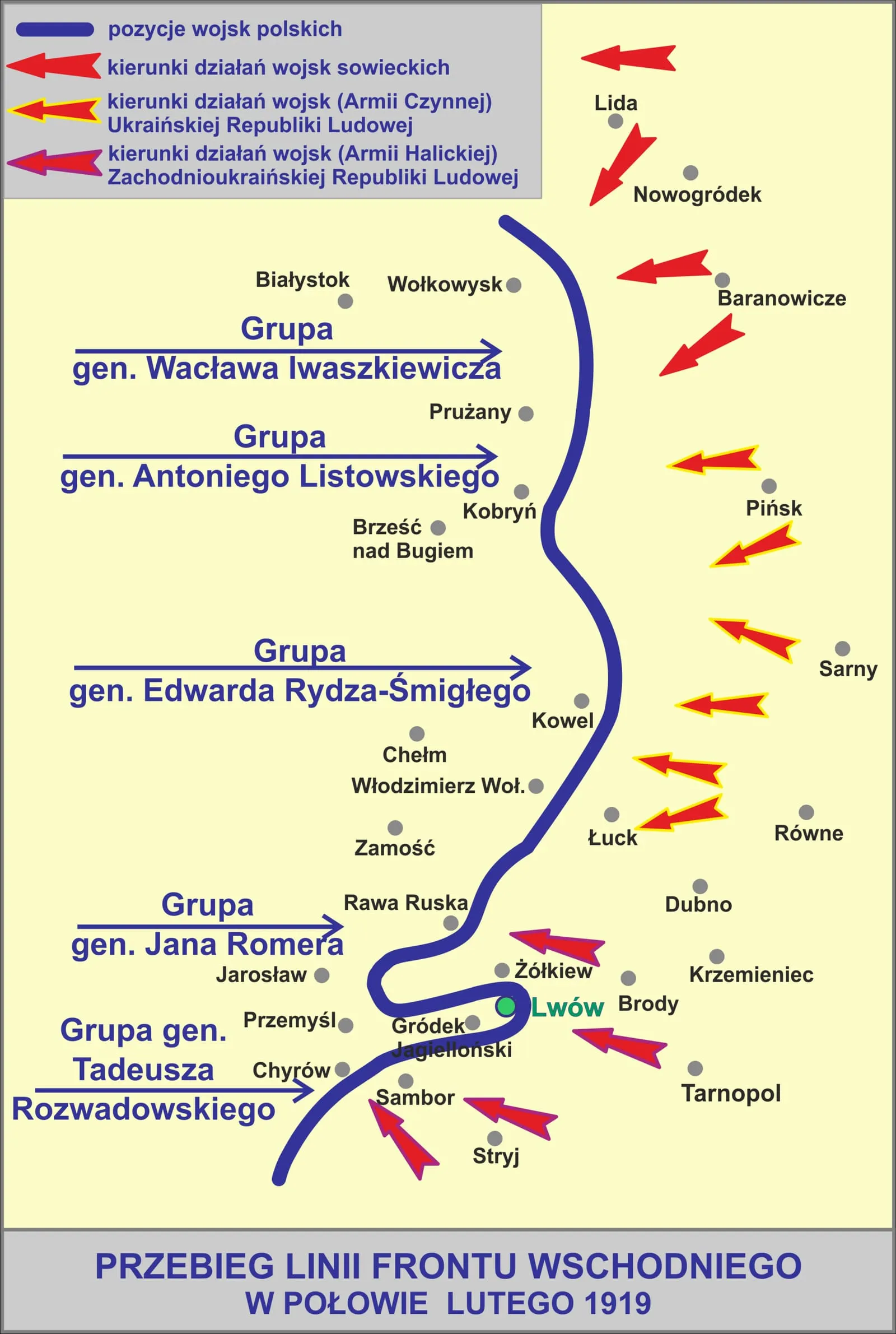
At dawn on 14 February 1919, on the vast plain between the Neman (Niemen) and Polesie, two minor clashes took place. Near the small town of Mosty on the Neman, some 50 kilometres from Grodno, a Polish detachment ran into the vanguard of the Red Army and forced it to retreat. At the same time, more than a hundred kilometres to the south, at Bereza Kartuska, a group of just over sixty soldiers under Captain Piotr Mienicki surprised a Bolshevik outpost and took some eighty Red Army men prisoner. Neither side had declared war, and neither suspected that these skirmishes were opening a conflict that would be decided outside Warsaw a year and a half later. That is precisely why many historians, led by the British scholar Norman Davies, regard this day as the beginning of the Polish–Soviet War.
The vacuum left by the Germans
When the armistice was concluded in the Forest of Compiègne on 11 November 1918, the German army was still standing far to the east. Under the Treaty of Brest-Litovsk of March 1918 Germany occupied Lithuania, Belarus and Ukraine, and a German military administration known as Ober Ost ruled the lands from the Baltic to Polesie. The armistice required the Germans to withdraw from the former Russian territories only when the Allies saw fit, but the revolution in Germany changed everything. The soldiers, organised in councils, wanted to get home as fast as possible, and discipline was crumbling. On 13 November the government of Vladimir Lenin annulled the Treaty of Brest-Litovsk, and a few days later the Western Army, formed in Smolensk, set off westwards, following step by step behind the evacuating Germans.
The Bolsheviks made no secret of why they were coming. For Lenin the former western provinces of the empire were not only territory to be regained but also a bridge to Germany, where he expected an imminent revolution. In the literature this advance is sometimes called Operation “Target Vistula”, a name popularised by Norman Davies. Historians dispute whether the Soviet command really planned at that stage to reach the Vistula or was simply occupying whatever the Germans left behind. Soviet forces grew quickly: according to Polish studies, from some 10,000 soldiers in November to nearly 50,000 in February 1919. Around 10 December 1918 the Red Army took Minsk, and on 3 January 1919 Riga. On 1 January the Byelorussian Soviet Socialist Republic was proclaimed in Smolensk; at the end of February it was merged with Soviet Lithuania into a republic known as Litbel.
The Poles in the east did not sit idle. In the autumn of 1918 volunteer self-defence units, built on cadres of the Polish Military Organisation, sprang up in Wilno (Vilnius), Minsk, Grodno and other towns with large Polish populations. By a decree of 7 December 1918 the Chief of State, Józef Piłsudski, recognised them as part of the Polish Army. When the Germans left Wilno on the night of 31 December to 1 January, the Self-Defence units of General Władysław Wejtko took over the city. For several days they held out against advancing Soviet troops, among them the Western Rifle Division, made up largely of Polish communists. On 5 January 1919, faced with superior enemy forces, they withdrew from the city, and the Red Army marched in. Some Polish historians regard this January fighting as the real beginning of the war.
Poland without borders
The state that was to confront this advance had existed for three months. In the west the Greater Poland Uprising was under way; in Eastern Galicia a war with the Ukrainians was being fought for Lwów (Lviv); and in January fighting broke out with Czechoslovakia in Cieszyn Silesia. On 16 January Ignacy Jan Paderewski became prime minister of a government soon recognised by the Western powers, and in Paris the peace conference was already in session, with Poland represented by Roman Dmowski. On 26 January elections were held to the Legislative Sejm, which met for the first time on 10 February.
Poland’s western border was to be settled by the victors in Paris. In the east things were different. The great powers had no troops there, Russia was engulfed in civil war, and the fate of the lands of the old Polish–Lithuanian Commonwealth would be decided by whoever occupied them first. Piłsudski said in February 1919 that in the east there were doors that opened and closed, and everything depended on who opened them and how wide. He himself dreamed of a belt of independent states – Lithuania, Belarus and Ukraine – bound to Poland and separating it from Russia. Dmowski’s National Democrats wanted not a federation but a border that would bring into Poland as much land with a Polish population as possible and allow it to be Polonised. For the time being both programmes required the same thing: troops in the east.
Between the Poles and the approaching Red Army, however, there still stood German troops, who were evacuating slowly and wanted a clear road home. On 5 February 1919, in Białystok, representatives of the Polish Army and the German command signed an agreement that allowed Polish units to pass through the German zone and take up positions east of it, in return for letting German transports through unhindered. This suited the Germans: they preferred their place to be taken by the Poles rather than by the Bolsheviks, who were agitating among their soldiers. Between 9 and 14 February two Polish formations passed through the German lines and took up a front some 150 kilometres long, from the Pripyat to Skidel near Grodno. In the north, around Wołkowysk, stood the Lithuanian-Belarusian Division of General Wacław Iwaszkiewicz-Rudoszański; in the south, around Prużana and Antopol, the Polesie Group of General Antoni Listowski. Together they amounted to a dozen or so infantry battalions and cavalry squadrons with a few artillery batteries – several thousand men, often without uniforms and carrying the weapons of several armies.
14 February
The first contact came when the Polish units began occupying positions abandoned by the Germans. At Mosty, where a crossing over the Neman carried the road from Grodno into the interior of Belarus, troops of the northern grouping encountered the vanguard of the Soviet Western Front and fought a successful skirmish with it. The sources say little about the details of this clash, and in Polish tradition mainly the date itself has survived.
Better known is the fight at Bereza Kartuska, a small town on the highway from Brest to Minsk. Captain Mienicki’s detachment set out for it from Prużana; according to Polish studies it numbered 57 soldiers and 5 officers and was part of Major Władysław Dąbrowski’s grouping of the Polesie Group. At dawn the Poles attacked the Bolshevik garrison, which was not expecting an assault. Some 80 Red Army men were taken prisoner, and two heavy machine guns were captured. The sources differ on the hour and the day: most give 14 February, at around 6 or 7 a.m., but some studies move the start of the action to 13 February and date the final capture of the town to 16 February. For a war later fought by armies a million strong, it was an almost symbolic episode.
But that is how all the wars for the borders of reborn Poland began: small units, unclear demarcation lines and skirmishes over little towns whose names rarely made the newspapers. In February 1919 no one in Warsaw or Moscow declared a state of war. At the same time the Soviet government was conducting diplomatic correspondence with Poland: on 10 February the People’s Commissar for Foreign Affairs, Georgy Chicherin, proposed to Paderewski talks on settling disputed questions and establishing relations. The Polish authorities did not take up the offer. Both sides were playing for time: the Bolsheviks needed their troops against the Whites, and Piłsudski wanted first to occupy as much of the disputed land as possible.
Why 14 February?
The Polish–Soviet War was never declared, so there is no single date for its outbreak. The date of 14 February 1919 is a convention, though the one most often adopted, especially in Western literature, ever since Norman Davies, in his book White Eagle, Red Star, identified the fight at Bereza Kartuska as the war’s first engagement. It is also the first day on which the regular Polish Army, rather than local self-defence units, clashed with the Red Army on an organised front.
Other reckonings are just as justified. Some historians begin the war with the fighting for Wilno at the turn of 1918 and 1919, with the first clash at Nowa Wilejka on 3 January. Others go back further still, to the fighting between the Polish I Corps of General Józef Dowbor-Muśnicki and the Bolsheviks in Belarus at the beginning of 1918. For decades Soviet historiography portrayed the war as Polish aggression and saw its real beginning in the Polish Kiev offensive of April 1920, which it called the “third Entente campaign”. In the West, too, some writers argue that what took place in 1919 was more of a border conflict, and that the real war, with hundreds of thousands of soldiers on each side, began only in the spring of 1920. The dispute is not purely academic: the judgement of the whole war depends on which side is held to have started it.
1919
After the clashes of mid-February the front settled down for several weeks. The Red Army halted because its command was preoccupied with the civil war against the Whites and, from March, with aid to the Hungarian Soviet Republic. The Poles advanced in small steps. On 2 March they took Słonim, and on 5 March Listowski’s group entered Pińsk. The main forces of the Polish Army, however, were still fighting the Ukrainians in Eastern Galicia. In the spring the superbly equipped army of General Józef Haller began arriving from France, and in Paris Poland’s representatives lobbied the Allies to recognise its claims to the eastern lands. From April the Polish military mission in Paris was headed by General Tadeusz Rozwadowski, previously commander of the forces defending Lwów.
On 16 April Piłsudski moved on Wilno. Colonel Władysław Belina-Prażmowski’s cavalry burst into the city at dawn on 19 April, and on 21 April, after the arrival of General Edward Rydz-Śmigły’s Legion infantry, the Bolsheviks abandoned Wilno. On 22 April Piłsudski issued a proclamation “To the inhabitants of the former Grand Duchy of Lithuania” promising them the right to self-determination. The National Democrats criticised it sharply, and the Lithuanians, who regarded Wilno as their capital, saw the Polish entry as an occupation. On 8 August the Poles took Minsk, and by the end of the summer the front rested on the Berezina and the Dvina. At the turn of 1919 and 1920 the two sides held secret talks, but no peace came of them.
In the spring of 1920 the conflict grew into a major war. The Polish offensive on Kiev, which was taken on 7 May, was followed by a Soviet counter-offensive that in August brought the Red Army to the gates of Warsaw. In the Battle of Warsaw of 13–25 August the armies of Mikhail Tukhachevsky were routed, and in September they also lost the Battle of the Niemen. A ceasefire came into force on 18 October 1920, and on 18 March 1921 a peace treaty was signed in Riga. Poland kept its independence and the western parts of Belarus and Ukraine, but Piłsudski’s federal plan collapsed. The war cost Poland, by various estimates, several tens of thousands of soldiers killed or dead of disease. Soviet losses were higher, and according to the findings of Polish and Russian historians some 16,000–20,000 prisoners died in Polish captivity of disease, hunger and ill-treatment. Many Polish soldiers were killed or died in Soviet captivity.
A border reclaimed in 1939
The war that began with a skirmish at Bereza Kartuska fixed Poland’s eastern border for the whole interwar period. For Moscow the Riga border, which cut across Belarusian and Ukrainian lands, was as much of a wound as the Versailles border was for Germany. A shared hostility to Poland drew the two states together as early as 1922, when they established diplomatic relations at Rapallo and their armies began secret military cooperation. Seventeen years later, in August 1939, the Molotov–Ribbentrop Pact divided Polish lands between Germany and the Soviet Union, and on 17 September the Red Army crossed the Riga border. Soviet propaganda presented this aggression as the liberation of Western Belarus and Western Ukraine from “lordly Poland” – the same Poland to which the Bolsheviks had lost in 1920.
The memory of that war returned in 1939 and 1940 in its cruellest form. Many of the officers and police officers murdered in the spring of 1940 in the Katyn massacre were veterans of 1920, and in communist Poland and later in Russia the fate of the Soviet prisoners of 1919–1921 was sometimes invoked as a supposed “answer” to Katyn. The men who held command on both sides in 1919–1920 also played their parts in the next war. In September 1939 Rydz-Śmigły was Commander-in-Chief of the Polish Army, while Joseph Stalin, in 1920 the political commissar of the front advancing on Lwów, stood at the head of the state that invaded Poland. Tukhachevsky perished in the Great Purge in 1937, while Semyon Budyonny, commander of the 1st Cavalry Army, lived to see the Second World War as a Marshal of the Soviet Union.
The war against the Bolsheviks also shaped interwar Poland itself. The victory of 1920 became the foundation of the legend of Piłsudski and his camp, which ruled the country after 1926 and prepared it for war. The conviction that Poland could defend itself against Russia on its own strengthened the policy of balance between Moscow and Berlin pursued right up to 1939. But then, unlike in 1920, Poland had to fight both its neighbours at once.
Sources
Related events
(04)The same battle, people or subject.
- 18 January 1919 · DiplomacyThe Paris Peace Conference opensOn 18 January 1919, at the French Foreign Ministry on the Quai d'Orsay, President Poincaré opened the peace conference. The defeated and Russia were absent.
- 27 December 1918 · Central and Eastern EuropeThe Greater Poland Uprising beginsOn 27 December 1918, a day after Paderewski arrived, shots rang out by the Hotel Bazar in Poznań. By night Poles held the station, post office and some forts.
- 18 March 1921 · DiplomacyThe Peace of RigaOn 18 March 1921 Poland made peace with Soviet Russia and Soviet Ukraine at Riga, ending the war and fixing the eastern border the USSR broke in 1939.
- 7 November 1917 · PoliticsThe October RevolutionOn 7 November 1917 Lenin's Bolsheviks took Petrograd almost unopposed and toppled the Provisional Government. The road to civil war and the USSR began.