- Category:
- Politics
- Date:
- 30 January 1933
- Author:
- Natalia
- Tags:
- Germany, Adolf Hitler, Nazi Party, Third Reich
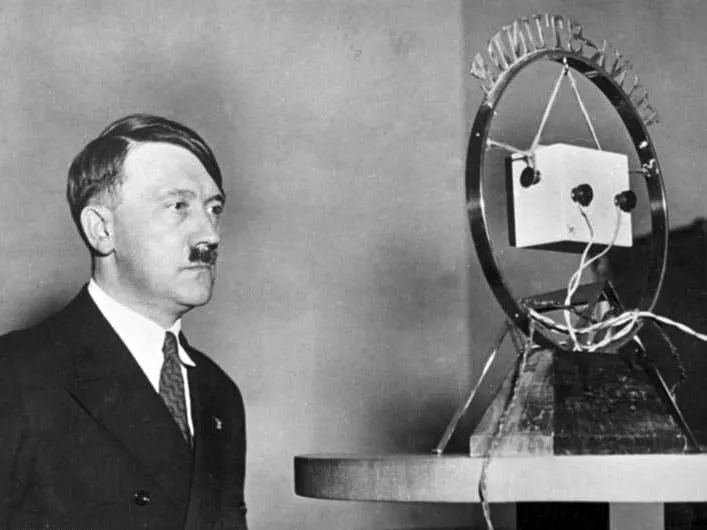
Shortly before noon on 30 January 1933, in the presidential residence on the Wilhelmstraße in Berlin, the 85-year-old Reich President Paul von Hindenburg swore in the new chancellor, Adolf Hitler, and his ministers. The leader of the NSDAP, who only the previous November had been told by the president that a government under his leadership would become a party dictatorship, now headed a cabinet in which only two other Nazis sat: the Reich Minister of the Interior, Wilhelm Frick, and the minister without portfolio Hermann Göring. The vice-chancellorship went to Franz von Papen, who had negotiated the government and was certain that he and his fellow conservatives could “fence Hitler in” and control him. That evening tens of thousands of members of the SA, the SS and the Stahlhelm marched by torchlight through the Brandenburg Gate. The appointment was in accordance with the Weimar constitution. Over the following months Hitler used the office he had gained to destroy that constitution, and within six years he had set Germany on the road to war.
The road to 30 January
Hitler did not win power at the ballot box. At the best election of his career, on 31 July 1932, the NSDAP took 37.3 per cent of the vote and 230 seats; in November it fell to 33.1 per cent. Since 1930, however, Germany had had no government backed by a majority in the Reichstag. After the September 1930 election the successive chancellors – Heinrich Brüning, Papen and General Kurt von Schleicher – governed by presidential decree under Article 48 of the constitution. Who governed was therefore decided by a narrow circle around the ageing president: his son and adjutant Oskar von Hindenburg, the head of the presidential office Otto Meissner, generals and friendly landowners.
From August 1932 Hitler had demanded the chancellorship for himself and would accept nothing less. Hindenburg turned him down twice: on 13 August, when he offered him the vice-chancellorship, and in November, when during his talks with Hitler he stated in writing that a presidential cabinet led by Hitler would turn into a party dictatorship. Instead Schleicher became chancellor, intending to split the NSDAP and win over its moderate wing. At the turn of 1932 and 1933 many observers believed that Hitler’s movement was in crisis: the party had lost two million voters, it was in debt, and in December its head of organisation, Gregor Strasser, had resigned his posts.
Cologne and Dahlem
Rescue came from Papen. Ousted by Schleicher at the beginning of December, he wanted to return to power and take revenge on his former friend. On 4 January 1933 he met Hitler at the house of the Cologne banker Kurt von Schröder, one of the signatories of the November petition to the president. Rudolf Hess, Heinrich Himmler and Hitler’s economic adviser Wilhelm Keppler also took part. The two politicians agreed that they wanted a joint government against Schleicher, although they had not yet settled who would lead it. Someone, however, photographed Papen entering the villa, and the very next day the pro-Schleicher press was writing of a conspiracy. Papen assured the chancellor that the aim had merely been to bring the Nazis into his government, but on 9 January he reported to Hindenburg, who, according to most accounts, allowed him to continue the talks without the chancellor’s knowledge.
On 15 January the NSDAP, throwing all its resources and its best speakers into the campaign in the tiny state of Lippe, won 39.5 per cent of the vote there. The result was worse than in July, but Goebbels’s propaganda presented it as proof that the party’s crisis was over. The talks moved to the villa of Joachim von Ribbentrop, a wine merchant and acquaintance of Papen’s, in the Berlin district of Dahlem. The decisive meeting took place there on the evening of 22 January. Oskar von Hindenburg and Meissner came. Hitler spoke with the president’s son alone, for between one and two hours according to different accounts. That same evening Papen gave up his claim to the chancellorship and agreed to serve as vice-chancellor under Hitler. Oskar, previously ill-disposed towards the Nazis, left convinced, according to Meissner, that there was no other way.
The hardest task was to persuade the president himself. Hindenburg disliked Hitler and contemptuously called him the “Bohemian corporal”; as late as 26 January, according to the notes of the head of the Army Command, General Kurt von Hammerstein-Equord, he assured him that he had no intention of making the “Austrian corporal” Reichswehr minister or chancellor. Papen, however, argued that Hitler would not be dangerous in a government dominated by conservatives, and that the alternative was a government without popular support, or civil war. Papen’s camp was working with the leader of the German National People’s Party, Alfred Hugenberg, and with the leaders of the Stahlhelm veterans’ league.
Schleicher’s fall
Schleicher had nothing left to offer. The Reichstag was due to meet on 31 January and would almost certainly have passed a vote of no confidence in the government. The chancellor asked Hindenburg to dissolve parliament and postpone the elections – exactly what he himself had refused Papen a month earlier. At a quarter past twelve on 28 January he received a final refusal. According to a note from the presidential office, he asked at the end that the Reichswehr ministry not be handed to a follower of Hitler, and Hindenburg replied that he firmly rejected any such idea himself. The government resigned, and the president instructed Papen to explore the possibilities of forming a new one.
The last two days were feverish. Papen negotiated the make-up of the cabinet with Hitler, Göring and Hugenberg. The president summoned General Werner von Blomberg, commander of the military district in East Prussia, from the disarmament conference in Geneva, wanting him as Reichswehr minister. On 29 January rumours spread through Berlin that Schleicher and Hammerstein had put the Potsdam garrison on alert and were preparing a coup. Historians have found no evidence of this, but the rumour did its work: it hastened the decision of the president and his circle.
The oath
On the morning of 30 January Blomberg arrived by train at the Anhalter Bahnhof. Waiting for him were Hammerstein’s adjutant, with orders to bring him to the head of the Army Command, and Oskar von Hindenburg, who took him straight to the president. At about nine o’clock Hindenburg swore him in as Reichswehr minister, even though the constitution provided that ministers were appointed on the chancellor’s proposal, and there was as yet no chancellor. The army was now in the hands of a general who would prove entirely obedient to Hitler.
The prospective ministers gathered in Meissner’s office. At the last moment a dispute broke out: Hitler demanded the dissolution of the Reichstag and new elections, counting on winning a majority under his own government. Hugenberg, who understood what this meant, objected vehemently. Meissner, watch in hand, urged them on, saying that the president could not be kept waiting any longer. Hitler finally gave an assurance that the composition of the government would not change whatever the outcome of the elections, and Hugenberg gave way. At about half past eleven Hindenburg swore in the new cabinet.
The government of “national concentration”, as it was called, was predominantly conservative. Alongside Hitler, Frick and Göring – who was also acting Prussian minister of the interior and thus in charge of the largest police force in Germany – sat Papen as vice-chancellor and Reich Commissioner for Prussia, the foreign minister Konstantin von Neurath, the finance minister Lutz Schwerin von Krosigk, the minister of posts and transport Paul von Eltz-Rübenach (all three carried over from Schleicher’s government), Hugenberg as minister of the economy and of food and agriculture, the Stahlhelm leader Franz Seldte as labour minister, and Blomberg. According to most studies, the justice ministry was filled only a few days later, so as to keep up the appearance that an agreement with the Centre Party was still possible; it went again to the incumbent minister, Franz Gürtner. Günther Gereke remained commissioner for job creation. Papen was sure of himself. According to one conservative’s account, he said: “Within two months we will have pushed Hitler so far into a corner that he’ll squeak.”
The torchlight procession
The news spread across Germany within an hour. Goebbels, not yet a minister, organised a huge demonstration in Berlin in a matter of hours. In the evening columns of the SA, the SS and the Stahlhelm carrying torches marched through the Brandenburg Gate and along the Wilhelmstraße. Hindenburg stood at one window of the Reich Chancellery; at another, a few dozen metres away, stood Hitler with Göring and Frick. The procession went on for several hours, late into the night. Estimates of the number of marchers vary widely: propaganda spoke of hundreds of thousands, while historians tend to accept somewhere between ten thousand and several tens of thousands. Radio broadcast the event live, and Goebbels wrote in his diary that it was “like a dream”. The telegram from Erich Ludendorff that circulates in the literature, in which Hindenburg’s old comrade supposedly predicted that Hitler would plunge Germany into the abyss, is in scholars’ view most probably apocryphal.
The Nazis’ opponents managed no joint resistance at all. The Communists called for a general strike, but the Social Democrats and the trade unions refused: they regarded the Communists as enemies and the government as legal, and advised waiting for the elections. In a country with more than six million unemployed a strike seemed hopeless in any case. Many German Jews, too, did not believe the worst would happen. The board of the Central Association of German Citizens of Jewish Faith declared that it received the new government “with the greatest mistrust”, but was convinced that no one would dare to violate the constitutional rights of Jews. Abroad, reactions were cautious. Part of the press wrote that the responsibility of government and the conservative ministers would tame the radical.
Seizure or transfer of power
The Nazis called 30 January the day of the “national uprising” and of the “takeover of power” (Machtübernahme). After the war the term Machtergreifung, “seizure of power”, became established. Many historians put it in quotation marks or replace it with “transfer of power” (Machtübertragung), because on 30 January Hitler won nothing by force. The office was given to him legally by the president, in accordance with constitutional procedure and on the initiative of conservative elites who wanted to use the Nazis’ mass movement for their own ends: the destruction of parliamentary government, the smashing of the left and the rebuilding of Germany’s military power. Nor, contrary to a widespread myth, was it the result of an electoral victory. At the moment of his appointment the NSDAP held a third of the seats in the Reichstag, and Hitler’s government had no majority.
Historians usually understand the “seizure of power” more broadly, however, as a process rather than a single day. The appointment was only its beginning. At the very first cabinet meeting, at five in the afternoon, the dissolution of the Reichstag was discussed. Hindenburg dissolved it on 1 February, and elections were called for 5 March. Göring, as head of the Prussian police, ordered it to use firearms ruthlessly against “enemies of the state” and brought SA and SS units into an auxiliary police. After the Reichstag fire on the night of 27–28 February the president signed a decree suspending basic civil rights. In March the Reichstag passed the Enabling Act, and by the summer the trade unions and every party except the NSDAP had been abolished. The conservatives who were supposed to control Hitler quickly lost all influence. Hugenberg left the government in June 1933, and Papen after the Night of the Long Knives in 1934.
Significance
30 January 1933 is one of the most important dates on the road to the Second World War. Hitler made no secret of his intentions. On 3 February, four days after his appointment, he addressed the senior commanders of the Reichswehr in Hammerstein’s apartment. According to the notes of one of the generals, he announced the rebuilding of the army and the reintroduction of conscription, and named as one possible aim “the conquest of new living space in the East and its ruthless Germanisation”. The generals did not protest. The army had gained a chancellor who promised it everything it had wanted for years.
In Warsaw the change in Berlin was received with unease. Historians still debate whether Józef Piłsudski seriously sounded out Paris in the spring of 1933 about a preventive war, but the demonstrative reinforcement of the Polish garrison on Westerplatte in March 1933 was a clear signal to the new government of the Reich. Hitler, who needed time to rearm, chose détente for the time being and in January 1934 signed a declaration of non-aggression with Poland. At the same time he steadily dismantled the Versailles order: in October 1933 Germany left the League of Nations, in 1935 it reintroduced conscription, in 1936 it marched into the Rhineland, and in 1938 it took Austria and the Sudetenland. On 1 September 1939, six and a half years after Hindenburg had sworn in the “Bohemian corporal”, Hitler’s army invaded Poland.
Sources
Related events
(04)The same battle, people or subject.
- 3 December 1932 · PoliticsSchleicher becomes chancellorOn 3 December 1932 Hindenburg made General Kurt von Schleicher chancellor. He hoped to split the NSDAP and win the unions, but lasted under two months.
- 23 March 1933 · PoliticsThe Enabling ActOn 23 March 1933 the Reichstag voted 444 to 94 to let Hitler’s government pass laws bypassing parliament and the constitution. Only the SPD opposed it.
- 28 February 1933 · Crimes and repressionThe Reichstag Fire DecreeOn 28 February 1933 Hindenburg signed a decree suspending civil rights. It allowed people to be locked up without trial and underpinned Nazi terror until 1945.
- 21 November 1932 · PoliticsThe Hindenburg–Hitler talksOn 21 November 1932 Hindenburg told Hitler to build a Reichstag majority. Hitler demanded a presidential chancellor's powers and was refused on 24 November.