Netherlands
Marinus van der Lubbe
Dutch bricklayer and council communist, convicted of setting fire to the Reichstag (1933)
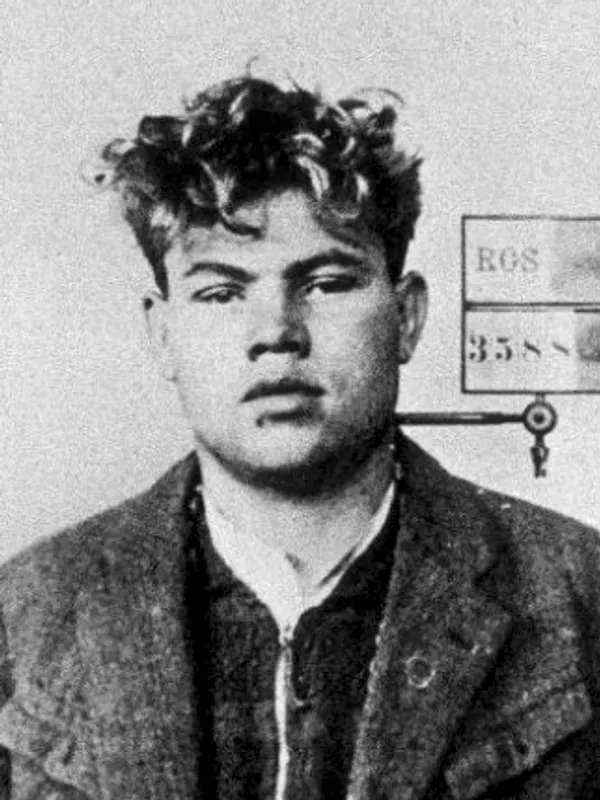
- Born:
- 13 January 1909, Leiden (Netherlands)
- Died:
- 10 January 1934, Leipzig
- Author:
- Natalia
- Photo:
- autor nieznany, domena publiczna, Wikimedia Commons

Marinus van der Lubbe was a young Dutch labourer – half-blind, unemployed and poor – who was convinced that a single violent act could rouse the workers to fight capitalism and fascism. On the evening of 27 February 1933 the police arrested him inside the burning Reichstag building in Berlin. He confessed to starting the fire and maintained to the end that he had acted alone. The Nazis presented him as the tool of a communist conspiracy and used the Reichstag fire to abolish civil liberties and destroy the left, which opened Hitler’s way to dictatorship. Van der Lubbe was sentenced to death under a law passed after his deed and was beheaded in Leipzig in January 1934. Historians still argue over whether he really was the sole culprit, but no one doubts that his act became one of the most consequential pretexts of the twentieth century.
Childhood and accident
He was born on 13 January 1909 in Leiden into a very poor family. His father, an itinerant pedlar, left the family after a few years. His mother died in 1921, when Marinus was twelve, and for the following years the boy lived with an older half-sister in nearby Oegstgeest. From 1924 he trained as a bricklayer. He was very strong, and his workmates called him “Dempsey” after the famous American boxer.
In the mid-1920s (in 1925 or 1926, according to different sources) he had an accident at work: quicklime got into his eyes. Despite surgery he almost lost his sight and could no longer work at his trade. He received an invalidity pension of 7.44 guilders a week, too little to live on, so he took casual work, among other things in bulb growing and as a messenger. His eyesight steadily deteriorated. By early 1933 he had only some ten to twenty per cent of his vision left.
A communist without a party
In the mid-1920s he joined the youth organisation of the Communist Party of the Netherlands. He organised lectures and meetings and set up premises in Leiden known as the “Lenin House”. He came into conflict with the authorities early on. In 1930 he smashed the windows of the welfare office and spent two weeks in custody. The party seemed to him less and less radical and too bureaucratic, and he chafed under party discipline. Around 1931 he broke with the communists and drew close to the Group of International Communists, a small circle of Dutch council communists who rejected parties and trade unions and believed in the spontaneous action of the workers themselves. He was active among the unemployed, urging them to organise themselves, and was jailed several more times for it.
He travelled a great deal. In 1931 he spent several weeks in Berlin and reportedly tried in vain to obtain a visa for the USSR. He walked back to the Netherlands, serving two weeks on the way for illegal peddling. In the autumn of 1931 he reached Budapest, and in the spring of 1932 he travelled again through Hungary and Czechoslovakia to Poland, where, according to his later accounts, he meant to cross the Soviet border. In June 1932 he was detained in Utrecht, having been sentenced in absentia to three months’ imprisonment for yet another broken window. In the autumn of 1932 his eyes worsened again, and until 28 January 1933 he was in the university clinic in Leiden.
Berlin, February 1933
Two days earlier Adolf Hitler had become Chancellor of Germany. Van der Lubbe believed that “important things” were happening in Germany, and in February he set off for Berlin, arriving on 18 February. He took a bed in a men’s hostel on Alexandrinenstraße. His movements over the following days are only partly known. He hung around among the unemployed in Neukölln, listened to communist and Social Democratic speakers, and was disappointed that no one was calling for active resistance. According to research by German historians, he had contact there with people who, as is now known, were informers of the political police, but whether this had any significance is unknown.
On the evening of 25 February, as he later testified, he tried to set fire to the welfare office in Neukölln, the Berlin City Hall and the Palace. All three fires were quickly spotted and put out. He spent the night of 26–27 February in a police shelter in Hennigsdorf outside Berlin, from where he walked back into the city on 27 February. After dark, according to his statements, he climbed onto a balcony by the main staircase of the Reichstag, broke a window into the restaurant and, using four packets of firelighters and his own clothes, set fire to curtains, furniture and panelling. Between 9.20 and 9.25 p.m. a policeman arrested him, without resistance, in the Bismarck Hall, half-naked and sweating. By then the debating chamber was already ablaze.
Under interrogation van der Lubbe was talkative, and the investigators described him as a “bright lad”. He said that he had wanted to give the signal for a workers’ protest against capitalist rule and the fascist seizure of power, and insisted firmly that he had acted alone. The head of the Prussian political police, Rudolf Diels, concluded that he was a madman acting on his own. Hermann Göring and Hitler, however, spoke from the very first minutes of a communist uprising. Mass arrests began that same night, and the next day President Paul von Hindenburg signed the Decree for the Protection of People and State, which suspended basic civil rights.
Trial and execution
Charged together with van der Lubbe were the chairman of the communist group in the Reichstag, Ernst Torgler, and three Bulgarian Comintern activists: Georgi Dimitrov, Blagoy Popov and Vasil Tanev. Since arson had not carried the death penalty at the time of the act, on 29 March 1933 the government, using the Enabling Act, issued a law that retroactively extended the death penalty to acts committed since 31 January. It became known as the “Lex van der Lubbe”. It was a blatant breach of the principle that laws do not apply retroactively (PL).
The trial before the Fourth Criminal Senate of the Reich Court in Leipzig opened on 21 September 1933. Van der Lubbe, still lively and talkative in the spring, sat in the courtroom utterly apathetic, hunched over, his head sunk on his chest. He spoke quietly, answered “yes” or “no”, and fell asleep during the closing speeches. Only twice did he briefly come to life and begin to speak. This was put down to a mental breakdown, but there were also suspicions that he was being given drugs. The psychiatric experts, among them Karl Bonhoeffer, found him of sound mind. Dimitrov, meanwhile, made a mockery of the prosecution and of Göring himself, and the trial that was meant to show the world a communist conspiracy turned into an embarrassment for the Nazis.
Abroad, communists from the circle of Willi Münzenberg published the Brown Book, which presented van der Lubbe as a tool of the SA. Alongside genuine accounts of Nazi terror it contained slanders: that the Dutchman had been the lover of the SA chief Ernst Röhm, that he was an antisemite and that he had no political views at all. His Dutch comrades replied the same year with a Red Book, in which they defended him as a revolutionary and accused the SPD and the KPD of betraying the workers.
On 23 December 1933 the court acquitted Torgler and the Bulgarians for lack of evidence and sentenced van der Lubbe to death for high treason and arson. Hindenburg did not exercise his right of pardon. On 10 January 1934, three days before his 25th birthday, Marinus van der Lubbe was beheaded by guillotine in the courtyard of the Leipzig prison. He refused the services of a clergyman and wrote no farewell letter. He was buried in an unmarked grave in Leipzig’s South Cemetery.
The case after the war
After the war Marinus’s brother, Jan van der Lubbe, campaigned for decades for his rehabilitation. In 1967 the Berlin Regional Court commuted the death sentence to eight years’ penal servitude for arson. In 1980 a Berlin court, on the application of Robert Kempner, the former Nuremberg prosecutor, who represented the family, quashed the verdict and acquitted van der Lubbe, but this decision was overturned on appeal, and in 1983 the Federal Court of Justice ruled that any further reopening of the case was inadmissible. Only on 6 December 2007 did the Federal Prosecutor’s Office declare, on the basis of the 1998 law quashing unjust Nazi verdicts, that the 1933 judgment was void. It stressed, however, that this did not settle the question of guilt or innocence.
The dispute over whether he acted alone has continued since 1933. For decades most historians accepted the lone-culprit thesis, developed from 1959 onwards by Fritz Tobias. Others, such as Benjamin Carter Hett, argue that the half-blind Dutchman could not have set the great debating chamber alight on his own within a quarter of an hour or so, and that SA men were also at work in the building. In 2019 a statement made in 1955 by a former SA member, Hans-Martin Lennings, came to light, according to which he had driven van der Lubbe to the Reichstag, where a fire was already burning. Its credibility is disputed.
In January 2023 van der Lubbe’s remains were exhumed. DNA tests confirmed his identity, and toxicological analysis found no traces of drugs, although the experts cautioned that after almost ninety years this did not prove that none had been administered. In 2024, on the 90th anniversary of his death, a grave with a memorial stone was laid out over his remains in the Leipzig cemetery. In Leiden he is commemorated by a monument, and a residential courtyard is named after him. Bertolt Brecht portrayed him in The Resistible Rise of Arturo Ui as the defendant Fish, the victim of a trial whose outcome had been decided in advance.
Significance
Van der Lubbe wanted to spark a workers’ revolt against the coming dictatorship, and instead he gave it the best pretext it could have wished for. His fire, whether or not it was the only one, enabled Hitler to suspend civil rights, imprison thousands of communists and Social Democrats and force through the Enabling Act. Within a few weeks Germany ceased to be a state governed by the rule of law. At the same time his trial revealed the limits of the regime’s power at that point: a court that was still independent refused to convict the communists without evidence, which Hitler took as a warning, and in 1934 he set up the People’s Court, a court entirely obedient to the party.
Van der Lubbe’s story also illustrates a method the Nazis used right up to 1939: exploit a real or fabricated incident to proclaim a threat and demand emergency measures. Convicted under a retroactive law and executed despite doubts about his state of mind, he became one of the first victims of Nazi “justice”, and his sentence a symbol of how quickly the law in the Third Reich became an instrument of power.
Sources
Often appears with
People who appear in the same events.