Germany
Franz von Papen
Reich Chancellor (1932), Vice-Chancellor (1933–1934), envoy and ambassador in Vienna (1934–1938), ambassador in Ankara (1939–1944)
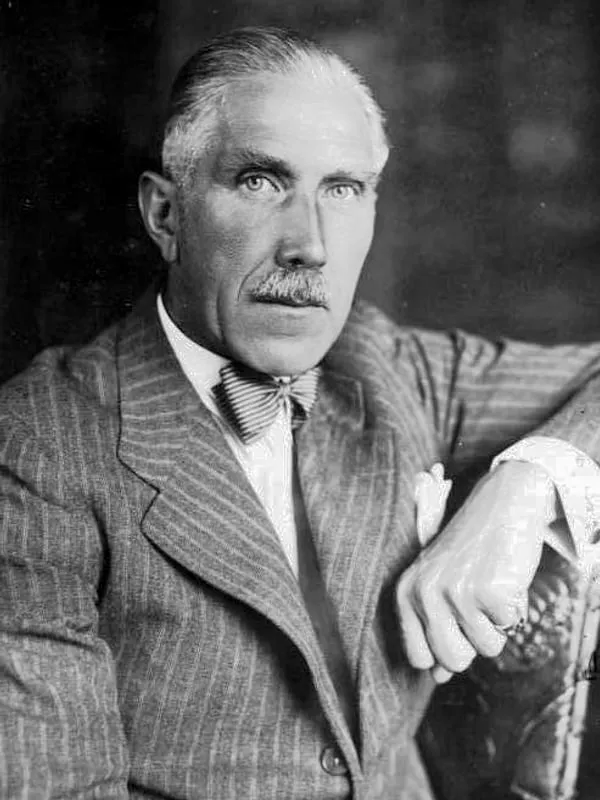
- Born:
- 29 October 1879, Werl (Westphalia, Kingdom of Prussia)
- Died:
- 2 May 1969, Obersasbach (Baden-Württemberg, West Germany)
- Author:
- Łukasz
- Photo:
- autor nieznany, CC BY-SA 3.0 DE, Wikimedia Commons

Franz von Papen was a Westphalian aristocrat, cavalry officer and politician whose name is for ever linked with Adolf Hitler’s rise to power. In 1932, entirely unknown to the wider public, he became Chancellor of Germany at the behest of General Kurt von Schleicher. In half a year in office he lifted the ban on the Nazi paramilitaries, dissolved the Reichstag twice and stripped the Social Democratic government of Prussia of power; and when he himself lost office, in January 1933 he persuaded President Paul von Hindenburg that Hitler, surrounded by conservative ministers, could be kept under control. As Vice-Chancellor he soon discovered that the reverse was true. He survived the Night of the Long Knives and then served the Third Reich as a diplomat in Vienna and Ankara. At Nuremberg he was acquitted.
Youth and military service
Franz Joseph Hermann Michael Maria von Papen was born on 29 October 1879 in Werl in Westphalia, into a wealthy Catholic noble family that had held a hereditary right to boil salt in the town since the Middle Ages. He was the third child of the cavalry officer Friedrich von Papen-Köningen. At the age of eleven, at his own wish, he was sent to a cadet school and then to the Main Cadet Institute at Berlin-Lichterfelde. He served as a page at the court of Wilhelm II and from 1898 was an officer of the Westphalian 5th Uhlan Regiment in Düsseldorf. He was a keen horseman, and his opponents later mocked him as the “Herrenreiter”, the gentleman rider.
In 1905 he married Martha von Boch-Galhau, the daughter of a Saarland industrialist and one of the heiresses of the ceramics firm Villeroy & Boch. Her dowry made him a rich man, and his wife’s family brought an estate at Wallerfangen on the Saar. Papen graduated from the War Academy and in March 1913 became a captain on the General Staff. There he met Schleicher, three years his junior, and the two became friends.
A spy in America
At the end of 1913 Papen went to the United States as military attaché at the German embassy, also accredited to Mexico. After the outbreak of war, shielded by diplomatic immunity, he organised an intelligence and sabotage network in the still neutral United States. His men forged passports for German reservists, bought up through front companies the raw materials needed to make munitions for the Entente, and planned attacks on Canadian railways and the Welland Canal. British intelligence was reading his correspondence. On 3 December 1915 the US government declared Papen persona non grata. On his way home British inspectors seized his papers, including the stubs of his chequebooks, from which the names of his agents were read. Arrests followed, and in 1916 an American grand jury indicted him; the charges were dropped only when he became Chancellor in 1932.
From 1916 Papen fought on the Western Front as a battalion commander and staff officer, among other places on the Somme. In 1917 he was transferred to Turkey, where he served on the staff of Erich von Falkenhayn’s army group on the Palestine front. In 1918, with the Ottoman rank of lieutenant colonel, he was chief of staff of the Turkish Fourth Army. In Constantinople he met a young officer, Joachim von Ribbentrop, an acquaintance that would matter in January 1933. After the armistice he refused to obey an order to set up soldiers’ councils and fled to Germany in civilian clothes. In the spring of 1919 he left the army with the rank of major.
A monarchist in the Catholic party
Papen never reconciled himself to the fall of the monarchy and did not want to serve in the army of the republic. He settled on the Merfeld estate at Dülmen in the Münsterland and took up farming and politics. He joined the Catholic Centre Party, although ideologically he was closer to the nationalists: he belonged to its far-right, monarchist wing, condemned cooperation with the Social Democrats and dreamed of a conservative, Christian, authoritarian monarchy. In 1921–1928 and 1930–1932 he sat in the Prussian Landtag, though he seldom attended. As the main shareholder of the party daily Germania he had an influence that his standing in the party did not give him. In 1925 he caused a scandal when, in the presidential election, he backed not the Centre candidate Wilhelm Marx but Hindenburg. He was a member of the exclusive Berlin Herrenklub, where conservative aristocrats, industrialists and intellectuals discussed replacing parliamentary democracy with authoritarian rule. In 1923 Pope Pius XI made him a papal chamberlain.
Chancellor of the “cabinet of barons”
When Schleicher was looking for a successor to Heinrich Brüning, he chose Papen: an aristocrat, a Catholic and a former officer who would attract the Centre, satisfy Hindenburg and do as he was told. According to acquaintances, Schleicher said that Papen was not meant to be a head but a “hat”. On 30 May 1932 Brüning resigned, and on 1 June Papen became Chancellor, even though the day before he had promised the Centre Party chairman, Ludwig Kaas, that he would not accept the office. He left the party to avoid being expelled. His government, in which most ministers bore noble titles, was dubbed the “cabinet of barons”. In the Reichstag only the German Nationalists supported him.
Papen honoured the bargain that Schleicher had struck with Hitler: on 4 June the Reichstag was dissolved, and on 16 June the government lifted the ban on the SA and the SS. At Lausanne, at the conference that ended on 9 July, he secured the replacement of reparations by a lump sum of three billion marks, which Germany never paid. On 20 July 1932, exploiting the bloody clashes in Altona, he removed the Social Democratic government of Prussia by presidential decree and took power there himself as Reich Commissioner. This coup, known as the “Preußenschlag”, deprived the republic of its strongest bastion. Hitler later admitted that Papen had been the first to violate the “sacred constitution”.
The election of 31 July made the NSDAP the largest party in Germany. Hitler demanded the chancellorship for himself, and when Hindenburg refused him on 13 August he went into opposition. Papen, who had won the old president’s trust, was planning an authoritarian revision of the constitution. When Hermann Göring, elected President of the Reichstag on 30 August, ostentatiously refused to let him speak on 12 September and parliament passed a vote of no confidence in his government by 512 votes to 42, Papen dissolved the Reichstag a second time. In the election of 6 November the Nazis lost two million votes, but Papen still had no majority of any kind. He resigned on 17 November, and when at the beginning of December he wanted to carry on governing without parliament, with the help of the army, Schleicher convinced the ministers that the army could not cope with a civil war. On 3 December 1932 Schleicher became Chancellor.
The man who brought Hitler to power
Papen did not forgive his old friend. He kept his access to Hindenburg, who had grown fond of him and in December sent him his photograph inscribed “I had a comrade”. On 4 January 1933 he met Hitler secretly in Cologne, at the house of the banker Kurt von Schröder. In the following weeks talks were held at Ribbentrop’s villa in Berlin, and on 22 January they were joined by the president’s son Oskar and the head of his office, Otto Meissner. Papen gave up his claim to the chancellorship and convinced the president that Hitler would be harmless in a government in which only three Nazis would sit and the other ministers would be conservatives. To acquaintances who were worried he is said to have remarked: “Within two months we will have pushed Hitler so far into a corner that he’ll squeak.” On 30 January 1933 Hindenburg appointed Hitler Chancellor, with Papen as Vice-Chancellor and Reich Commissioner for Prussia.
The calculation proved catastrophically wrong. Göring, as Prussian interior minister formally subordinate to Papen, took over the police of the largest state in the Reich and paid no heed to the Vice-Chancellor. Papen did not oppose the Decree for the Protection of People and State after the Reichstag fire, nor the Enabling Act. In April 1933 he lost the post of Commissioner for Prussia to Göring. As the government’s plenipotentiary he negotiated in Rome with Cardinal Eugenio Pacelli, the future Pope Pius XII, the Concordat signed on 20 July 1933. The Concordat sealed the end of political Catholicism in Germany, and the regime broke it almost from the start. From November 1933 Papen also directed the propaganda campaign ahead of the Saar plebiscite.
Marburg and the Night of the Long Knives
On 17 June 1934, at the University of Marburg, Papen delivered a speech written by his adviser Edgar Julius Jung. In it he criticised the terror of the SA, the talk of a “second revolution”, the personality cult and the propaganda, and called for freedom of speech. It was the sharpest public criticism of the regime ever voiced in the Third Reich by a member of the government. Goebbels banned its distribution, and Papen allowed Hitler to placate him.
Two weeks later, during the Night of the Long Knives, the SS occupied his office. Jung, the head of his press office Herbert von Bose and the Catholic activist Erich Klausener were murdered. Papen himself – on Göring’s orders, according to most accounts – was held under house arrest for several days. He resigned but did not break with the regime. Shortly before leaving office he also signed the law that, on Hindenburg’s death, made Hitler head of state.
In Vienna and Ankara
As early as 26 July 1934, the day after the failed putsch by the Austrian Nazis and the assassination of Chancellor Engelbert Dollfuss, Hitler appointed him envoy extraordinary in Vienna. Papen, answerable directly to Hitler rather than to the foreign minister, was to reassure the Austrians while at the same time preparing the annexation of their country. He negotiated the agreement of 11 July 1936, in which Germany recognised Austria’s sovereignty and Austria undertook to conduct the policy of a “German state” and to admit representatives of the “national opposition” to power. On 4 February 1938 he was unexpectedly recalled, but it was he who arranged the meeting between Chancellor Kurt Schuschnigg and Hitler at Berchtesgaden on 12 February, at which the Austrian was presented with an ultimatum. A month later came the Anschluss. Papen accepted the Golden Party Badge and joined the NSDAP, even though in those same days the SD murdered his close associate Wilhelm von Ketteler in Vienna.
In April 1939, when Turkey’s importance grew after the Italian invasion of Albania, Papen became ambassador in Ankara. Turkey was then governed by the successor of Mustafa Kemal Atatürk, President İsmet İnönü. Papen did not prevent Turkey from allying itself with Britain and France in October 1939, but after the fall of France his position grew stronger. In June 1941, a few days before the attack on the Soviet Union, he signed the German–Turkish Treaty of Friendship, which secured the Reich’s southern flank. On 24 February 1942 a bomb planted by agents of the Soviet NKVD exploded near him in Ankara. Only the bomber was killed, and Papen came through the attack almost unscathed. In 1943–1944 the embassy made use of documents stolen from the British embassy by the ambassador’s valet, Elyesa Bazna, known as “Cicero”. At the same time Papen sounded out the Americans about peace through intermediaries, but Franklin Delano Roosevelt rejected these contacts. In August 1944 Turkey broke off relations with Germany, and Papen returned home.
After the war Papen claimed to have saved Jews from occupied Europe. Research in the files of the German Foreign Office does not bear this out. He learnt early of the murder of Jews in Poland from the nuncio in Turkey, Angelo Roncalli, the future Pope John XXIII, but did not support his rescue efforts.
Nuremberg and the last years
In April 1945 Papen was arrested by American paratroopers at his son-in-law’s hunting lodge in the Sauerland. He stood trial before the International Military Tribunal at Nuremberg, charged with taking part in a conspiracy against peace. On 1 October 1946 the tribunal acquitted him: it found that he had been guilty of “political immorality” but not of the crimes in the indictment. The Soviet judge entered a dissenting opinion. In February 1947 a German denazification tribunal classified him as a major offender and sentenced him to eight years in a labour camp, but he was released on appeal in January 1949.
In 1952–1953 he published his memoirs, Der Wahrheit eine Gasse (“A Path for the Truth”), and in 1968 a book on the collapse of Weimar democracy. In them he presented himself as a tragic patriot who had tried to tame Hitler, and historians have pointed out their many omissions and falsehoods. In 1959 Pope John XXIII restored his title of papal chamberlain. He died on 2 May 1969 at Obersasbach in Baden, at the age of 89, and was buried at Wallerfangen.
Significance
Papen was not a Nazi and did not want a world war. He was a conservative monarchist who despised parliamentary democracy and believed that Germany should be ruled by the old elite: the aristocracy, the army and big industry. That is precisely why his role was so disastrous. It was his government that lifted the ban on the SA, did away with the democratic government of Prussia and accustomed Germans to the idea that the constitution could be broken by decree. It was he who, out of wounded ambition and in the belief that he would use Hitler for his own ends, persuaded Hindenburg to hand him power. When the calculation failed, he did not break with the regime that had murdered his friends.
Historians agree in seeing him as a symbol of the blindness of the German conservatives who believed they would “tame” Hitler’s movement. One biographer called him the “devil in a top hat”; others have seen him rather as a frivolous and vain dilettante. Without Papen, Hitler’s road to power would probably have looked different. With him it became shorter, and the country that Papen wanted to save from revolution found itself within a few years in a war that ended in its destruction.
Sources
Often appears with
People who appear in the same events.