- Category:
- Politics
- Date:
- 23 March 1933
- Author:
- Natalia
- Tags:
- Germany, Nazi Party, Adolf Hitler, Third Reich
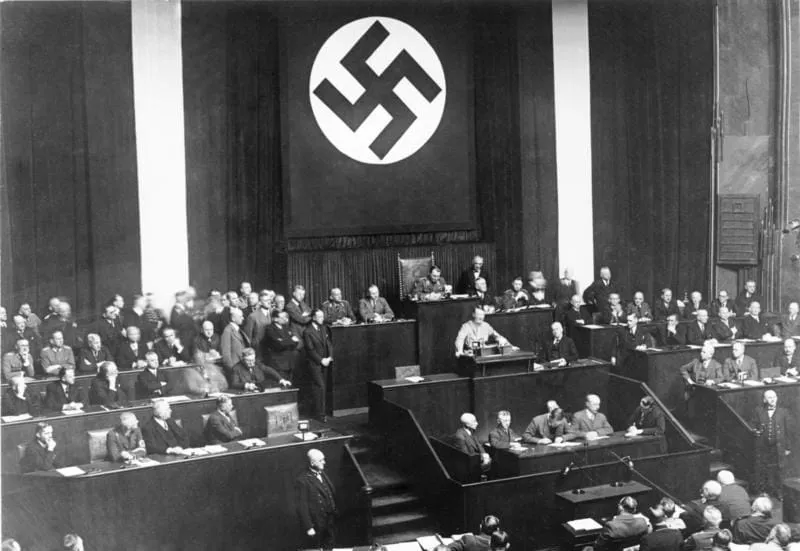
On 23 March 1933 the Reichstag, sitting in the Kroll Opera House in Berlin, voted by 444 to 94 to pass the “Law to Remedy the Distress of People and Reich” (Gesetz zur Behebung der Not von Volk und Reich), known as the Enabling Act (Ermächtigungsgesetz). Its five short articles allowed the government of Adolf Hitler to enact laws for four years without the participation of parliament and without the president’s signature, including laws that deviated from the constitution. Only the Social Democrats present in the chamber voted against. There were no Communists in the chamber: they were in prison, in hiding or had fled the country. All the middle-class parties supported the law, led by the Catholic Centre Party, whose votes secured the required two-thirds majority. Parliament stripped itself of its own power, and the Act, extended several times, remained the legal basis of Nazi rule until 1945.
It is often said that the Act “made Hitler dictator of Germany”. In political practice this is true, but in the legal sense it needs qualifying. The Act gave power not to Hitler personally but to the Reich government, in which the Nazis were still in a minority. It was limited in time, guaranteed the inviolability of the Reichstag, the Reichsrat and the president’s prerogatives, and President Paul von Hindenburg still commanded the armed forces and could formally dismiss the chancellor. Hitler’s dictatorship was completed only over the next sixteen months: after the abolition of all parties except the NSDAP in the summer of 1933, after the purge of the SA leadership in June 1934, and after the merging of the offices of chancellor and president on Hindenburg’s death in August 1934. The Act of 23 March was nevertheless the key that opened the way.
Precedents and arithmetic
Enabling acts were nothing new in Germany. In the crisis of 1923 the governments of Gustav Stresemann and Wilhelm Marx received from the Reichstag a temporary right to issue decrees on economic and financial matters. The Weimar constitution did not forbid such laws provided they were passed by the majority needed to amend the constitution. Those powers, however, were narrow, brief and subject to parliamentary control. The law Hitler wanted had no limits on its content.
From the outset Hitler did not intend to govern by presidential decree, as his predecessors had done, since that would have made him dependent on Hindenburg and his circle. When he became chancellor on 30 January 1933, only two other Nazis sat in his government: the interior minister Wilhelm Frick and Hermann Göring. The conservatives – the vice-chancellor Franz von Papen and the leader of the German National People’s Party (DNVP), Alfred Hugenberg – believed they could “fence him in”. Hitler forced through the dissolution of the Reichstag and new elections, which were to give him a majority of his own.
The election of 5 March 1933 was held in an atmosphere of terror, after the Reichstag fire and the issuing of the Decree for the Protection of People and State, which had suspended basic civil rights. Even so, the NSDAP won only 43.9 per cent of the vote and 288 of the 647 seats. Together with the 52 deputies of the DNVP and the Stahlhelm, who stood as the Black-White-Red Combat Front, the governing coalition had 340 seats – a narrow majority. That was not enough to amend the constitution. A double two-thirds majority was needed: two-thirds of the statutory number of deputies, that is 432, had to be present, and two-thirds of those present had to vote in favour. The Social Democrats had 120 seats, the Communists 81, the Catholic Centre 73, and its Bavarian sister party, the Bavarian People’s Party, 19.
At the first cabinet meeting after the election, on 7 March, Hitler announced the Enabling Act, and on 15 March Frick told the ministers that it would be broad enough to allow any provision of the constitution to be set aside. The only conservative to raise objections was Hugenberg. He proposed that government laws should require the president’s consent, but Hindenburg’s chief of staff, Otto Meissner, declared this “unnecessary”.
How to win two-thirds
The Communists were no obstacle. The KPD had not formally been banned, and its deputies had been elected, but since 28 February the party had been hunted down, and its deputies, unless they had managed to go into hiding or flee, were locked up in “protective custody”. None of them could appear in the Reichstag. The problem lay elsewhere: if, besides the Communists and Social Democrats, another dozen or so deputies stayed away, there would be no quorum and the vote would be invalid. On Frick’s initiative the government therefore proposed a change to the Reichstag’s standing orders under which deputies absent “without excuse” would be counted as present. It was for the President of the Reichstag, Göring, to deem them unexcused – including those whom his own police had thrown into prison. The Social Democrats warned of abuse, but the other parties adopted the change. The only open question was the two-thirds majority of those voting, and that depended on the Centre.
The Centre, a party that had shared in governing the republic since 1919, was divided. Its chairman, the priest and prelate Ludwig Kaas, believed that resistance would change nothing and that cooperation would make it possible to save what mattered most to Catholics. The former chancellor Heinrich Brüning and the former minister Adam Stegerwald wanted to vote against. Kaas spoke with Hitler on 20 and 22 March. Hitler promised that the government would not touch the existence of the Reichstag, the Reichsrat or the federal states, or the president’s prerogatives; that it would respect the rights of the Churches, the concordats concluded with the states and the influence of Christianity on schools; and that judges would remain irremovable. A small committee was also to be set up, which the government would keep informed of the laws issued under the Act. Kaas demanded that Hitler confirm this in writing. The chancellor agreed.
Some historians, such as Klaus Scholder, believed that the background also included the Reich Concordat with the Holy See, which had long been a priority for the Cardinal Secretary of State Eugenio Pacelli, a close associate of Kaas. Kaas left for Rome the day after the vote, and the concordat was signed in July 1933. Other scholars find no evidence of a direct “Act for concordat” deal. Most agree that the Centre’s decision was determined above all by fear: of a Communist revolution, whose threat the Reichstag fire had supposedly confirmed, but also of Nazi violence if the party refused. Many deputies received threats against themselves and their families.
Two days before the vote the Nazis staged a spectacle designed to reassure the middle classes. On 21 March, the “Day of Potsdam”, the new Reichstag gathered for its ceremonial opening in the Garrison Church in Potsdam, by the tomb of Frederick the Great. Hitler, in a civilian tailcoat, bowed before Hindenburg in his field marshal’s uniform and shook his hand. The black-white-red imperial flags flew over the ceremony. The message was clear: the new regime was not a revolution but a continuation of the old Prussian traditions. That same day the government issued a decree setting up special courts for political cases and a decree punishing “malicious attacks” on the government. The day before, Heinrich Himmler had announced the opening of the concentration camp at Dachau.
The session in the Kroll Opera House
Since the Reichstag’s debating chamber had burned down, the deputies met on the afternoon of 23 March in the Kroll Opera House, opposite the ruins of the building. The building was surrounded by SS men, appearing in public in such numbers for the first time. SA stormtroopers stood at the entrance and in the corridors, chanting: “We demand the Enabling Act – or else there’ll be hell to pay!” A huge swastika flag hung behind the rostrum. The NSDAP deputies came in brown uniforms. Göring, as president, opened the session with a tribute to the Nazi poet Dietrich Eckart, who had died ten years earlier.
Hitler, also in a brown shirt, gave his first speech in the Reichstag. Many deputies were seeing him for the first time. He began with the November Revolution and the “fourteen years of decline”, announced the moral renewal of the nation and the fight against communism and unemployment, and for the Centre’s benefit repeated almost word for word the promises negotiated with Kaas, stressing that Christianity was the foundation of the nation’s morality. He assured them that the government would use its powers only to the extent essential, and that the existence of the Reichstag, the Reichsrat and the states was not threatened. At the end he issued a threat: the government was prepared to accept either assent or refusal, and the deputies should “decide for themselves whether they want peace or war”.
After a recess Kaas announced that the Centre, “setting aside its misgivings”, would support the bill. He never received Hitler’s promised letter. He was assured that it was just being typed, and it never reached him. Brüning kept silent. A deputy of the Bavarian People’s Party also backed the Act, and on behalf of the liberals of the German State Party Reinhold Maier declared that his five-member group, despite serious reservations about the lack of guarantees for civil rights, would also vote in favour. Among its members was Theodor Heuss, later the first President of the Federal Republic of Germany, who had grave doubts but submitted to the majority of the group.
Otto Wels’s speech
The only speaker to oppose the Act was the chairman of the Social Democratic Party of Germany, Otto Wels. He spoke amid the jeers of SS and SA men. According to what Willy Brandt recounted years later, he carried a phial of poison in his pocket in case he was arrested in the chamber itself. Wels recalled that it was the Social Democrats who had rebuilt Germany after the defeat of 1918, and rejected the claim that the government needed extraordinary powers when it had a majority in parliament. He spoke the words that went down in history: “You can take our freedom and our lives, but not our honour.” He said that the Weimar constitution was not a socialist one, but that the Social Democrats stood by its principles: the rule of law, equal rights and social justice. He greeted his persecuted and imprisoned comrades and concluded: “No enabling act gives you the power to destroy ideas that are eternal and indestructible.”
It was the last free speech in the German Reichstag until 1945. Hitler immediately returned to the rostrum and, in an improvised reply full of hatred that opened with Schiller’s words “You come late, but you come”, denied the Social Democrats the right to speak of honour and recalled the persecution of the Nazis under the republic. “I do not even want you to vote for it,” he cried. “Germany shall be free, but not through you!” The NSDAP deputies and the public in the gallery responded with ovations.
The vote
The vote was by roll call. 538 valid votes were cast. 444 deputies – everyone present except the Social Democrats – voted in favour, and 94 Social Democrats against. 109 deputies were absent: all 81 Communists, 26 Social Democrats who had been arrested or were in hiding, and two others who were excused. More than 82 per cent of those voting supported the Act, far more than the two-thirds required. Even if all the Social Democrats had been present, the result would not have changed, and had the Communists come and voted against as well, the Act would still have passed. When Göring announced the result, the NSDAP deputies rushed to the front of the rostrum and sang the Horst-Wessel-Lied.
That same evening the Act was approved unanimously and without debate by the Reichsrat, the chamber representing the federal states, where Nazi commissioners had already taken power. Hindenburg signed it, and on 24 March it was published in the Reich Law Gazette and came into force. That is why German literature often calls it the law of 24 March.
The Act had five articles. The first provided that Reich laws could be enacted not only by the procedure laid down in the constitution but also by the Reich government, including the budget law and laws on raising loans. The second allowed government laws to deviate from the constitution, provided they did not concern the institutions of the Reichstag and the Reichsrat, and left the president’s prerogatives untouched. The third provided that government laws were drawn up by the chancellor and came into force the day after publication. The fourth exempted international treaties from the requirement of parliamentary consent. The fifth limited the Act’s validity to 1 April 1937 or until the present government was replaced by another. This last clause was meant as a safeguard for the conservatives, but in practice it meant nothing.
The dispute over legality
The Nazis boasted that they had taken power legally, and the Enabling Act was the chief proof of this “legality”. Many historians challenge it. The British historian Richard J. Evans considers the Act invalid: Göring had no right to leave the Communist deputies out of the quorum count, since their mandates had not been annulled, and the Reichsrat that approved the Act consisted of representatives of state governments that had been unlawfully overthrown on the basis of the decree of 28 February. More important than the procedural questions, however, were the circumstances. The deputies voted in a building surrounded by the SS, under the eyes of armed stormtroopers, after weeks of terror in which some of their colleagues had ended up in prisons and camps. Consent extorted under such conditions was not a free choice, even if it preserved the appearance of due procedure.
In any case, the Act alone did not satisfy the Nazis for long. On 30 January 1934 the Law on the Reconstruction of the Reich abolished the state parliaments and stripped the states of their autonomy, and on 14 February the government abolished the Reichsrat, although Article 2 had guaranteed its existence. In August 1934 Hitler assumed the powers of the president, also in breach of that article. By then no one could challenge it any longer.
Consequences
The Act transferred legislative power from parliament to the government, and in practice to Hitler. Ministers stopped debating draft laws, the cabinet met less and less often, and from 1938 never again in full. Within a few months laws issued under it had turned Germany into a one-party state. On 31 March and 7 April 1933 two laws on the coordination (Gleichschaltung) of the states with the Reich subordinated them to the government and to Nazi Reich governors. On 7 April the Law for the Restoration of the Professional Civil Service made it possible to remove Jews and political opponents from public office. On 29 March the government issued the law known as the “lex van der Lubbe”, which retroactively introduced the death penalty for the Reichstag arsonist. A law that was supposed to be an emergency measure became the normal way of making law in the Third Reich.
The parties that had supported it did not survive the summer. On 2 May the Nazis smashed the trade unions, on 22 June the SPD was banned, and by early July all the remaining parties had dissolved themselves, Hugenberg’s DNVP and the Centre included. On 14 July 1933 the NSDAP became the only legal party in Germany. The committee that was supposed to inform the parties about government laws met just three times. Wels emigrated in May 1933 and led the SPD’s executive in exile, first in Prague and then in Paris, where he died in September 1939. Kaas never returned to Germany and remained in the Vatican until his death in 1952.
The Reichstag, elected from a single list from November 1933 onwards, became mere decoration, mockingly dubbed “the most expensive choir in the world”. It met a few times a year to listen to Hitler’s speeches. Twice, on 30 January 1937 and 30 January 1939, it unanimously extended the Enabling Act, the second time until 10 May 1943. On that date Hitler extended it indefinitely by decree on his own authority. The Allies repealed it by Allied Control Council Law No. 1 of 20 September 1945.
Significance
The Enabling Act was the last act of Weimar democracy and the first legal act of the dictatorship. Together with the decree of 28 February it formed the foundation of the Third Reich: the decree took away citizens’ rights, the Act took away parliament’s power. Hitler obtained these not by a coup d’état, as he had attempted in the Beer Hall Putsch of 1923, but through the votes of parliament, which gave him an appearance of legitimacy in the eyes of officials, judges, officers and many citizens. That is why after 1945 the Germans framed their Basic Law so that no majority could ever again hand legislative power to the government or abolish fundamental rights.
Without the Act of 23 March Hitler could not have reshaped the state and prepared it for war so quickly and without resistance. The government no longer had to ask parliament about rearmament, the budget or treaties with foreign states. When Germany left the League of Nations in October 1933, and when on 16 March 1935 the government, by a single law issued under the Act, reintroduced universal conscription and announced the creation of an army of 36 divisions, the Reichstag learned of it like every other citizen. When Germany invaded Poland in 1939, no one in the Reich had any legal means left to stop Hitler.
Sources
Related events
(04)The same battle, people or subject.
- 30 January 1933 · PoliticsHitler becomes chancellorOn 30 January 1933 Hindenburg made Hitler Reich Chancellor. Papen's conservatives believed they could “fence him in”. Within months he built a dictatorship.
- 28 February 1933 · Crimes and repressionThe Reichstag Fire DecreeOn 28 February 1933 Hindenburg signed a decree suspending civil rights. It allowed people to be locked up without trial and underpinned Nazi terror until 1945.
- 27 February 1933 · PoliticsThe Reichstag fireOn 27 February 1933 the Reichstag chamber burned. Dutchman Marinus van der Lubbe was arrested, and the Nazis declared it the signal for a Communist uprising.
- 26 April 1933 · Crimes and repressionThe founding of the GestapoOn 26 April 1933 Göring set up the Prussian political police as a separate Secret State Police Office. Under Himmler and Heydrich it became a byword for terror.