Germany
Rudolf Diels
Head of the Prussian political police and of the Secret State Police Office (1933–1934), district president in Cologne (1934–1936) and Hanover (1936–1942)
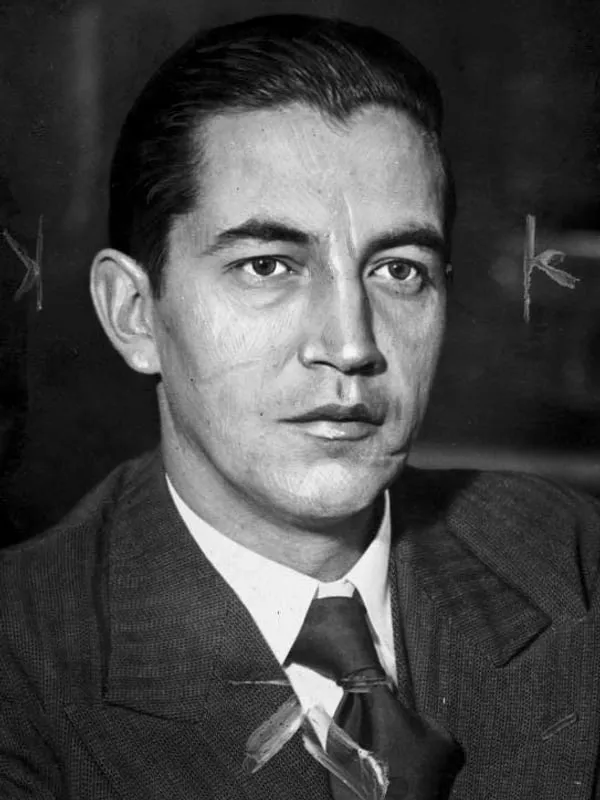
- Born:
- 16 December 1900, Berghausen (Prussia, German Empire)
- Died:
- 18 November 1957, Katzenelnbogen
- Author:
- Natalia
- Photo:
- autor nieznany, CC BY-SA 3.0 DE, Wikimedia Commons

Rudolf Diels was the first head of the Gestapo. An able and ambitious lawyer in the Prussian civil service who sympathised with the liberals during the Weimar Republic, in 1932 he went over to the side of those who were dismantling the republic and attached himself to Hermann Göring. After the Nazis took power he ran the Prussian political police and, from 26 April 1933, the Secret State Police Office (Geheimes Staatspolizeiamt), from which the Gestapo grew. In the first year of the dictatorship, when tens of thousands of people were imprisoned and tortured in SA cellars and the first concentration camps, he was one of the officials who gave this terror its administrative form. In April 1934 he lost a power struggle with Heinrich Himmler and Reinhard Heydrich, but under Göring’s protection he held senior posts throughout the Third Reich. After the war he presented himself as an old-school civil servant who had tempered the Nazi terror. Historians see him rather as an opportunist whose career shows clearly how a state governed by the rule of law passed into the hands of a dictatorship with the help of its own officials.
Youth and early career
He was born on 16 December 1900 in Berghausen in the Taunus, into a prosperous farming family. He attended a classical grammar school (Gymnasium) in Wiesbaden, where he took the wartime school-leaving examination in September 1918. In the last weeks of the First World War he served in a signals unit in Alsace. From 1919 he studied law and political science at the University of Marburg, where he belonged to a student fraternity and acquired duelling scars of which he was later proud. After his state examinations he worked as a trainee lawyer (Referendar) and, from 1925, as an assessor in district administrations in Brandenburg and in Peine near Hanover. At this time he belonged to the liberal German Democratic Party and frequented the Democratic Club in Berlin, run by the city’s deputy police president, Bernhard Weiß. In 1931 he married Hildegard Mannesmann, the daughter of an industrialist from the family that founded the Mannesmann concern, which opened doors for him in business circles.
In the Prussian interior ministry
In April 1931, with the backing of State Secretary Wilhelm Abegg (PL), he moved to the police department of the Prussian interior ministry, headed by the Social Democrat Carl Severing. As a government counsellor (Regierungsrat) he was responsible for combating the communist movement. He soon began playing both sides, however. In 1932 he passed confidential material to the deputy Gauleiter of the NSDAP in Berlin, and in March he became a supporting member of the SA. In July 1932 he supplied the people of Chancellor Franz von Papen with a distorted account of a conversation between Abegg and the communist deputies Ernst Torgler and Wilhelm Kasper. Published in the press, it served as proof that Prussia’s Social Democratic government was conspiring with the communists, and as one of the pretexts for its overthrow by Papen on 20 July 1932. Diels, promoted to senior government counsellor (Oberregierungsrat), took charge of the political department of the Prussian police. From the end of 1932 he passed information on communists and Social Democrats directly to Göring.
The Reichstag fire
When Adolf Hitler became Chancellor, Göring, the new commissioner of the Prussian interior ministry, ordered Diels that very day to draw up a list of all communist functionaries. In February 1933 he appointed him head of the political department of the Berlin police headquarters. On the evening of 27 February Diels was in the burning Reichstag and was among the first to interrogate Marinus van der Lubbe, who had been arrested on the spot. According to his memoirs he concluded that the Dutch communist had acted alone, but Hitler and Göring, who arrived at the scene, at once declared the fire to be the signal for a communist uprising and demanded a ruthless crackdown on the communists. That same night the police arrested thousands of people from lists prepared by Diels’s department. For years Diels changed his mind about who was behind the Reichstag fire. In 1946, in a statement to the British delegation at Nuremberg, he named the SA leader Hans Georg Gewehr as the probable arsonist, but later inclined once more towards the lone-perpetrator version.
The first head of the Gestapo
On 26 April 1933 Göring separated the political police from the general police administration as the Secret State Police Office, subordinate directly to himself, and put Diels at its head. The office was housed at Prinz-Albrecht-Straße 8, and prisoners were interrogated and beaten in its cellars. Diels helped to build the system of “protective custody” and the first concentration camps, among them the camp at Sonnenburg (today Słońsk in Lubusz Province, Poland), where Carl von Ossietzky was among those held. He also pressed for lists of Jewish activists and organisations to be drawn up. After the war witnesses testified that he had been present when, in September 1933, the SA murdered Albrecht Höhler, who had been convicted of killing Horst Wessel, and that he had issued the document under which the prisoner was handed over to the stormtroopers. His later disputes with the SA and the SS, including over the “wild” camps, which he himself described as a struggle for the rule of law, stemmed, according to his biographers, chiefly from rivalry over jurisdiction. At the same time he was friends with Martha Dodd, the daughter of the United States ambassador in Berlin.
On 15 September 1933 Himmler admitted him to the SS with the rank of Obersturmbannführer, and in November promoted him to Standartenführer. Even so, to Himmler and Heydrich Diels remained an outsider: a former democrat and Göring’s man. In the autumn of 1933, caught up in the struggle between Göring, Himmler and the SA leadership, he lost his post and, fearing for his life, fled to Karlovy Vary (Karlsbad) in Czechoslovakia. Göring brought him back, and Hitler himself, according to the diary of Joseph Goebbels, was displeased at his removal. On 18 November 1933 Diels became deputy police president of Berlin, and on 29 November head of the Gestapo once again. His position, however, was untenable. Himmler was taking over the political police forces of the German states one by one, and Göring needed him as an ally against Ernst Röhm. On 20 April 1934 Göring handed the Gestapo over to Himmler, and the next day Diels was retired. According to some accounts he was also harmed by having helped the lawyer Robert Kempner, who had earlier been dismissed from the Prussian ministry, to leave the country.
District president
In May 1934 Göring appointed him district president (Regierungspräsident) in Cologne and installed him in office in person, a rare distinction. A few days later, during the Night of the Long Knives, Göring’s protection saved him from the fate of many of the people on the SS lists. In Cologne Diels tried to ease the conflicts between the party and the Catholic Church, which embroiled him in disputes with the local Gauleiter and with the senior president (Oberpräsident) of the Rhine Province, Josef Terboven. In July 1936 he was transferred to the post of district president in Hanover. On 1 May 1937 he joined the NSDAP, and in 1939 he became an SS-Oberführer. He was an official of a committed state: during Kristallnacht in November 1938 synagogues burned in his district, as across the Reich, and Jewish men were taken away to camps. In 1939 he was proposed as deputy head of the administration in occupied Kraków, and in 1941 he himself sought the post of commissioner of Leningrad, which the Germans intended to capture. Neither plan came to anything.
In Hanover he came into conflict with the new Gauleiter and senior president, Hartmann Lauterbacher, who considered him insufficiently zealous in persecuting the Jews. When in 1941 he hesitated to introduce further restrictions on Jews’ use of public transport, he justified it by saying that most of them would “soon be deported”. In March 1942 Göring made him chairman of the inland shipping board of his state-owned concern, the Reichswerke Hermann Göring. The concern’s business took him to occupied Ukraine, where, as researchers have established, he witnessed mass killings. On 17 January 1943 he married Ilse Göring, the widow of Hermann Göring’s brother. At the end of 1943, after fresh quarrels with the SS, he went to a sanatorium in Lugano, where he tried in vain to obtain asylum in Switzerland. There he met Hans Bernd Gisevius, his former rival from the Gestapo and now one of the conspirators against Hitler. After his return the Gestapo twice arrested him briefly, in the spring and in November 1944. He did not join the conspiracy against Hitler, although, as he himself admitted, friends urged him to do so.
After the war
Diels was detained by the Allies on 3 May 1945 and remained interned until 1948. From the autumn of 1945 to the summer of 1947 he appeared as a witness before the tribunals at Nuremberg. At the trial of the major war criminals he gravely incriminated his former patron, testifying that as early as 1933 Göring had been responsible for the lawlessness and violence of the SA. He also made statements incriminating other defendants, among them Friedrich Jeckeln, the Higher SS and Police Leader responsible for the mass murder of Jews in Ukraine and the Baltic states. Kempner, by then one of the American prosecutors, regarded him as a good witness. Diels himself was never charged.
In his denazification proceedings he produced testimonials from more than thirty people, among them Severing, the former Reichstag president Paul Löbe and Torgler, whom he had helped in the past. In 1952 he was finally classified as “exonerated”, and the state of Lower Saxony paid him a salary for the rest of his life as a civil servant in temporary retirement. In 1949 he published his memoirs, Lucifer ante portas, extracts from which were reprinted by the weekly Der Spiegel. The book, an important if partisan source for the history of the first months of the dictatorship, portrayed Prussian officials as a bulwark against Nazi lawlessness and was silent about the author’s own part in the terror. In 1954, after Otto John, head of West German counter-intelligence, defected to East Germany, Diels published a pamphlet in which he maligned members of the German resistance and criticised the Nuremberg trials. He died on 18 November 1957 in Katzenelnbogen when, during a hunt, a gun went off accidentally as he was taking it out of a car.
Significance
Diels was neither a Nazi fanatic nor a man who killed anyone with his own hands. He was an efficient official who, at the decisive moment, backed the winners and placed his knowledge, his card indexes and his organisational skills at their disposal. It was thanks to people like him that within a few months of 1933 the Nazis were able to turn the police of a state governed by the rule of law into an instrument of terror: with lists of opponents drawn up while the republic still existed, with “protective custody” without trial, and with camps in which communists, Social Democrats and anyone who might stand in Hitler’s way disappeared. The destruction of the opposition inside Germany was a precondition without which Hitler could not have prepared the country for war. The office that Diels built for Göring was turned by Himmler and Heydrich into the Gestapo, which from 1939 terrorised occupied Europe, Poland included. Diels’s post-war career as a witness, an author and a pensioner classified as “exonerated” shows, in turn, how easily many of those who had helped to build the Nazi state returned to life in the Federal Republic.
Sources
Often appears with
People who appear in the same events.