Japan
Michitsura Nozu
Commander of the 5th Division and the First Army in the war with China (1894–1895), Inspector-General of Military Training, commander of the Fourth Army in the war with Russia (1904–1905), field marshal (gensui, from 1906)
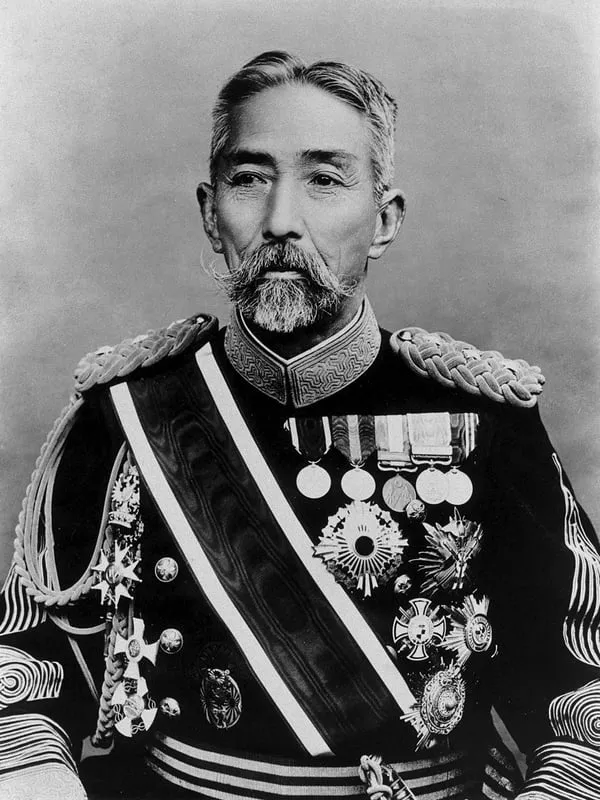
- Born:
- 1841, Kagoshima (Satsuma domain, Japan)
- Died:
- 18 October 1908, Tokyo
- Author:
- Łukasz
- Photo:
- autor nieznany, domena publiczna, Wikimedia Commons

Michitsura Nozu was one of the Satsuma soldiers who built the army of the Meiji era and led it to victory in two wars. In the war with China in 1894–1895 his 5th Division defeated the Chinese at Pyongyang and drove them out of Korea, and then, as commander of the First Army, he brought the campaign in Manchuria to a close. In the war with Russia he commanded the Fourth Army, which held the centre of the Japanese front in the battles of Liaoyang, the Shaho and Mukden. Nozu stayed out of politics, but he left an important successor: his son-in-law, General Yūsaku Uehara, became leader of the Satsuma faction in the army and in 1912, as Army Minister, brought down the government, showing that the military could impose its will on civilian cabinets.
A samurai from Satsuma
He was born in 1841 in Kagoshima, the capital of the Satsuma domain on the island of Kyushu, into a low-ranking samurai family. Sources differ on the exact date. Japanese encyclopaedias give the eleventh month of the twelfth year of the Tenpō era in the lunar calendar, that is, the turn of 1841 and 1842, but they disagree on the day, and some Western studies even give 1840. His elder brother, Shizuo Nozu, also became a general.
The young Nozu learned swordsmanship from Kaneyoshi Yakumaru, a master of a branch of the Jigen-ryū school typical of the Satsuma samurai. In the Boshin War, which overthrew the shogunate in 1868–1869, he commanded a unit of Satsuma troops and followed the whole campaign of the imperial forces, from the Battle of Toba–Fushimi near Kyoto in January 1868, through the fighting in the Aizu region in northern Honshu, to the last engagements at Hakodate on Hokkaido in 1869.
Building the army
In 1871 Nozu became a major in the newly formed Imperial Army, and in 1874 a colonel. In 1876 he travelled to the United States, where he visited the Centennial Exposition in Philadelphia. In 1877, during the Satsuma Rebellion, he was chief of staff of the 2nd Brigade and fought against the rebels of Takamori Saigō, his own countrymen from Kagoshima. In 1878 he was promoted to major general, and in 1884 he accompanied the Army Minister, Iwao Ōyama, on a tour of Europe to study the organisation of European armies. That same year, when Japan created its modern peerage, he was made a viscount. In 1885, by then a lieutenant general, he took command of the Hiroshima military district, which in 1888 became the 5th Division.
War with China
In the summer of 1894 Japanese troops entered Korea, where Chinese troops were already stationed, and the First Sino-Japanese War began. Nozu’s 5th Division was the first large Japanese formation sent to the peninsula. In September, without waiting for the rest of the First Army under General (later Field Marshal) Aritomo Yamagata, Nozu led several columns against Pyongyang, where well over ten thousand Chinese soldiers had dug in. At the Battle of Pyongyang on 15 September the Japanese attacked the city from several sides, and during the night the Chinese abandoned it and fled north, suffering heavy losses in the retreat. The victory cleared Korea of Chinese troops and opened the way for the Japanese to the Yalu and into Manchuria.
In the winter Yamagata, who was ill and at odds with the high command in Tokyo, which criticised his decisions taken without authorisation, was recalled home. On 19 December 1894 Nozu succeeded him in command of the First Army. In early 1895 he conducted operations in southern Manchuria around Haicheng, repelling Chinese attempts to retake the town, and in March his troops defeated the Chinese at the battles of Niuzhuang (PL), Yingkou and Tianzhuangtai, the last major land battles of the war. In March 1895 Nozu was promoted to general, and after the war he was made a count. The Treaty of Shimonoseki gave Japan Taiwan and the Liaodong Peninsula, but under pressure from Russia, France and Germany Japan had to return Liaodong to China. The lands over which Nozu’s troops had fought became a battlefield again ten years later, this time against Russia.
Between the wars
After the war Nozu commanded the Imperial Guard Division, the defence of Tokyo and the Eastern District, and then served as Inspector-General of Military Training, responsible for the training of the entire army. He furthered the career of a young Satsuma officer, Yūsaku Uehara, whom he helped to obtain an engineering education in France and to whom he gave his daughter Makiko in marriage.
The Fourth Army
In May 1904, a few months after the outbreak of the Russo-Japanese War, the 10th Division landed on the Manchurian coast at Dagushan, between the armies of Tamemoto Kuroki and Yasukata Oku. In June a new Fourth Army was formed around it, and Nozu, by then over sixty, took command. The task of Nozu’s army was to fill the gap between the other two and advance on Liaoyang in the centre of the front.
At Liaoyang, from 25 August to 3 September 1904, the Fourth Army attacked the Russian positions from the south alongside Oku’s army, while Kuroki outflanked the Russians from the east. In October on the Shaho river, when Aleksey Kuropatkin struck the Japanese right wing, the troops of Nozu and Oku counter-attacked, outflanked the Russian right wing and forced the Russians to retreat.
At the Battle of Mukden, from 20 February to 10 March 1905, the Fourth Army stood in the centre of the Japanese line, east of the railway. Nozu did not attack frontally; instead he shelled the Russian positions with more than a hundred heavy guns and pinned down the troops facing him, while the armies on the wings, above all the Third Army of Maresuke Nogi in the west, tried to encircle the Russians. Even so, his army lost nearly 17,000 dead and wounded at Mukden. According to Japanese studies Nozu sought to spare his soldiers, and his army came out of the war in the best condition of all. A few months later the war was ended by the Treaty of Portsmouth.
Last years
In January 1906 Nozu received the dignity of field marshal (gensui), and in September 1907 the title of marquis. He sat in the House of Peers. Shortly before his death he received Japan’s highest decoration, the Grand Cordon of the Order of the Chrysanthemum. He died in Tokyo on 18 October 1908 and was buried in Aoyama Cemetery.
The heir: Uehara
Nozu’s most important legacy in Japanese politics proved to be his son-in-law. In December 1912 Yūsaku Uehara, as Army Minister in the second government of Kinmochi Saionji, demanded the creation of two new divisions to garrison annexed Korea. When the government refused on financial grounds, Uehara resigned, submitting his resignation directly to the emperor over the Prime Minister’s head. The army refused to nominate a successor, and since only a serving general could be Army Minister, the whole cabinet had to resign. This precedent showed that the army could bring down any government that opposed it, and in the 1930s it made use of this power many times. Uehara later served as Chief of the General Staff in 1915–1923 and became a field marshal in 1921. The Satsuma faction in the army gathered around him, and according to some historians the later leaders of the radical Imperial Way faction (Kōdō-ha) of the 1930s, Generals Sadao Araki and Jinzaburō Mazaki, came from his circle.
Significance
Nozu was an outstanding field commander of the Meiji era, valued for his skill in manoeuvre and his concern for his soldiers’ lives. His victory at Pyongyang in 1894 ended Chinese influence in Korea, and his Fourth Army helped to drive the Russians out of southern Manchuria in 1904–1905. The two wars gave Japan Korea and a foothold in Manchuria, from which in 1931 it set out to conquer the whole region. Through his son-in-law Nozu was also linked to a process that would weigh heavily on Japan’s fate: the transformation of the army from an instrument of government into an independent political force that took control of the state in the 1930s.