Japan
Maresuke Nogi
Governor-General of Taiwan (1896–1898), commander of the Third Army at Port Arthur and Mukden (1904–1905), head of the Gakushūin school and tutor of Hirohito (1907–1912)
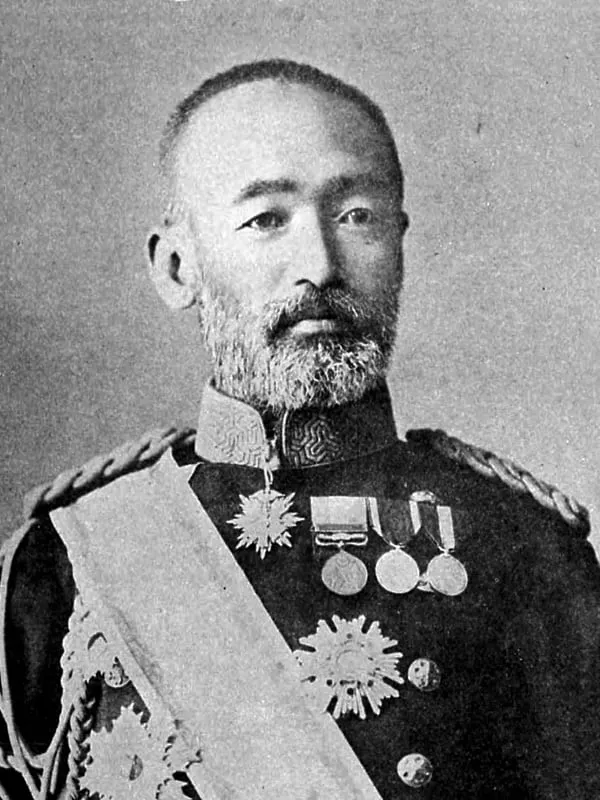
- Born:
- 25 December 1849, Edo (now Tokyo)
- Died:
- 13 September 1912, Tokyo
- Author:
- Łukasz
- Photo:
- 大本営写真班, domena publiczna, Wikimedia Commons

Maresuke Nogi was the general who in 1904–1905 captured the Russian fortress of Port Arthur for Japan, at the cost of tens of thousands of dead and wounded soldiers, both his sons among them. In his lifetime he was regarded as a model of samurai virtue: stern with himself, modest, chivalrous towards a defeated enemy. On 13 September 1912, the day of the funeral of Emperor Meiji (Mutsuhito), he and his wife took their own lives in ritual suicide so as to follow his master into death. The act shook Japan and turned Nogi into a national legend. For the next thirty years schools, the army and propaganda held him up to young Japanese as an example of unconditional self-sacrifice for the emperor, and as a child the future Emperor Hirohito had been his pupil. Military historians today judge him far more harshly, as a commander who at Port Arthur stubbornly sent his infantry against machine guns.
Youth in Chōshū
He was born on 25 December 1849 in Edo, present-day Tokyo, in the residence maintained there by the Chōfu domain, a branch of the powerful Chōshū domain at the western tip of the island of Honshu. He was the son of Maretsugu Nogi, a samurai of modest means. As a child he was sickly and timid, and his father brought him up with great severity. In his early teens the boy moved to Hagi, the capital of Chōshū, where he studied under Bunnoshin Tamaki, a distant relative and the uncle of the famous teacher Shōin Yoshida, and then at the domain school. In 1866, when the shogunate sent a punitive expedition against Chōshū, he fought with the artillery on the Kokura front.
Chōshū, together with Satsuma, led the camp that in 1868–1869 overthrew the shogunate and restored power to the emperor. Men from this domain, led by Aritomo Yamagata, went on to dominate the newly created Imperial Army. Nogi joined it in 1871 and almost immediately, at the age of 22, was made a major – an exceptionally rapid promotion. It was then too that he took the name Maresuke.
The Satsuma Rebellion and the lost colours
In October 1876 the Hagi Rebellion broke out in Chōshū, one of the risings of former samurai against the reforms of the Meiji government. Nogi sided with the government and helped to suppress the parallel rebellion at Akizuki, but his younger brother fought on the rebels’ side and was killed. His old teacher Tamaki, whose pupils had taken part in the rebellion, took responsibility and killed himself.
A year later came the Satsuma Rebellion, the largest and last samurai rising, led by Takamori Saigō. Nogi commanded the 14th Infantry Regiment, which lost its colours in the fighting on Kyushu in February 1877. Regimental colours were presented personally by the emperor and regarded as almost sacred, so their loss was the greatest disgrace that could befall a commander. Nogi afterwards sought death in subsequent fighting and was wounded several times, and in the farewell letter he left before his suicide he named the loss of the colours as one of the faults he had sought to atone for over 35 years.
In 1878 he married Shizuko, the daughter of a doctor from Satsuma, with whom he had two sons, Katsunori and Yasunori. For the next few years in Tokyo he led, as he himself later admitted, the life of a pleasure-loving officer, a habitué of teahouses and geisha houses.
Germany and transformation
In 1887 Nogi went to Germany with General Sōroku Kawakami for a year and a half to study Prussian military organisation. The visit transformed him. He returned in 1888 an ascetic who always wore uniform, ate frugally, shunned amusements and demanded strict discipline and morality from his officers. In a report to the high command he wrote that the strength of an army lay not only in its weapons but above all in its spirit, virtue and sense of duty. This way of life, combined with a cult of the old samurai ideals, became his hallmark.
War with China and Taiwan
In the First Sino-Japanese War of 1894–1895 Major General Nogi commanded the 1st Infantry Brigade in the Second Army of General (later Field Marshal) Iwao Ōyama. His brigade was among the troops that on 21 November 1894 took Port Arthur, the Chinese fortress at the tip of the Liaodong Peninsula, in a single day. After the city fell, Japanese soldiers spent several days killing its inhabitants. Estimates of the victims of the Port Arthur massacre range from several hundred to several thousand, and responsibility for it rests with the whole army command, Nogi included. After the war he was made a baron and promoted to lieutenant general.
Under the Treaty of Shimonoseki Japan received Taiwan. The islanders resisted, and in the autumn of 1895 Nogi, at the head of the 2nd Division, took part in suppressing the resistance in the south of the island. On 14 October 1896 he became the third Governor-General of Taiwan. He took his whole family to the island, and his mother died there of malaria. Nogi had neither a talent for administration nor any taste for politics, and the young Japanese administration of the island was struggling with corrupt officials and armed resistance from the population. At the end of 1897 he asked to be relieved, and in February 1898 he was succeeded by General Gentarō Kodama. He then commanded the 11th Division on the island of Shikoku, and in 1901 he retired from active service and settled on a country estate.
Port Arthur
The war with Russia brought him back into service. On 2 May 1904 Nogi took command of the newly formed Third Army, whose task was to capture Port Arthur – this time a Russian fortress and the base of the Pacific Squadron. In June he was promoted to general. Even before his army landed on the Liaodong Peninsula, his elder son Katsunori, a lieutenant in the Second Army of General Yasukata Oku, was killed on 26 May at the Battle of Jinzhou.
Port Arthur, which Nogi had taken in a day ten years earlier, was now an entirely different fortress. The Russians had surrounded it with a ring of concrete forts, trenches, barbed-wire entanglements and machine-gun positions, and it was defended by a garrison under General Anatoly Stessel, while the soul of the defence was General Roman Kondratenko. The high command in Tokyo pressed for the fortress to be taken quickly, before a Russian relief fleet could arrive from the Baltic. Nogi shared this sense of urgency. The first general assault, on 19–24 August, cost his army well over ten thousand dead and wounded and gained almost nothing. The Japanese turned to a regular siege, digging mines and approach trenches, and heavy 280-millimetre coastal howitzers were brought in from Japan. The next assaults, at the end of October and on 26 November, again ended in slaughter. Indignation grew at home, Nogi received thousands of letters demanding that he resign or kill himself, and the high command talked of recalling him. Emperor Mutsuhito, however, is said to have come to his defence.
The key to the fortress proved to be Hill 203, from whose summit the harbour and the ships lying in it could be seen. The chief of staff of the armies in Manchuria, General Gentarō Kodama, had long believed that the effort should be concentrated there. At the turn of November and December he came to Port Arthur with full powers from Marshal Ōyama, and on 5 December, after ten days of fighting, the Third Army took the hill, losing more than 8,000 men in this one operation. Nogi’s younger son Yasunori was also killed there. How far Kodama actually took over command at that point is disputed. The version popular in Japan, fixed in Ryōtarō Shiba’s novel Saka no ue no kumo, gives him all the credit, but historians point out that contemporary documents do not bear this out. With an observer on the summit, the heavy artillery sank the ships in the harbour within a few days. On 2 January 1905 Stessel surrendered the fortress. According to official figures, the Japanese army lost nearly 58,000 dead and wounded at Port Arthur, and tens of thousands of soldiers fell sick.
On 5 January Nogi met Stessel in the village of Shuishiying. He allowed the Russian officers to keep their swords and permitted the photographer only a single picture, in which both sides stand together, so as not to humiliate the vanquished. This chivalry was reported around the world and enhanced Japan’s international reputation as a state that waged war according to the rules.
Mukden
After the fall of Port Arthur Nogi’s army marched north and joined the main forces of Marshal Ōyama. At the Battle of Mukden, from 20 February to 10 March 1905, the Third Army outflanked the Russian western wing and worked its way into the Russian rear, towards the railway north of the city. The Russian commander, Aleksey Kuropatkin, who overestimated Nogi’s strength, threw reserve after reserve against him, and when he was threatened with encirclement he ordered a retreat. Mukden was the last great land battle of the Russo-Japanese War, which ended a few months later with the Treaty of Portsmouth.
When Nogi returned to Tokyo in January 1906, he refused to take part in celebrations in his honour. While delivering his report on the course of the war to the emperor, he broke down in tears, apologised for the enormous losses at Port Arthur and asked for permission to kill himself. According to tradition the emperor replied that responsibility for the war lay with him, the sovereign, and that Nogi must not die as long as he himself was alive. The general devoted a large part of his fortune to hospitals for the wounded and memorials to the fallen, and at Port Arthur he had a memorial erected to the Russian dead as well. In 1907 he was made a count.
Tutor to Hirohito
In January 1907 the emperor appointed Nogi head of the Gakushūin, the school for children of the aristocracy and the imperial family, with special permission to keep his status as a general on active service. Nogi introduced boarding and a strict, almost military regime at the school, with an emphasis on fencing and modesty, and looked askance at Western novelties. From 1908 his most important pupil attended the school: the seven-year-old Prince Hirohito, the emperor’s grandson. Nogi made him walk to school rather than ride in a carriage and taught him to bear cold and discomfort. The future emperor’s biographers regard him as one of the most important figures of his childhood. Among the pupils of the Gakushūin in those years was also Fumimaro Konoe, the future Prime Minister under whose government war with China broke out in 1937.
In 1911 Nogi and Admiral Heihachirō Tōgō accompanied Prince Higashifushimi to London for the coronation of King George V. In England he was introduced to General Robert Baden-Powell, the defender of Mafeking, and the meeting is remembered as one of the beginnings of scouting in Japan.
Death
Emperor Mutsuhito died on 30 July 1912. On 10 September Nogi saw Hirohito for the last time and gave him books, among them a work by the seventeenth-century thinker Sokō Yamaga on the uniqueness of Japan and its imperial dynasty. The boy was troubled by his tutor’s strange behaviour. On the evening of 13 September, as the cortège bearing the emperor’s coffin left the palace, Nogi and his wife Shizuko took their own lives at their home in the Akasaka district. He cut open his abdomen in accordance with the ritual of seppuku; she pierced her heart with a dagger. The general left letters giving as his reasons his wish to follow his late sovereign, the old disgrace of the lost colours and the burden of the losses at Port Arthur. He also bequeathed his body to science.
Suicide to follow a dead lord, known as junshi, had been banned since the seventeenth century and in modern Japan seemed to belong to another age. Part of the press and the intelligentsia saw it as an anachronism; others saw in it a protest against the materialism and corruption that modernisation had brought. The writer Ōgai Mori, who had known Nogi since their time in Germany, soon afterwards wrote a story about a suicide to follow a lord in the past, and Sōseki Natsume made the general’s death the backdrop to his novel Kokoro. Nogi’s funeral on 18 September drew some 200,000 people onto the streets of Tokyo, according to estimates at the time. He was buried with his wife and sons in Aoyama Cemetery.
The legend
In the following years Nogi became one of the deities of State Shinto. A shrine was built on the site of his house, the street was renamed Nogizaka, and similar shrines were built across the country and in the colonies, including Korea. His figure entered school textbooks, songs and the theatre as the embodiment of bushidō – loyalty, simplicity and readiness to die for the emperor.
In the 1930s this model became a tool of militarism. The army that occupied Manchuria in 1931 after the Mukden incident and attacked China in 1937 trained its soldiers in a cult of fighting spirit that was supposed to overcome the enemy’s material superiority, and in the conviction that death was better than captivity. Port Arthur was presented as proof that will and sacrifice could take even the strongest fortresses, and Nogi’s suicide as the purest expression of devotion to the emperor. The same teaching cost the lives of hundreds of thousands of Japanese soldiers in suicidal charges and last-man defences in 1941–1945.
Significance
Nogi was a tragic figure: a man who lived with a sense of guilt, demanded much of himself and was probably sincere in his cult of the old virtues. As a commander, however, he remains controversial to this day. His defenders point out that the fortress was exceptionally strong, the siege techniques of the time limited and the high command in Tokyo insistent on haste. Critics, such as the Israeli historian Danny Orbach, accuse him of a lack of imagination, neglect of engineering work and obstinacy in repeating frontal assaults even when it was clear that taking Hill 203 would suffice. European observers drew from Port Arthur the conclusion that properly trained fighting spirit would allow infantry to break through modern defences. Ten years later the European armies paid for that lesson on the fronts of the First World War, and the Japanese army went on repeating it until 1945. Nogi’s most enduring legacy thus proved to be not Port Arthur but the myth of sacrificial death for the emperor, instilled in generation after generation – including his most famous pupil, Hirohito.