Japan
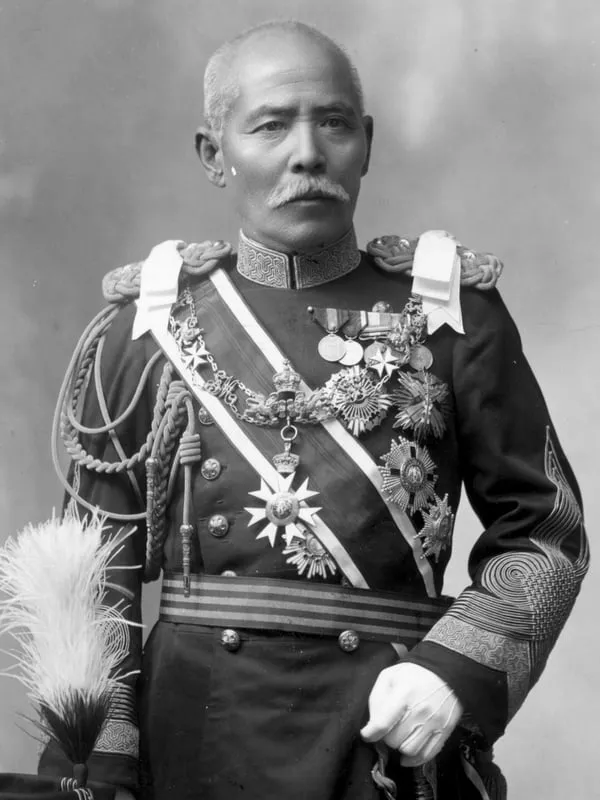
Tamemoto Kuroki
Commander of the 6th Division in the war with China (1894–1895), commander of the First Army in the war with Russia (1904–1905), member of the Privy Council (1917–1923)
- Born:
- 3 May 1844, Kagoshima (Satsuma Domain, Japan)
- Died:
- 3 February 1923, Tokyo
- Author:
- Łukasz
- Photo:
- autor nieznany, domena publiczna, Wikimedia Commons

Tamemoto Kuroki was one of the four army commanders who defeated the Russians in Manchuria in 1904–1905, and the most aggressive of them all. His First Army landed in Korea in the opening days of the Russo-Japanese War, occupied the peninsula and on 1 May 1904, on the border river Yalu, won Japan’s first land victory over the army of a European great power. In the battles that followed at Liaoyang, on the Shaho and at Mukden he pressed against the Russian flank, and the Russians, who feared his bold manoeuvres, nicknamed him “Kurokin”. Kuroki was no politician and had little influence on the course of Japanese policy, but his march through Korea was the first step towards turning the peninsula into a Japanese colony, and his victories strengthened the conviction in Japan that offensive spirit could overcome any enemy.
A samurai from Satsuma
He was born on 3 May 1844 in Kagoshima, in the samurai quarter of Kajiya-chō, which produced many leaders of the Meiji era, among them Takamori Saigō, Marshal Iwao Ōyama and Admiral Heihachirō Tōgō. He was the third son of Chōsa Tameemon, a samurai in the service of the Shimazu lords who ruled the Satsuma Domain, and was adopted into the Kuroki family, whose name he took.
In the Boshin War, which overthrew the shogunate in 1868–1869, he commanded a small unit of Satsuma riflemen. In January 1868 he fought in the Battle of Toba–Fushimi near Kyoto, which opened the war, and in the spring in the assault on Utsunomiya Castle north of Edo.
An officer of the Imperial Army
In 1871 Kuroki joined the new Imperial Army as a captain and was posted to the Imperial Guard. He rose quickly, and in 1875, as a colonel, took command of the 12th Infantry Regiment. In 1877, during the Satsuma Rebellion, he led his regiment against Saigō’s rebels, his own countrymen from Kagoshima. He became a major general in 1885, and in 1893 a lieutenant general and commander of the 6th Division at Kumamoto. He married the adopted daughter of Prime Minister Kiyotaka Kuroda, one of the leaders of the Satsuma faction.
In the First Sino-Japanese War his 6th Division joined General Ōyama’s Second Army in Shandong at the beginning of 1895 and took part in the siege of the naval port of Weihaiwei, where the Chinese Beiyang Fleet surrendered in February. After the war Kuroki was made a baron. He went on to command the Guards Division and the Western District, and in November 1903, as war with Russia drew ever closer, he was promoted to full general.
The Yalu
When war broke out in February 1904, Kuroki took command of the First Army, made up of the Guards Division and the 2nd and 12th Divisions. Its first units landed at the Korean port of Chemulpo as early as 8 February, the day of the attack on Port Arthur, and occupied Seoul. Korea, which had declared its neutrality in January, was forced to sign a protocol allowing the Japanese to use its territory to wage the war. Kuroki’s army marched north through the peninsula and at the end of April reached the Yalu, the river separating Korea from Manchuria.
On the far bank waited the Russian Eastern Detachment of General Mikhail Zasulich, some 25,000 strong. Kuroki had nearly a twofold advantage and prepared the crossing with great care. His engineers built pontoon bridges, while feigned work at other crossing points drew the Russians’ attention and fire. The Japanese had reconnoitred the enemy positions thoroughly and placed their heavy howitzers under concealment. On 30 April and 1 May the First Army crossed the river and in the Battle of the Yalu River routed the Russians, who lost about 2,700 killed, wounded and captured, as well as 21 of the 24 field guns that had taken part in the battle. The Japanese lost about 1,000 men.
The battle itself was not large, but its significance was enormous. It was the first land engagement of the war and the first victory in centuries of an Asian army over the army of a European power. It dispelled the belief, widespread in Russia and in Europe, that the Japanese would be an easy opponent and the war a short one. Foreign military observers were attached to Kuroki’s headquarters, among them the British general Ian Hamilton, whose later published memoirs described the Japanese commander and his army with great admiration. Ten years later Hamilton commanded the Entente forces in the failed Dardanelles operation.
Liaoyang, the Shaho and Mukden
In the summer of 1904 the First Army crossed the mountain passes towards Liaoyang, the main Russian base in southern Manchuria. At Liaoyang, where the battle lasted from 25 August to 3 September, Kuroki formed the right wing of Marshal Ōyama’s forces. While the armies of Yasukata Oku and Michitsura Nozu attacked the Russian positions from the south, Kuroki crossed the Taizi River east of the city with part of his force and threatened the Russian line of retreat to the north. Fierce fighting raged for Manjuyama hill, but Aleksey Kuropatkin, overestimating Kuroki’s strength, concluded that he was in danger of encirclement and on 3 September ordered a retreat to Mukden.
In October Kuropatkin struck on the Shaho River precisely at Kuroki’s right wing, intending to outflank it. Kuroki read the Russians’ intentions correctly and held his ground, and a counter-attack by the other Japanese armies threw the Russians back. In the Battle of Mukden, from 20 February to 10 March 1905, the First Army advanced east of the railway against the troops of General Nikolai Linevich, pinning them down with night attacks and infiltration. Kuroki was so eager to push forward that headquarters several times halted his attacks. In the end the Russians abandoned Mukden. A few months later the war was ended by the Treaty of Portsmouth.
After the war
Kuroki emerged from the war as one of its most famous commanders, known abroad as well. In 1906 he received high Japanese decorations and the British Order of St Michael and St George. In 1907 he visited the United States, where he was received with honours, and in September of that year he was made a count. Unlike Ōyama, Oku and Nozu, however, he was not given the dignity of marshal (gensui), and nor was Maresuke Nogi. Japanese sources explain this in different ways: by his rough and hot-tempered character, which won him few friends in the high command, or by Kuroki’s own dislike of honorary titles. Some authors also see it as a result of the rivalry between the Satsuma and Chōshū factions in the army.
He retired to the reserve in 1909. From 1917 he sat on the Privy Council, which advised the emperor on constitutional matters and treaties. He died of pneumonia following influenza in Tokyo on 3 February 1923, at the age of 78.
Kuroki was remembered as the embodiment of the old daring of the Satsuma samurai. An anecdote went round that when Emperor Meiji (Mutsuhito) jokingly challenged him to a sumo bout, the general threw the sovereign to the ground without a moment’s hesitation.
Significance
Kuroki was a capable and courageous field commander, not a maker of strategy or policy. His importance on the road to the Second World War lies in what his army achieved. The First Army’s march through Korea in 1904 turned a formally neutral kingdom into Japan’s wartime rear base and opened the way to the protectorate of 1905 and the annexation of Korea in 1910. The victory on the Yalu showed the world that Japan was a military power and that its soldiers could beat Europeans. In Japan itself the victories of Kuroki and the other commanders of 1904–1905 became a model to which the army appealed in the 1930s: the conviction that a bold attack and fighting spirit would overcome a more numerous enemy. In 1904 that conviction was borne out. In the war against China and the United States in 1937–1945 it led the Japanese army to catastrophe.