Japan
Yasukata Oku
Commander of the Second Army in the war with Russia (1904–1905), Chief of the General Staff (1906–1912), Field Marshal (gensui, from 1911)
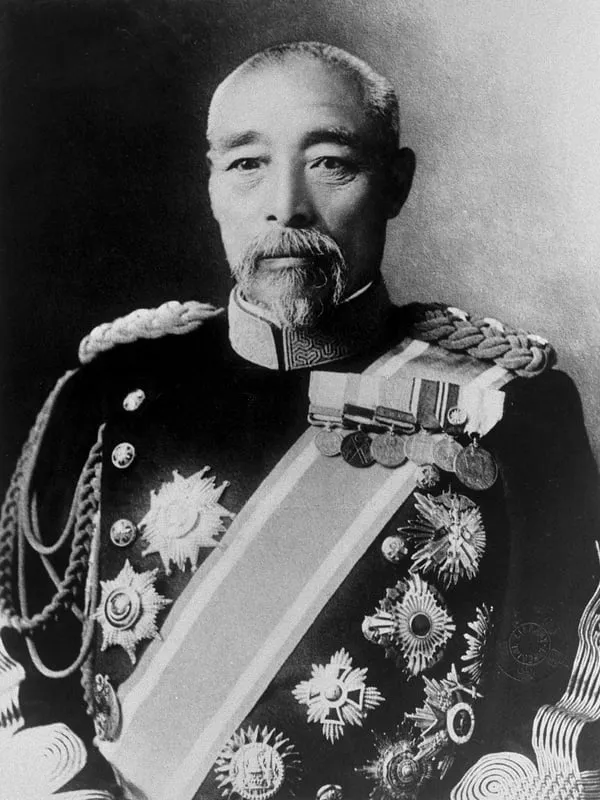
- Born:
- 5 January 1847, Kokura (Kokura Domain, Japan)
- Died:
- 19 July 1930, Tokyo
- Author:
- Natalia
- Photo:
- autor nieznany, domena publiczna, Wikimedia Commons

Yasukata Oku was the least known – and, in the view of some contemporaries, the ablest – of the four generals who commanded Japanese armies in Manchuria in 1904–1905. His Second Army landed on the Liaodong Peninsula, cut Port Arthur off from the rest of Manchuria and fought the bloodiest battles of the campaign, from Jinzhou to Mukden. He was a quiet man, hard of hearing and averse to politics, and the only one of the great commanders of that war who did not come from the victorious Satsuma and Chōshū clans that ruled the Japanese army. Even so, he became the first such officer to be made a field marshal, and for six years he headed the General Staff while Japan was establishing itself in conquered Manchuria and annexing Korea.
A samurai from Kokura
He was born on 5 January 1847 in Kokura, a castle town in Buzen Province at the northern tip of the island of Kyushu, today part of Kitakyushu. He was the son of a samurai in the service of the Ogasawara family, lords of the Kokura Domain, and at the age of fifteen he was adopted as heir to the main line of the Oku family.
In the 1860s the Kokura Domain sided with the shogunate. When in 1866 the shogunate sent a punitive expedition against the rebellious Chōshū Domain on the other side of the strait, Oku fought in the ranks of the Kokura forces, which were defeated, and Kokura Castle burned down. Having come from the losing camp weighed on him throughout his career in an army whose most important posts were held by men from Chōshū and Satsuma.
Career and the samurai revolts
In 1871 Oku joined the new Imperial Army, and three years later he was already a major. In 1874 he was wounded while helping to suppress the Saga Rebellion, and in the autumn of the same year he took part in the punitive expedition to Taiwan, the first overseas military operation of modern Japan.
In 1877, during the Satsuma Rebellion, he commanded a battalion of the 13th Infantry Regiment in Kumamoto Castle, which was besieged by the army of Takamori Saigō. At dawn on 8 April he led his battalion in a sortie that broke the ring of the siege and made contact with the relief force. A bullet pierced his cheek and mouth, but according to accounts he went on commanding, pressing one hand to the wound and holding his sword in the other. The feat made him one of the heroes of the war.
In the years that followed he rose step by step through the command hierarchy. In 1894 he visited Europe. In the First Sino-Japanese War he succeeded General Michitsura Nozu in command of the 5th Division, which fought as part of the First Army in Manchuria. After the war he was made a baron, commanded the Guards Division and the 1st Division, and was commander of the defence of Tokyo; in 1903 he was promoted to full general.
The Second Army
After the outbreak of the Russo-Japanese War, Oku took command of the Second Army, made up initially of the 1st, 3rd and 4th Divisions. On 5 May 1904 his troops began landing on the eastern coast of the Liaodong Peninsula and cut the railway linking Port Arthur with Manchuria. On the isthmus at Jinzhou, the road to the fortress was barred by strong Russian fortifications on Nanshan hill, with trenches, wire entanglements and machine guns. On 26 May the Second Army assaulted them frontally all day long, and in that single day the Japanese artillery fired more shells than in the whole war with China. Only in the evening, when units wading through the sea outflanked the Russian wing, did the defenders withdraw. The Battle of Jinzhou (Nanshan) cost the Japanese, according to various figures, from over 4,000 to over 6,000 killed and wounded. Among the dead was Lieutenant Katsunori Nogi, son of General Maresuke Nogi. A few days later the Japanese took the port of Dalny without a fight.
Leaving the siege of Port Arthur to Nogi’s army, Oku set off north. At the end of May Aleksey Kuropatkin, under pressure from the Viceroy, Yevgeny Alekseyev, sent General Georgy Stackelberg’s corps to relieve the fortress. On 14–15 June, at the Battle of Telissu (Delisi), Oku turned its flank and forced it to retreat. In July he drove the Russians from Dashiqiao and advanced along the railway towards Liaoyang.
At Liaoyang, from 25 August to 3 September, the Second Army attacked the strongest Russian positions from the south along the railway. In October, on the Shaho River, it went over to the counter-offensive and broke through the Russian lines. In January 1905 at Sandepu, which the Japanese called Heikoutai, it repelled the winter offensive of General Oskar Grippenberg’s Russian Second Army. At Mukden it advanced west of the railway, alongside Nogi’s Third Army, which was outflanking the Russian wing, and lost more than 18,000 killed and wounded. On 10 March the Japanese entered Mukden.
Oku was hard of hearing and is said to have communicated with his staff officers in writing. Contemporaries stressed that, unlike the other army commanders, who relied heavily on their chiefs of staff, he planned his operations himself. After the war he refused to talk about them. According to an anecdote, watching the victory celebrations, he merely whispered “Forgive me”, thinking of the soldiers who had fallen.
Chief of the General Staff
After the sudden death of General Gentarō Kodama, Oku became Chief of the General Staff on 30 July 1906 and remained in the post until January 1912. In 1907 he was made a count. These were the years in which Japan was consolidating its new position in Asia. During his tenure, in 1907, the emperor approved the first Imperial National Defence Policy, which named Russia as the army’s principal future enemy and the United States as the navy’s, and set target strengths for both services. In 1910 Japan annexed Korea, and the army demanded new divisions to garrison it. The initiative in these matters, however, lay mainly with Field Marshal Aritomo Yamagata and his associates, and Oku, as his biographers stress, took no interest in politics and avoided disputes with the government.
In October 1911 he was granted the dignity of field marshal (gensui). He was the first marshal who was neither a member of the imperial family nor a native of Satsuma or Chōshū.
Final years
Oku outlived the other army commanders of the war with Russia and for almost twenty years lived quietly in Tokyo as one of the last veterans of the Meiji era. In the mid-1920s Poland decided to honour the Japanese veterans of the war with Russia. The initiative is attributed to Józef Piłsudski, who in 1904 had himself sought Japanese help for the Polish cause in Tokyo. Oku, as one of two Japanese field marshals so honoured, received the Commander’s Cross of the Virtuti Militari, Poland’s highest military decoration, and several dozen Japanese officers received lower classes of the order. They were presented in Japan by Wacław Jędrzejewicz, Polish military attaché in Tokyo from 1926, who recalled the Japanese being surprised that the Poles still remembered their services years later.
Oku died of a cerebral haemorrhage in Tokyo on 19 July 1930, at the age of 83. He was buried in Aoyama Cemetery. He thus did not live to see the Mukden incident, which a little over a year later began the conquest of Manchuria, the land his army had fought over in 1904–1905.
Significance
Oku was the type of commander the Japanese army of the Meiji era needed most: professional, persevering and keeping well away from politics. His career also showed that in an army dominated by men from Chōshū and Satsuma it was possible to rise to the very top on merit. The battles he fought, from Jinzhou to Mukden, gave Japan Port Arthur and the railway in southern Manchuria, which became the foundation of its expansion on the continent. The bloody lesson of Nanshan, where infantry making a frontal assault on machine guns suffered enormous losses yet still won, strengthened the Japanese army’s faith in fighting spirit and in attack at any cost. During his time as Chief of the General Staff the army also began to draw up plans in which Manchuria and Korea were already a permanent part of Japan’s security zone.