- Category:
- Diplomacy
- Date:
- 18 October 1943
- Author:
- Natalia
- Tags:
- Soviet Union, United States, United Kingdom, Poland
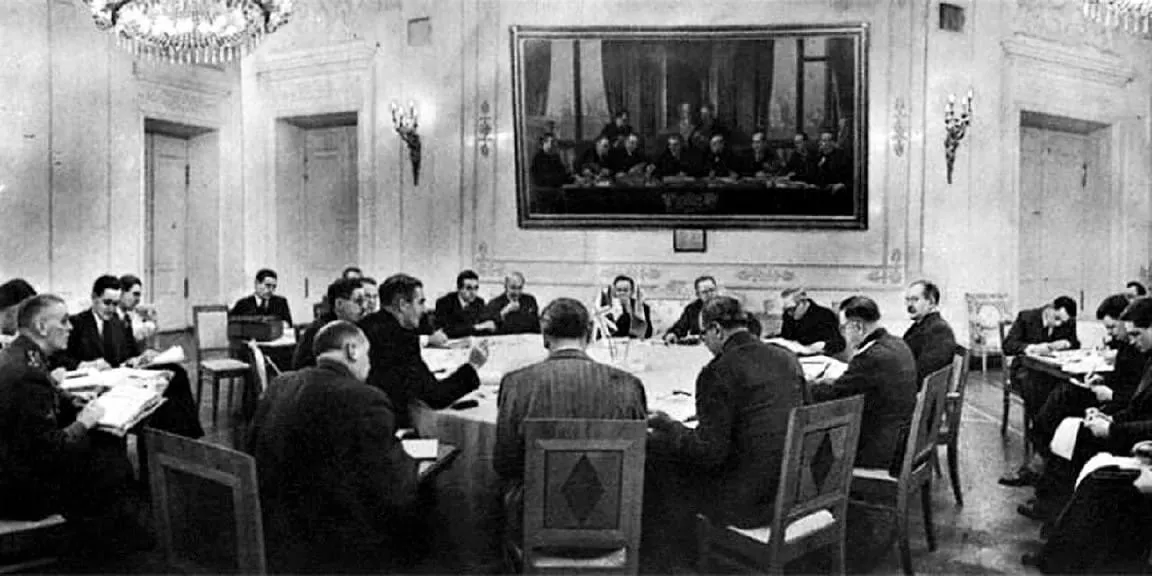
On 18 October 1943 the US Secretary of State, Cordell Hull, and the British Foreign Secretary, Anthony Eden, landed at a Moscow airfield. On the tarmac they were greeted by the People’s Commissar for Foreign Affairs, Vyacheslav Molotov, a guard of honour and a crowd of press photographers. In the evening the two visitors called on Molotov and discussed practical matters: press communiqués, the make-up of the delegations and the time the talks would begin. So opened the Moscow Conference, the first wartime meeting of the foreign ministers of the three great powers of the anti-Hitler coalition. The formal sessions, twelve in twelve days, were held from 19 to 30 October in the grand mansion on Spiridonovka Street where the Soviet foreign commissariat received its guests. The close of the conference was announced in a communiqué published on 1 November.
War chronologies often describe 18 October as the day the conference was “convened”. It was the day the delegations arrived and held a preliminary conversation; the conference proper began the following day. Dates in November given in some accounts as the end of the conference refer to the signing of the protocol (1 November) and to talks held after it had closed.
The road to Moscow
Until the autumn of 1943 the grand coalition had no standing political forum. Winston Churchill and Franklin Delano Roosevelt met many times, but Joseph Stalin took part neither in the Casablanca Conference, nor in the Trident Conference in Washington, nor in the Quebec Conference. He had met Churchill in person only once, in August 1942, when he was told that there would be no second front in France that year. In the spring of 1943 relations with the Western Allies cooled markedly: Stalin sharply demanded an invasion, reacted with great irritation to the suspension of the Arctic convoys, and the recall of his ambassadors from London and Washington, Ivan Maisky and Maxim Litvinov, was read in the West as a sign of displeasure.
The idea of a meeting of foreign ministers came out of Quebec. Churchill and Roosevelt proposed it to Stalin as a step towards a meeting of the leaders, which Stalin was still avoiding on the grounds that he was directing operations at the front. The British preferred London; Stalin demanded Moscow and got his way. Roosevelt considered sending Hull’s deputy, Sumner Welles, whom he rated more highly as a negotiator, but in the end the Secretary of State went himself, since Moscow might have taken his absence as a slight. Hull, who had turned 72 on 2 October, endured a long and exhausting journey by air; on the way he had a brief meeting with Eden in Tehran.
The atmosphere in Moscow in October 1943 was entirely different from a year earlier. After its victory at Kursk the Red Army was pushing towards the Dnieper, and every few days artillery salutes in Moscow announced the recapture of more cities. The USSR received the Western ministers as a power bearing the main burden of the land war and fully conscious of the fact. New uniforms had even been introduced for diplomats for the occasion; Molotov appeared in a black uniform with gold facings, which the American interpreter Charles Bohlen found somewhat comical.
Delegations and agenda
The delegations were led by the ministers. Hull was accompanied by the ambassador in Moscow, Averell Harriman, Major General John R. Deane, the future head of the US military mission in the USSR, and State Department advisers; Eden by the ambassador Archibald Clark Kerr, the diplomat William Strang and General Hastings Ismay, chief of staff to Churchill in his capacity as Minister of Defence. On the Soviet side, Molotov was joined by Marshal Kliment Voroshilov, the deputy people’s commissars Andrey Vyshinsky and Litvinov, and representatives of foreign trade and the General Staff. To his guests’ surprise, Molotov announced that the entire seven-member Soviet delegation would sit at the sessions. At the guests’ suggestion, Molotov chaired the proceedings.
The agenda consisted of more than a dozen items put forward by the three sides. The USSR came with only one, but the one that mattered most to it: “measures to shorten the war against Hitlerite Germany and its allies in Europe”. The Americans brought a draft four-power declaration on general security. The British raised the largest number of issues: the creation of a permanent consultative body, Italy and the Balkans, the attitude towards the French Committee of National Liberation, the treatment of Germany, agreements between the great powers and smaller allies, policy towards Turkey and Iran, and – in two items – Polish-Soviet relations and the future of Poland and of the Danubian and Balkan countries.
The second front, Turkey and Sweden
What interested the Soviet side most was when the Allies would land in France. At the second session, on 20 October, General Ismay, supported by General Deane, set out in detail the preparations for a cross-Channel invasion in 1944: the numbers of divisions and aircraft, the course of the bombing offensive, and the conditions on which the date depended. Molotov and Voroshilov asked businesslike questions, and the next day Molotov tried to obtain an assurance that a landing in the spring of 1944 was a final decision, and to have the Western statements entered in the protocol as a commitment. All he received was a reference to Ismay’s written statement, which tied the date to the weather in the Channel and to the weakening of the German air force in Western Europe. These assurances were recorded in the secret protocol; the public communiqué said in general terms that the three governments regarded hastening the end of the war as their first aim.
Under the same item the Soviet side proposed that the three powers jointly induce Turkey to enter the war without delay, and Sweden to make air bases available to the Allies. Eden agreed that Turkey’s entry into the war would be desirable, Hull was clearly reserved, and both referred the question of bases in Sweden to their governments. No binding decision on these matters was taken before the conference ended.
Molotov also demanded that the USSR be given part of the Italian fleet that had fallen into Allied hands after Italy’s surrender: one battleship, one cruiser, eight destroyers and four submarines, as well as 40,000 tons of merchant shipping. Hull and Eden raised no objection but reserved their final answer. This matter, like the Turkish question, came up again in talks after the sessions had closed.
The Four-Nation Declaration
The conference’s most important achievement was the American initiative that Hull cared about more than anything else: a joint declaration on general security. The governments of the United States, Great Britain, the USSR and China, invoking the Declaration by United Nations of January 1942, undertook to continue the war until the Axis powers laid down their arms on the basis of unconditional surrender, and to cooperate after it had ended as well. In the fourth point they recognised “the necessity of establishing at the earliest practicable date a general international organization, based on the principle of the sovereign equality of all peace-loving states”, open to all such states, “large and small”, for the maintenance of international peace and security. Until it was established, the powers were to consult and act jointly, not to use their armed forces on the territory of other states after the war except for the purposes of the declaration and after joint consultation, and to seek agreement on the regulation of armaments.
The longest dispute concerned China’s participation. The USSR remained neutral towards Japan, and Molotov, although he welcomed the American draft, immediately asked whether it was proper to alter the document in the absence of a Chinese representative, and hinted that signing jointly with the Chinese government might cause the Soviet Union difficulties. Hull stubbornly defended Chinese participation. By his own account, he warned Molotov during a break in the talks that without China the United States would have to make “adjustments” in its Pacific policy. Roosevelt regarded Chiang Kai-shek’s government as the future fourth power of the post-war order. The Soviet side finally gave way. On 30 October the declaration was signed by the three ministers and by the Chinese ambassador in Moscow, Fu Bingchang, who had received full powers from his government just in time.
Hull considered the document one of the most important achievements of his long career. For the first time the USSR had committed itself in writing to taking part in building a general organisation to replace the discredited League of Nations. The ministers decided to begin the preparatory work with a preliminary exchange of views, conducted first in Washington, and also in London and Moscow.
A commission in London, Italy and Austria
The British wanted the Allies to stop settling political questions ad hoc, by telegrams between capitals. Eden proposed a permanent body, and the ministers decided to set up in London the European Advisory Commission, composed of representatives of the three powers. It was to study European problems connected with the end of the war and make recommendations to the governments, above all on the terms of Germany’s surrender and control over it. Matters that could not be settled in Moscow were also referred to it: a plan for the administration of liberated France, policy towards Allied territories recaptured from the Germans, and the details of the occupation of Germany.
The ministers discussed Germany itself on 25 October. According to the protocol, the discussion showed “agreement of views on the main questions”: complete disarmament, occupation, the dissolution of the Nazi Party, reparations and the punishment of the guilty. Hull presented an American plan for Germany’s political decentralisation, Eden spoke of the possibility of detaching Prussia, and Molotov called the partition of Germany a minimum solution, but none of the sides wanted to commit itself to a specific plan. The question of the future Germany’s borders and political system was deferred.
Italy provoked a sharper dispute. Molotov complained that the USSR had no influence on Allied policy in occupied Italy and proposed a declaration, which the conference adopted. Fascism was to be completely destroyed in Italy; representatives of anti-Fascist groups were to be brought into the government of Marshal Pietro Badoglio; freedom of speech, religion, the press and assembly was to be restored; political prisoners were to be released, Fascists removed from the administration, and leaders and generals suspected of war crimes arrested. It was stipulated that as long as military operations continued, the pace of these changes would be decided by the Allied command, and that the Italians would ultimately choose their own form of government – which left open the question of Victor Emmanuel III’s monarchy. The ministers also set up an Advisory Council for Italy, with the three powers and the French Committee of National Liberation, to be joined by the Greeks and Yugoslavs. A few days earlier Italy had declared war on Germany and been recognised by the Allies as a co-belligerent.
A short declaration on Austria called it “the first free country to fall a victim to Hitlerite aggression”. The three powers declared the annexation imposed on it in March 1938, the Anschluss, “null and void” and announced the restoration of a free and independent Austria. The last paragraph, however, reminded Austria that it bore responsibility for taking part in the war on Germany’s side, and that in the final settlement account would be taken of its own contribution to its liberation. After the war the Austrian authorities readily cited the declaration’s first sentence while passing over the last; historians call this the “victim myth”.
The statement on atrocities
The Moscow package also included a statement on German atrocities, issued in the names of Roosevelt, Churchill and Stalin. Churchill wrote the draft, and the Soviet government accepted it on 25 October with a few amendments. The text stated that the retreating “Hitlerites” were desperately redoubling their cruelties, as shown by the crimes committed in the liberated territories of the USSR, in France and in Italy. The three powers, speaking “on behalf of the thirty-two United Nations”, declared that when an armistice was granted to any German government, the officers, soldiers and members of the Nazi Party responsible for atrocities would be sent back to the countries in which they had committed them, to be tried there under local law. Lists of perpetrators were to be compiled in all the occupied countries, with particular attention to the USSR, Poland and Czechoslovakia. The perpetrators were to know that the Allies would pursue them “to the uttermost ends of the earth”. The major criminals, whose offences had no particular geographical location, were to be punished separately by joint decision of the Allies.
The statement developed the pledge made in the St James’s Declaration of January 1942, signed by the governments of nine occupied countries, Poland among them. This time the commitment was assumed by the three great powers. One phrase sounded particularly bitter to Polish ears. Among the examples of atrocities it listed “the wholesale shooting of Polish officers”. Six months earlier the Germans had announced the discovery of the graves at Katyn, containing officers murdered by the NKVD in 1940. Moscow attributed the crime to the Germans, and the Western Allies did not publicly dispute this. Churchill’s wording, accepted without objection by the Soviet side, could be read as an allusion to Katyn in the version convenient to the USSR.
The Polish question
For the Polish government in London the conference was a test of whether the Western Allies would be willing to stand up for it. Since the USSR had broken off relations with the Polish government in April 1943, after it asked the International Red Cross to investigate the graves discovered in the Katyn Forest, the situation had only grown worse. After the death of General Władysław Sikorski, Stanisław Mikołajczyk had become prime minister and General Kazimierz Sosnkowski, whom Moscow regarded as an implacable enemy, Commander-in-Chief. The Red Army was approaching Poland’s pre-war border, while in Moscow the Union of Polish Patriots was already active and a Polish army subordinate to Stalin was being formed. Mikołajczyk’s government pressed the British and Americans to secure the restoration of relations before the Red Army entered Polish territory, and an agreement on cooperation with the Home Army.
Hull did not want to become involved in territorial disputes and in practice left the Polish question to Eden. Eden raised it at the penultimate session, on 29 October. According to research by the historian Derek Watson, based on British and Soviet records, he expressed regret that the USSR had no relations with the Polish government and asked about aid to the Polish underground. Molotov replied sharply: weapons could be given only to reliable hands, and there were none in Poland. Polish-Soviet relations were above all a matter for the two neighbours. The USSR wanted an independent Poland, but with a government friendly to the Soviet Union, and the present government-in-exile, in which Sosnkowski played an important part, did not qualify as such. Further pressure from Eden and Hull achieved nothing. The protocol merely recorded that “an exchange of views took place” on Polish-Soviet relations.
The discussion of future federations, held on 26 October, ended just as badly for Poland. The British favoured plans for unions of Central and Eastern European states, such as the Polish-Czechoslovak confederation discussed in 1940–1942 by Sikorski and Edvard Beneš. Molotov rejected them, arguing that they might become a new “cordon sanitaire” directed against the USSR. He also rejected Eden’s proposal of a mutual undertaking by the great powers not to conclude separate post-war agreements with smaller allies. Eden stated in return that he had no objection to the planned Soviet-Czechoslovak treaty.
A promise at a banquet
The final session took place on 30 October. That evening Stalin gave a banquet in the Kremlin for the conference participants. According to Hull’s memoirs, the Soviet leader told him confidentially then, with instructions to pass it on to Roosevelt, that once Germany was defeated the USSR would enter the war against Japan. Hull regarded this as an unexpected and generous gesture, made without any conditions. Bohlen, who interpreted the conversation, later observed that the fact that Stalin had named no conditions by no means meant that he had none. At the table Molotov answered Harriman’s toast to a common fight against Japan with the words: “Why not? With pleasure – the time will come.”
Stalin also agreed in principle to a meeting with Roosevelt and Churchill, although he still refused to travel further than Tehran, citing the need to direct operations at the front. The final communiqué and the declarations were published on 1 November, the same day on which the ministers signed the conference’s secret protocol.
Significance
The Moscow Conference opened the best period in the grand coalition’s relations. From Moscow the road led directly to the Tehran Conference (28 November – 1 December 1943), the first meeting of Stalin, Roosevelt and Churchill. On his return to Washington, Hull assured Congress that the new organisation would make spheres of influence, alliances and the balance of power unnecessary. That faith proved illusory, but the Four-Nation Declaration did indeed set off a path that led through the Dumbarton Oaks Conference in 1944 to the founding of the United Nations in 1945. For this Hull received the Nobel Peace Prize in 1945. The European Advisory Commission first met in January 1944 and drew up, among other things, the terms of Germany’s surrender and the boundaries of the occupation zones.
The statement on atrocities became one of the foundations of the post-war reckoning. The promise that the major criminals would be punished by joint decision of the Allies gave rise to the International Military Tribunal at Nuremberg and the Nuremberg trials. The principle of returning perpetrators to the scene of their crimes allowed, among others, the commandant of Auschwitz, Rudolf Höss, to be tried in Poland. Austria regained its independence in 1945 and full sovereignty in 1955.
For Poland the conference was a warning. The Western Allies had shown that they would not risk unity with the USSR for the sake of the London government, and Molotov had set out the programme to which Moscow held until the end of the war: Poland was to have a government “friendly” to the Soviet Union, and its shape and borders would in practice be decided by the two neighbours – that is, in reality, by the USSR. At Tehran Churchill and Roosevelt, without the Poles taking part, accepted the Soviet position on Poland’s eastern border, based approximately on the Curzon Line. The promise made to Hull at the banquet of 30 October was fulfilled in August 1945, when the USSR declared war on Japan – at the price of concessions that Roosevelt agreed to pay at Yalta.
Sources
Meanwhile
(04)Elsewhere, within a week.
- 14 October 1943 · Western FrontBlack Thursday over SchweinfurtOn 14 October 1943, 291 American B-17s again struck the ball-bearing plants at Schweinfurt. Sixty bombers failed to return and some 600 airmen were missing.
- 22 October 1943 · Western FrontThe raid on KasselOn the night of 22–23 October 1943, 569 RAF bombers attacked Kassel. A firestorm consumed the old town; sources put the dead at 6,000–10,000.
- 13 October 1943 · MediterraneanItaly declares war on GermanyOn 13 October 1943 Badoglio's government in Brindisi declared war on Germany. The Allies recognised Italy as a co-belligerent, but not as an ally.
- 23 October 1943 · AtlanticThe sinking of HMS CharybdisOn 23 October 1943 German torpedo boats sank the cruiser HMS Charybdis and the destroyer Limbourne off Brittany. More than 500 British servicemen died.
Related events
(04)The same battle, people or subject.
- 28 November 1943 · DiplomacyThe Tehran ConferenceOn 28 November 1943 Stalin, Roosevelt and Churchill met in Tehran. They decided to invade France in May 1944 and discussed Poland without its government.
- 19 August 1943 · DiplomacyThe Quebec Conference and the Quebec AgreementOn 19 August 1943 in Quebec Churchill and Roosevelt signed a secret agreement on jointly building the atomic bomb. The conference also confirmed Overlord.
- 4 January 1944 · Eastern FrontThe Red Army crosses the pre-war Polish borderOn the night of 3–4 January 1944 troops of the 1st Ukrainian Front crossed the pre-war Polish border near Rokitno in Volhynia.
- 25 April 1943 · PolandUSSR breaks relations with the Polish governmentOn the night of 25-26 April 1943 Molotov read Ambassador Romer a note breaking relations with the Polish government. The pretext was an appeal to the Red Cross.