Germany
Martin Bormann
Chief of staff to the Deputy Führer (1933–1941), head of the NSDAP Party Chancellery (1941–1945), Secretary to the Führer (1943–1945), Party Minister (1945)
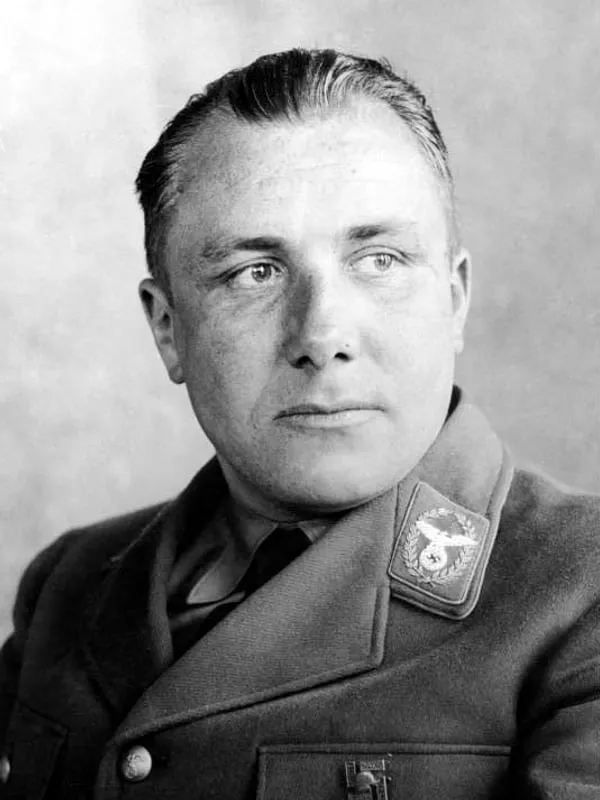
- Born:
- 17 June 1900, Wegeleben (Province of Saxony, German Empire)
- Died:
- 2 May 1945, Berlin
- Author:
- Natalia
- Photo:
- autor nieznany, CC BY-SA 3.0 DE, Wikimedia Commons

Martin Bormann was a man whose face few Germans outside the narrow circle of power would have recognised, yet in the last years of the war he was one of the most powerful men in the Third Reich. He was neither an orator nor an ideologue, and he commanded neither an army nor a police force. His strength lay in administration: as chief of staff to Rudolf Hess, from 1941 head of the Party Chancellery and from 1943 also the Führer’s official secretary, he decided who reached Adolf Hitler and with what, passed on Hitler’s verbal instructions and forged them into decrees. He was at the same time one of the regime’s most radical functionaries – an enemy of the Churches and an advocate of a ruthless policy towards the Jews, the Poles and the other peoples of the conquered East. He died on 2 May 1945 while trying to escape from besieged Berlin, but his body was not found until 1972 – in the meantime the Nuremberg Tribunal had sentenced him to death in absentia.
Wegeleben, the army and an estate in Mecklenburg
Martin Ludwig Bormann was born on 17 June 1900 in Wegeleben, a small town in the Prussian Province of Saxony. He was the son of Theodor Bormann, a post office official and former military bandsman, and his second wife, Antonie Bernhardine, née Mennong. His father died in 1903, when Martin was three; his mother soon remarried, to a banker. Of his siblings, the one who survived to adulthood was his younger brother Albert (1902–1989), who also made a career in Hitler’s entourage, in his private chancellery – though the brothers were at odds.
Bormann did not finish grammar school; he attended an agricultural college. In June 1918 he was called up as a gunner in the 55th Field Artillery Regiment, but he never reached the front, serving on garrison duty until February 1919. After a short spell working at a feed mill he became the manager of a large agricultural estate in Mecklenburg, near Parchim. In the years of inflation many estates were guarded by bands of former soldiers from the Freikorps (PL). Bormann joined an antisemitic landowners’ association and in 1922 Gerhard Roßbach’s Freikorps, in which he was a section leader and treasurer.
The Parchim murder
In this milieu he met Rudolf Höss, later commandant of Auschwitz. On the night of 31 May/1 June 1923 a group of Roßbach’s men, Höss and Bormann among them, drove Walther Kadow, a young teacher working on the estate, out of town, where they beat him savagely and murdered him. The perpetrators accused Kadow of embezzlement and, according to some accounts, also of having betrayed to the French occupation authorities in the Ruhr the saboteur Albert Leo Schlageter, whom the French had shot on 26 May 1923.
In March 1924 the State Court for the Protection of the Republic in Leipzig sentenced Höss, as one of the principal perpetrators, to ten years’ penal servitude, and Bormann, as an accessory, to one year in prison. Bormann was released in February 1925. It was a “Feme murder” (Fememord) typical of the early Weimar Republic – a vigilante killing of a supposed traitor by the far right, which in the National Socialist movement was regarded as a badge of merit rather than a stain.
Party official
After his release Bormann joined the Frontbann, an organisation that stood in for the SA, banned after the Beer Hall Putsch, and in 1927 the NSDAP (membership number 60,508). In Thuringia he was press officer and then business manager of the party district (Gau). In October 1928 he moved to Munich, where he worked on the staff of the SA Supreme Command and in its insurance fund. In 1930 he set up the party’s relief fund (Hilfskasse der NSDAP), which paid compensation to members wounded or killed in street fights. In practice the payments depended on him, and many activists felt indebted to him.
On 2 September 1929 he married nineteen-year-old Gerda Buch, daughter of Major Walter Buch, chairman of the party court (USchlA). Hitler and Hess were witnesses at the wedding. The couple had ten children; the eldest son, Martin Adolf (born 1930), was Hitler’s godson.
Hess’s chief of staff and steward of the Obersalzberg
After Hitler came to power, on 1 July 1933 Bormann became chief of staff in the office of the Deputy Führer, Rudolf Hess, and his personal secretary. On 10 October 1933 Hitler appointed him a Reichsleiter, a member of the party’s top leadership, and in November he entered the Reichstag. Hess’s office settled disputes within the party, gave opinions on draft legislation and had a say in appointments to the civil service; Bormann built up a bureaucracy within it that allowed him to meddle in almost everything, and he came into conflict with the Interior Minister, Wilhelm Frick, and other dignitaries.
Even more important was the fact that Hitler entrusted him with his private affairs. From 1935 Bormann oversaw the rebuilding of the Berghof on the Obersalzberg: he bought up the surrounding farms, built barracks, roads and houses for the dignitaries, and for Hitler’s 50th birthday had the so-called Eagle’s Nest built on the summit of the Kehlstein. He also managed the Führer’s private finances, including the Adolf Hitler Fund (Adolf-Hitler-Spende), to which industrialists contributed. He was constantly at Hitler’s side, noting down his instructions and deciding who would be received. It was also on his initiative that Hitler’s monologues at table were recorded; they were published after the war as the Table Talk. In 1937 he joined the SS, where he was given an honorary low membership number and rose to the rank of Obergruppenführer, but in practice he was never subordinate to Heinrich Himmler – he was rather his rival.
Head of the Party Chancellery
During the war Hess, sidelined from foreign policy and military command, lost importance, and his duties were increasingly taken over by Bormann, who accompanied the Führer at his field headquarters, including the Wolf’s Lair. After Hess’s solo flight to Scotland on 10 May 1941, Hitler abolished the post of Deputy Führer and on 12 May entrusted his office, renamed the Party Chancellery (Parteikanzlei), to Bormann; on 29 May Bormann was given the powers of a Reich minister. From then on he ran the entire NSDAP apparatus, appointing and controlling the Gauleiters, and from 1942, when they were made Reich Defence Commissioners, he gained influence through them over the civil administration in the districts.
Hitler deliberately divided responsibilities and fostered rivalry among his subordinates. He often gave his instructions verbally or through Bormann, and anyone who fell out with Bormann lost access to the Führer. In this way Bormann was able to curb the influence of Hermann Göring, Joseph Goebbels, Himmler, Alfred Rosenberg, Hans Frank and Albert Speer, most of whom hated him. In January 1943, together with the head of the Reich Chancellery, Hans Lammers, and Field Marshal Wilhelm Keitel, he joined the so-called Committee of Three, which was to mobilise the last reserves of manpower through compulsory labour service; the committee soon lost its importance, but Bormann’s position did not. On 12 April 1943 Hitler officially appointed him “Secretary to the Führer”, which entitled him to act in Hitler’s name in any matter.
Against the Churches, the Jews and the Slavs
Bormann was a declared enemy of Christianity. In June 1941 he sent the Gauleiters a confidential circular stating that National Socialism and Christianity were irreconcilable and that the influence of the Churches had to be broken. When in the summer of 1941 the Bishop of Münster, Clemens August von Galen, condemned in his sermons the confiscation of monasteries and the killing of the mentally ill, men in Bormann’s circle demanded his arrest and even his execution; Hitler, however, postponed the reckoning and halted the open phase of Aktion T4.
On racial policy Bormann – historians agree – almost always argued for the most radical solutions. It was he who wrote the note of a meeting with Hitler on 2 October 1940 which recorded that the General Government was to be a reservoir of cheap labour and that the Polish intelligentsia was to be liquidated. He pressed for a separate, draconian criminal law for Poles and Jews in the annexed territories, introduced by the decree of 4 December 1941, which provided for the death penalty even for minor offences. In July 1942, after a visit to the area around Vinnytsia in Ukraine, he passed on to Rosenberg guidelines according to which the Slavs were to work for the Germans, while their reproduction, education and health care were “undesirable”.
The Party Chancellery helped to draft the anti-Jewish legislation that built on the Nuremberg Laws, and its representative, Gerhard Klopfer, attended the Wannsee Conference, at which the organisation of the “Final Solution” was agreed in January 1942. On 9 October 1942 Bormann sent out a confidential circular on the “solution of the Jewish question” in which – responding to rumours about the fate of the Jews in the East – he wrote that the problem could no longer be solved by emigration, but only “by the application of ruthless severity” in camps in the East. He was one of the signatories of the decree of 1 July 1943 which placed the Jews of the Reich exclusively under the authority of the police.
He took an equally radical line in the last year of the war. In May 1944, when Goebbels was publicly justifying lynchings of downed Allied airmen, Bormann ordered in a confidential circular that Germans taking part in such lynchings should not be prosecuted. After the 20 July plot the party took over more and more of the functions of the state, and in the autumn of 1944 Bormann and Himmler jointly organised the Volkssturm – a levy of men aged 16 to 60, organised along party lines and commanded by the Gauleiters. From February to April 1945 Bormann also recorded Hitler’s last monologues, published after the war as the so-called Bormann dictations; historians question their authenticity and the extent of his editing.
In the bunker
On 16 January 1945 Hitler moved his headquarters to Berlin, to the shelter beneath the garden of the Reich Chancellery; Bormann was with him the whole time. When the Berlin operation began on 16 April and, after Hitler’s last birthday, one dignitary after another left the city, he remained in the bunker. He was present at Hitler’s breakdown on 22 April, and the next day he played the leading role in the downfall of his long-standing rival: he presented Göring’s telegram, which asked whether Göring should take over power, as an ultimatum and an attempted coup, and then ordered the SS to arrest the Reichsmarschall on the Obersalzberg. On 28 April, after the news of Himmler’s negotiations with the West, Hitler expelled the Reichsführer-SS from the party as well and ordered his arrest.
On the night of 28/29 April Bormann was a witness at Hitler’s wedding to Eva Braun and signed his will as a witness. In it Hitler called him his “most loyal party comrade”, made him executor of his private will and, in the government to be headed by Karl Dönitz as Reich President and Goebbels as Chancellor, appointed him “Party Minister”. After Hitler’s suicide on 30 April, Bormann informed Dönitz that he had been named as successor, without mentioning that Hitler was dead. On 1 May Goebbels and Bormann sent General Hans Krebs to Chuikov with a proposal for a ceasefire, but rejected the Soviet demand for unconditional surrender. That evening the Goebbelses took their own lives, having first killed their children.
Escape and death
Bormann had no intention of dying in the bunker: he wanted to reach Dönitz with a copy of the will and take up the office entrusted to him. At around 11 p.m. on 1 May he set out with one of the breakout groups, together with the Hitler Youth leader Artur Axmann, the SS doctor Ludwig Stumpfegger, Werner Naumann and Hitler’s pilot Hans Baur. They went through a U-Bahn tunnel to Friedrichstraße station; they managed to cross the Weidendammer Bridge over the Spree, sheltering behind a tank that was hit, only at the third attempt, at around 1 a.m. on 2 May.
Bormann, Stumpfegger and Axmann continued along the railway tracks towards the Lehrter Bahnhof, where Axmann split from the other two. When he ran into a Soviet patrol he turned back and – as he later testified – on the bridge by Invalidenstraße he saw two bodies, which he recognised as those of Bormann and Stumpfegger. No one witnessed their deaths; examination of the remains found years later showed that both had most probably bitten into cyanide capsules when they realised that they could not break out of the encirclement. The date of death is taken to be 2 May 1945. On the morning of that same day General Helmuth Weidling surrendered Berlin.
Bormann’s family survived the war. After the air raid of 25 April 1945 Gerda fled with the children from the Obersalzberg to South Tyrol; she died of cancer on 23 March 1946 in Merano. The eldest son, Martin Adolf, became a Catholic priest and missionary in Africa, and later spoke publicly for many years about his father’s crimes.
The verdict in absentia at Nuremberg
Since no body had been found and Axmann’s account was for a long time the only evidence of Bormann’s death, the International Military Tribunal at Nuremberg (PL) tried him in absentia, together with Göring, Dönitz, Keitel, Alfred Jodl and other leaders of the Reich, on charges of conspiracy against peace, war crimes and crimes against humanity. His court-appointed counsel, Friedrich Bergold, argued in vain that the defendant was dead. On 1 October 1946 the Tribunal acquitted Bormann of conspiracy, found him guilty on the other charges and sentenced him to death by hanging, with the proviso that if he were captured he could present new facts.
The legend and the discovery of his remains
The absence of a body made Bormann the subject of one of the most persistent post-war legends. He was supposedly sighted in South America and in Europe; Simon Wiesenthal believed he was hiding in South America, and the former head of West German intelligence, Reinhard Gehlen, claimed in his memoirs that Bormann had been a Soviet agent and had fled to Moscow. In 1964 the West German government offered a reward of 100,000 marks for information about him. In 1963 a former post office worker testified that around 8 May 1945, on Soviet orders, he had buried two bodies from beneath the bridge near the Lehrter Bahnhof, but excavations in 1965 found nothing.
On 7 December 1972, however, construction workers came across two skeletons a dozen or so metres from the spot indicated. Fragments of glass from poison capsules were found in the jaws of both. The remains were identified as those of Bormann and Stumpfegger on the basis of, among other things, a dental chart reconstructed from memory in 1945 by Hitler’s dentist, Hugo Blaschke, and a comparison of the skulls with photographs. In 1973 the West German authorities officially declared Bormann to have died in Berlin on 2 May 1945. The last doubts were dispelled in 1998 by a DNA test of the skull, compared with genetic material from a relative. In 1999 the remains were cremated and the ashes scattered over the Baltic, so that the grave would not become a place of pilgrimage for neo-Nazis.
Significance
Bormann is an example of power that had no need of publicity. In a state governed by verbal orders, in which the responsibilities of offices deliberately overlapped, the man who controlled access to the leader could gain more than ministers and field marshals, and Bormann exploited this without scruple. His biography brings together the regime’s different faces: the violence of the Freikorps militias, the party bureaucracy, the struggle against the Churches and shared responsibility for the extermination of the Jews and the oppression of the Poles and the other peoples of the East. The resolution of the mystery of his death after more than half a century closed one of the last riddles of the fall of the Third Reich.
Sources
Mentioned in battles
(01)Often appears with
People who appear in the same events.
On the timeline
(19)1941
1942
1943
1944
1945
April
May
- 02
- Key eventThe surrender of BerlinOn 2 May 1945 General Helmuth Weidling surrendered Berlin to General Chuikov and ordered the garrison to lay down arms. Krebs's talks the day before had failed.
- The breakout from the bunkerOn the night of 1–2 May 1945 the occupants of Hitler's bunker tried to break out of Berlin. Krebs and Burgdorf shot themselves; Bormann died while fleeing.