Poland
Tadeusz Rozwadowski
Chief of the General Staff of the Polish Army (1918 and 1920–1921), commander of the East Army (1918–1919), head of the Polish military mission in Paris (1919–1920), lieutenant general
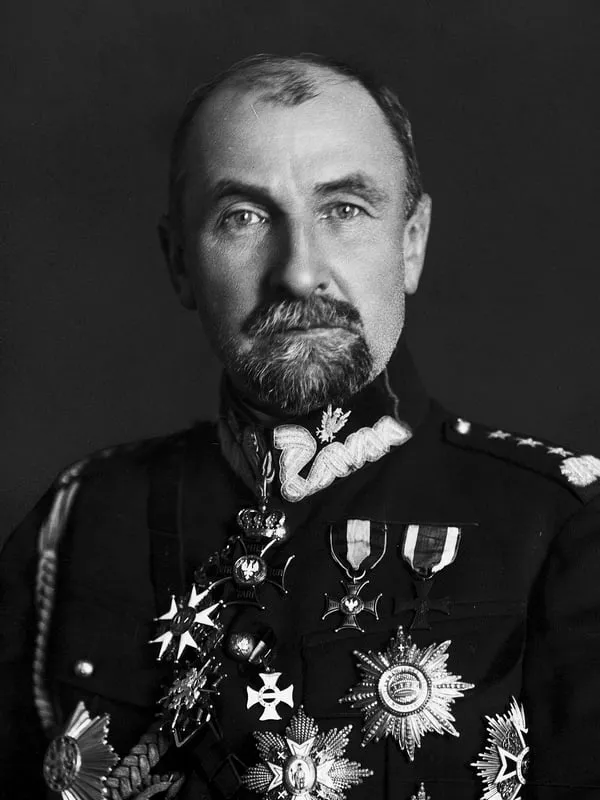
- Born:
- 19 May 1866, Babin near Kałusz (Austrian Empire)
- Died:
- 18 October 1928, Warsaw
- Author:
- Łukasz
- Photo:
- autor nieznany, domena publiczna, Wikimedia Commons

Tadeusz Jordan-Rozwadowski was one of the ablest officers that reborn Poland inherited from the Austro-Hungarian army, and one of the most forgotten architects of its victories. In 1915 his artillery helped to break the Russian front at Gorlice. In the autumn of 1918 he became the first Chief of the General Staff of the Polish Army; he then directed the defence of Lwów against the Ukrainians, and in July 1920, in the darkest days of the Polish–Soviet War, he returned as Chief of Staff and, at the side of Józef Piłsudski, prepared the Battle of Warsaw. The dispute over how much of the credit for the victory of August 1920 is his continues to this day. In May 1926 he commanded the defence of the lawful government against Piłsudski’s coup, for which he spent a year in prison. He died soon after his release, and for years the ruling camp erased his name from the history of the war he had helped to win.
From a line of soldiers
He was born on 19 May 1866 at Babin near Kałusz, in Eastern Galicia, into a family of counts with strong military and patriotic traditions. One ancestor fought in the Kościuszko Uprising and his grandfather in the November Uprising, while his father, Tomisław, commanded a cavalry unit in the January Uprising and later sat in the Galician Diet and in the parliament in Vienna. The family used the by-name Jordan, which, according to tradition, commemorated an ancestor who was the first Pole to set eyes on the River Jordan during a crusade.
Rozwadowski chose a career in the Austro-Hungarian army. He was educated at the cadet school at Hranice in Moravia, from 1882 to 1886 at the Military Technical Academy in Vienna, from which he graduated as a second lieutenant of artillery, and then at the War School, the training ground of Austrian staff officers. From 1896 he spent several years as the Austro-Hungarian military attaché in Bucharest. There he built up a wide circle of acquaintances among the Romanian elite, which later proved useful to Poland. He then commanded a field artillery regiment, and in 1913 he became a Generalmajor.
Gorlice and dismissal
At the start of the Great War he took command of the 12th Artillery Brigade in the Kraków-based 12th Infantry Division and fought the Russians in Galicia. In May 1915, by then a divisional commander, he took part in the breakthrough at Gorlice, in which the German and Austro-Hungarian armies shattered the Russian front. Artillery played a decisive role in that operation, and Rozwadowski is credited with devising a barrage of fire moving ahead of the advancing infantry, known as the “rolling barrage” (Feuerwalze). For his services in the first years of the war he received the Knight’s Cross of the Military Order of Maria Theresa, Austria’s highest military decoration, which was ceremonially presented to him in August 1918.
In November 1915 he was promoted to Feldmarschalleutnant, but a dozen or so days later he was placed on the inactive list, and in February 1916 he formally left the service. Officially this was on grounds of health; according to his Polish biographers, the real reason was conflict with his superiors, among other things over his defence of the local population against reprisals. He devoted his free time to the Polish cause. He formed ties with politicians in Kraków and Warsaw and prepared himself for the role he was to play in a future Polish army.
The first Chief of Staff
At the end of October 1918, as Austria-Hungary was falling apart, the Regency Council appointed him Chief of the General Staff of the Polish Army then being formed. Within a few weeks he laid the foundations of the central military institutions and ordered units to be organised in Galicia. One of the officers who raised troops there on his orders was Władysław Sikorski. After Piłsudski returned from Magdeburg, the two men quickly fell out. Rozwadowski wanted to build the army on conscription; Piłsudski relied on volunteers and on men from the Legions and the Polish Military Organisation (POW). On 15 November Rozwadowski stepped down.
He was given a new task at once. Since 1 November, Poles had been fighting Ukrainians in Lwów (Lviv), where the Ukrainians had proclaimed their own state. Rozwadowski took command of the East Army, arrived in the city just after the Ukrainian units had been driven out of it, and for almost four months directed the defence of Lwów, which was surrounded on nearly all sides by the Ukrainian Galician Army. He set up a fund to help the widows and orphans of the fallen defenders. In March 1919 he handed over command.
Paris
From the spring of 1919 Rozwadowski headed the Polish military mission in Paris and worked alongside the delegation to the peace conference. He lobbied the Allies for weapons, equipment and credits for an army that had been fighting the Red Army since February 1919. He helped to recruit the American volunteers who formed the Kościuszko Squadron, and took part in the military talks with Romania that led to the Polish–Romanian defensive alliance of 1921. In July 1920, when Poland asked the Great Powers for help at the conference at Spa, he sharply opposed the terms the Allies imposed on it.
The Battle of Warsaw
On 22 July 1920, as the Red Army marched on Warsaw, Piłsudski recalled him to the post of Chief of the General Staff. Rozwadowski also joined the State Defence Council. The French general Maxime Weygand, who had arrived with the Allied mission, attached himself to the staff, but his proposals, which were essentially defensive, were not adopted. Rozwadowski was a man of extraordinary energy who inspired confidence: he moved about the headquarters, talked to commanders and put heart into those who had lost it. On the night of 5/6 August, at the Belweder, the decision was taken to concentrate forces on the Wieprz river and strike at the flank of Mikhail Tukhachevsky’s armies. The operational order to that effect, issued on 6 August, was signed by Rozwadowski as Chief of Staff, and over the following days his orders reinforced Sikorski’s 5th Army, which was to defend the capital from the north.
Whose work the plan of the Battle of Warsaw was became a matter of dispute from the first days after the victory. Piłsudski’s supporters credited it solely to the Marshal; his political opponents, especially in the National Democratic camp, credited it to Weygand or to Rozwadowski. According to historians who have studied his papers, Rozwadowski had considered a similar solution but loyally carried out the decisions of the Commander-in-Chief. The most widely accepted view today is that the concept of the counter-stroke from the Wieprz was worked out jointly, that the final decision was Piłsudski’s, and that Rozwadowski played a key part in preparing it and in directing the defence of Warsaw while Piłsudski was with the strike group on the Wieprz. For his part in the war he was awarded the Virtuti Militari.
Inspector of Cavalry
After the war Rozwadowski remained Chief of the General Staff until 1921 and then became Inspector General of Cavalry. He reformed the Polish cavalry, which he saw not as a relic but as a fast force capable of independent action, supported by artillery, armoured cars, tanks and aircraft. In 1921 he was promoted to lieutenant general (generał broni). Among those who served on his staff at that time was Władysław Anders, later commander of the Polish II Corps.
May 1926
On 12 May 1926 Piłsudski led the troops loyal to him on Warsaw. President Stanisław Wojciechowski and the government of Wincenty Witos entrusted Rozwadowski with command of the forces defending the capital. He had fewer troops than his opponent, and with each passing day more units went over to the Marshal. His chief of staff during those days was Anders. Among other measures, Rozwadowski ordered air attacks on the rebels’ positions, in which civilians were also killed. On the evening of 14 May the President and the government abandoned the struggle and resigned, and Rozwadowski obeyed the order to cease fighting. Several hundred people were killed in the May Coup.
The victors did not forgive him for those days. Rozwadowski was arrested together with several other generals who had commanded the government forces, and at the end of May he was taken to the military prison at Antokol in Wilno (Vilnius). He was held there in harsh conditions, without sentence or trial, until May 1927. The pro-Sanation press published accusations of financial misconduct against him, unsupported by any evidence. No trial ever took place. In August 1927, after Rozwadowski’s release, General Włodzimierz Zagórski, who had been imprisoned with him and had commanded the air force during the May fighting, disappeared without trace. His fate has never been explained.
Death
Rozwadowski left prison in poor health and was retired. As late as 1928 he drew up a memorandum on national defence, warning that Poland needed fast, modernly equipped forces capable of repelling a surprise attack by Germany or Russia. He died on 18 October 1928 in a Warsaw clinic. Rumours soon circulated among those close to him that he had been poisoned in prison, but they were never confirmed and historians regard them as unproven. It is more likely that illness and a year in prison had worn him down. He was buried in Lwów among the fallen defenders of the city in the Cemetery of the Defenders of Lwów, known as the Cemetery of the Eaglets. After the Second World War, when Lwów became part of the Soviet Union and the cemetery was being destroyed, his remains were secretly moved, to save them from destruction, to a place that is unknown today.
Memory
Under the Sanation regime little was said about Rozwadowski, because he did not fit the legend in which the victory of 1920 was Piłsudski’s work alone. In the People’s Republic of Poland he was passed over in silence for other reasons: as an aristocrat, an Austrian general and a victor over the Bolsheviks. The fate of his family added a further chapter to the story. His younger brother Wiktor, an officer of the Austrian army and of the Polish Army, was killed in 1940 in the Katyn massacre, murdered by the state that Tadeusz had helped to defeat twenty years earlier.
Only after 1989 were historians able to study his role freely. Today he is regarded as one of the most outstanding Polish commanders of the interwar period – an organiser, a staff officer and an innovator – whose career also shows the price of political conflict in a young state. The purge of the generals who in 1926 had remained loyal to the lawful authorities deprived the army of some of its best commanders, and their places were taken by men loyal to Piłsudski. It was they who led the Polish Army into the war against Germany and the Soviet Union in 1939.
Sources
Commanded in battles
(01)Often appears with
People who appear in the same events.