France
Maxime Weygand
Chief of staff to Ferdinand Foch (1914–1918), Chief of the General Staff (1930–1931), Commander-in-Chief designate (1931–1935), Commander-in-Chief of the French Army (1940)
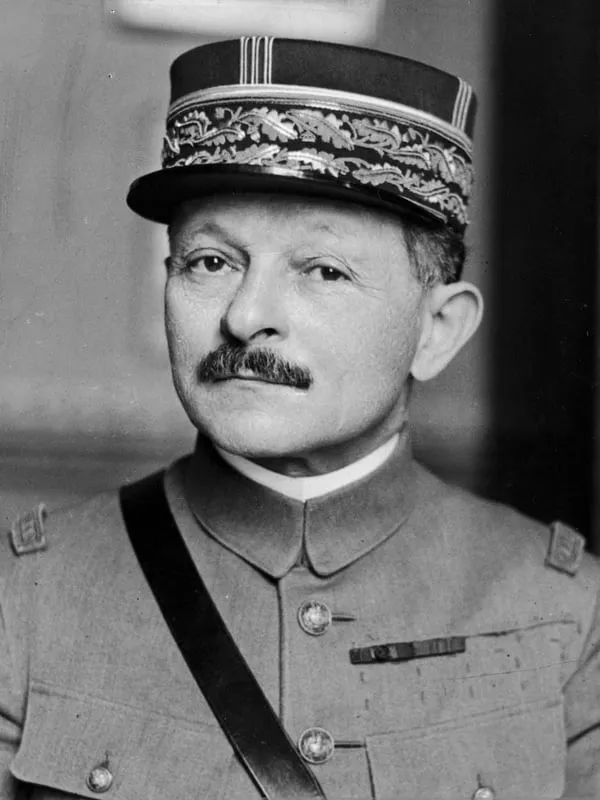
- Born:
- 21 January 1867, Brussels (Belgium)
- Died:
- 28 January 1965, Paris
- Author:
- Natalia
- Photo:
- autor nieznany, domena publiczna, Wikimedia Commons

Maxime Weygand is one of the few figures who stood in the Forest of Compiègne both in November 1918 and, if only indirectly, in June 1940. Throughout the First World War he was chief of staff to Ferdinand Foch. He turned his chief’s ideas and instructions into clear orders, spoke for him to the British and the Americans, and in November 1918, in a railway carriage in the Forest of Compiègne, read out the terms of the armistice to the Germans. In 1920 he went to Poland, then threatened by the Red Army, with an Allied mission, and in the 1930s he stood at the head of the French Army. In May 1940, at the moment of catastrophe, he was given supreme command. He failed to halt the Germans, came out in favour of an armistice and, as Minister of Defence in Marshal Pétain’s government, was in charge of the army when France accepted Hitler’s terms in the very carriage in which, twenty-two years earlier, he had read out the terms to the Germans.
A mystery of birth
He was born on 21 January 1867 – in Brussels, according to his birth certificate – to unknown parents. The mystery of his origins has never been solved. Biographers name several possible pairs of parents, most often the Belgian officer Alfred van der Smissen and Empress Charlotte of Mexico, daughter of the King of the Belgians, but none of these hypotheses has been proved. Weygand himself maintained that he did not know who his parents were. He grew up in Marseilles, and someone wealthy paid for his education at good schools.
In 1885, under the name Maxime de Nimal, he entered the military academy of Saint-Cyr, admitted as a foreigner. In 1888 François-Joseph Weygand, an accountant from Marseilles, acknowledged him as his son. The young officer thus received the name under which he went down in history, together with French citizenship. He was a cavalry officer, a devout Catholic and a conservative. During the Dreyfus affair he contributed to a subscription for the widow of Colonel Henry, who had forged the evidence against Dreyfus. In 1900 he married Renée de Forsanz, a general’s daughter. He never sat the entrance examination for the École de Guerre, the school that trained staff officers. In July 1914 he was a lieutenant colonel in the 5th Hussars at Nancy.
At Foch’s side
At the end of August 1914 Foch took command of a detachment that soon became the Ninth Army, and Weygand became his chief of staff. The two men hardly knew each other, and nothing suggested that their partnership would last the whole war. Yet already during the Battle of the Marne they worked out a method that would endure until 1918: Foch thought fast and spoke in shorthand, while Weygand turned his ideas into orderly instructions and saw to the details. Foch would send visitors to his chief of staff with the words: “Ask Weygand, it’s the same thing.” Weygand was with him in Flanders, in Artois, on the Somme and during his period of disfavour after 1916. At the end of 1917 he was the French military representative on the Supreme War Council at Versailles.
When Foch became commander of the Allied armies in the spring of 1918, Weygand headed his small staff. He drafted the directives that brought victory in the summer and autumn, and delivered them in person to the commanders-in-chief. On 8 November 1918, in the Forest of Compiègne, he read out the main points of the armistice terms to the German delegation of Matthias Erzberger. Foch appeared before the Germans only at the first and last sessions; the details were discussed with Weygand and with the British officers of Admiral Rosslyn Wemyss. When the Germans argued that their army was falling apart, Weygand replied that the disintegration was the result of the victorious Allied offensive. During the night of 10–11 November he went through the text article by article, and immediately after the signing he sent out Foch’s order to cease hostilities at 11 a.m. At the peace conference he shared Foch’s conviction that France’s security required a military frontier on the Rhine.
Warsaw, 1920
In the summer of 1920, as the Red Army advanced on Warsaw, Weygand travelled to Poland with an Allied mission that also included the French diplomat Jules Jusserand and the British ambassador in Berlin, Lord D’Abernon. He expected to take command of the Polish Army, but at their first meeting Józef Piłsudski asked him how many divisions he had brought. Weygand had none. He became adviser to the Chief of the General Staff, General Tadeusz Rozwadowski, and proposed a defence on the Bug and then a purely defensive stance on the Vistula, but his plans were rejected. Some Polish officers regarded him as an intruder, and he understood neither their language nor their style of command.
After the Battle of Warsaw he was welcomed in Paris as the victor, even though as early as 21 August he had told a French journalist that the victory was Polish, the plan was Polish and the army was Polish. The legend of the “victor of Warsaw” nevertheless survived for decades, including in the work of Western historians. The Poles awarded him the Virtuti Militari cross.
The Levant and command of the army
At the turn of 1922 and 1923 he became French High Commissioner in the Levant, in charge of the mandated territories of Syria and Lebanon. He governed more gently than his predecessor, founded a university in Damascus and built roads, but after the left won the elections of 1924 he was recalled. On his return he headed the Centre for Higher Military Studies and wrote biographies of Turenne and Foch. After the marshal’s death in 1929 he was regarded as his spiritual heir. In January 1930, despite the left’s distrust of a Catholic cavalry general, he became Chief of the General Staff, and from 1931 to 1935 he was vice-president of the Supreme War Council, which made him Commander-in-Chief designate in the event of war. In 1931 he was also elected to the Académie française.
These were years of the Great Depression, frequent changes of government and austerity. Weygand called for the modernisation of the army and a longer term of military service, and he secured the creation of the first light mechanised division and several motorised infantry divisions, but the politicians would not provide money for large-scale rearmament, and the French Army clung to a defensive doctrine built around the Maginot Line. In 1933 Hitler came to power in Germany and began openly rearming the Reich. In 1935 Weygand retired and was succeeded by General Maurice Gamelin. In the following years he warned in articles and books of German superiority, but he rejected the ideas of a young colonel, Charles de Gaulle, who wanted to create an independent armoured corps.
1940
In August 1939 the government recalled him to service and sent him to Beirut as commander of French forces in the Middle East. In May 1940, when the Germans broke through the front at Sedan and reached the English Channel, cutting off the Allied armies in Belgium, Prime Minister Paul Reynaud dismissed Gamelin and on 19 May gave supreme command to the 73-year-old Weygand. For his first few days the new commander travelled to meetings with his generals, and he replanned the attack on the flanks of the German wedge that Gamelin had prepared. In the view of many historians he thereby lost time that France did not have. The Weygand Plan failed, and the British troops and some of the French were evacuated from Dunkirk.
On the Somme and the Aisne Weygand organised a new defensive line of strongpoints in villages and woods, but on 5 June the Germans opened the second phase of the French campaign and soon broke through it. From 12 June Weygand openly demanded an armistice at cabinet meetings. He rejected Reynaud’s idea that the army should capitulate in the field, as the Dutch had done, while the government fought on from North Africa. He believed that this would dishonour the army and that Britain would soon make peace in any case. He also feared revolution and chaos at home. On 16 June Reynaud resigned, and Marshal Philippe Pétain became Prime Minister. Weygand entered his government as Minister of National Defence.
On 21 June the French delegation under General Charles Huntziger stood before Hitler in the Forest of Compiègne, in Foch’s carriage, placed on the very spot where it had stood in 1918. Huntziger agreed the terms by telephone with the government in Bordeaux, chiefly with Weygand himself. On 22 June the armistice was signed: the Germans occupied the north and west of France, while the rest of the country remained under a government that soon settled in Vichy.
Vichy and imprisonment
In September 1940 Weygand became the government’s Delegate-General in North Africa. There he maintained the Armistice Army and hoped one day to resume the fight, yet at the same time he harshly repressed opponents of Vichy – Gaullists, communists and Jews – and enforced the anti-Jewish laws with excessive zeal. On his own initiative he introduced a quota on the admission of Jewish children to schools. He did, however, oppose handing over African bases to the Germans, as the Paris Protocols of May 1941 had promised them, and in November 1941 Pétain, under pressure from Hitler, recalled him. After the American landings in North Africa in November 1942 the Germans arrested him and held him until May 1945, latterly at Itter Castle in the Tyrol, together with Gamelin, Reynaud and other politicians of the Third Republic.
On his return to France he was charged with collaboration with the enemy. He was released from prison in 1946, and in 1948 the High Court of Justice dismissed the case. To the end of his life he defended his decisions of 1940 and quarrelled with de Gaulle. He died in Paris on 28 January 1965, at the age of 98.
Assessment
Historians of the First World War agree that Weygand was an outstanding staff officer and that his part in Foch’s victories is hard to separate from the marshal’s own achievement. De Gaulle wrote of him that he was by nature a brilliant second-in-command, but that in his entire career he had never held an independent command in the field. Many historians believe that this partly explains his helplessness in 1940, when for the first time he had to take decisions alone – and in a hopeless situation.
On the road to the Second World War, Weygand links the two armistices in the Forest of Compiègne. In 1918 he represented a victorious army convinced that Germany would never again be able to threaten France. In the 1930s he led that army while Germany rebuilt its strength and France failed to prepare for it. In 1940, convinced that the war was lost, he helped bring about the decision to seek an armistice that gave birth to the Vichy state. His life shows how short the road was from the triumph of 1918 to the defeat of 1940.
Sources
Commanded in battles
(01)Mentioned in battles
(04)Often appears with
People who appear in the same events.