Japan
Gentarō Kodama
Governor-General of Taiwan (1898–1906), Army Minister (1900–1902), chief of staff of the Manchurian Army (1904–1905), Chief of the General Staff (1906)
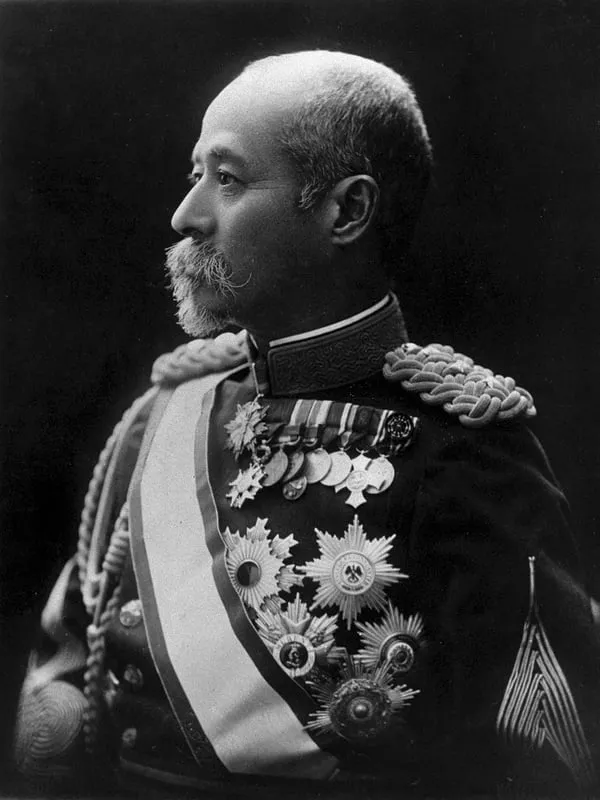
- Born:
- 14 April 1852, Tokuyama (Tokuyama Domain, Japan)
- Died:
- 23 July 1906, Tokyo
- Author:
- Natalia
- Photo:
- autor nieznany, domena publiczna, Wikimedia Commons

Gentarō Kodama was regarded as the ablest strategist of the Japanese army in the Meiji era. Short, energetic and blunt, he combined the gifts of a staff officer with those of an administrator and politician. For eight years he governed Taiwan, Japan’s first colony, and together with his deputy Shinpei Gotō created a model of colonial rule that combined the ruthless suppression of resistance with modern administration and investment. In the war with Russia he was chief of staff to Field Marshal Iwao Ōyama and the brains behind Japanese operations in Manchuria, and after Mukden one of the first to urge the government to seek peace. He died suddenly in 1906 while heading the commission that was setting up the South Manchuria Railway Company. In the decades that followed, that company and the troops guarding it became the basis of Japanese expansion in Manchuria, which ended with its conquest in 1931.
Childhood in Tokuyama
He was born on 14 April 1852 (some sources give 16 March) in Tokuyama, a small domain subordinate to the lords of Chōshū at the western end of the island of Honshu. Today the town is called Shūnan. His father, a samurai of middling rank, died when the boy was four. The head of the family became the husband of his elder sister, but in 1864, during the bloody factional struggles within the domain, he was murdered by supporters of the shogunate, and the Kodama family lost its property and standing. These years of poverty and humiliation shaped an ambitious boy who had to fight for his place in the world all his life.
At sixteen he joined the domain’s volunteer troops and in 1869 fought in the last phase of the Boshin War at Hakodate on Hokkaido, where the last supporters of the shogunate laid down their arms. From 1870 he served in the new imperial army, starting in the lowest non-commissioned ranks, but he rose remarkably quickly.
Saga, Kumamoto and Satsuma
In the 1870s the imperial army put down a series of rebellions by samurai discontented with the reforms. As a captain, Kodama was badly wounded in 1874 while suppressing the Saga Rebellion, and in 1876 he took part in crushing the Shinpūren Rebellion in Kumamoto. In 1877, during the Satsuma Rebellion, he was a staff officer in Kumamoto Castle, which held out for nearly two months against the army of Takamori Saigō. The defence of the castle under General Tateki Tani sealed the rebellion’s defeat, and the young major earned a reputation as an outstanding officer.
Shaping the army’s officer corps
In the 1880s Kodama belonged to the group of officers who were rebuilding the Japanese army on Prussian lines. From 1885 he worked at the Army War College, which trained staff officers, and in 1887 he became its commandant. He worked closely with the German adviser Major Jakob Meckel, who taught Japanese officers tactics, organisation and staff work. According to contemporary accounts Meckel rated him above his other pupils. In 1891 Kodama made a study tour of Europe, and in 1892 he became Vice-Minister of the Army.
During the First Sino-Japanese War of 1894–1895 Kodama remained at the ministry in Tokyo and was responsible for the army’s logistics. After the war he was put in charge of quarantining more than 200,000 soldiers returning from the mainland, among whom cholera was spreading. To run the quarantine stations he engaged a young doctor and official, Shinpei Gotō. The efficiency with which the two men carried out the operation marked the beginning of their long partnership.
Governor-General of Taiwan
Under the Treaty of Shimonoseki Japan acquired Taiwan, but for the first few years it was unable to bring the island under control. Armed resistance continued, and successive governors, among them General Maresuke Nogi, failed to cope with the administration. In Tokyo there were even voices calling for the island to be sold. On 26 February 1898 Kodama became the fourth Governor-General of Taiwan, with Gotō as head of civil administration. They held power for eight years and transformed the colony.
Their policy was described as one of stick and carrot. The stick meant the merciless suppression of armed resistance, which the authorities called banditry. Under the Bandit Punishment Ordinance of 1898, summary courts sentenced thousands of people to death, and the amnesty promised to those who “submitted” was sometimes a trap. According to the colonial authorities’ own figures, around 12,000 people deemed rebels were killed or executed in 1898–1902. The Japanese police built up a network of posts across the whole island and introduced a system of collective responsibility modelled on the Chinese baojia, under which neighbouring households answered for an offence committed by any one resident. The carrot was modern administration: a census and land survey that put property and taxation in order, a state opium monopoly intended to curb the addiction gradually, water supply, sewerage and the fight against epidemics, railways, ports and the growth of the sugar industry. By the end of Kodama’s tenure Taiwan no longer needed subsidies from the Japanese budget, and Japanese politicians presented it as proof that their country could govern colonies as well as the Europeans.
Taiwan did not absorb Kodama completely. He spent much of his time in Tokyo and held a series of other offices, leaving the day-to-day government to Gotō. From December 1900 to March 1902 he was Army Minister in the cabinet of Hirobumi Itō and in the first cabinet of Tarō Katsura. In the summer of 1903 Katsura entrusted him for a few months with the portfolios of home affairs and education, and in Japan he was spoken of as a future prime minister.
Preparing for war
On 1 October 1903 General Iyozō Tamura, Vice-Chief of the General Staff, who had been preparing the plans for war with Russia, died suddenly. Kodama then gave up his ministerial portfolio and on 12 October took over as vice-chief of staff, a lower post than the one he had held. This step, seen as an act of patriotic self-sacrifice, made him the de facto director of war preparations. Together with Marshal Ōyama, Chief of the General Staff, and the Navy Minister, he drew up plans for joint army and navy operations. Kodama was among those who argued to the government that time was on Russia’s side and that war had to begin before new Russian troops could arrive in the east along the Trans-Siberian Railway.
The war with Russia
After the outbreak of the Russo-Japanese War, on 20 June 1904 the Emperor appointed Ōyama commander-in-chief of the Manchurian Army and Kodama, newly promoted to full general, its chief of staff. In practice it was Kodama who planned the operations, while Ōyama gave him a free hand and took responsibility upon himself. The two formed one of the best-matched command teams of the era.
At Liaoyang, in late August and early September 1904, the three Japanese armies of Generals Tamemoto Kuroki, Yasukata Oku and Michitsura Nozu forced Aleksey Kuropatkin to retreat, and in October they repulsed the Russian offensive on the Shaho river. Meanwhile Nogi’s Third Army was bleeding itself white before Port Arthur. Kodama had long believed that the effort should be concentrated on 203 Metre Hill, from which the Russian ships in the harbour could be shelled. In late November and early December, with full powers from Ōyama, he went to Nogi’s headquarters. On 5 December the hill fell, and within a few days the heavy artillery had sunk the ships of the squadron. The extent of his role is disputed. A story popular in Japan, fixed in Ryōtarō Shiba’s novel Saka no ue no kumo (Clouds Above the Hill), holds that Kodama effectively took command from Nogi and led the victorious assault himself. Historians point out that contemporary documents do not confirm this, and that Kodama himself said nothing about his part.
At the beginning of 1905 Kodama planned the Battle of Mukden, fought from 20 February to 10 March. The Japanese aimed to outflank the Russians on both sides, and when the Third Army, brought up from Port Arthur, began to turn their western flank, Kuropatkin ordered a retreat. The encirclement failed, and the victory cost the Japanese some 70,000 killed and wounded. Kodama understood that the army had neither the reserves nor the ammunition for another such battle, while Russia could keep sending fresh troops. In March he went to Tokyo and urged Prime Minister Katsura and the elder statesmen to make peace as quickly as possible, while Japan was still the victor. These efforts led to the mediation of President Theodore Roosevelt and the Treaty of Portsmouth.
Manchuria and death
In April 1906 Kodama became Chief of the General Staff and was made a viscount. He devoted himself above all to the question of Manchuria, where Japan had taken over from Russia the lease of Port Arthur and the railway running south from Changchun. Kodama wanted Japan to establish itself there permanently and to govern the railway zone on the Taiwanese model, through a powerful company that would manage not only the tracks but also mines, towns and settlement. His plans met opposition both from the Western powers, which demanded that Manchuria be opened to trade, and from some Japanese politicians. At a conference at the prime minister’s residence in May 1906, Hirobumi Itō criticised the military for prolonging the occupation and reminded them that Manchuria was not Japanese territory but belonged to China.
In July 1906 Kodama became head of the commission that was setting up the South Manchuria Railway Company. On his recommendation Gotō became its first president. Ten days later, on 23 July 1906, Kodama died suddenly in Tokyo of a cerebral haemorrhage, aged only 54. His death was regarded in Japan as a national calamity. The following year his son Hideo was made a count in recognition of his father’s services. Kodama was later venerated as a Shintō deity at shrines on the island of Enoshima and in his native Shūnan.
Significance
Kodama died before Japan fully entered the era in which the army began to pursue its own policy, but much of what he built outlived him and served that era. The South Manchuria Railway Company, which he helped to create, became a state within a state, running mines, ports and towns in southern Manchuria. The troops guarding the leased territory and the railway were reorganised in 1919 as the Kwantung Army, whose officers in September 1931 blew up the tracks of that very railway near Mukden and began the conquest of Manchuria. The Taiwanese model of Kodama and Gotō, which combined modernisation with repression and police surveillance, was later carried over by Japan to Korea and Manchukuo.
Kodama’s family remained close to power. His son Hideo served several times as a minister in the 1930s and 1940s, and his daughter married Kōichi Kido, who as Lord Keeper of the Privy Seal in 1940–1945 was the closest adviser of Emperor Hirohito. The memory of Kodama as the brilliant strategist of the war with Russia, revived after the Second World War by Shiba’s novel, still overshadows his role as a colonial governor in Japan today.