China
Sun Yat-sen
Provisional President of the Republic of China (1912), leader of the Kuomintang (1912–1925), head of the government in Canton (1917–1918, 1921–1922, 1923–1925)
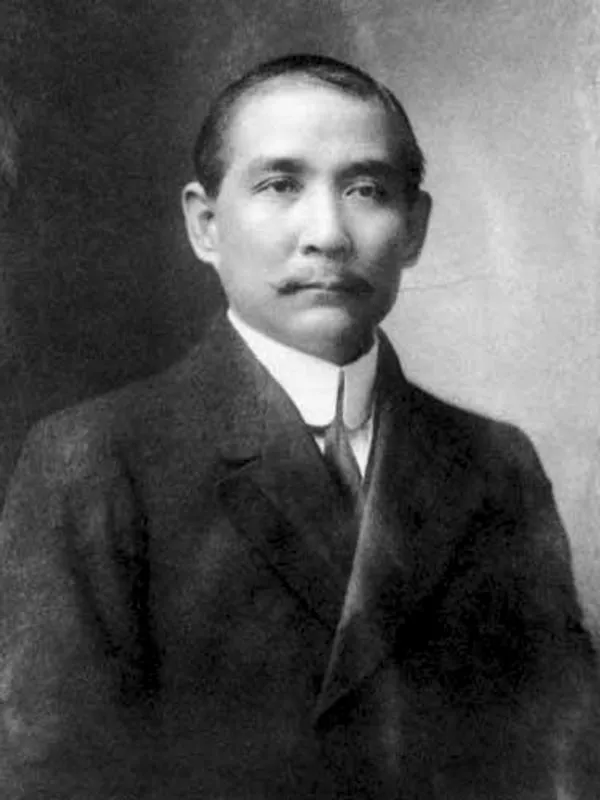
- Born:
- 12 November 1866, Cuiheng, Xiangshan County, Guangdong province (Qing Empire)
- Died:
- 12 March 1925, Beijing
- Author:
- Łukasz
- Photo:
- autor nieznany, domena publiczna, Wikimedia Commons

For thirty years Sun Yat-sen conspired against the empire, and when it fell in 1911 he was, for a few weeks, the first president of the Republic of China. He could not hold on to power, and he spent the rest of his life trying to unite a country torn apart by generals. His ideas – the Three Principles of the People – and his party, the Kuomintang, outlived him by many decades. Seen from the perspective of the wars that followed, the last years of his life matter most. It was Sun who in 1923 concluded an alliance with Soviet Russia and admitted the communists into his party. That alliance produced both the army with which Chiang Kai-shek united China and the Communist Party which, under Mao Zedong, eventually defeated him. Japan, which for years gave him shelter and support, was bound up with his hopes of a common Asian front against the West. Later everyone invoked his name: the Nationalists, the communists and, during the war, China’s collaborators with the Japanese as well.
Youth between China and the West
He was born on 12 November 1866 into a peasant family in the village of Cuiheng in Xiangshan County, Guangdong province, not far from Portuguese Macau. After his death the county was renamed Zhongshan in his honour. At the age of thirteen he went to Hawaii to join his elder brother, who had made money there in trade and farming. In Honolulu he attended Anglican and American schools, learned English and encountered Christianity. In 1883 his brother sent him home, alarmed that the boy wanted to be baptised. Back in his native village Sun and a friend damaged a statue in the temple, and he had to flee to Hong Kong. There he was baptised and began to study medicine. In 1892 he graduated from the Hong Kong medical college and opened a practice in Macau, and later in Canton.
China under the Manchu Qing dynasty was losing one confrontation with foreigners after another. In 1894 Sun still tried the path of reform: he wrote a long memorandum to the influential statesman Li Hongzhang, who refused to receive it. In the autumn of 1894, in Hawaii, he founded the Revive China Society, his first conspiratorial organisation. China’s defeat in the war with Japan – the same defeat after which the Japanese strengthened their hold on Korea and murdered Queen Min – convinced him that the dynasty had to be overthrown. A rising in Canton planned for the autumn of 1895 was discovered before it broke out; several conspirators were executed and Sun fled abroad. He spent sixteen years in exile.
A conspirator in exile
It was a kidnapping that made him famous. In October 1896 in London he was lured into the Chinese legation and held there for twelve days, facing deportation to China and execution. He was saved by his former teacher from Hong Kong, the physician James Cantlie, who alerted the press and the Foreign Office. Sun described the episode in a book and became known throughout the West as a Chinese revolutionary.
Japan became his most important base. From 1897 he lived there for long periods, supported by Japanese pan-Asianists: the activist Tōten Miyazaki, Mitsuru Tōyama, leader of the nationalist Black Ocean Society, and the politician Tsuyoshi Inukai, later prime minister. Some of them sincerely sympathised with the Chinese revolution; others saw it as a way of weakening China and extending Japanese influence on the continent. Sun hailed Japan’s victory over Russia in the war of 1904–1905 as proof that Asians could defeat Europeans. In August 1905 in Tokyo several groups of Chinese students and émigrés merged into the Revolutionary Alliance (Tongmenghui), with Sun as its chairman. Its programme was summed up in four slogans: expel the Manchus, restore China, establish a republic and equalise rights to land. Sun developed it into the Three Principles of the People: nationalism, the power of the people (democracy) and the people’s livelihood.
By 1911 the Alliance and its allies had launched several risings in southern China. All of them failed. During these years Sun travelled around South-East Asia, Europe and America raising money among Chinese émigrés, while criticism of his leadership grew within the Alliance.
Revolution and presidency
On 10 October 1911 troops mutinied in Wuchang, and the mutiny grew into the Xinhai Revolution. Province after province declared its secession from the dynasty. Sun learned of it from a newspaper in the United States and, instead of returning at once, went to London and Paris to seek the neutrality of the powers. He reached Shanghai at the end of December, and delegates of the provinces elected him provisional president. On 1 January 1912 in Nanjing he proclaimed the Republic of China.
Real power, however, lay with Yuan Shikai, the general who commanded the best army in the north. Sun struck a deal with him: Yuan persuaded the court to abdicate and in return received the presidency. On 12 February 1912 the last emperor, Puyi, abdicated, and the next day Sun resigned, formally handing over the office on 1 April. In August 1912 the Alliance and several smaller groups formed the Kuomintang, which won the first parliamentary elections. Its de facto leader, Song Jiaoren, was shot in March 1913, and Yuan was blamed for the assassination. In the summer of 1913 Sun called for a “second revolution”, but Yuan’s troops quickly crushed it. Sun fled to Japan once again.
Years of defeat
In Tokyo he founded the Chinese Revolutionary Party, whose members swore personal obedience to the leader. Many old comrades refused. In 1915, when Japan presented China with the “Twenty-One Demands”, Sun was still seeking Japanese support against Yuan, something his critics long held against him. On 25 October 1915 in Tokyo he married the much younger Soong Ching-ling, the daughter of his friend, a wealthy Shanghai publisher. He never formally divorced his first wife, whom he had married at his family’s wish.
Yuan died in June 1916 after a failed attempt to proclaim himself emperor, and China broke up into zones ruled by generals known as warlords. The government in Beijing, recognised by the outside world, changed with the rhythm of their wars. Sun tried to build a counterweight in the south. In 1917 in Canton he became head of a “military government for the protection of the constitution”, but each time he depended on local generals, who sooner or later got rid of him. In October 1919 he revived the party under its old name, the Kuomintang. In 1921 he was elected “extraordinary president” in Canton, but on 16 June 1922 his ally, General Chen Jiongming, who preferred a federation of provinces to an expedition against the north, shelled his headquarters. Sun took refuge on a gunboat, where he was joined by a young officer, Chiang Kai-shek. After several weeks they sailed for Shanghai. This shared ordeal made Chiang a trusted man.
The alliance with Moscow
The West and Japan did not take seriously a politician without an army or money. Moscow did. Sun had welcomed the October Revolution with sympathy and admired the Bolshevik party as an organisation, although he was no Marxist. The Comintern concluded that a socialist revolution was not on the agenda in China and that the communists should support the national movement, that is, the Kuomintang. On 26 January 1923 in Shanghai Sun and the Soviet envoy Adolph Joffe issued a joint declaration that opened the way to the First United Front. Both stated that the Soviet system was not suitable for China, and Russia promised help in uniting the country.
In February 1923 Sun returned to Canton as generalissimo. In the autumn Moscow’s envoy Mikhail Borodin arrived and helped to rebuild the Kuomintang on the Bolshevik model. In January 1924 the party’s First Congress admitted members of the Chinese Communist Party to its ranks, while allowing them to keep their own organisation. In June 1924 the Whampoa Military Academy, an officers’ school financed by Moscow, opened near Canton, and Sun placed Chiang Kai-shek at its head. Its graduates formed the officer corps of the National Revolutionary Army. In the same year Sun gave a series of lectures on the Three Principles of the People, which became the canon of his party.
The last journey
In the autumn of 1924 a coup took place in Beijing, and its authors invited Sun to talks on reuniting the country. In November he set out from Canton for the north by a roundabout route, via Shanghai and Japan. At the end of November, in Kobe, he delivered his famous lecture on “Great Asianism”. In it he contrasted the Western “way of the hegemon”, based on force, with the Eastern “kingly way”, based on morality, and asked the Japanese which they would choose: whether they would become a tool of Western hegemony (literally its “falcon and hunting dog”) or the “bulwark” of the East.
He reached Beijing at the end of December 1924, already gravely ill. In January 1925 doctors diagnosed inoperable cancer; it is usually said to have been cancer of the liver, although the surviving autopsy report points to the gall bladder. He died on 12 March 1925. He left a political testament, written down by Wang Jingwei, containing a sentence that whole generations would later repeat: “The revolution has not yet succeeded; comrades must continue to strive.” He also signed a letter to the Soviet government expressing the hope that the alliance with Russia would continue. In 1929 his remains were moved to a monumental mausoleum outside Nanjing, the new capital of China.
Sun’s legacy
Sun’s death opened a struggle for his inheritance. It was won by Chiang Kai-shek, who in 1926 marched north, in April 1927 broke bloodily with the communists in the Shanghai massacre, and in December 1927 married Soong Mei-ling, the sister of Sun’s widow. Soong Ching-ling sided with the communists and held high, though largely honorary, posts in the People’s Republic of China. Both sides in the civil war regarded themselves as Sun’s rightful heirs: on Taiwan he is called the Father of the Nation, in the People’s Republic the forerunner of the revolution.
Collaborators, too, made use of Sun’s name. Wang Jingwei, for years his closest associate and the author of his testament, went over to the Japanese in 1938, and in March 1940 in Nanjing he became head of a puppet government that flew the Kuomintang flag and invoked the “Great Asianism” of the Kobe lecture. Japanese propaganda for “Greater East Asia” liked to recall that the father of the Chinese republic had dreamed of a united Asia under Japanese leadership. Sun, however, had spoken of the equality of the nations of Asia and had warned Japan against the path of force.
Sun Yat-sen was more a prophet than a politician. He seldom succeeded, often changed allies and overestimated the power of words. Yet he left two things that decided China’s fate in the Second World War: the idea of a modern, unified nation state, which made the Chinese resist Japan for eight years, and the alliance with Moscow, from which both future rivals, Chiang Kai-shek and Mao Zedong, emerged.
Sources
Often appears with
People who appear in the same events.