Poland
Zofia Kossak-Szczucka
Co-founder of the Front for the Rebirth of Poland (1941) and of the Provisional Committee to Aid Jews "Żegota" (1942)
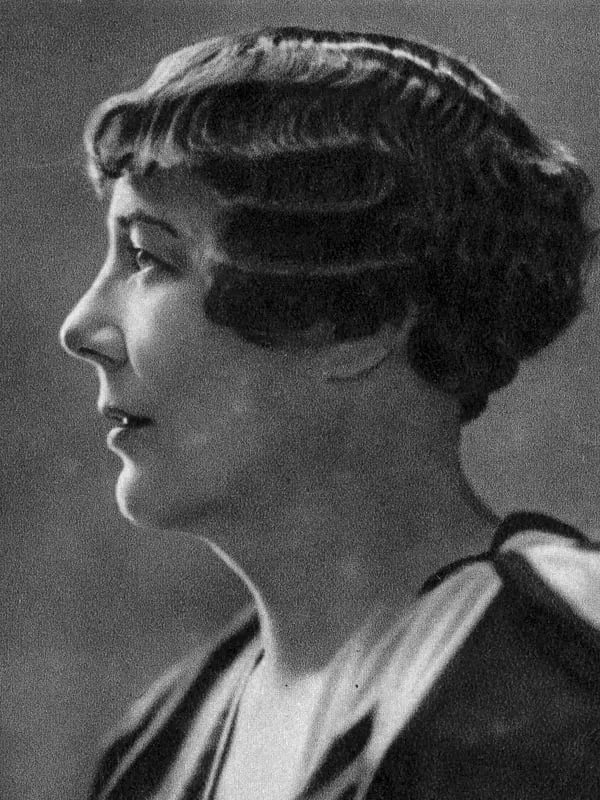
- Born:
- 10 August 1889, Kośmin (Congress Poland, Russian Empire)
- Died:
- 9 April 1968, Bielsko-Biała (Poland)
- Author:
- Natalia
- Photo:
- autor nieznany, domena publiczna, Wikimedia Commons

Zofia Kossak, Szczucka by her first husband and Szatkowska by her second, was one of the most widely read Polish novelists of the interwar years, the author of novels about the Crusades. During the occupation she became one of the leading figures of the Catholic underground: she co-founded the Front for the Rebirth of Poland (PL), wrote the leaflet “Protest!” against the murder of the Jews, and initiated the committee from which the Council to Aid Jews “Żegota” grew. Her stance was complex: before the war she wrote about Jews with hostility, and in the “Protest” itself she called them enemies of Poland; yet at the same time, out of religious and moral conviction, she risked her life to save them. The Italian historian Carla Tonini titled her biography “A Time of Hatred and a Time of Care: Zofia Kossak-Szczucka, the Antisemite Who Saved Jews”. She survived Auschwitz-Birkenau and a death sentence, went into exile after the war, and returned to Poland in 1957.
Of the Kossak family
She was born on 10 August 1889 in Kośmin (PL) in the Lublin region; most publications give the year 1890, but documents found later point to a year earlier. She was the daughter of Tadeusz Kossak, twin brother of the painter Wojciech Kossak (PL), and granddaughter of Juliusz Kossak (PL); her first cousins were the poet Maria Pawlikowska-Jasnorzewska (PL) and the satirist Magdalena Samozwaniec (PL). She spent her childhood in the Lublin region and in Volhynia. She was educated at home, studied painting at the Warsaw School of Fine Arts in 1912–1913 and then drawing in Geneva, from where she returned after the outbreak of the First World War.
In 1915 she married Stefan Szczucki and lived with him in Nowosielica in Volhynia, where their sons Juliusz and Tadeusz were born. The years 1917–1919, the revolution, the peasants’ attacks on manor houses and the Bolshevik invasion, she described in the memoir “Pożoga” (“The Blaze”, 1922), which became her literary debut and was translated into several languages. Critics point out that the book reinforced the stereotype of “Judeo-communism”.
A novelist of the interwar years
After her husband’s death in 1923 she moved with her sons to her father’s estate at Górki Wielkie (PL) in Cieszyn Silesia. In 1925 she married an officer of the Polish Army, Zygmunt Szatkowski (PL), with whom she had a son, Witold, and a daughter, Anna; her eldest son, Juliusz, died in childhood. She wrote historical novels, stories for children and journalism. Her greatest success was the cycle about the Crusades, published in the mid-1930s: “The Crusaders (PL)”, “The Leper King” and “Blessed Are the Meek (PL)”. In 1936 she received the Golden Laurel of the Polish Academy of Literature.
She was a fervent Catholic, connected with Catholic Action, and an opponent of communism. In her journalism of the 1930s she preached an antisemitism with a racial tinge: in the article “The Most Urgent Matter” (1936) she wrote that the traits of the “Jewish race” persisted through generations. She did, however, distance herself from violence and criticised fascist-leaning Catholic youth.
The underground and the Front for the Rebirth of Poland
In September 1939 she evacuated eastwards with her children, but after the Soviet aggression, and after her husband was taken prisoner by the Germans following the battle of Tomaszów Lubelski, she returned to Warsaw. From October 1939 she wrote for one of the first underground papers, “Polska Żyje” (“Poland Lives”), and after its publisher was arrested in September 1940 she ran its editorial office together with Witold Bieńkowski (PL) until it was broken up in January 1941. In the underground she used pseudonyms, among them “Weronika”.
In 1941, with Bieńkowski and Father Edmund Krauze, she founded the Front for the Rebirth of Poland, a secret Catholic organisation that continued the work of the pre-war Catholic Action. She was its leader and ideologue and edited its paper, “Prawda” (“Truth”). In June 1942 she published the pamphlet “W piekle” (“In Hell”). Among the circle of the FOP was the young Władysław Bartoszewski.
“Protest!” and Żegota
On 11 August 1942, in the third week of the Great Deportation in the Warsaw Ghetto, the Front for the Rebirth of Poland issued the leaflet-poster “Protest! (PL)” in 5,000 copies. Kossak wrote it. She described the ghetto, where “several hundred thousand condemned people are waiting for death”, and condemned the silence of the world, of the Allies and of the Poles: “Whoever is silent in the face of murder becomes an accomplice of the murderer. Whoever does not condemn, consents.” In the same text she wrote that the feelings of Polish Catholics towards the Jews “have not changed” and that they still regarded them as “political, economic and ideological enemies of Poland”, but that this did not release them from the duty to condemn the crime. On its way to London the text was censored precisely because of these phrases. The appeal surprised left-wing circles and the Jews themselves, because it was written by a representative of circles that before the war had been hostile to the Jews.
Kossak did not stop at words. On 27 September 1942, together with the socialist Wanda Krahelska-Filipowicz (PL), she set up the Provisional Committee to Aid Jews. She invented its underground name, “Konrad Żegota”. The committee paid out allowances and looked for lodgings for those in hiding, and on 4 December 1942 it was transformed into the Council to Aid Jews attached to the Government Delegation for Poland. Kossak herself did not join the Council, but the FOP had its representatives in it, and she went on helping Jews in hiding with money and false documents. Her motives were also a fear of the moral collapse of Polish society and opposition to German propaganda, which tried to shift the blame for the murder onto Poles and Lithuanians.
Birkenau and Pawiak
On 25 September 1943 she was detained in Warsaw by a chance street patrol. After a spell in Pawiak, on 5 October 1943 she was deported to the Auschwitz-Birkenau camp. Her son Tadeusz Szczucki, arrested in the same year, also died in Auschwitz. In April 1944 she was taken back to Pawiak. The Germans offered her collaboration against the USSR; when she refused, she was sentenced to death. From prison she wrote to President Władysław Raczkiewicz (PL) asking for help for the women held in Auschwitz. The underground managed to buy her freedom: according to Polish Wikipedia she was released on 28 July 1944, a few days before the uprising broke out. She described her camp experiences after the war in the book “Z otchłani” (“From the Abyss”).
In the Warsaw Uprising she wrote appeals and articles for the “Biuletyn Informacyjny” and the “Barykada Powiśla”. She also prepared an appeal of Polish women to Pope Pius XII, broadcast by the insurgent radio on 21 August 1944.
Exile and return
After the fall of the uprising she stayed in Częstochowa. The new authorities knew of her underground activity; according to accounts, Jakub Berman (PL), one of the most powerful communist politicians, suggested she leave the country to avoid arrest, in gratitude for the rescue of his relatives during the war. On 15 August 1945 she left with her daughter via Stockholm for London. Part of the emigration received her with hostility, believing a rumour that she had been Bierut’s secretary. For more than a decade she lived with her husband on a farm in Cornwall. Her novels were successful in the United States, where “Blessed Are the Meek” reached the top of the Book of the Month list. At home, after 1948, when she refused to give the testimony the authorities expected in the case of Władysław Dering, a doctor and Auschwitz prisoner, her books were censored and withdrawn from libraries; the ban lasted until 1956.
On 21 February 1957 she returned to Poland, and in 1958 settled in Górki Wielkie, in the “Gardener’s Cottage”, because the family manor had burned down in 1945. Against Bartoszewski’s advice she published her books with the “Pax (PL)” Association. In 1964 she signed the Letter of 34 (PL) in defence of freedom of speech, and in 1966 she refused to accept a state literary prize. In August 1967, during a ceremony at the site of the former camp in Oświęcim, she collapsed, and after returning home suffered a severe heart attack.
She died on 9 April 1968 in Bielsko-Biała (PL) and was buried in Górki Wielkie, next to her father and her son Juliusz.
Memory
On 13 September 1982 the Yad Vashem institute posthumously recognised her as Righteous Among the Nations. In 2009 the National Bank of Poland put her likeness on a coin commemorating Poles who rescued Jews, alongside Irena Sendler and Matylda Getter. On 11 November 2018 President Andrzej Duda posthumously awarded her the Order of the White Eagle. A museum devoted to her has operated in Górki Wielkie since 1973.
Her memory remains contested: some emphasise above all the “Protest!” and the rescue of Jews, others the pre-war and wartime antisemitism of her journalism. Both faces belong to the same biography, that of a woman who did not renounce her prejudices and yet concluded that in the face of murder, silence is complicity.
Sources
Often appears with
People who appear in the same events.