Poland
Władysław Bartoszewski
Auschwitz prisoner (1940–1941), member of the Council to Aid Jews “Żegota” and Home Army soldier (1942–1945)
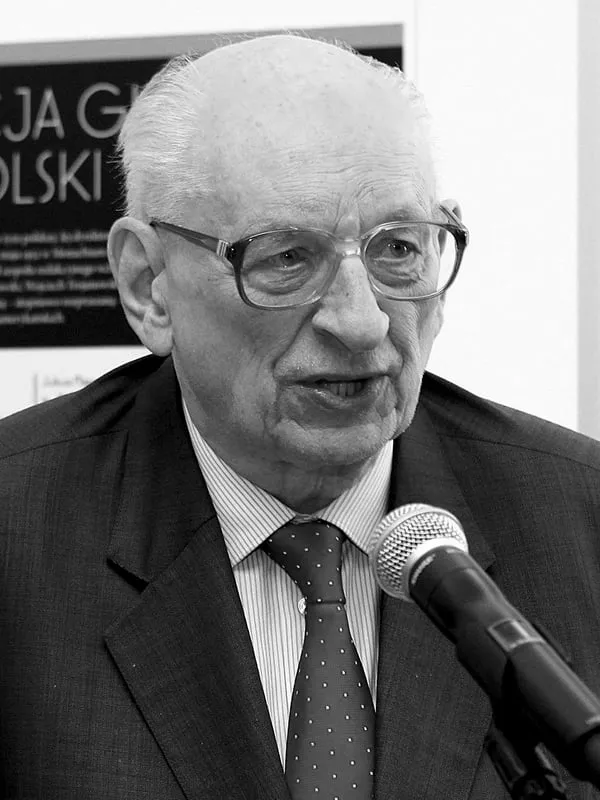
- Born:
- 19 February 1922, Warsaw (Poland)
- Died:
- 24 April 2015, Warsaw (Poland)
- Author:
- Łukasz
- Photo:
- Michał Józefaciuk, CC BY-SA 3.0 PL, Wikimedia Commons

Władysław Bartoszewski was seventeen when, as a Polish Red Cross stretcher-bearer, he lived through the siege of Warsaw, and eighteen when he was sent to Auschwitz. Over the next four years he was in turn a soldier of the Home Army’s Bureau of Information and Propaganda, an activist of the Catholic Front for the Rebirth of Poland, a member of the Council to Aid Jews “Żegota”, deputy head of the Jewish desk of the Government Delegation and a participant in the Warsaw Uprising. After the war the communist authorities imprisoned him twice. He went on to become one of the foremost chroniclers of the occupation of Warsaw, one of the Righteous Among the Nations, and, in a free Poland, twice foreign minister and an advocate of Polish–German and Polish–Jewish reconciliation.
Youth and September 1939
He was born on 19 February 1922 in Warsaw, the son of Władysław and Beata (née Zbiegniewska). He attended the St Stanislaus Kostka Gymnasium and passed his school-leaving examinations at the “Przyszłość” Society’s lyceum in 1939, a few months before the outbreak of war. When Germany invaded Poland, he took part in the civil defence of the capital as a stretcher-bearer for the Polish Red Cross, collecting the wounded from the streets during the defence of Warsaw. Years later he described those weeks in a chronicle of the siege. From May 1940 he worked in the administration of a Red Cross clinic.
Number 4427
On 19 September 1940 Bartoszewski was seized in a large round-up in Żoliborz – the same one in which Witold Pilecki deliberately let himself be caught. On 22 September both were in the second Warsaw transport to the Auschwitz concentration camp; Bartoszewski was given the number 4427. The camp was then above all a place of torment for Poles, and the death rate in the first months was enormous. After more than six months, on 8 April 1941, he was released through the efforts of the Polish Red Cross – at that time the Germans still released some prisoners.
Through an acquaintance he made contact with the Union of Armed Struggle, and in the summer of 1941 he submitted to the Main Command’s Bureau of Information and Propaganda a report on his time in the camp – one of the early testimonies about Auschwitz to reach the underground. From October 1941 he studied Polish literature at the clandestine University of Warsaw.
Bureau of Information and Propaganda
In August 1942 he became a soldier of the Home Army. As “Teofil” – he took the pseudonym from the hero of Jan Parandowski’s novel Niebo w płomieniach (Heaven in Flames) – he worked in the Information Department of the Home Army Main Command’s Bureau of Information and Propaganda (PL), in the two-man section “P-1”, together with Kazimierz Moczarski.
At the same time, in the summer of 1942, he joined the Front for the Rebirth of Poland (PL), a Catholic underground organisation led by Zofia Kossak. From November 1942 to September 1943 he was editorial secretary of its monthly Prawda, and until the spring of 1944 editor-in-chief of Prawda Młodych, a paper for university and secondary-school youth. In November 1942 he also became deputy head of the Prison Cell of the Interior Department of the Government Delegation for Poland, which organised aid for prisoners, including those held in Pawiak.
Żegota and the Jewish desk
In the summer of 1942, during the Great Deportation, the Germans took about 250,000–300,000 people from the Warsaw Ghetto to Treblinka and murdered them. From September 1942 Bartoszewski took part, on behalf of the Front, in the work of the Provisional Committee to Aid Jews, founded on the initiative of Zofia Kossak and Wanda Krahelska-Filipowicz, and after its transformation on 4 December 1942 into the Council to Aid Jews “Żegota” attached to the Delegation he was one of the members of its presidium; he remained active in it until the outbreak of the Warsaw Uprising. The Council gave Jews in hiding money, false papers, lodgings and medical care, and its children’s section was headed by Irena Sendler.
In February 1943 Bartoszewski became information officer and deputy head of the Jewish Desk of the Delegation’s Interior Department, headed by Witold Bieńkowski (PL). The desk linked the Council with the underground authorities, gathered information on the fate of the Jews and passed it on to London. In April 1943, after the outbreak of the Warsaw Ghetto Uprising, Bartoszewski helped organise aid for its fighters. Years later he said that Żegota was the only state institution in occupied Europe that rescued Jews, but he also stressed that the aid reached thousands, not millions.
The Warsaw Uprising
From 1 August 1944 Bartoszewski served in the uprising as adjutant to Kazimierz Ostrowski, commander of the “Anna” information and radio post, and as editor-in-chief of the papers Wiadomości z Miasta and Wiadomości Radiowe, which carried news to the inhabitants of the divided city. On 20 September he received the Silver Cross of Merit with Swords, on 1 October General Tadeusz Bór-Komorowski promoted him to second lieutenant, and on 4 October he was awarded the Cross of Valour.
After the capitulation of the uprising he left Warsaw on 7 October. He continued working for the Bureau in Kraków, from November 1944 to January 1945 he was editorial secretary of the Biuletyn Informacyjny, and in February 1945 he returned to the ruined capital and joined the information branch of the “NIE” organisation, and then of the Armed Forces Delegation for Poland, again under Moczarski.
Prisoner of communist Poland
On 10 October 1945 he disclosed his Home Army service before the liquidation commission. He began working with the Main Commission for the Investigation of German Crimes in Poland, drawing on the information he had gathered in the underground; in May 1946 he gave a radio talk on the executions at Palmiry. He worked for Gazeta Ludowa and joined the opposition Polish People’s Party of Stanisław Mikołajczyk. On 15 November 1946 he was arrested on a false charge of espionage; he was released in April 1948 with the help of Zofia Rudnicka, a former Żegota colleague. Arrested again in December 1949, on 29 May 1952 he was sentenced to eight years’ imprisonment. In August 1954, seriously ill, he was granted a break in his sentence, and on 2 March 1955 the Supreme Military Court found that he had been wrongly convicted.
Historian and witness
After 1956 he wrote for Stolica and Tygodnik Powszechny and became one of the foremost historians of the occupation of Warsaw. His books include Warszawski pierścień śmierci 1939–1944 (Warsaw Death Ring, 1967), Palmiry (1969) and 1859 dni Warszawy (1974), as well as a collection of accounts of Poles who rescued Jews, This One Is from My Homeland; in Prawda o von dem Bachu (The Truth about von dem Bach) he described the crimes of Erich von dem Bach-Zelewski. In 1963 in Jerusalem he accepted on Żegota’s behalf a distinction from the Yad Vashem institute, and in 1966 he was individually awarded the medal of the Righteous Among the Nations. He worked with Radio Free Europe, was secretary-general of the Polish PEN Club, and lectured at the Catholic University of Lublin and in Germany. Kept under surveillance by the Security Service and banned from publishing in the 1970s, he was active in the democratic opposition and in Solidarity; after martial law was declared he was interned until the spring of 1982.
In a free Poland
From 1990 to 1995 he was ambassador to Austria, and in 1995 and again in 2000–2001 foreign minister. On 28 April 1995, on the 50th anniversary of the end of the war, he was the only foreign speaker at the ceremonial session of the Bundestag and Bundesrat in Bonn. From 1997 to 2001 he was a senator, from 2001 he chaired the Council for the Protection of Struggle and Martyrdom Sites, and from 2007 he was the prime minister’s plenipotentiary for international dialogue. He received the Order of the White Eagle. He died in Warsaw on 24 April 2015 and was buried in the Avenue of the Meritorious at the Powązki Military Cemetery.
Bartoszewski’s wartime path – from Auschwitz through the Bureau and Żegota to the uprising – brings together the threads that best show what the Polish Underground State was: an army, an administration and help for people whom the occupier had condemned to extermination.
Sources
Mentioned in battles
(01)Often appears with
People who appear in the same events.