Holy See
Pius XII
Nuncio to Bavaria (1917–1925) and to Germany (1920–1929), Cardinal Secretary of State (1930–1939), Pope (1939–1958)
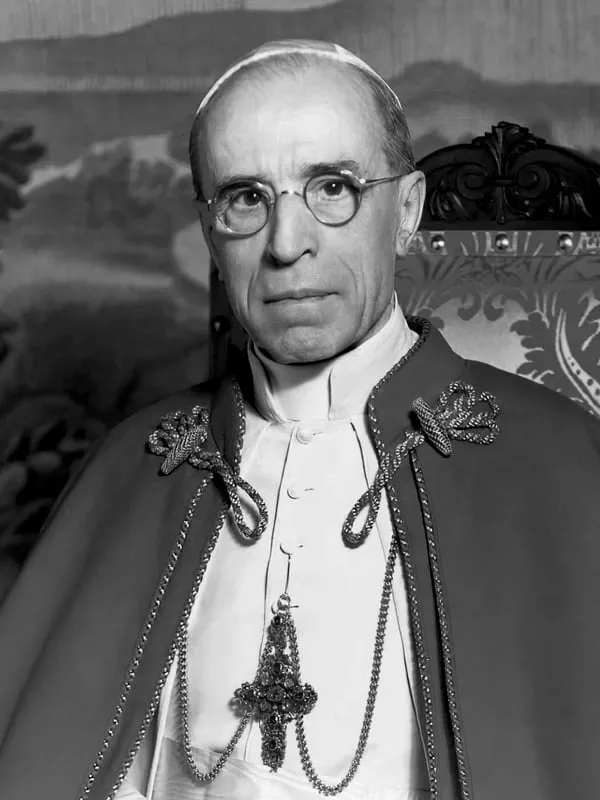
- Born:
- 2 March 1876, Rome (Kingdom of Italy)
- Died:
- 9 October 1958, Castel Gandolfo (Italy)
- Author:
- Łukasz
- Photo:
- Michael Pitcairn, domena publiczna, Wikimedia Commons

Pius XII, born Eugenio Pacelli, was the pope of the Second World War. Throughout his adult life he was a diplomat of the Holy See: as nuncio in Munich and Berlin he came to know Germany better than any other Vatican churchman, and as Secretary of State he signed the 1933 concordat with Adolf Hitler’s Reich. Elected pope in March 1939, six months before the outbreak of war, he tried to prevent it, and then for six years led the Church through a conflict in which millions of Catholics fought on both sides and genocide was carried out in the lands occupied by Germany. He supported relief for the victims of the war and the hiding of the persecuted, but never once publicly named the perpetrators of the Holocaust. Some see him as a prudent protector who saved as many as he could, others as a pope who failed in the decisive hour. The dispute has gone on for more than sixty years.
A Roman from a Vatican family
He was born on 2 March 1876 in Rome, into a family that had served the papacy for generations. His grandfather was an official of the Papal States and a co-founder of the newspaper L’Osservatore Romano, his father was an advocate in the ecclesiastical courts, and his elder brother Francesco, a lawyer, negotiated the Lateran Treaty with Mussolini’s government on the pope’s behalf. Eugenio attended a state secondary school and then studied philosophy and theology, largely as an external student living at home. He was ordained priest on 2 April 1899.
In 1901 he joined the Vatican’s equivalent of a foreign ministry, the Congregation for Extraordinary Ecclesiastical Affairs, where Pietro Gasparri became his mentor. He assisted Gasparri with the codification of canon law, promulgated in 1917, and rose quickly; in 1914 he became secretary of the congregation. During the First World War he dealt with papal relief work for prisoners of war.
Nuncio in Germany
In April 1917 Pope Benedict XV appointed him nuncio to Bavaria, and on 13 May consecrated him archbishop. Since the Holy See had no representative in Berlin, Pacelli was in practice nuncio to the whole of Germany. In the summer of 1917 he presented the papal peace initiative in Munich and at General Headquarters, and held talks with Wilhelm II and Chancellor Bethmann Hollweg, but Benedict XV’s proposal came to nothing.
In the spring of 1919 he lived through the days of the Bavarian Soviet Republic in Munich. Revolutionaries threatened the nunciature staff and tried to requisition its car. In a report to Gasparri, Pacelli described the leaders of the soviet as Jews, in a tone in which some historians, such as John Cornwell, see the antisemitic stereotypes of the age, and others above all a fear of revolution. The experience of 1919 confirmed his conviction that communism was the Church’s greatest enemy.
In 1920 he became nuncio to the government of the Reich, and from 1925 he lived in Berlin. He was received by President Paul von Hindenburg and Foreign Minister Gustav Stresemann, spoke excellent German and travelled all over the country. His most important task was concordats – agreements guaranteeing the rights of the Church: with Bavaria (1924) and with Prussia (1929). He worked closely with the chairman of the Catholic Centre Party, Monsignor Ludwig Kaas. In December 1929 he returned to Rome and received the cardinal’s hat.
Secretary of State
In February 1930 Pius XI made him Secretary of State. Pacelli pursued a policy of concordats, convinced that legal guarantees for schools, organisations and pastoral work were the Church’s best protection under any government. When Hitler came to power, he saw a chance of an agreement that had proved impossible with the Weimar governments. On 20 July 1933 he signed the Reich Concordat with Vice-Chancellor Franz von Papen. The Centre Party, whose leader Kaas had himself taken part in the negotiations, had dissolved itself before the signing, and the NSDAP was left as the only party in Germany. For Hitler it was his first great international success. The Nazis soon began to violate the concordat, and between 1933 and 1939 Pacelli sent several dozen notes of protest to Berlin. Together with Cardinal Michael von Faulhaber, he also helped draft the 1937 encyclical Mit brennender Sorge, which condemned the deification of race and state.
As Secretary of State he travelled a great deal, which was rare among curial cardinals at the time. In 1934 he was papal legate to the Eucharistic Congress in Buenos Aires, in 1935 at Lourdes, in 1937 in Paris – where in Notre-Dame he spoke of the noble German nation being led astray into the ideology of race by “evil shepherds” – and in 1938 in Budapest. In the autumn of 1936 he visited the United States and met President Franklin Delano Roosevelt. He was seen as a more cautious diplomat than his impulsive superior; some historians believe that he toned down Pius XI’s anti-Nazi pronouncements, others that he was their co-author.
Election and attempts to save the peace
Pius XI died on 10 February 1939. The conclave lasted a single day: on 2 March, his 63rd birthday, Pacelli was elected on the third ballot. He was the first Secretary of State to become pope since the 17th century. He took the name Pius XII as a sign of continuity with his predecessor. His coronation on 12 March was the first to be broadcast on radio. The cardinals had chosen a diplomat to steer the Church through the gathering crisis.
The new pope made it clear at once that he wanted to improve relations with the Reich. A few days after his election he sent Hitler a courteous letter, and on 6 March, even before his coronation, he received the German cardinals to discuss the situation of the Church in Germany. In the spring he proposed a conference of five powers – Germany, Poland, Italy, France and Great Britain – but without success. On 24 August 1939, the day after the Molotov–Ribbentrop Pact, he made a radio appeal: “Nothing is lost with peace. Everything may be lost with war.” When Germany invaded Poland, the pope did not publicly condemn the aggression. The Vatican declared its neutrality, following the example of Benedict XV in 1914–1918.
The wartime pope
Pius XII signed his first encyclical, Summi Pontificatus, on 20 October 1939. In it he condemned the forgetting of the unity of the human race and the deification of the state, and wrote of Poland that it had a right to the sympathy of the whole world and was awaiting the hour of its “resurrection”. He did not, however, name either Germany or the USSR. The Holy See did not recognise the partition of Poland, maintained relations with the government-in-exile and refused to fill the dioceses in the territories annexed to the Reich with German bishops, although in 1942 it appointed a German apostolic administrator for German Catholics in the Warthegau, which Poles took as recognition of a fait accompli.
Behind the scenes the pope did a great deal more than he said in public. In the winter of 1939–1940, through the Munich lawyer Josef Müller, he acted as intermediary between German conspirators in the circle of General Ludwig Beck and the Abwehr on the one hand, and the British government on the other, which was asked on what terms it would make peace with Germany once Hitler had been overthrown. In early May 1940 the Vatican passed on warnings of the impending attack on Belgium and the Netherlands, and after the invasion the pope sent telegrams of sympathy to the monarchs of Belgium, the Netherlands and Luxembourg, which Mussolini regarded as an affront. On 11 March 1940 he received Joachim von Ribbentrop and, according to contemporary accounts, listed German crimes in Poland to him. He failed to dissuade Mussolini from entering the war in June 1940. The Vatican Information Office, headed by the future Pope Paul VI, Giovanni Battista Montini, searched for prisoners of war and missing persons throughout the war and answered millions of enquiries.
On the Holocaust the pope was well informed. From 1942 reports of the mass murder of Jews reached him from nuncios, the Polish underground, Allied governments and German clergy. The Vatican intervened diplomatically against deportations in Slovakia, whose president was a priest, Jozef Tiso, in Vichy France, in Romania and in Hungary, where in 1944 the pope’s protest was one of the voices that persuaded the Regent, Horthy, to halt the transports. Publicly, Pius XII spoke out most forcefully in his Christmas message of 1942, referring to the “hundreds of thousands” of people who, through no fault of their own, sometimes solely on account of their nationality or descent, were condemned to death or gradual extinction. He did not use the words “Jews” or “Germans”. The Allies considered this too little, while the Germans read it as an attack on themselves. The pope explained to the American government that he could not condemn the Nazis without at the same time condemning the Bolsheviks, and in 1943 he wrote to the Bishop of Berlin, Konrad von Preysing, that he imposed restraint on himself so as not to bring an even worse fate upon the victims. The Polish President-in-exile, Władysław Raczkiewicz, and Ambassador Kazimierz Papée repeatedly asked for an unequivocal condemnation of the crimes in Poland and did not obtain it, while at the same time some bishops in the occupied country, including the Archbishop of Kraków, Adam Stefan Sapieha, feared the consequences of such statements.
The hardest test came in September 1943, when the Germans occupied Rome. On 16 October 1943 the SS carried out a round-up in the Roman ghetto and throughout the city. More than 1,200 people were detained, of whom more than a thousand were deported to Auschwitz; little more than a dozen returned. The round-up took place almost beneath the pope’s windows. The Vatican protested unofficially to the Reich’s ambassador, Ernst von Weizsäcker, and no further round-ups on such a scale took place in Rome, but there was no public protest. At the same time thousands of Roman Jews found refuge in monasteries, convents, colleges and church institutions, several hundred of them in the Vatican itself. Historians disagree on how far this was the result of the pope’s instructions and how far the initiative of the religious and clergy themselves with his tacit consent.
After the war
After the war Pius XII became above all a Cold War pope. He regarded communism as a mortal threat to the Church and to Europe. In 1948 the Vatican threw itself into the Italian election campaign on the side of Alcide De Gasperi’s Christian Democrats, and in 1949 the Holy Office threatened with excommunication Catholics who supported communist parties. At the first consistory after the war, in 1946, the pope created cardinals including Sapieha, József Mindszenty and German bishops who had opposed the Nazis, such as Clemens August von Galen and Preysing; in 1953 the red hat went to the Primate, Stefan Wyszyński, who was imprisoned shortly afterwards. Relations with communist Poland were broken off: in 1945 the government in Warsaw declared the 1925 concordat no longer binding, citing among other things the wartime appointments of German administrators. For many years the Vatican did not establish permanent Polish dioceses in the Recovered Territories, waiting for a peace treaty, which was received with bitterness in Poland.
At the same time some clerics in Rome, notably the Austrian bishop Alois Hudal, helped fugitive Nazi war criminals escape to South America. How much the pope knew of this remains a subject of research.
Pius XII was also an important pope in the history of the Church itself. In encyclicals of the 1940s he opened the way to modern biblical scholarship, and on 1 November 1950, in the Holy Year, he proclaimed the dogma of the Assumption of the Blessed Virgin Mary. He internationalised the College of Cardinals, appointing the first cardinals from China and India. He governed in an increasingly personal manner: after the death of Cardinal Maglione in 1944 he did not appoint a new Secretary of State. He died on 9 October 1958 at Castel Gandolfo. He was succeeded by John XXIII, who a few months later convened the Council.
The dispute over the pope
At the time of his death Pius XII was widely respected, including by Jewish leaders; Israel’s Foreign Minister, Golda Meir, said that during the years of terror the pope had raised his voice for the victims. The picture changed in 1963, when Rolf Hochhuth’s play The Deputy was staged in Berlin, portraying the pope as a man who kept silent about the Holocaust out of cold calculation. Since then the dispute has never died down. Critics such as John Cornwell, author of Hitler’s Pope (1999), Michael Phayer and David Kertzer argue that the pope put the safety of the Church as an institution and his fear of communism before the fate of the victims, that he had a particular weakness for Germany, and that his diplomatic caution saved neither Poles nor Jews. His defenders point out that the Nazis treated him as an enemy, that during the war the Church saved many thousands of Jews, often with the Vatican’s knowledge, and that an open condemnation might have provoked reprisals – as allegedly happened in the Netherlands, where after the bishops’ protest in 1942 the Germans also deported Catholics of Jewish origin.
Paul VI opened the cause for the beatification of Pius XII in 1965, and in 2009 Benedict XVI promulgated the decree on his heroic virtues, which provoked protests. On 2 March 2020 Pope Francis opened the Vatican archives of his pontificate to researchers. The first studies based on them confirmed that from the autumn of 1942 the pope had reliable information about the mass extermination of the Jews, and strengthened the critical voices, though they did not settle the debate. For the history of the Second World War, Pius XII remains the figure who most clearly embodies the dilemma of a neutral moral authority: caught between the duty to speak the truth and the fear that the truth spoken aloud would bring the victims still greater suffering.
Sources
Mentioned in battles
(01)Often appears with
People who appear in the same events.