- Category:
- Military operations
- Front:
- Western Front
- Date:
- 29 December 1940
- Author:
- Łukasz
- Battle:
- The Blitz
- Tags:
- United Kingdom, Luftwaffe, Winston Churchill
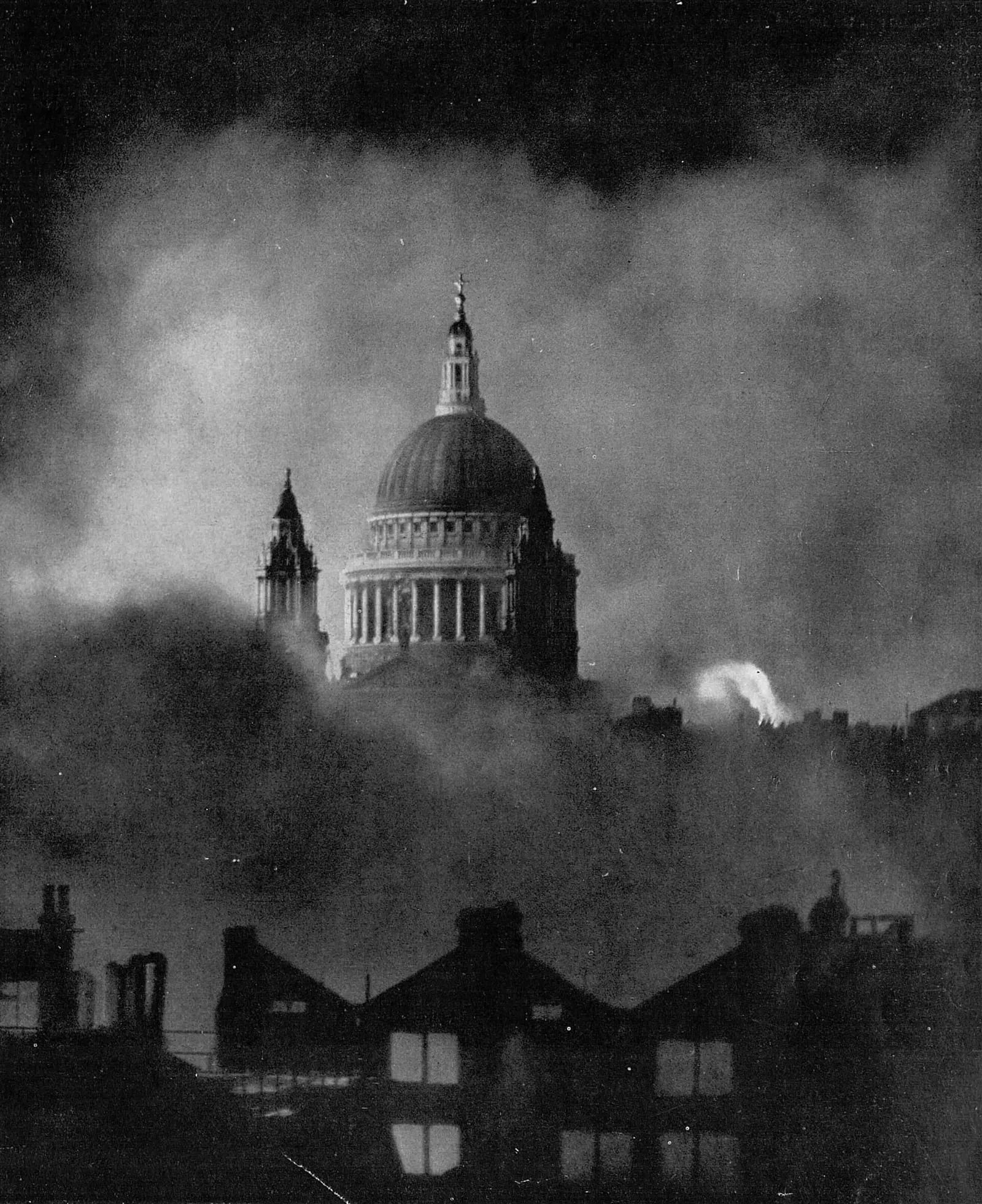
On Sunday 29 December 1940, a few minutes after six in the evening, the first German bombers appeared over the City of London, the historic and financial heart of the British capital. In less than three hours they dropped tens of thousands of small incendiary bombs on the City and the neighbouring districts. Some 1,500 fires broke out, and several of them merged into great conflagrations engulfing whole blocks of streets. The water in the Thames was exceptionally low, bombs had smashed the water mains, and the wind carried burning debris from roof to roof. The roof of the great hall of the Guildhall, the medieval seat of the City’s government, went up in flames, along with several churches built by Christopher Wren and the whole publishing quarter around Paternoster Row. Some 160 people were killed. An American correspondent cabled that night that “the second Great Fire of London has begun”, and the name, recalling the fire of 1666, has stuck to the raid ever since.
In the middle of the burning district stood St Paul’s Cathedral, Wren’s masterpiece, built precisely after the fire of 1666. According to the log of the cathedral’s watch, 28 incendiary bombs fell on it and its immediate surroundings. The volunteers guarding the roofs, supported by firemen who, on the orders of the Prime Minister, Winston Churchill, were to defend the cathedral at all costs, prevented the fire from taking hold of the building. The photograph of its dome rising out of the smoke became one of the most famous images of the entire war.
War chronologies record under 29 December “heavy German raids on London” and the damaging of St Paul’s Cathedral. This needs to be made more precise. That night there was a single raid, if an exceptionally destructive one, and the cathedral came through it almost untouched: according to its archives, the damage amounted to scorched partitions in a side aisle by the library and local damage to the lead covering and roof timbers. It suffered far more seriously in other raids: on 10 October 1940 a bomb pierced the roof of the choir and destroyed the high altar, and on 17 April 1941 another exploded above the north transept.
The Blitz in December
By December 1940 the Blitz was in its fourth month. Since 7 September the Luftwaffe had been bombing London almost every night, and from November it struck more and more often at industrial cities and ports: Coventry, Birmingham, Southampton and Liverpool, Bristol, and in December Sheffield and Manchester. In October a bomb that penetrated an Underground tunnel killed dozens of people sheltering at Balham station. The British, for their part, were sending bombers over German cities – in mid-December to Mannheim, deliberately aiming for the first time at the very centre of a city.
With the switch to night raids, German tactics changed. At night it was hard to hit a single factory or dock, so incendiaries made up an ever larger part of the bomb load. Small one-kilogram bombs with a magnesium-alloy casing and a thermite filling, dropped in containers holding several dozen, scattered across the roofs. A single one, spotted in time, could be put out with a bag of sand or a stirrup pump. Hundreds of bombs that burned through the roofs of locked buildings started fires the fire brigade could not cope with. At the head of the formations flew the aircraft of Kampfgruppe 100, a specialised unit that had already marked the target with fire for the following waves over Coventry.
Over Christmas a relative calm settled over Britain for a few days. Many business owners, employees and volunteers had gone away for the holiday, and the fire-watching regulations in force since September 1940 (the Fire Watchers Order) covered only premises employing at least 30 people, together with large warehouses and timber yards. The City’s offices, shops, churches and warehouses, locked up on a Sunday evening, for the most part had no one who could climb onto the roof and throw a burning bomb off it.
Sunday evening
The raid was carried out by Field Marshal Hugo Sperrle’s Luftflotte 3, operating from airfields in northern France. According to some accounts, it was Sperrle who proposed a massed incendiary attack on central London. At about 6.15 p.m. ten Heinkel He 111s of KGr 100 began dropping the first bombs. Further waves followed. According to compilations based on German data, 136 bombers were dispatched to the target; other accounts speak of about 130. Estimates of the number of incendiaries dropped vary greatly, from about 24,000 to as many as 100,000. What is certain is that the load consisted overwhelmingly of incendiaries, with relatively few high-explosive bombs, although it was these that broke the water mains and brought down many of the burning buildings.
According to the plan, the bombers with incendiary loads were to be followed by further waves carrying high explosive, which would have caused even more destruction in the burning city and hampered firefighting. The weather over France, however, was deteriorating rapidly. In the evening the command cancelled further take-offs, and before midnight rain and cloud closed the airfields. The all-clear sounded shortly after 9 p.m., but that was not the end: the fire the raid had started burned all night. In the view of many historians, only the break in the weather saved London from even greater destruction.
No water
Firemen – professionals of the London Fire Brigade and volunteers of the Auxiliary Fire Service – set off for the City within minutes. By about eight in the evening some 300 pumps were already at work there, and by morning, according to post-war figures, some 2,300 pumps from all over London and beyond had been committed to the fight. The brigade’s records list six fires so large that each required more than a hundred pumps, and several dozen more that needed dozens each.
Water was short from the start. High-explosive bombs had damaged three 36-inch trunk mains and a dozen or so other large pipes. When many crews connected to the same hydrants at once, the pressure dropped and barely a trickle came from the hoses. That left the Thames, but that evening the tide was exceptionally low and drawing water from the river was very difficult. A strong south-westerly wind fanned the flames and carried sparks over the narrow streets, lined largely with warehouses several storeys high full of paper, textiles and timber.
The firemen paid a heavy price that night. The painter Leonard Rosoman, who served in the Auxiliary Fire Service, was fighting a fire in Shoe Lane when a colleague took over the hose from him. A moment later a wall collapsed, burying two firemen standing on the spot Rosoman had just left. The fireman who had relieved him was killed. Rosoman later painted the scene in A House Collapsing on Two Firemen. The American reporter Ernie Pyle, who watched the raid from a balcony, wrote of the cathedral’s dome slowly emerging from the pinkish-white smoke, “like objects taking shape at dawn”.
“St Paul’s must be saved”
St Paul’s Cathedral stands on Ludgate Hill, the highest point in the City. Since the First World War, when it was threatened by Zeppelin raids, it had been guarded by a volunteer cathedral watch (the St Paul’s Watch), made up of clergy, cathedral staff, architects and other volunteers. In September 1939 the Watch was re-formed. Its members knew by heart the roofs, galleries and timber structures above the vaults; they set out buckets of sand and water and practised putting out bombs.
That evening the fire surrounded the cathedral on every side. The Dean, Walter Matthews, noted that within half an hour fires were raging all around it. The most dangerous moment came when an incendiary pierced the lead covering of the dome and lodged in it. The lead began to melt, and beneath it lay a timber structure which, if it caught fire, could have destroyed the whole dome. To put it out, the watchmen would have had to force their way between the beams, with little chance of success. The bomb, however, fell outwards onto the stone gallery, where it was quickly extinguished. Molten lead dripping down the roofs and burning debris carried by the wind from neighbouring buildings were dealt with all night. The roof of the neighbouring Chapter House burned, but the cathedral itself survived.
During the raid Churchill reportedly telephoned the Guildhall and ordered that the cathedral be saved at all costs. Its destruction, he explained, would take the heart out of the whole country. The firemen working around the cathedral managed to keep the fire away from its walls, although almost all the buildings in its immediate vicinity burned down.
Herbert Mason’s photograph
On the roof of Northcliffe House, the offices of the Daily Mail in Tudor Street, just off Fleet Street, the paper’s chief photographer, Herbert Mason, was on fire-watching duty. For several hours he waited for the smoke to clear for a moment. “Suddenly the wind rose,” he described, “and the shining cross, dome and towers stood out like a symbol in the midst of the inferno. The sight was unbelievable. At that moment I released the shutter.” The photograph, taken in the early hours of 30 December, was passed by the censor and appeared on the front page of the Daily Mail on 31 December under the caption “War’s Greatest Picture”.
The photograph, St Paul’s Survives, became one of the symbols of the Blitz and of British endurance. German propaganda used it too, seeing in it the image of a city ringed by fire. Researchers later showed that the published picture had been heavily cropped and retouched: many ruined buildings had been removed, and the whole had been touched up with paint in the studio. That does not alter the fact that the cathedral really did survive amid surroundings that had been almost entirely burned out.
What burned
By the morning of 30 December most of the fires had been brought under control, but the ruins smoked for many days afterwards. The fire consumed, among other areas, the blocks around the cathedral, the area around the Guildhall and the Cripplegate district by the old city walls. According to some accounts, the area destroyed by fire was larger than in 1666.
At the Guildhall, the medieval seat of the Lord Mayor and the Court of Common Council, the wooden roof of the great hall, reconstructed in the nineteenth century on the model of the original, burned. The fifteenth-century stone walls survived. According to frequently cited figures, eight churches built by Wren after the fire of 1666 burned that night. Among them were St Bride’s in Fleet Street, known as the journalists’ church, whose bells melted in the fire; Christ Church Greyfriars, from which reportedly only the font cover survived, carried out by an unknown fireman; St Lawrence Jewry beside the Guildhall; and St Vedast in Foster Lane. Among the buildings damaged were the medieval church of All Hallows-by-the-Tower and Trinity House, the corporation responsible for lighthouses.
The world of books suffered worst. Along Paternoster Row and Ave Maria Lane, in the shadow of the cathedral, London’s publishers and wholesalers had been concentrated since the nineteenth century. The buildings and warehouses of some twenty publishers were wholly or partly destroyed, along with Stationers’ Hall, home of the guild of booksellers and publishers, and the wholesaler Simpkin Marshall. Some five million books are estimated to have been lost in the fires.
The toll
According to most accounts, the raid killed about 160 people, including a dozen or so firemen. Other compilations give 162 civilians and 12 firemen killed. The number injured ranges from about 250 to more than 500, depending on the source. Compared with the bloodiest nights of the Blitz, casualties were relatively light, because on a Sunday evening the City, a district of offices, banks and warehouses, had hardly any residents. The material losses were all the greater: destruction in the very heart of the capital, in a place that for centuries had been a symbol of London, shook the British more than many raids that killed more people.
King George VI and Queen Elizabeth, who had not left the capital despite the bombing of Buckingham Palace in September, had been visiting bombed districts and cities since the start of the Blitz, and after the raid on Coventry the King went to the ruined city. For Londoners the royal couple, like Churchill, became the embodiment of the will to endure.
The same evening in Washington
That same evening, at 9.30 p.m. Washington time (half past two in the morning in London, with the City still burning), the President of the United States, Franklin Delano Roosevelt, gave one of his radio “fireside chats”. Less than two months after his election to a third term, he argued to Americans that their security depended on whether Britain survived, and that the ocean was no longer a shield for them. The United States, he said, must become “the great arsenal of democracy” and supply weapons to those fighting Germany, although it did not itself intend to send soldiers. The speech heralded the Lend-Lease Act, passed and signed in March 1941. It was America’s next step, after the destroyers-for-bases deal, towards open support for Britain.
Compulsory fire-watching
The night of 29 December laid bare the weakness of the existing defences against incendiary bombs. Many fires broke out in buildings locked up for the holiday, which no one could enter, and every bomb put out in time on a roof meant one fire fewer. In the press and in Parliament people asked why the City had been left unguarded. The Minister of Home Security, Herbert Morrison, responsible for civil defence since October, called in a radio broadcast for volunteers to come forward in their masses; the appeal was remembered for its slogan “Britain shall not burn”.
As early as January 1941 fire-watching ceased to be a matter of goodwill. New regulations obliged the owners of commercial and office buildings to keep a permanent watch, and men aged 16 to 60 had to register and serve on rooftop duty for several dozen hours a month. In August 1941 the fire-watchers were brought together in a nationwide Fire Guard, under the air raid precautions services, and the local fire brigades were merged into a single National Fire Service. From then on the bucket of sand, the stirrup pump and a turn on the roof became part of everyday life for millions of Britons, and in time for women too.
Place in the war
The raid of 29 December closed the first and, for London, heaviest period of the Blitz. The Luftwaffe did not, however, stop bombing. In the winter and spring of 1941 it struck mainly at ports: Plymouth, Portsmouth, Swansea, Cardiff, Bristol, Liverpool, Glasgow, Hull and Belfast. It returned to London in great strength several more times, in March and April, culminating in the raid of the night of 10/11 May 1941, the bloodiest of the whole war, in which more than 1,400 people were killed and the debating chamber of the House of Commons was burned out. After that most of the German bombers flew east ahead of the attack on the Soviet Union. The Blitz cost the lives of more than 40,000 British civilians, almost half of them in London, but it broke neither Britain’s war economy nor its will to resist.
For the British the night of 29 December became the symbol of that winter, and the photograph of St Paul’s dome amid the smoke, alongside Churchill’s words of the summer of 1940, the most enduring image of the “finest hour” of a country standing alone against Germany. At the same time the night showed how destructive the massed use of incendiaries against densely built-up cities could be, and in Britain the memory of the Blitz served as a moral justification for its own bombing offensive. In the years that followed, RAF Bomber Command carried out incendiary raids on German cities on an incomparably larger scale; in July 1943, in Hamburg, incendiary bombs started a firestorm in which tens of thousands of people died.
The devastated area around the cathedral was rebuilt over decades. Some of Wren’s churches were raised from the ruins; others, such as Christ Church Greyfriars, were left as permanent ruins or gardens. On the site of the burned-out Cripplegate district the Barbican estate rose after the war, and on the site of Paternoster Row the new buildings of Paternoster Square. The cathedral itself, which survived the night of 29 December thanks to the volunteers on its roofs and the firemen in the streets, remained for London what Herbert Mason’s photograph had made it: a sign that the city had survived.
Sources
Meanwhile
(02)Elsewhere, within a week.
- 5 January 1941 · MediterraneanThe capture of BardiaOn 5 January 1941 General Mackay’s Australians broke the last resistance at Bardia. Some 36,000–40,000 Italians were captured, but Bergonzoli escaped to Tobruk.
- 5 January 1941 · PoliticsDegrelle declares for NazismOn 5 January 1941, at a rally in Liège, the Rexist leader Léon Degrelle proclaimed the kinship of Rex and Nazism and ended his speech with “Heil Hitler!”.
Related events
(04)The same battle, people or subject.
- 11 January 1941 · Western FrontThe Bank station disasterOn 11 January 1941 a bomb exploded in the booking hall of Bank Underground station, by the Royal Exchange. 56 died; the crater was some 37 by 30 metres.
- 14 November 1940 · Western FrontThe Coventry BlitzOn the night of 14–15 November 1940 hundreds of German bombers razed the centre of Coventry and St Michael's Cathedral. Some 568 people were killed.
- 19 February 1941 · Western FrontThe Swansea Three Nights’ BlitzFrom 19 to 21 February 1941 the Luftwaffe bombed Swansea on three nights running. About 230 people died and the Welsh port’s town centre ceased to exist.
- 22 December 1940 · Western FrontThe Manchester BlitzOn the nights of 22/23 and 23/24 December 1940 the Luftwaffe bombed Manchester. The city centre burned, and some 680 people were killed in the city itself.